Channel Sales Manager Resume Examples: read this first
Build a Channel Sales Manager Resume That Expands Your Reach
By Mustafa Tarabya, founder of CVBooster · Published · Updated
Create a partnership-driven channel sales manager resume with partner recruitment, enablement programs, and indirect revenue growth that channel-focused companies seek.
Sample resumes for a channel sales manager
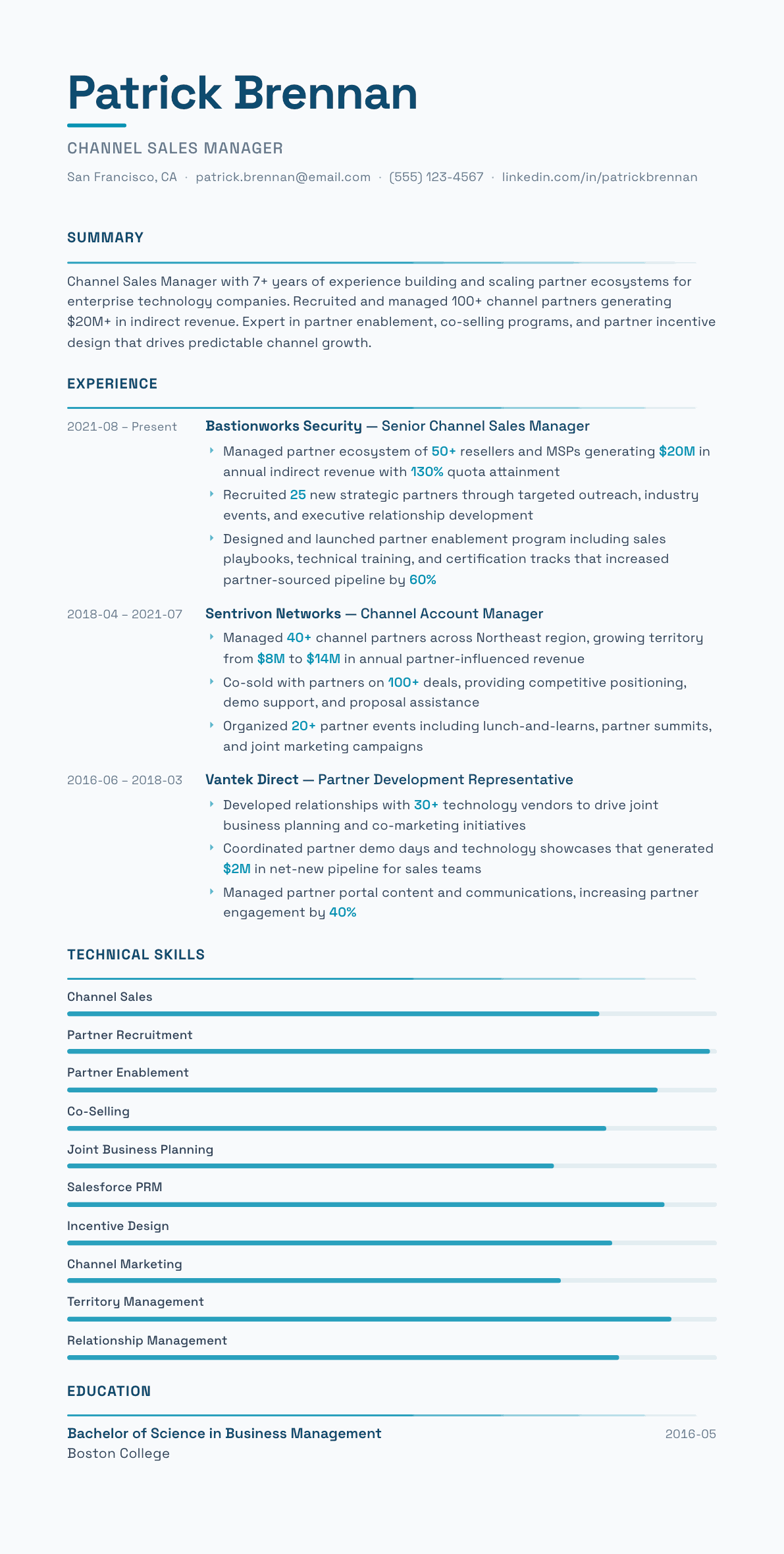
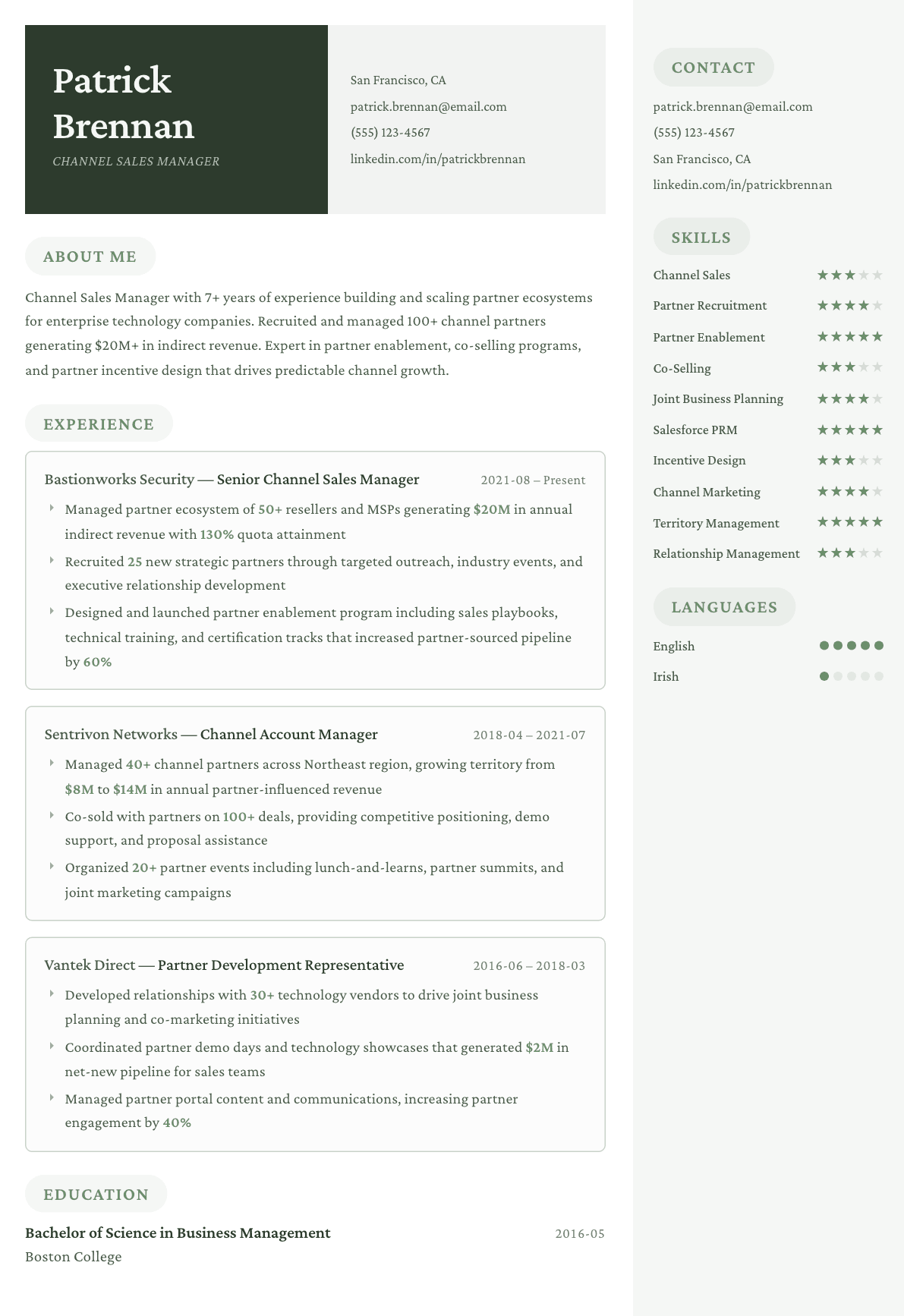
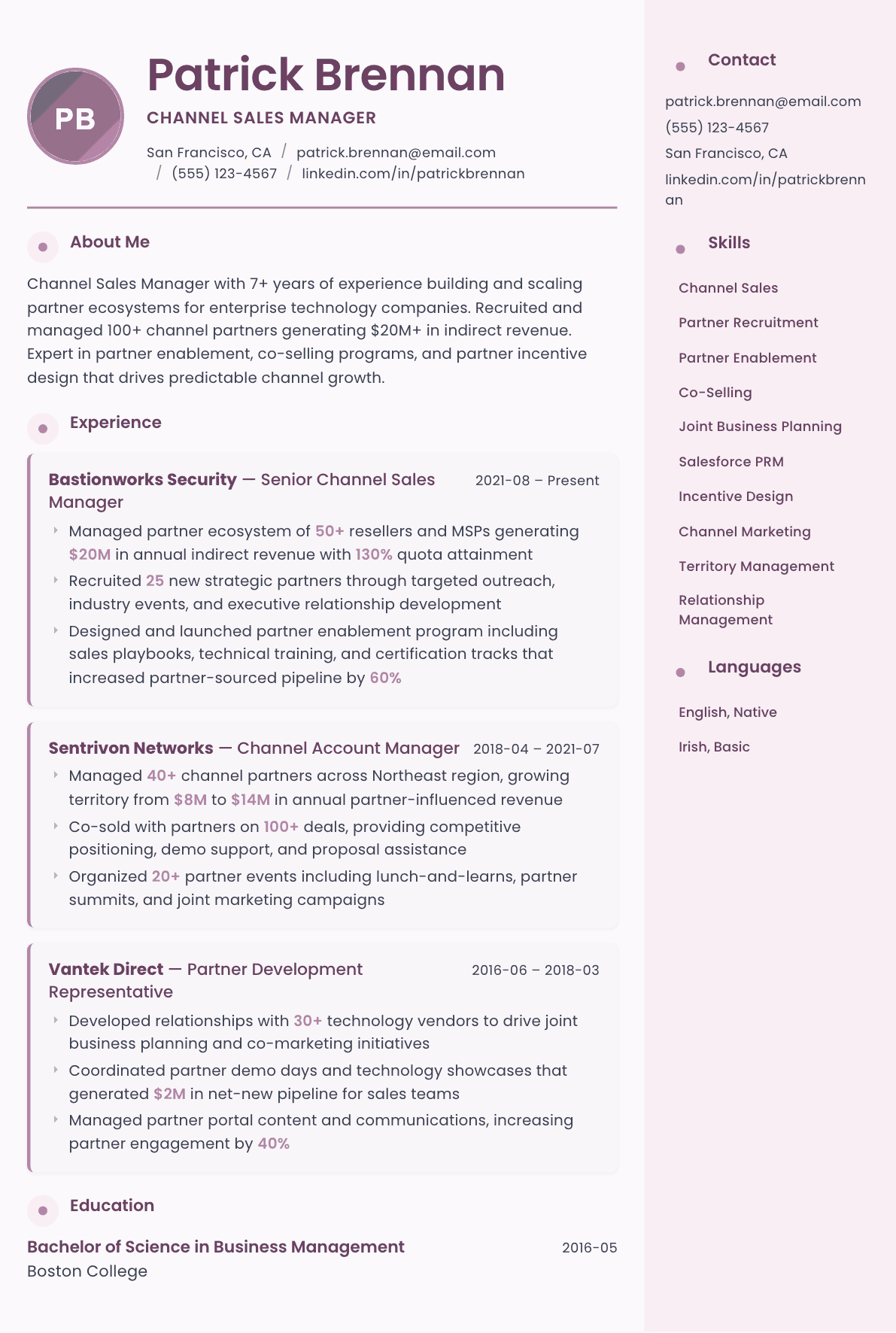
The same channel sales manager content laid out in three CVBooster templates, so you can see what the finished document looks like before you write a word.
Example Channel Sales Manager summary
Channel Sales Manager with 7 years building partner ecosystems that produce $20M+ in indirect revenue. Recruited 25 strategic resellers and MSPs at Bastionworks Security and built the enablement program that grew partner-sourced pipeline 60%. Runs co-selling, joint business planning, and incentive design.
Skills to list on a Channel Sales Manager resume
- Channel Sales
- Partner Recruitment
- Partner Enablement
- Co-Selling
- Joint Business Planning
- Salesforce PRM
- Impartner
- Channel Marketing
- Incentive Program Design
- Territory Management
- Partner Events
- Deal Registration
- Relationship Management
- Revenue Forecasting
What actually gets this resume read
- Quantify indirect revenue: total partner-sourced and partner-influenced revenue managed.
- Highlight partner recruitment success: number of partners recruited and their performance trajectory.
- Showcase enablement programs: training, certification, playbooks, and their impact on partner performance.
- Include co-selling experience: how you support partners in deals and the resulting win rate improvement.
- Mention partner event management: summits, training days, lunch-and-learns, and joint marketing.
- List PRM tools and platforms: Salesforce PRM, Impartner, Channeltivity, Allbound.
How to write a channel sales manager resume
A channel sales manager resume is read by someone who has to decide whether you can grow revenue you do not directly control. Partner sold and partner influenced revenue arrive through resellers, systems integrators, managed service providers and distributors, which means the hiring leader is looking for evidence that you can recruit a partner, get their sellers trained, and keep them choosing your product over the three competing lines sitting next to it on their price book.
That makes the resume different from a direct sales one. Quota attainment still matters, but so does partner count, the split between recruited and inherited partners, the tier structure you managed, the enablement you built, and how much of the number came from a small group of top partners. A leader who sees a portfolio where nearly all revenue sits with two partners reads risk, not success.
This guide covers how to structure the page, how to write a summary a channel chief recognizes, how to write bullets that separate partner sourced from partner influenced, which programs and systems to name, and the questions channel managers ask when they move from a direct seat into partnerships or between vendors.
Format: two pages once you have run a partner ecosystem
One page early in a channel career, two pages once you have managed a portfolio across multiple partner types. Keep a single column, put the partner portfolio scope in the first line of every job, and give the reader the shape of the ecosystem before the achievements. The scope line should say how many active partners, of what type, across what geography, and what portion of regional revenue ran through them.
Add a short programs block if you have designed one. Deal registration rules, margin and rebate structures, tier criteria, market development fund processes and certification tracks are the artifacts of the job, and naming the ones you built or ran tells a hiring leader what level you operated at.
- Header: name, city and state, phone, email, professional profile link.
- Order: summary, experience with partner scope lines, programs built, systems, education, certifications.
- Every job: partner count, partner types, territory, and the revenue those partners carried.
- Separate recruited partners from inherited ones, since recruiting is the harder half of the role.
Summary: ecosystem size, partner type, revenue, attainment
Name the partner types you have worked with by their real category, because they behave differently. Value added resellers, distributors, managed service providers, global systems integrators, independent software vendors and referral partners each demand a different motion, and a channel leader hiring for a managed service provider heavy model will filter on that word.
Then give the number and the attainment. A channel sales manager who grew partner sourced revenue in a defined territory across a stated partner count has said something specific. Statements about being a relationship builder who drives synergy across the ecosystem describe nothing that can be checked.
Experience: sourced, influenced, and the partners behind it
The most important distinction on the page is between partner sourced revenue, where the partner brought the opportunity, and partner influenced or partner fulfilled revenue, where your own team found the deal and the partner transacted it. Blending the two into one large figure is the most common way channel resumes lose credibility, because the interviewer will ask for the split and the candidate who did not prepare it looks careless.
Show partner recruitment as a funnel rather than a headline: how many targets you identified, how many you signed, how many reached first transaction, and how long that took. A partner signed and never activated is a line in a system, not revenue. Naming time to first deal proves you understand where the work actually is.
Enablement belongs in its own bullets. Sales playbooks, technical certification tracks, joint value propositions, demo environments, partner led webinars and quarterly business reviews are the mechanisms that make a partner sell your product instead of a competing one. Say how many partner sellers you certified and what changed in their production afterward.
- Portfolio: active partner count by tier, and the concentration of revenue in the top partners.
- Recruitment: targets identified, agreements signed, partners reaching first transaction.
- Enablement: certifications delivered, playbooks built, partner sellers trained.
- Co-selling: deals worked jointly with partner reps, and the win rate on them.
- Governance: quarterly business reviews, joint business plans, market development fund allocation.
Programs and systems: name the machinery
Channel work runs on specific tooling and a hiring leader wants to see it. Name the partner relationship management platform (Impartner, Allbound, ZINFI, Channeltivity), the customer relationship system and how deal registration was handled inside it, the partner portal, and any distributor systems you worked through. If you ran market development funds, say how the requests, approvals and proof of performance worked.
Vendor program experience is a hiring signal in itself. Working inside an established partner program at a large technology vendor teaches tier mechanics, margin stacking and registration disputes in a way that is hard to pick up otherwise, so name the program rather than only the employer.
Keywords a channel recruiter scans for
Partner recruitment, partner enablement, deal registration, co-selling, joint business planning, partner sourced pipeline, indirect revenue, distribution, managed service provider, systems integrator, tiering, margin and rebate structure, market development funds, quarterly business review, and partner relationship management. Use the posting language once in the summary and again attached to a result, since the reader after the software is a channel leader who knows which of these words carry weight.
Channel Sales Manager resume summary examples
Moving in from direct sales
Account executive with four years selling network security direct to mid-market, moving into channel management after two years co-selling every deal with resellers. Familiar with deal registration, margin structure and joint business planning, and looking to own partner recruitment and enablement for a regional territory.
Regional channel manager
Channel Sales Manager for a Northeast territory running 38 active resellers and managed service providers, of whom I recruited fourteen. Partner sourced pipeline covers a majority of regional bookings, and I built the enablement track that certified 60 partner sellers in a year.
Channel leader
Channel leader with nine years across distribution, reseller and systems integrator models in North America, managing a partner portfolio of more than one hundred accounts and a team of four channel managers. Designed the tier and rebate structure now used across the program and reduced revenue concentration in the top three partners.
Work experience bullets: before and after
Before: Managed relationships with channel partners in the region.
After: Owned a portfolio of 38 active resellers and managed service providers across eight states, running quarterly business reviews with the top twelve and joint business plans with the top five.
Portfolio size, partner type, geography and the cadence of governance describe a job that managing relationships does not.
Before: Recruited new partners to the program.
After: Recruited fourteen partners in eighteen months, of whom eleven reached first transaction within a quarter of signing, adding a new managed service provider motion to a reseller heavy territory.
Signing is easy and activation is the real test, so the time to first transaction is what proves the recruitment worked.
Before: Increased partner revenue significantly.
After: Grew partner sourced bookings 46% year over year while cutting the share carried by the top three partners from 71% to 48%, making the territory less dependent on a single reseller.
Growth plus a concentration figure shows the number is durable rather than propped up by one account.
Before: Created training materials for partners.
After: Built a three-stage partner enablement track covering discovery, competitive positioning and technical demo, certifying 60 partner sellers whose registered deals rose from 20 to 55 a quarter.
The structure of the program and the change in registered deals connect the training to an outcome.
Before: Worked with partners on joint deals.
After: Co-sold 90 opportunities alongside partner account managers, providing competitive positioning and pricing structure, and closed those deals at a higher rate than the unassisted partner average.
It names the contribution inside the deal and compares the outcome to a baseline the reader can judge.
Hard skills
- Partner recruitment
- Partner enablement and certification
- Deal registration management
- Joint business planning
- Co-selling with partner sellers
- Distribution management
- Margin, rebate and tier design
- Market development fund programs
- Partner relationship management platforms
- Salesforce pipeline reporting
- Quarterly business reviews
- Channel conflict resolution
Soft skills
- Influence without authority
- Negotiation across organizations
- Executive relationship building
- Conflict mediation
- Long horizon patience
- Cross-team coordination
Certifications worth listing
- Salesforce Certified Administrator (Salesforce)
- AWS Certified Cloud Practitioner (Amazon Web Services)
- Microsoft Certified: Azure Fundamentals (Microsoft)
Mistakes that cost channel sales manager candidates the interview
- Reporting one blended revenue number instead of splitting partner sourced from partner influenced, which is the first split an interviewer asks for.
- Counting signed partners as an achievement when most never transacted, since activation rate is what a channel leader actually measures.
- Omitting partner types, so the reader cannot tell whether you ran a distribution model or a small group of systems integrators.
- Writing about relationships and trust without a single mechanism: no tiering, no registration process, no enablement track, no business plan.
- Hiding revenue concentration when nearly the whole territory ran through one or two partners, which an interviewer will surface anyway.
- Treating channel conflict as something to leave off the page, when handling it well is a core part of the job and worth one specific example.
Channel Sales Manager resume questions
How do I move from direct sales into a channel sales manager role?
Pull out every deal you closed alongside a partner and rewrite it from the partner side: who registered it, what margin structure applied, how you split the work with their seller. Then name the program mechanics you already know, since deal registration and tiering are the vocabulary a channel leader listens for.
Should I list partner company names on my resume?
Name recognizable partners sparingly and only where they carry weight, such as a national distributor or a global systems integrator. For the rest, describe the type and size instead, because a hiring leader cares more about the motion you ran than about a list of logos.
What is the strongest metric on a channel sales resume?
Partner sourced revenue growth paired with an activation figure, because together they show you both grew the number and built the base that produces it. A single revenue total with no partner count, activation rate or concentration figure is hard for a channel leader to interpret.
How do I show enablement work that has no direct revenue attached?
Attach it to partner behavior instead of revenue: sellers certified, registered deals per quarter before and after, demo requests from partner teams, or the number of partners who moved up a tier. Those are the leading indicators channel leaders use when revenue lags the work by two quarters.
Do I need technical certifications for a channel role?
A foundational cloud or security credential helps when you are enabling technical partners, because it proves you can hold a conversation with a partner solution architect. It will not replace channel experience, so keep it in a certifications block rather than leading the resume with it.