Book on Interviewing: 5 Worth Reading and 6 Model Answers
By Mustafa Tarabya, founder of CVBooster · Published · Updated
9 min read
The best book on interviewing is the one written for the interview you actually have next: a general guide for a first job, a coding book for a technical interview, a hiring book if you sit on the other side of the table. The constraint is time, because a book only helps if you turn its advice into answers you have said out loud before the day. The publisher Penguin Random House describes one of the picks below as "The first interview book from the What Color Is Your Parachute? career guru Richard Bolles." Below are five real books matched to five situations, six model answers that show what each one trains you to do, and a short plan for reading one in a week. Written by Mustafa Tarabya, who hired for his own company, read every application himself and now writes CVBooster's guides.
Buying the book feels like progress. Reading chapter one on the train feels like more progress. The interview, rudely, still asks you to talk.
Tell me about yourself: what every book starts with
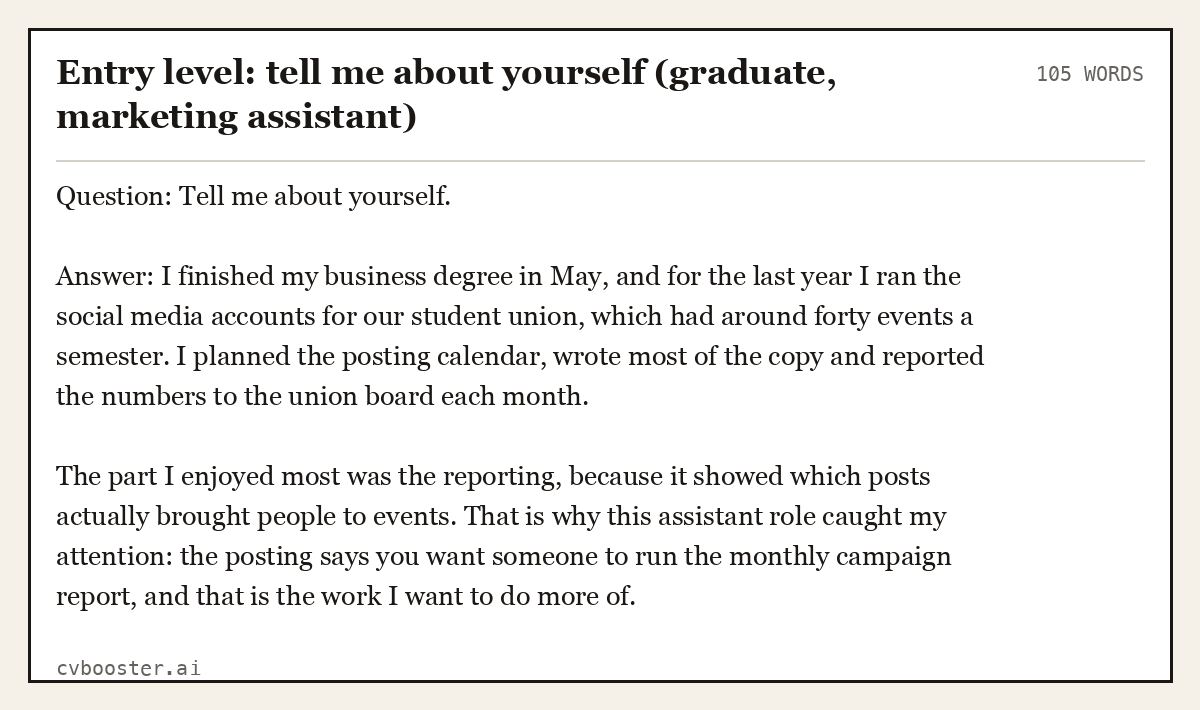
Every general book on interviewing starts with the questions every employer asks, and the most common opener is "tell me about yourself". The mistake is answering with your life story. Answer with three parts: what you do now, one piece of evidence, and why this job is the next step.
Entry level: tell me about yourself (graduate, marketing assistant) (105 words)
Question: Tell me about yourself.
Answer: I finished my business degree in May, and for the last year I ran the social media accounts for our student union, which had around forty events a semester. I planned the posting calendar, wrote most of the copy and reported the numbers to the union board each month.
The part I enjoyed most was the reporting, because it showed which posts actually brought people to events. That is why this assistant role caught my attention: the posting says you want someone to run the monthly campaign report, and that is the work I want to do more of.
Book on interviewing: which one for which interview
Pick by the interview in front of you, not by the bestseller list. Each of these is a real, current title, and each one does a different job:
- General job interviews: *What Color Is Your Parachute? Guide to Rethinking Interviews* by Richard N. Bolles. A broad guide from the Parachute series, useful when you have not interviewed in years.
- Software engineering interviews: *Cracking the Coding Interview* by Gayle Laakmann McDowell. Its official site says you "practice on 189 interview questions and solutions", and it also covers "Techniques to prepare for and ace the soft side of the interview: behavioral questions."
- Getting the interview in the first place: *The 2-Hour Job Search* by Steve Dalton. Penguin Random House describes the third edition as a guide that "helps you quickly target potential employers and secure the essential first interview".
- The salary conversation: *Never Split the Difference* by Chris Voss with Tahl Raz, a negotiation book by a former FBI hostage negotiator. Read it for the offer stage, not for the first round.
- Interviewing candidates: *Who: The A Method for Hiring* by Geoff Smart and Randy Street. The publisher's page says it teaches you to "define the outcomes you seek" and to "ask the right interview questions to dramatically improve your ability to quickly distinguish an A Player from a B or C candidate".
If you only read one, read the one that matches your next interview. The examples below are written in the spirit of each book; they are model answers, not quotations from the books.
Behavioral questions: the framework every book shares
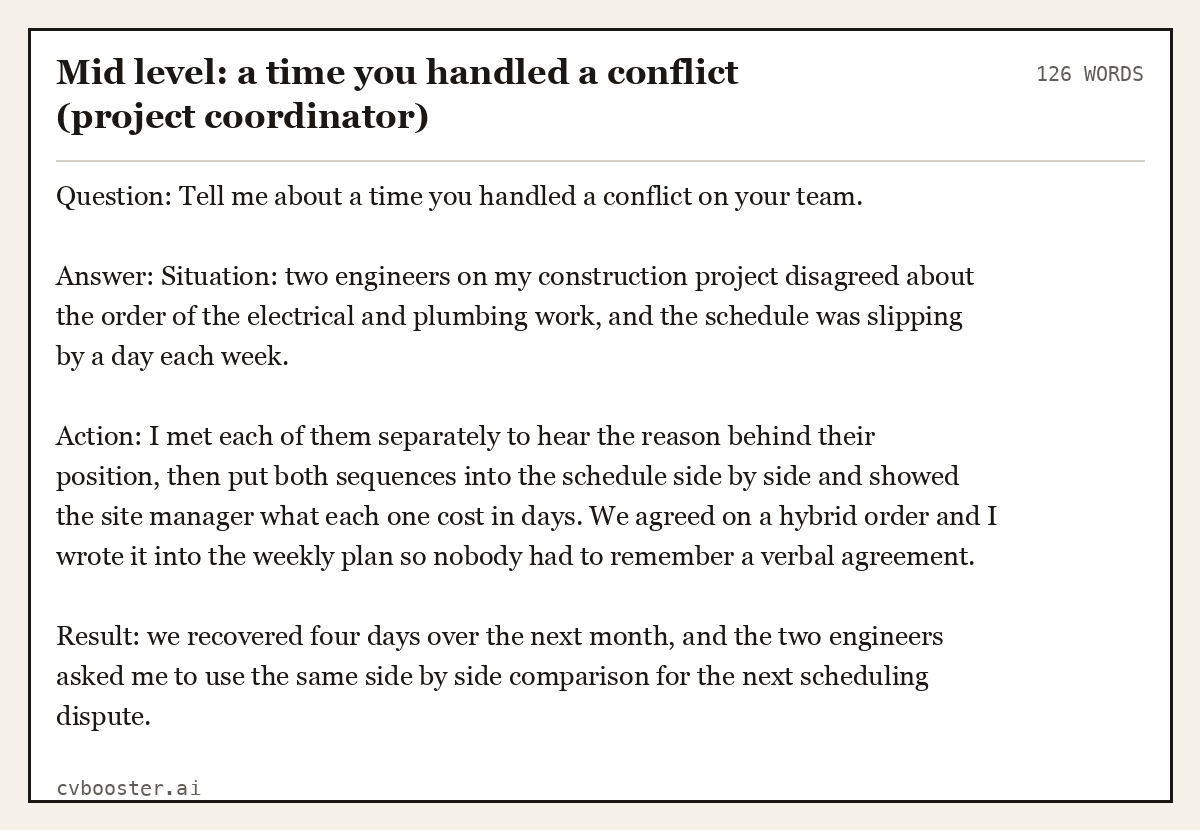
Almost every interview book teaches a story framework for "tell me about a time" questions, under different names. Harvard's career office gives the short version in its interviewing guide: "1. Situation, 2. Action, 3. Result". The same page explains why employers ask these questions: "The principle behind this type of interview is that past behavior is a good predictor of future behavior." Our STAR method answer examples show the longer four step version.
Mid level: a time you handled a conflict (project coordinator) (126 words)
Question: Tell me about a time you handled a conflict on your team.
Answer: Situation: two engineers on my construction project disagreed about the order of the electrical and plumbing work, and the schedule was slipping by a day each week.
Action: I met each of them separately to hear the reason behind their position, then put both sequences into the schedule side by side and showed the site manager what each one cost in days. We agreed on a hybrid order and I wrote it into the weekly plan so nobody had to remember a verbal agreement.
Result: we recovered four days over the next month, and the two engineers asked me to use the same side by side comparison for the next scheduling dispute.
Coding interviews: think out loud
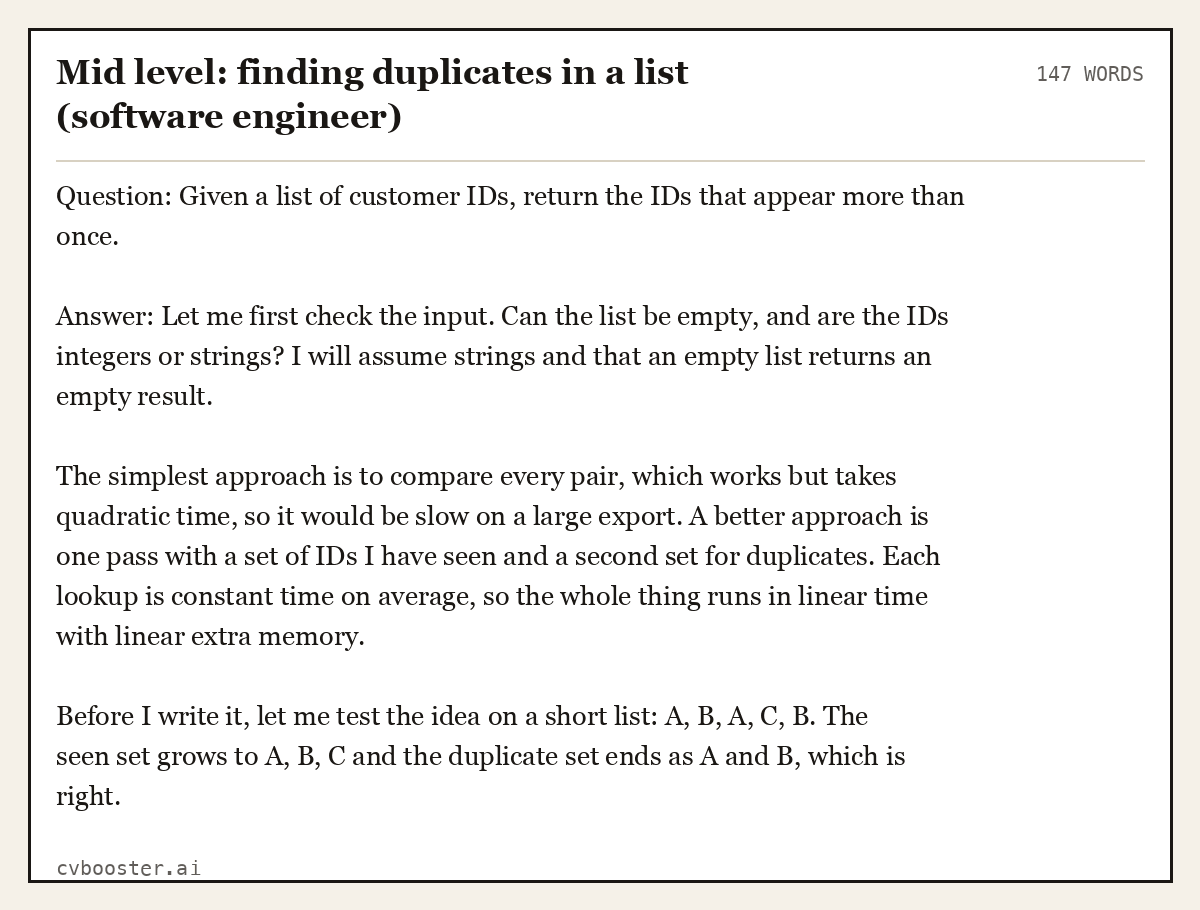
A coding interview book trains a habit that a general book does not: explaining your approach before you write anything, then improving it. The interviewer scores the reasoning as much as the final code, so a candidate who works in silence gives the interviewer less to score, even with the right answer. Our technical interview questions page covers the wider round.
Mid level: finding duplicates in a list (software engineer) (147 words)
Question: Given a list of customer IDs, return the IDs that appear more than once.
Answer: Let me first check the input. Can the list be empty, and are the IDs integers or strings? I will assume strings and that an empty list returns an empty result.
The simplest approach is to compare every pair, which works but takes quadratic time, so it would be slow on a large export. A better approach is one pass with a set of IDs I have seen and a second set for duplicates. Each lookup is constant time on average, so the whole thing runs in linear time with linear extra memory.
Before I write it, let me test the idea on a short list: A, B, A, C, B. The seen set grows to A, B, C and the duplicate set ends as A and B, which is right.
Getting the first interview: the outreach note
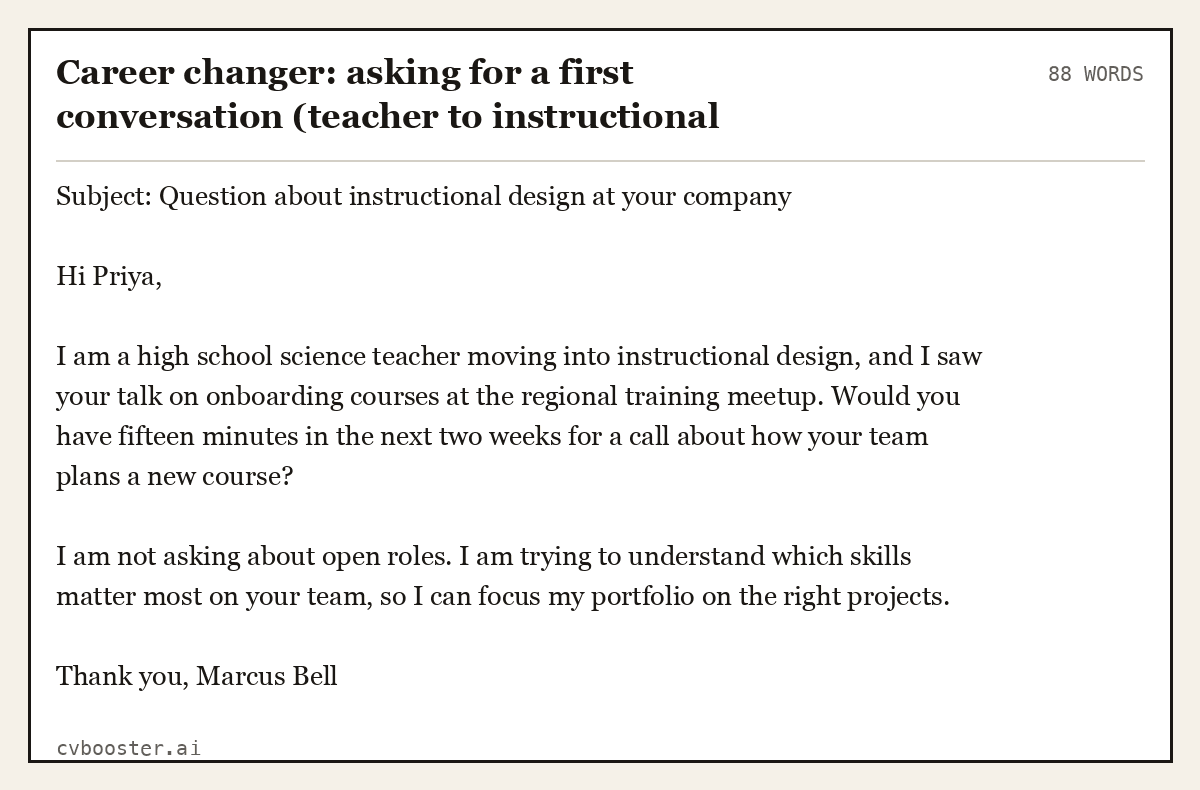
Some books on interviewing start before the interview, with the conversation that gets you one. A short, specific note to someone inside the company works better than a long one, because it is easy to say yes to. Ask for a brief conversation about their work, not for a job.
Career changer: asking for a first conversation (teacher to instructional designer) (88 words)
Subject: Question about instructional design at your company
Hi Priya,
I am a high school science teacher moving into instructional design, and I saw your talk on onboarding courses at the regional training meetup. Would you have fifteen minutes in the next two weeks for a call about how your team plans a new course?
I am not asking about open roles. I am trying to understand which skills matter most on your team, so I can focus my portfolio on the right projects.
Thank you, Marcus Bell
The salary question: hold the number back
A negotiation book is for the offer stage. The first time pay comes up, the useful move is to show interest, ask about the range and the full package, and give your own figure only once you know the scope. Our guide to how to negotiate salary covers the offer conversation itself.
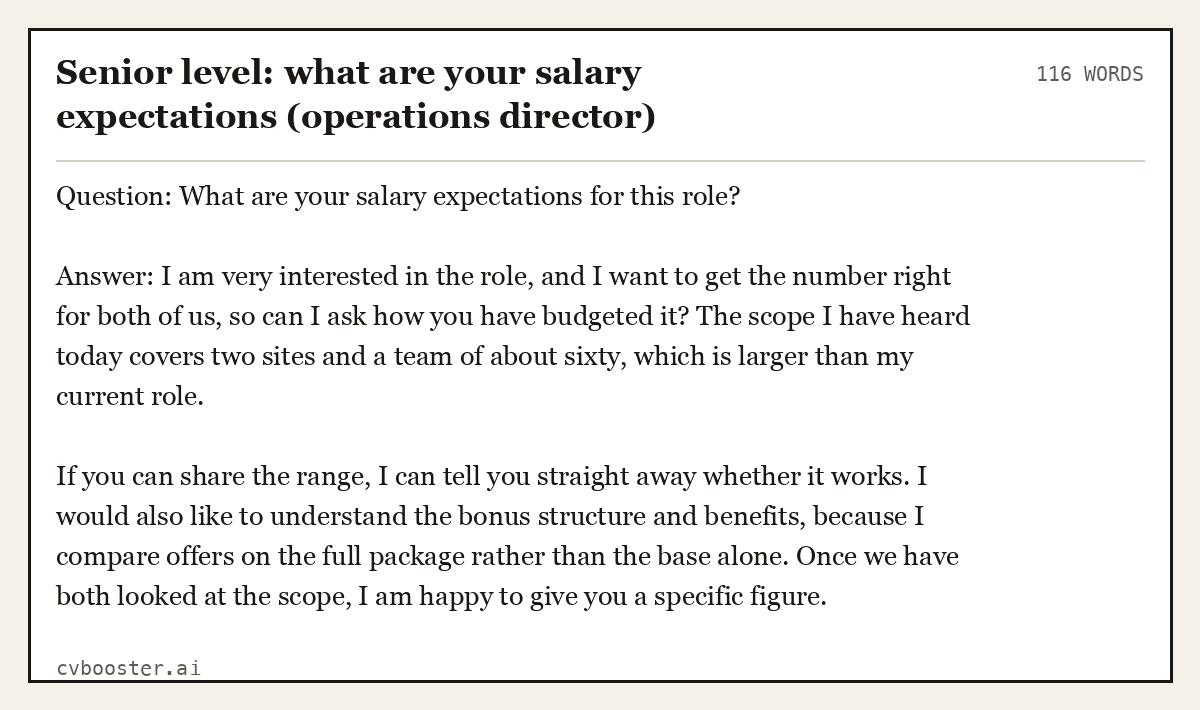
Senior level: what are your salary expectations (operations director) (116 words)
Question: What are your salary expectations for this role?
Answer: I am very interested in the role, and I want to get the number right for both of us, so can I ask how you have budgeted it? The scope I have heard today covers two sites and a team of about sixty, which is larger than my current role.
If you can share the range, I can tell you straight away whether it works. I would also like to understand the bonus structure and benefits, because I compare offers on the full package rather than the base alone. Once we have both looked at the scope, I am happy to give you a specific figure.
Interviewing candidates: start with the scorecard
If you are the one asking the questions, a hiring book changes the order of your preparation: write down the outcomes the person must deliver, then write the questions that test for them. Our page of questions to ask an interviewee gives more questions for each stage.
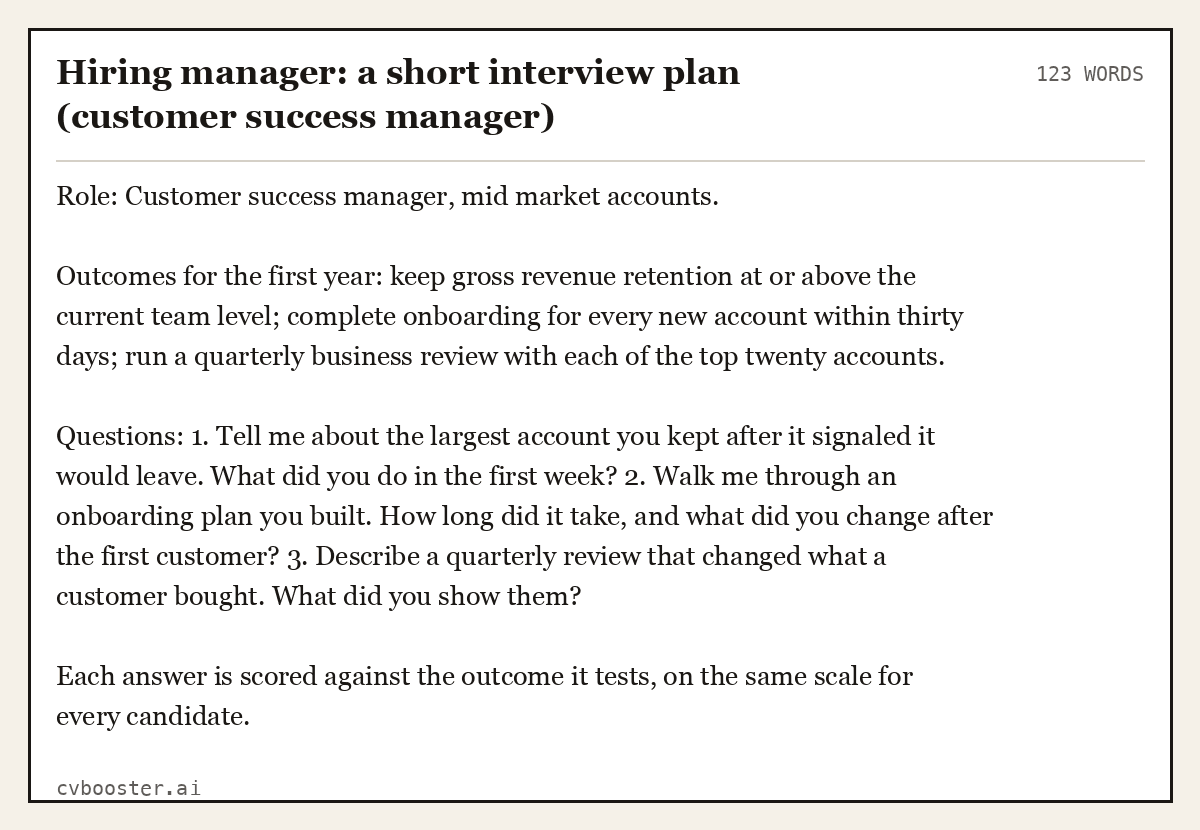
Hiring manager: a short interview plan (customer success manager) (123 words)
Role: Customer success manager, mid market accounts.
Outcomes for the first year: keep gross revenue retention at or above the current team level; complete onboarding for every new account within thirty days; run a quarterly business review with each of the top twenty accounts.
Questions: 1. Tell me about the largest account you kept after it signaled it would leave. What did you do in the first week? 2. Walk me through an onboarding plan you built. How long did it take, and what did you change after the first customer? 3. Describe a quarterly review that changed what a customer bought. What did you show them?
Each answer is scored against the outcome it tests, on the same scale for every candidate.
How to read a book on interviewing in one week
- Day one: read only the chapters for the interview type you have. Skip the rest for now.
- Day two: write your answers to the five questions the book treats as most common, in your own words.
- Days three and four: say them out loud. CareerOneStop's interview tips put it plainly: "Review common interview questions. Practice answering them with someone else or in front of a mirror."
- Day five: match three stories to the job posting, one for each main requirement.
- Day six: update your resume so the stories match what is on the page. Every claim you make in the room should already be on paper.
- Day seven: rest, then reread your notes, not the book.
Our page on how to prepare for an interview covers the day itself, and common interview questions and answers gives more model answers to practice with.
Frequently asked questions
What is the best book on interviewing?
There is no single best book, because interviews differ. For general job interviews, Richard N. Bolles's Parachute interview guide is a broad start. For software engineering, Cracking the Coding Interview is a widely used practice book. For hiring managers, Who by Geoff Smart and Randy Street covers interviewing candidates against defined outcomes.
Are interview books worth reading?
Yes, if you use them to practice rather than to feel prepared. A book gives you the common questions and a structure for answers, but the gain comes from writing your own answers and saying them out loud several times. Reading without practice changes very little on the day.
What book should I read before a technical interview?
For software engineering roles, Cracking the Coding Interview by Gayle Laakmann McDowell is the usual choice, with 189 practice questions and a section on behavioral questions. Work the problems on paper or a whiteboard while explaining your reasoning out loud, because that is how most technical rounds are scored.
Is there a good book on interviewing candidates?
Who: The A Method for Hiring by Geoff Smart and Randy Street is written for people who hire. Its approach starts by defining the outcomes a role must deliver and then asking interview questions that test for them, so every candidate is scored on the same criteria rather than on general impressions.
How long before an interview should I start reading?
About a week is enough for most interviews if you read selectively. Spend the first two days on the chapters for your interview type and writing answers, and the rest of the week practicing them out loud. For technical interviews, start several weeks earlier, because problem practice takes longer.
Related articles
- Accountancy CV Example: 6 UK Accounts CVs by Career Level
- Accounting Interview Questions and Answers: 7 Full Examples
- Activity Resume Example: 6 Samples for College Applications
- Administration CV Example: 6 Admin CVs from Entry to Senior
More articles
- Business Administrator Resume: 5 Examples and Key Skills
- Business Management Interview Questions: 7 Full Answers
- Cabin Crew Cover Letter: 6 Examples for Airline Jobs
Looking for a worked example for your job title? Browse the resume examples by job title.