CV Language: How to List Language Skills and Levels
By Mustafa Tarabya, founder of CVBooster · Published · Updated
6 min read
The clearest way to show a language on your CV is the language name, a recognised level and one line of proof: "Spanish, C1 (CEFR), used daily with clients in Madrid." Employers in the UK and Europe know the CEFR scale from A1 to C2, so a level they can check beats "fluent" or "good working knowledge." The one constraint: only claim a level you could use in an interview tomorrow, because many employers test it on the spot. The Council of Europe's CEFR global scale describes C2 as being able to "understand with ease virtually everything heard or read." Below you will find how the levels work, six CV language sections tagged by level, and the wording that makes the rest of your CV read as confident. Written by Mustafa Tarabya, who hired for his own company, read every application himself and now writes CVBooster's guides.
Language skills section examples for a CV
Here are six complete examples using the CEFR levels explained below, from a graduate with one beginner language to a bilingual professional. Every CV pile has a candidate who lists "French (fluent)" and then, at interview, meets a manager whose mother is from Lyon. The fix is boring and reliable: use the scale.
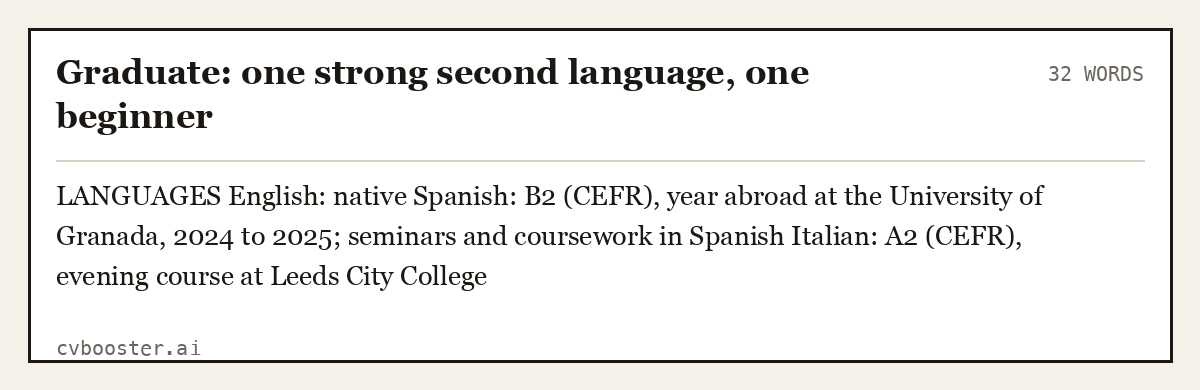
Graduate: one strong second language, one beginner (32 words)
LANGUAGES English: native Spanish: B2 (CEFR), year abroad at the University of Granada, 2024 to 2025; seminars and coursework in Spanish Italian: A2 (CEFR), evening course at Leeds City College
Notice that each line answers the next question before it is asked. Where did you learn it, and when did you last use it?
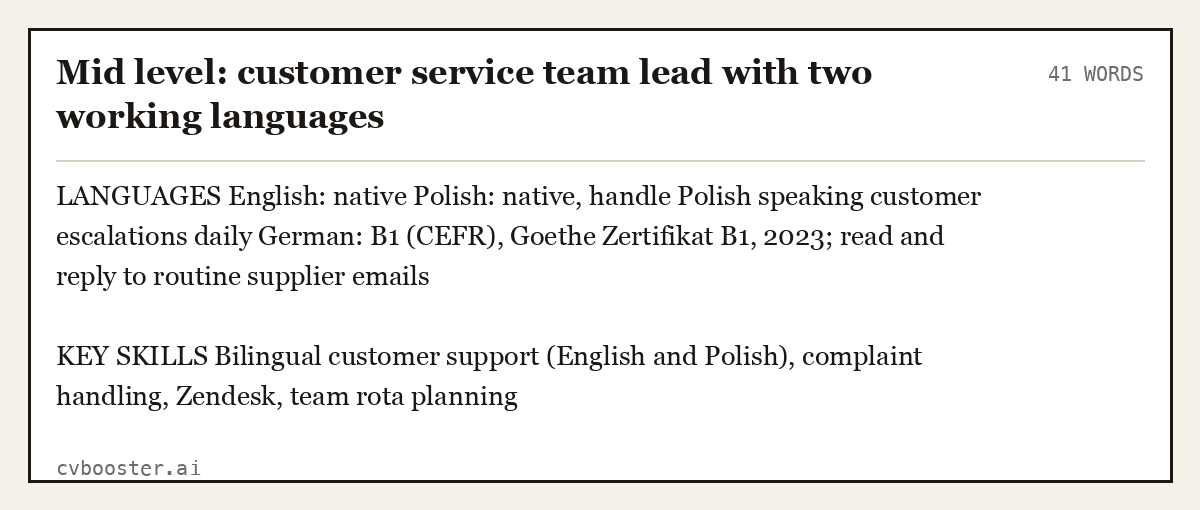
Mid level: customer service team lead with two working languages (41 words)
LANGUAGES English: native Polish: native, handle Polish speaking customer escalations daily German: B1 (CEFR), Goethe Zertifikat B1, 2023; read and reply to routine supplier emails
KEY SKILLS Bilingual customer support (English and Polish), complaint handling, Zendesk, team rota planning
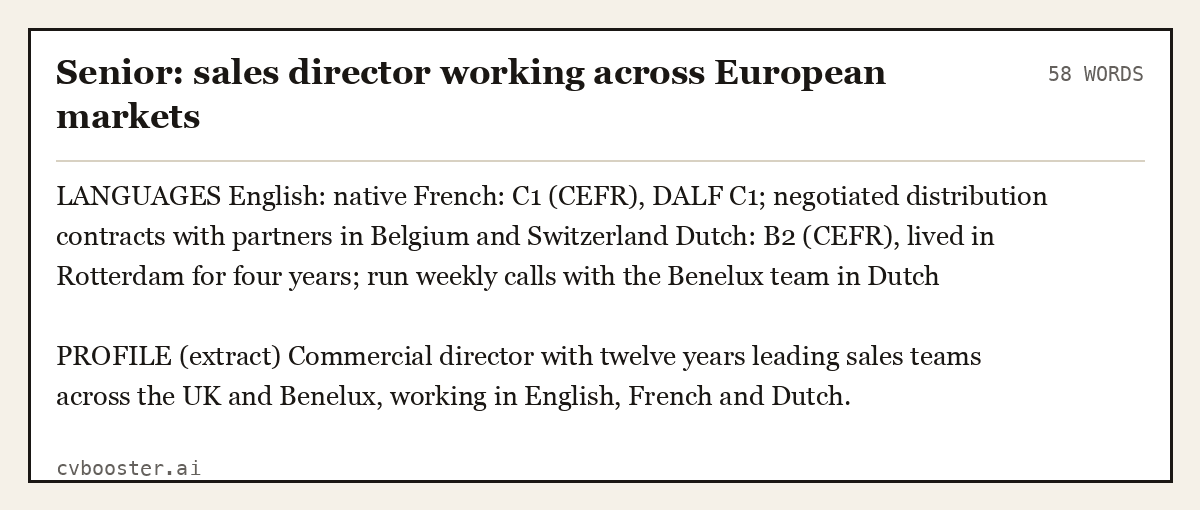
Senior: sales director working across European markets (58 words)
LANGUAGES English: native French: C1 (CEFR), DALF C1; negotiated distribution contracts with partners in Belgium and Switzerland Dutch: B2 (CEFR), lived in Rotterdam for four years; run weekly calls with the Benelux team in Dutch
PROFILE (extract) Commercial director with twelve years leading sales teams across the UK and Benelux, working in English, French and Dutch.
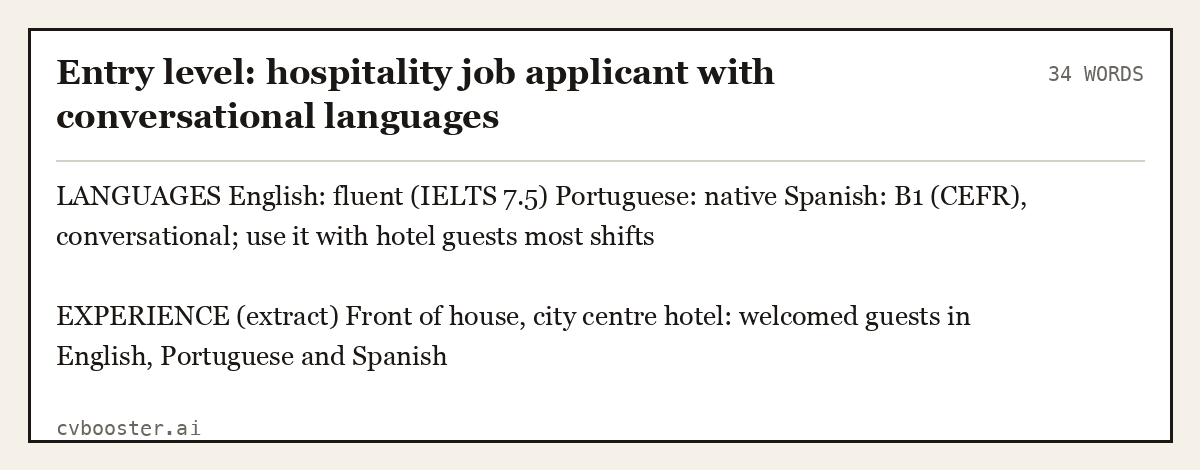
Entry level: hospitality job applicant with conversational languages (34 words)
LANGUAGES English: fluent (IELTS 7.5) Portuguese: native Spanish: B1 (CEFR), conversational; use it with hotel guests most shifts
EXPERIENCE (extract) Front of house, city centre hotel: welcomed guests in English, Portuguese and Spanish
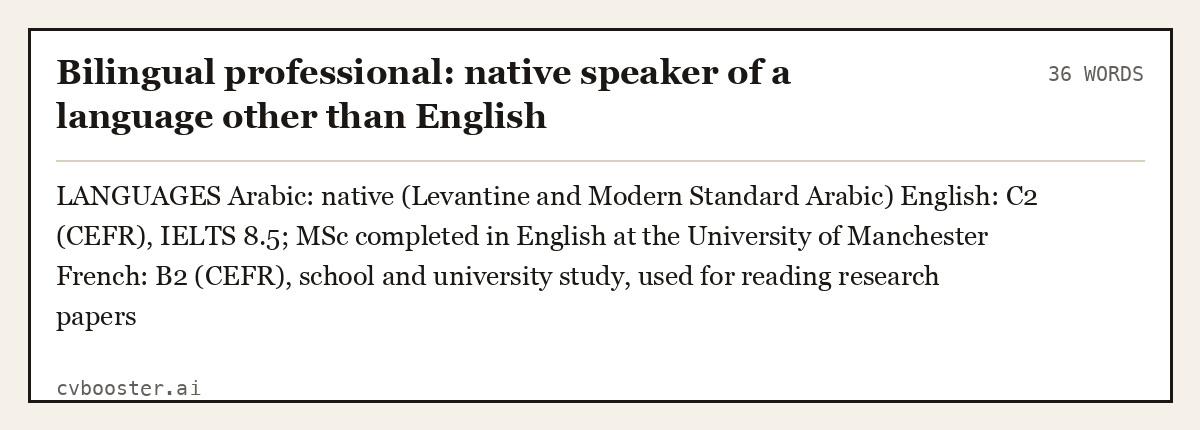
Bilingual professional: native speaker of a language other than English (36 words)
LANGUAGES Arabic: native (Levantine and Modern Standard Arabic) English: C2 (CEFR), IELTS 8.5; MSc completed in English at the University of Manchester French: B2 (CEFR), school and university study, used for reading research papers
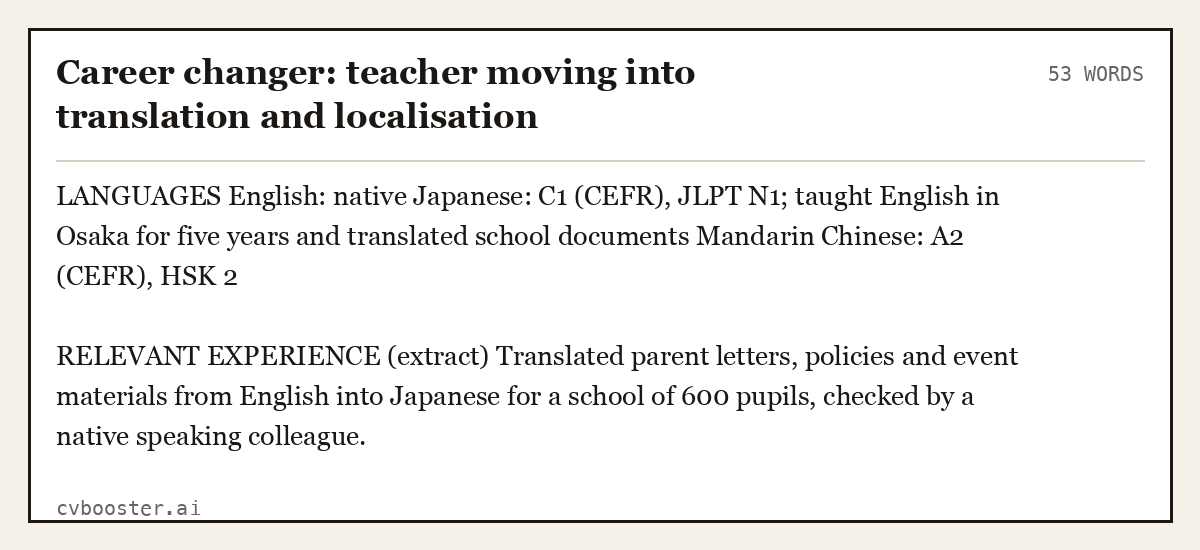
Career changer: teacher moving into translation and localisation (53 words)
LANGUAGES English: native Japanese: C1 (CEFR), JLPT N1; taught English in Osaka for five years and translated school documents Mandarin Chinese: A2 (CEFR), HSK 2
RELEVANT EXPERIENCE (extract) Translated parent letters, policies and event materials from English into Japanese for a school of 600 pupils, checked by a native speaking colleague.
CV language levels explained: the CEFR scale
The Common European Framework of Reference groups learners into three bands. The Council of Europe calls them "PROFICIENT USER" (C1 and C2), "INDEPENDENT USER" (B1 and B2) and basic user (A1 and A2).
| Level | Band | What it means on a CV |
|---|---|---|
| A1 | Basic | Greetings, simple questions, very basic phrases |
| A2 | Basic | Routine tasks and simple exchanges at work |
| B1 | Independent | Familiar topics, travel, simple connected text |
| B2 | Independent | Technical discussions in your field, fluent with native speakers |
| C1 | Proficient | Demanding texts, flexible use for work and study |
| C2 | Proficient | Near effortless, precise and nuanced |
The official wording for B2 is the one most employers care about, because it is the usual threshold for working in a language: "Can understand the main ideas of complex text on both concrete and abstract topics, including technical discussions in his/her field of specialisation." For C1, the scale says you "Can use language flexibly and effectively for social, academic and professional purposes."
If you have a certificate such as IELTS, DELF, DELE, Goethe or TOEFL, add it in brackets. If you do not, give the CEFR level you honestly hold and back it with how you use the language.
Where language skills go on a CV
Put a short "Languages" section after skills or education. Move it up into your profile when the language is a requirement in the advert, for example "Bilingual English and Welsh speaker" for a public sector job in Wales.
The National Careers Service gives a simple rule for every CV section: "you could highlight skills you have that they have asked for. This can improve your chances of getting an interview." If the advert asks for German, German goes in your profile, your skills and the job where you used it.
The European Union's Europass CV builder includes a languages section based on the same scale, so if you apply for jobs in Europe your levels will look familiar to recruiters. For the differences between UK and continental CVs more broadly, see our guide to the European CV vs American resume.
The other kind of CV language: words that sound confident
Some people searching for "CV language" mean something else: the wording of the CV itself. The same principle applies. Plain, specific and checkable beats impressive and vague.
- Start bullets with a verb: led, built, reduced, trained, negotiated.
- Use numbers you can defend: team size, budget, volume, timescale.
- Cut filler: "responsible for", "duties included", "team player", "hard working".
- Write in the first person without "I": "Managed a team of six", not "I managed a team of six."
- Use UK spelling for UK jobs: organised, programme, centre, licence.
Our guide to CV action verbs has a longer list, and skills based CV template shows how to build a CV around skills when your job titles do not tell the story.
Mistakes with languages on a CV
- Writing "fluent" for a language you studied at school ten years ago.
- Listing a language with no level at all. The reader assumes the lowest.
- Using different scales for different languages ("fluent", "B2", "intermediate") in the same section.
- Forgetting your native language. Write "native" so the reader knows.
- Claiming a certificate you have not passed yet. Write "DELE B2, exam booked for June" instead.
Frequently asked questions
How do I write language skills on a CV?
Write the language, a level and one line of proof. Use the CEFR scale from A1 to C2, add any certificate such as IELTS or DELF, and say how you use the language, for example with customers or in meetings. Put native languages first and keep the same scale for every language.
What does B2 mean on a CV?
B2 is the upper independent level on the CEFR scale. It means you can follow complex texts and technical discussions in your field and talk with native speakers without strain on either side. Many employers treat B2 as the minimum for working day to day in a language.
Should I put my native language on my CV?
Yes, especially if you are applying in a country where that language is not the main one. Writing "Polish: native" tells the employer you can serve customers or work with partners in that language. If English is not your first language, add your English level or test score as well.
Is it OK to say fluent on a CV?
Use it only alongside a recognised level or test score, such as "fluent (C1)". On its own, "fluent" means different things to different readers. Many employers test languages at interview, so the level you claim should be the level you can show in conversation that day.
Related articles
- Accountancy CV Example: 6 UK Accounts CVs by Career Level
- Accounting Interview Questions and Answers: 7 Full Examples
- Activity Resume Example: 6 Samples for College Applications
- Administration CV Example: 6 Admin CVs from Entry to Senior
More articles
- CV Personal Statement With No Experience: 8 UK Examples
- CV Template for Finance: 6 UK Finance CVs by Career Level
- CV vs Resume: Which One Do You Actually Send?
Looking for a worked example for your job title? Browse the resume examples by job title.