CV Personal Statement With No Experience: 8 UK Examples
By Mustafa Tarabya, founder of CVBooster · Published · Updated
14 min read
You can write a CV personal statement with no work experience, because the block is evidence about you and not a summary of jobs you have held. The limit is the thing that makes it hard: this is three or four lines under your name, so 60 to 110 words is the entire budget. The National Careers Service guidance, read again in September 2026, calls it your introduction and describes it as "a few short lines that sum up who you are and what you hope to do". Eight finished statements follow, each naming the advert it was written for, with the school, volunteering or home evidence behind it shown underneath. Written by Mustafa Tarabya, who hired for his own company, read every application himself and now writes CVBooster's guides.
Start with one, then read how it was built
Targets: Sales Assistant, Farmfoods, Dundee, 12 hours a week, no experience required
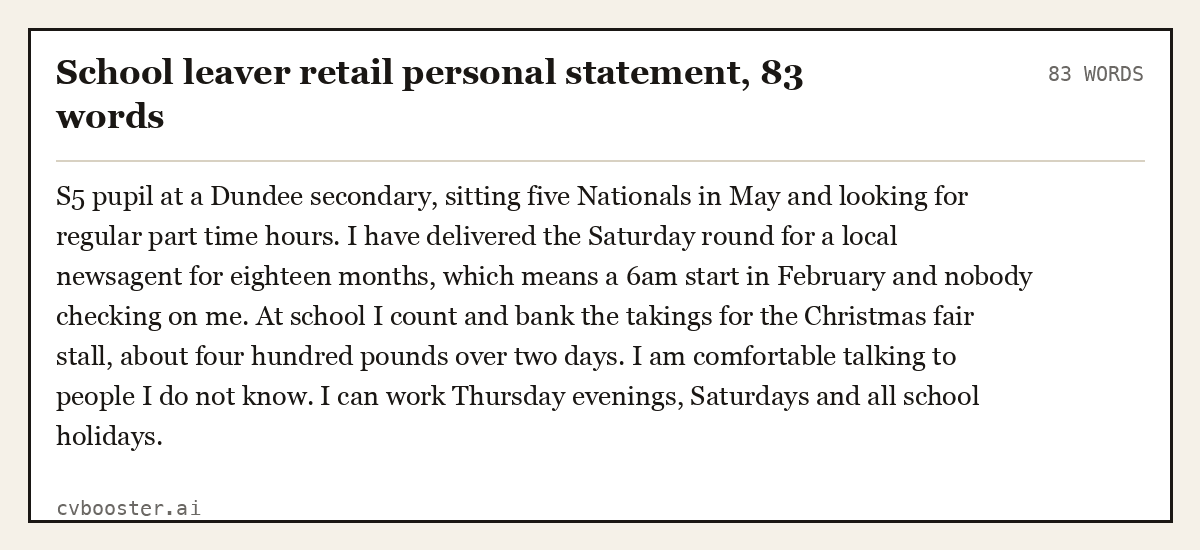
School leaver retail personal statement, 83 words (83 words)
S5 pupil at a Dundee secondary, sitting five Nationals in May and looking for regular part time hours. I have delivered the Saturday round for a local newsagent for eighteen months, which means a 6am start in February and nobody checking on me. At school I count and bank the takings for the Christmas fair stall, about four hundred pounds over two days. I am comfortable talking to people I do not know. I can work Thursday evenings, Saturdays and all school holidays.
Nothing in that paragraph is a job in the way an employer usually means it. A paper round, a school stall and a stated availability are all the evidence there is, and they answer the only two questions this advert has: can you face a customer, and when can you work.
The audit that comes before the writing
Open a blank note. Spend ten minutes listing anything from the last three years where you were responsible for an outcome, held to a schedule, or answerable to somebody who is not a relative. Most of it will feel like it does not count. Write it down anyway.
- Qualifications in progress with predicted grades. A predicted grade is a fact about you today, not a promise.
- Non-exam assessment: food preparation practicals, an art portfolio, the science NEA, BTEC briefs with fixed submission dates.
- The Extended Project Qualification, a T Level industry placement, the Welsh Baccalaureate Skills Challenge Certificate, or an Advanced Higher project in Scotland.
- Duke of Edinburgh sections named individually, with the month count, rather than the award level on its own.
- National Citizen Service, Scouts, Girlguiding, cadet forces, St John Ambulance, the Boys' Brigade.
- Paid work with no contract behind it: a round, babysitting, a market stall, the family takeaway, plus a Year 10 or Year 11 placement.
- School roles: prefect, form rep, school council, peer mentor, sports captain. Caring and household duties belong here too.
- Certificates that sound small and are not: emergency first aid, Level 2 Food Hygiene, the National Pool Lifeguard Qualification, a CSCS card.
Coursework belongs on that list because employers hiring at this stage are not testing whether you know the subject. They are checking whether you can hit a date, follow a specification and finish something without being chased. Non-exam assessment is the cleanest proof of that you will own at seventeen, and almost nobody puts it on a CV.
Describe it in the language of delivery. A GCSE food preparation practical is three dishes cooked and plated inside a timed window. A BTEC assignment brief is a specification with a deadline. The Extended Project Qualification is self-directed, normally a report of around 5,000 words plus a production log and a presentation. A T Level carries a mandatory industry placement of at least 315 hours.
Tip: If a project or placement involved a real organisation, name it. A 315 hour T Level placement at a named housing team beats any adjective you could put in its place.
Care, admin and hospitality
Targets: Care Assistant, bank hours, a 42-bed residential home in Swansea
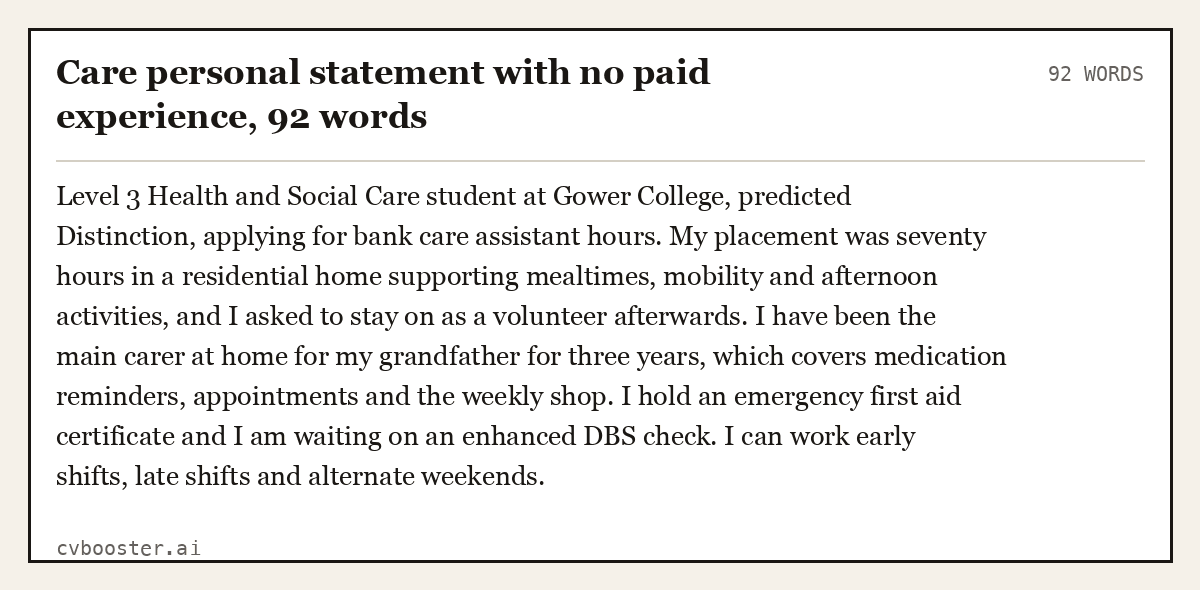
Care personal statement with no paid experience, 92 words (92 words)
Level 3 Health and Social Care student at Gower College, predicted Distinction, applying for bank care assistant hours. My placement was seventy hours in a residential home supporting mealtimes, mobility and afternoon activities, and I asked to stay on as a volunteer afterwards. I have been the main carer at home for my grandfather for three years, which covers medication reminders, appointments and the weekly shop. I hold an emergency first aid certificate and I am waiting on an enhanced DBS check. I can work early shifts, late shifts and alternate weekends.
Targets: Administration Assistant, a four-vet veterinary practice in Norwich
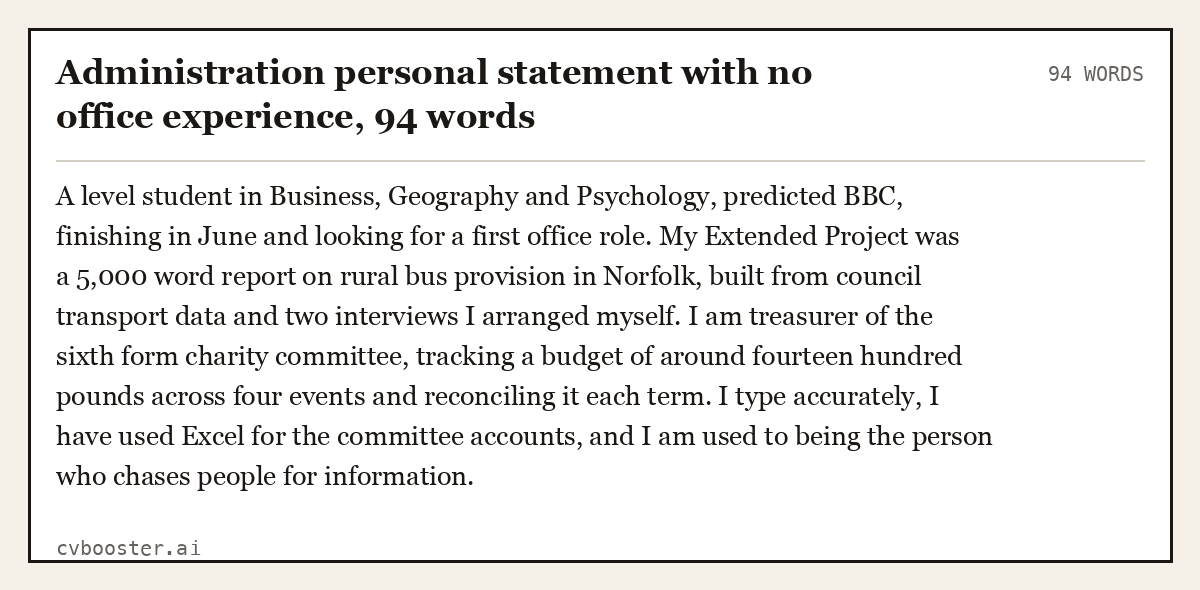
Administration personal statement with no office experience, 94 words (94 words)
A level student in Business, Geography and Psychology, predicted BBC, finishing in June and looking for a first office role. My Extended Project was a 5,000 word report on rural bus provision in Norfolk, built from council transport data and two interviews I arranged myself. I am treasurer of the sixth form charity committee, tracking a budget of around fourteen hundred pounds across four events and reconciling it each term. I type accurately, I have used Excel for the committee accounts, and I am used to being the person who chases people for information.
Targets: Waiting Staff, a 60-cover seafront hotel in Scarborough, seasonal
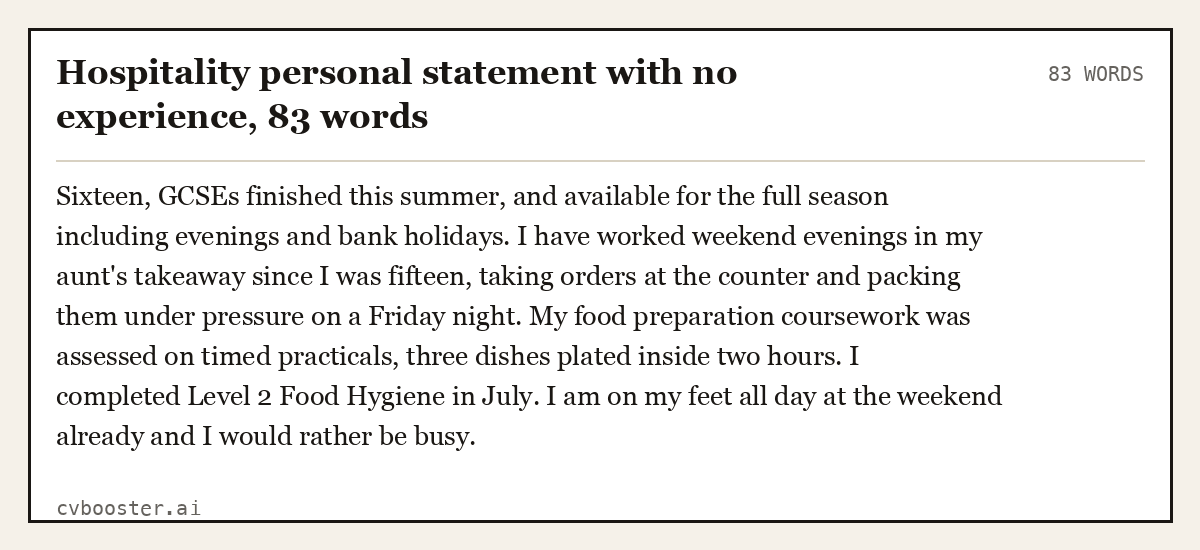
Hospitality personal statement with no experience, 83 words (83 words)
Sixteen, GCSEs finished this summer, and available for the full season including evenings and bank holidays. I have worked weekend evenings in my aunt's takeaway since I was fifteen, taking orders at the counter and packing them under pressure on a Friday night. My food preparation coursework was assessed on timed practicals, three dishes plated inside two hours. I completed Level 2 Food Hygiene in July. I am on my feet all day at the weekend already and I would rather be busy.
Warehouse, apprenticeship, graduate and returner
Targets: Warehouse Operative, a chilled distribution centre in Rugby, nights
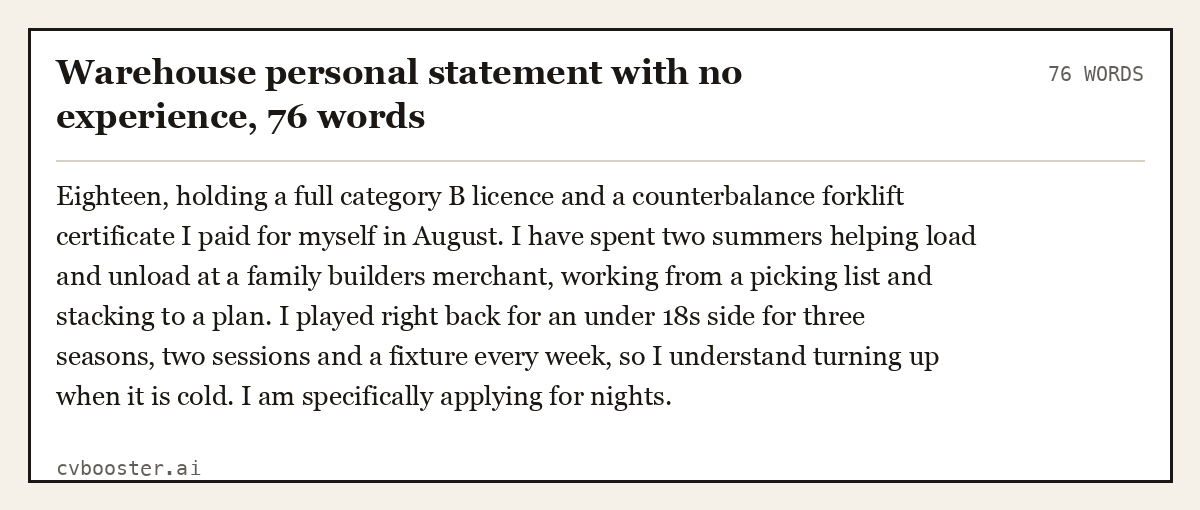
Warehouse personal statement with no experience, 76 words (76 words)
Eighteen, holding a full category B licence and a counterbalance forklift certificate I paid for myself in August. I have spent two summers helping load and unload at a family builders merchant, working from a picking list and stacking to a plan. I played right back for an under 18s side for three seasons, two sessions and a fixture every week, so I understand turning up when it is cold. I am specifically applying for nights.
Targets: Level 3 Engineering Technician Apprenticeship, a manufacturer in Redditch
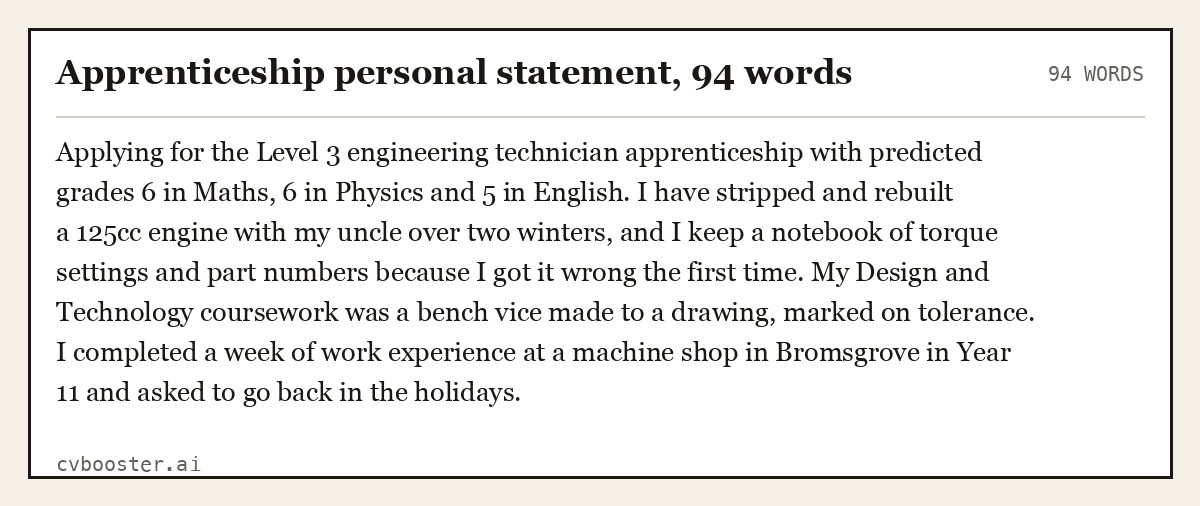
Apprenticeship personal statement, 94 words (94 words)
Applying for the Level 3 engineering technician apprenticeship with predicted grades 6 in Maths, 6 in Physics and 5 in English. I have stripped and rebuilt a 125cc engine with my uncle over two winters, and I keep a notebook of torque settings and part numbers because I got it wrong the first time. My Design and Technology coursework was a bench vice made to a drawing, marked on tolerance. I completed a week of work experience at a machine shop in Bromsgrove in Year 11 and asked to go back in the holidays.
Targets: Trainee Housing Officer, a housing association in Bristol
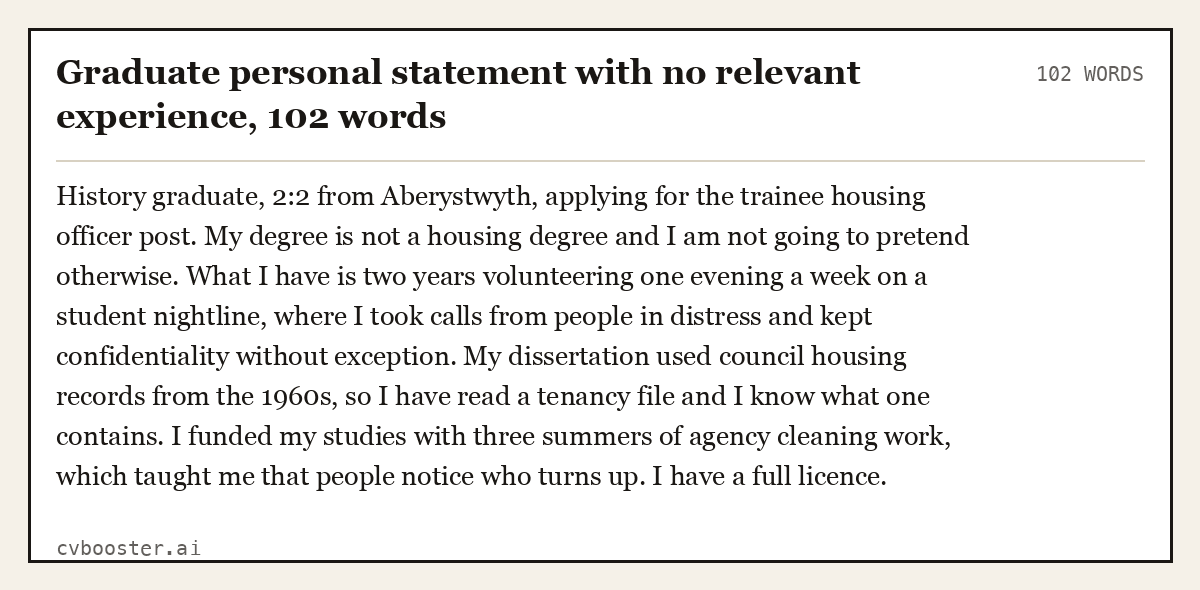
Graduate personal statement with no relevant experience, 102 words (102 words)
History graduate, 2:2 from Aberystwyth, applying for the trainee housing officer post. My degree is not a housing degree and I am not going to pretend otherwise. What I have is two years volunteering one evening a week on a student nightline, where I took calls from people in distress and kept confidentiality without exception. My dissertation used council housing records from the 1960s, so I have read a tenancy file and I know what one contains. I funded my studies with three summers of agency cleaning work, which taught me that people notice who turns up. I have a full licence.
Targets: Customer Service Adviser, a credit union in Belfast, part time
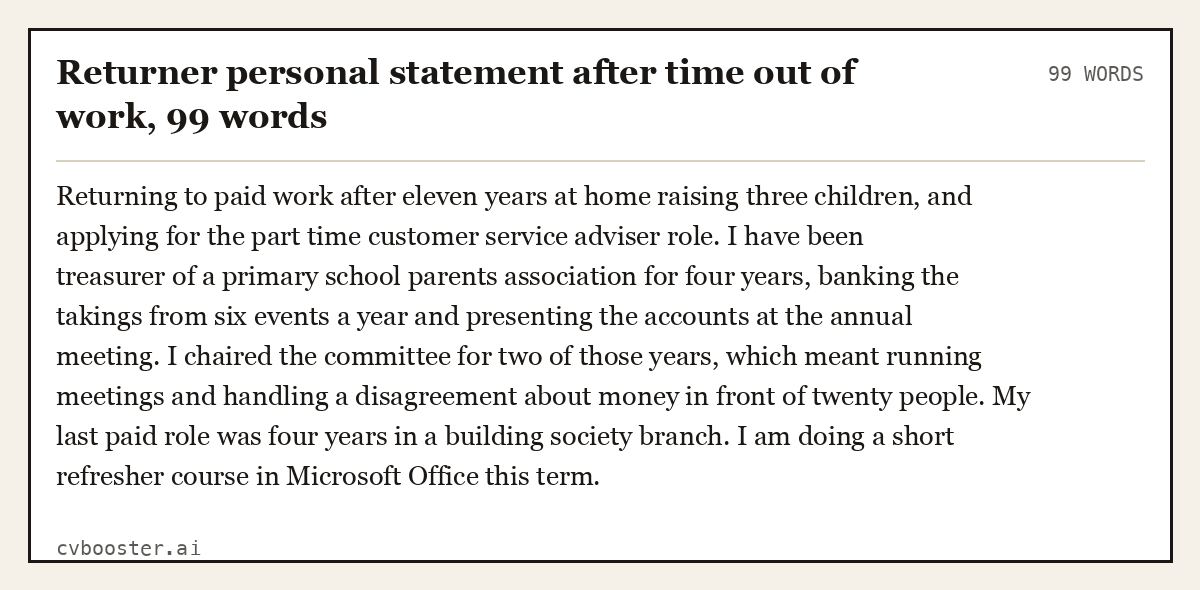
Returner personal statement after time out of work, 99 words (99 words)
Returning to paid work after eleven years at home raising three children, and applying for the part time customer service adviser role. I have been treasurer of a primary school parents association for four years, banking the takings from six events a year and presenting the accounts at the annual meeting. I chaired the committee for two of those years, which meant running meetings and handling a disagreement about money in front of twenty people. My last paid role was four years in a building society branch. I am doing a short refresher course in Microsoft Office this term.
What the National Careers Service actually asks for
The National Careers Service CV guidance sets out the sections in order, and the order is different when you have no work history.
Quoted from nationalcareers.service.gov.uk: "Your CV should include a section for your contact details, an introduction, your education history, your work history and references." On the introduction: "This is a few short lines that sum up who you are and what you hope to do. It should go just under your name and contact details." And: "Make your introduction sound like you're the right person for the job."
On the order, the same guidance is explicit about which section comes next: "You can add this after the introduction if you’re early in your career or do not have much work experience." So education goes second, and it carries the detail.
There are three names in circulation for the same block: personal statement, personal profile, CV introduction. They all mean the paragraph under your contact details. What British readers do not want is the American objective, the sentence about what you hope to get from the employer. Evidence first. Your goal last, in one clause, if at all.
It is also not your UCAS statement. UCAS now walks applicants through a set of personal statement answers and tells them to "make the most of the 4,000 characters". That is written for an admissions tutor with time to read. A CV personal statement is read by a store manager between deliveries. Do not paste one into the other, but raid the UCAS answers for material.
Duke of Edinburgh, cadets and uniformed groups
A Gold Award on its own tells a reader you did something admirable and nothing about what. The award is built from sections, each with a duration you logged, and the duration is the evidence. So write the section and the months, not the badge.
Volunteering at a Saturday football club for under 9s across a school year is weekend attendance with children, which is directly relevant to retail, hospitality, care and childcare. A residential section is the closest thing you have on paper to starting a new job with strangers. If you stopped at Silver, say Silver and say exactly what you completed and for how long.
National Citizen Service has changed shape more than once, so the brand may mean little to whoever reads your CV. Describe the activity instead: a residential week, a skills week, then a social action project your team delivered and presented. That is planning, fundraising and public speaking.
Cadet forces and uniformed groups give you something rare on a first CV, which is attendance sustained over years plus graded qualifications. A cadet who has passed classification tests, held a rank or run a drill night has supervised people. One detail to get right: you have to be 16 before an enhanced DBS check can be issued, so any earlier work with children was supervised, and it is fine to say so.
Saturday jobs, and the caring you did not count
A great deal of first work in Britain happens without a payslip, and people leave it off because it feels informal. A round is a route completed before school in the dark, unsupervised. Weekend hours in a family business are shift work with real customers, and it does not stop counting because the employer is your aunt.
The rules give you vocabulary too. GOV.UK sets out the restrictions on child employment: school-age children cannot work “before 7am or after 7pm”, and “During term time, children can only work a maximum of 12 hours a week.” Most councils also require an employment permit before a school-age child can be employed at all. If a permit was issued for you, you were legally employed, so name the employer and the dates like any other job. If it was cash and casual, describe it by activity and duration rather than inventing a job title.
Tip: For informal work, line up a referee before you send anything. The neighbour whose children you sat, the shop owner, the newsagent. A phone number for a real person turns "helped out" into a checkable claim.
If you have been caring for a parent, grandparent or sibling, you are doing something more demanding than most of the jobs you are applying for, and you are entitled to use it. The Children and Families Act 2014 gave young carers the right to a needs assessment from the council, and many schools have a designated young carers lead. If either applies, the role is documented, which makes it verifiable in the same way a job is. Write it in operational language and leave the medical detail out. You owe no employer your family's medical history, and if you would rather it did not open the CV, move it down under a heading such as Responsibilities.
The lines that cost you the interview
| Weak | Rewritten |
|---|---|
| Hardworking and motivated individual. | Eighteen months of a Saturday paper round, never a missed week. |
| Good team player. | Right back for the under 18s, two sessions and a fixture a week for three seasons. |
| Excellent communication skills. | Took calls on a student nightline one evening a week for two years. |
| Organised and reliable. | Treasurer of the sixth form charity committee, reconciling about fourteen hundred pounds each term. |
| Although I have no work experience, I am a fast learner. | Completed Level 2 Food Hygiene in July so I could pick up kitchen shifts. |
Cut anything a reader could paste onto somebody else's CV without changing a word. Cut the apology in all its forms, because naming the gap makes the gap the headline. Cut "seeking an opportunity to develop my skills", which describes what the job does for you. And cut anything you could not defend if somebody asked about it in a room.
Before you send it
- Put the statement directly under your contact details and education directly under that.
- Count the words. Between 60 and 110, in continuous prose, because many first jobs are applied for through a plain text box.
- Name the job and the employer in the first line or the last one.
- Attach a duration, a number or a named organisation to every claim.
- Leave out your age, date of birth, marital status, nationality and photograph.
- Line up one referee who will answer the phone.
An honest limit: a good statement will not win you an apprenticeship whose entry requirements you do not meet. What it does is stop you reading as one more identikit applicant, and hand the interviewer something specific to ask about.
More worked statements: CV personal statement examples for people who do have a work history, supporting statement example for application forms with a free text box, and teaching assistant supporting statement example for school roles.
Frequently asked questions
What is a good example of a personal statement on a CV?
The eight statements on this page are examples, all written for a named advert by somebody with no relevant paid work. A good one runs 60 to 110 words, names the job, and attaches a duration, a number or a named organisation to every claim. The Farmfoods statement above is typical: eighteen months of a round, a school stall with a figure on it, and a clear line on availability.
How do I start a personal statement for a CV?
Start with what you are and at what stage, in five or six words, then go straight to your strongest piece of evidence. "S5 pupil sitting five Nationals in May" or "Level 3 Health and Social Care student, predicted Distinction" does the job. Never open with an adjective about yourself, and never open by apologising for the experience you do not have.
What do you put on a CV if you have no experience?
Education first with the detail in it, then anything with a duration attached: coursework and non-exam assessment, a Duke of Edinburgh section, volunteering, a placement, cadets, caring at home, informal paid work. The National Careers Service tells you the order: education "after the introduction if you're early in your career or do not have much work experience". Add certificates, a licence and your availability.
What is an example of a good personal profile for a CV?
A personal profile is the same block under a different name, so any of the eight above works as one. The care example is a good model: a course and a predicted grade, a placement with the hours on it, three years of caring at home described in operational terms, a first aid certificate, and a line on shift availability. Ninety-two words, no adjectives about the writer, and every claim checkable by a phone call.
How long should a CV personal statement be?
Three or four sentences, which lands between 60 and 110 words. The National Careers Service describes it as "a few short lines that sum up who you are and what you hope to do", and it sits under your name where a longer paragraph pushes your education below the fold. Write it as continuous prose without bullets, because many application forms accept plain text only.
Can I write a CV with no work experience at all?
Yes, and it is normal at sixteen and at every point somebody returns to work. The CV changes shape rather than shrinking: the introduction and education carry the weight, and a Responsibilities or Volunteering section replaces the work history. Everything on it must still be checkable, so name the school, the group, the placement or the family business rather than describing the activity in the abstract.
More in this series: Supporting statements
- CV Personal Statement Examples: 12 Written for Real Jobs
- Care Worker Supporting Statement Example: 3 Full Statements
- How to Write a Personal Statement for a Job Application
- How to Write a Supporting Statement: One Built Step by Step
- NHS Supporting Statement Examples: Band 3, Band 5, Band 6
- Supporting Statement Example: 4 Full Statements, Annotated
- Teaching Assistant Supporting Statement: 3 Full Examples
Related articles
- How to Write a Resume for Your First Job (No Experience Needed)
- About Me Examples: 12 Written for a Resume and a Bio
- Bartender Job Descriptions for a Resume: 8 Examples
- Certification for Office Managers: 6 Lines That Get Read
More articles
- CV vs Resume: Which One Do You Actually Send?
- Delivering at Pace: 4 Civil Service Examples, EO to G7
- Developing Self and Others: 4 Civil Service Examples