Public Policy Analyst Resume Examples: read this first
Public Policy Analyst Resume Built on Evidence and Method
By Mustafa Tarabya, founder of CVBooster · Published · Updated
Public policy analyst resume example with keywords and a guide to writing about program evaluation, cost analysis, statistical tools and published findings.
Sample resumes for a public policy analyst
The same public policy analyst content laid out in three CVBooster templates, so you can see what the finished document looks like before you write a word.
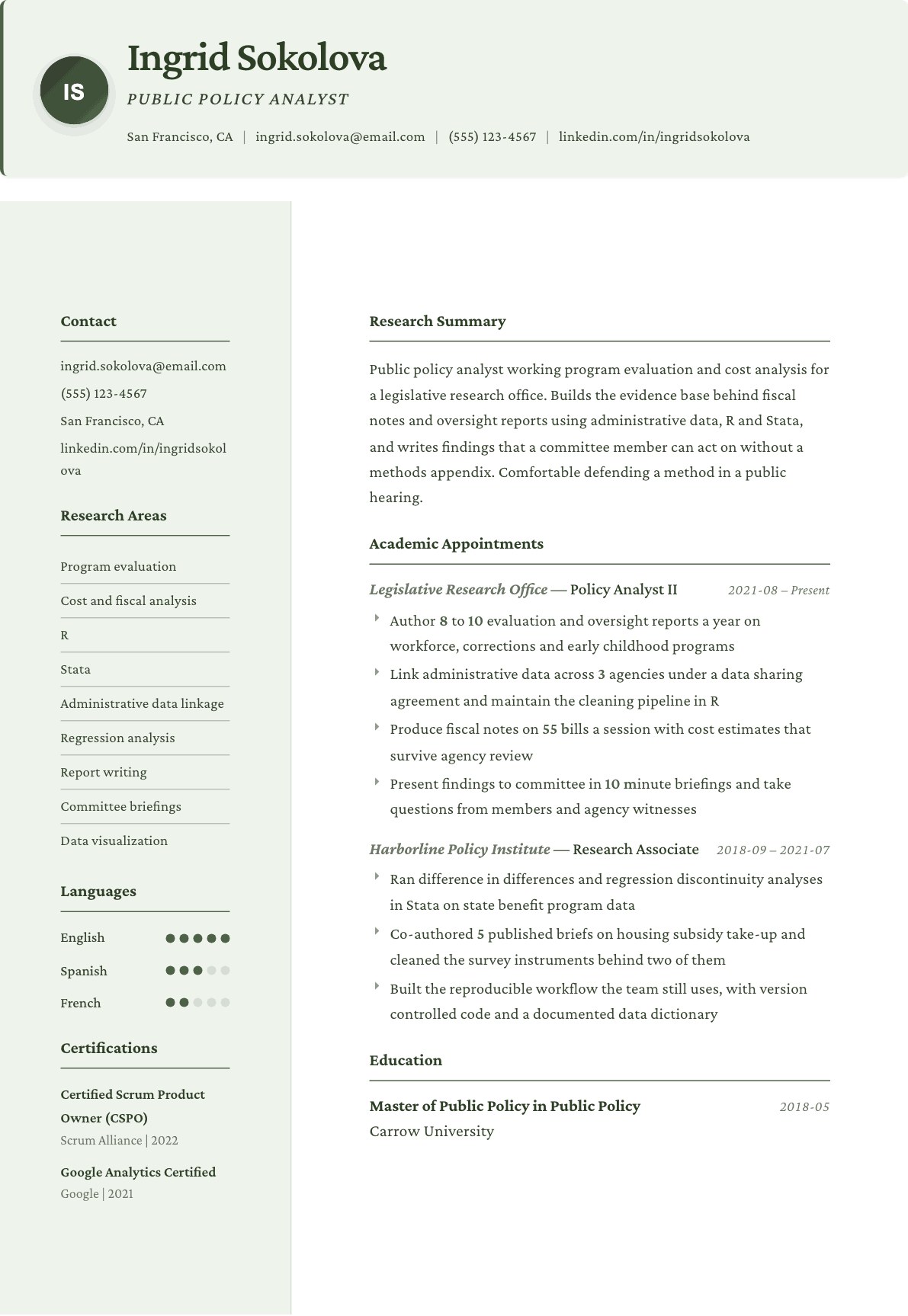
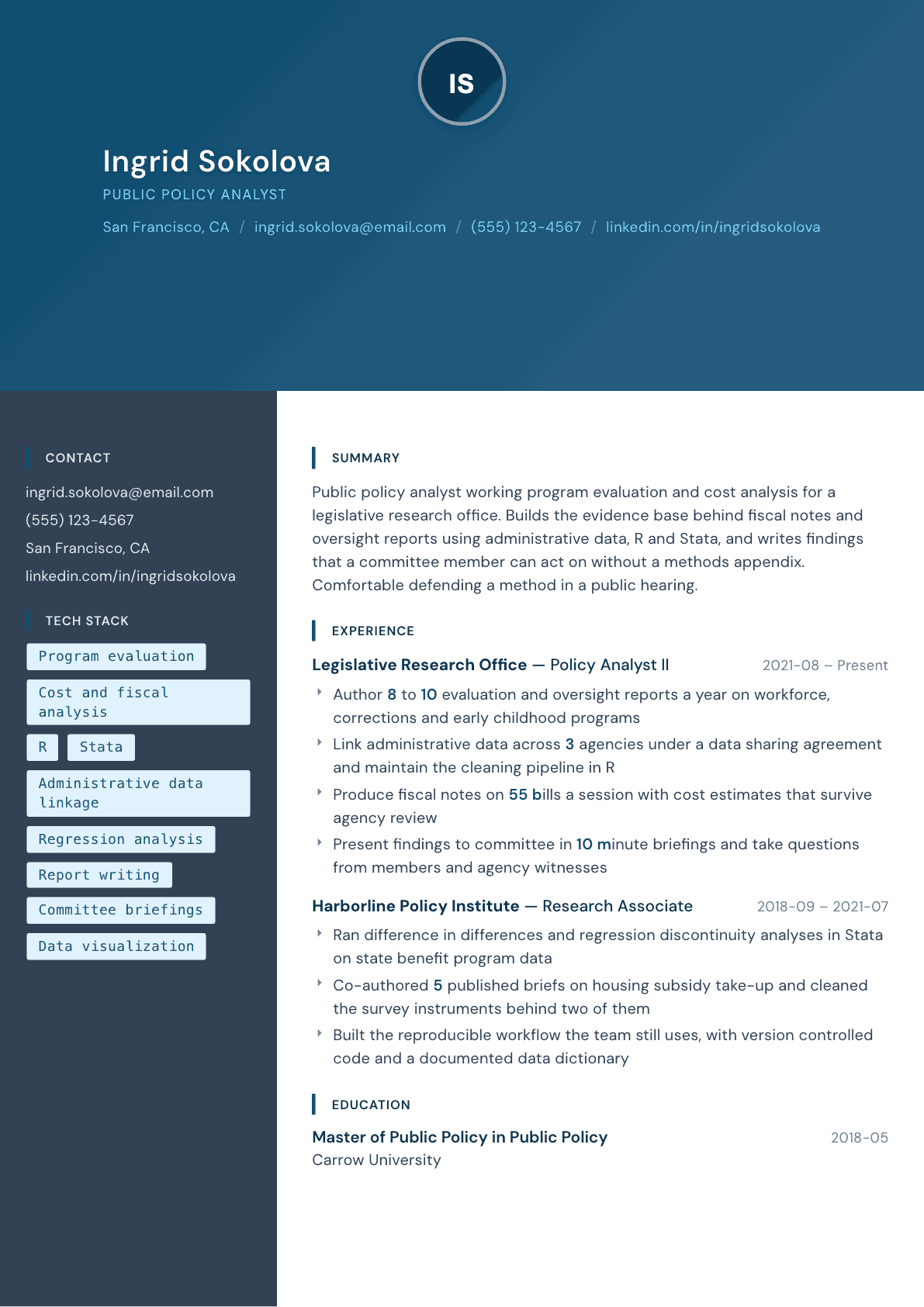
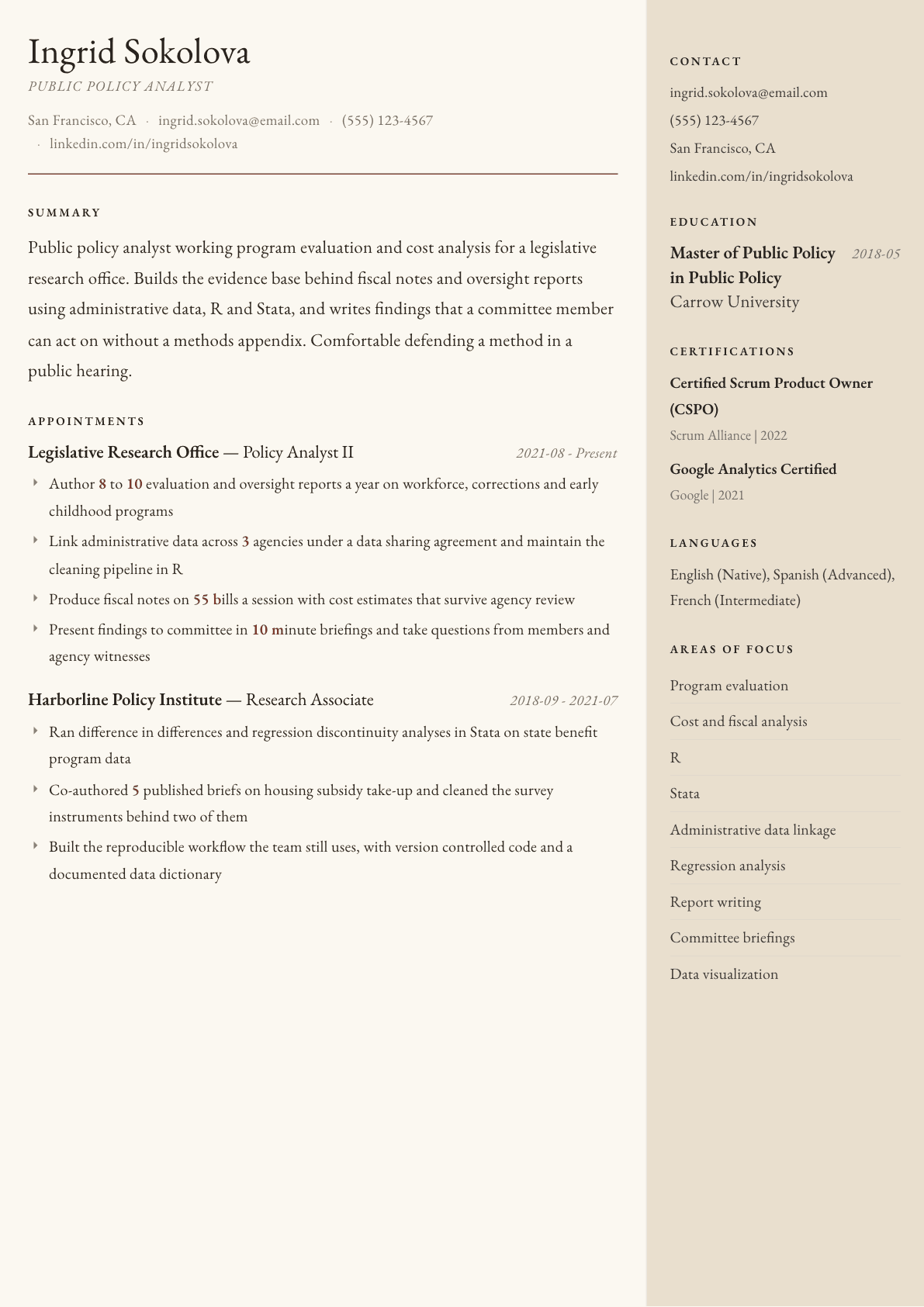
Example Public Policy Analyst summary
Public policy analyst with six years between a research institute and a legislative research office, producing evaluations, fiscal notes and oversight reports. Links administrative data across agencies, works in R, Stata and SQL, and writes findings a committee can use without wading through a methods appendix. Master of Public Policy, seeking a senior analyst role.
Skills to list on a Public Policy Analyst resume
- Program evaluation design
- Quasi-experimental methods
- Cost benefit and fiscal analysis
- Regression and causal inference
- R
- Stata
- SQL
- Administrative data linkage
- Survey design and analysis
- Data visualization
- Policy brief and report writing
- Legislative fiscal notes
- Committee testimony
- Literature review and evidence synthesis
What actually gets this resume read
- Name your methods explicitly, because a research director hires for difference in differences and regression discontinuity, not for analysis in general.
- List the statistical tools you actually use and the data sources you have linked, including any data sharing agreements.
- Give the count of reports, fiscal notes or briefs you produce a year, since throughput is a real constraint in a policy shop.
- Cite your published work by title and outlet in a short publications section rather than burying it in a bullet.
- Describe one finding that changed a program, a budget line or a bill, and keep the description factual.
- Show that you can write for a non-technical reader by mentioning the briefing formats and page limits you work to.
How to write a public policy analyst resume
Public policy analyst covers two very different jobs that share a title. One is quantitative: linking administrative data, estimating effects, building cost models, defending a specification. The other is synthetic: reading the literature, interviewing practitioners, and writing a brief that a legislator can act on. Research directors hire for one or the other, and a resume that stays neutral between them tends to lose both competitions.
The second thing a hiring director checks is whether your work has ever left the building. Analysis that sits in a folder is worth less than analysis that became a fiscal note, an oversight report, a published brief or a committee presentation. Volume of finished, released products is the strongest single signal on a policy analyst resume.
This guide covers how to declare your method stack without turning the page into a tool list, how to write about data access, how to present publications, and how to describe a finding that changed something without overstating the causal chain.
Format: method, data, output
Two pages, with a publications section if you have released work under your name. Open with a short block that states your policy domains, your methods and the tools you work in. A research director reading a stack will filter on that block first, because the rest of the resume is expensive to read.
Order experience by employer, but within each job group the bullets: the products you authored, the methods you used, and the data you built or maintained. Analysts who list everything as one undifferentiated stream force the reader to reconstruct the shape of the job.
- Domain block: the policy areas you have published in, not the ones you find interesting.
- Method block: the designs you have actually run, named precisely.
- Tools with the work attached: R for cleaning pipelines, Stata for estimation, SQL for extraction.
- A publications list with title, outlet and date, capped at the strongest handful.
Methods: name the design, not the discipline
Write difference in differences, regression discontinuity, interrupted time series, propensity score matching, synthetic control, survival analysis. Those phrases are what a director scans for. Quantitative analysis as a phrase tells him nothing and appears on every applicant page in the stack.
Be honest about depth. Having run a design under supervision, having specified one yourself and having defended one against a hostile reviewer are three different levels of competence, and the interview will find the boundary anyway. State the level plainly and you gain credibility instead of losing it.
For qualitative work, be equally specific: semi-structured interview protocols, coded transcripts, site visits, case study design, comparative jurisdiction scans. These are methods too, and an office doing oversight work values them as highly as the estimation skills.
Data: access is half the job
Getting the data is often harder than analyzing it. Say which administrative systems you have worked with, whether you negotiated or maintained a data sharing agreement, and what governance you operated under. Analysts who can navigate an interagency data request save an office months, and almost nobody puts it on the resume.
Describe the pipeline you built and whether it is reproducible. Version controlled code, a documented data dictionary, a rerunnable cleaning script. Directors have inherited too many undocumented analyses to be indifferent about this.
Output: fiscal notes, reports and testimony
Give annual counts of the products you author: evaluation reports, oversight reviews, fiscal notes, issue briefs, presentations to committee. If your fiscal notes go out under an office name rather than yours, say how many you produced and note that the estimates survived agency review, which is the real test.
Presentation counts too. A ten minute briefing to a committee where members and agency witnesses ask questions is a different skill from writing, and offices that testify want to know you can do it. Say how often you present and to whom.
- Reports authored or co-authored per year, with the topics and the requesting body.
- Fiscal notes or cost estimates produced per session and whether they were contested.
- Presentations to committees, boards or advisory panels, with frequency.
- Peer review or technical advisory roles you have served for other offices.
Writing for a non-technical reader
The hardest part of the job is compressing a defensible analysis into something a member reads before a vote. Show that you can do it: name the brief format you write to, the page limits, whether you produce a one-page summary alongside the technical appendix, and whether you build the charts yourself. A director who sees that will assume the methods are teachable and the writing is not.
Public Policy Analyst resume summary examples
Research associate
Policy research associate with 3 years at an independent institute, running difference in differences and regression discontinuity analyses in Stata on state benefit program data. Co-authored 5 published briefs on housing subsidy take-up and built the reproducible workflow the team still uses. Master of Public Policy.
Policy analyst
Public policy analyst with 6 years producing evaluation and oversight reports for a legislative research office. Authors 9 reports a year on workforce, corrections and early childhood programs, links administrative data across 3 agencies under a sharing agreement, and produces 55 fiscal notes a session.
Senior analyst or research manager
Research manager leading a team of 4 analysts across program evaluation and fiscal estimation, with 12 years in legislative and institute settings. Sets the evaluation agenda with committee chairs, reviews every published estimate before release, and testifies on methodology when findings are contested.
Work experience bullets: before and after
Before: Conducted data analysis on state programs.
After: Ran difference in differences and regression discontinuity analyses in Stata on state benefit program data covering 4 years of monthly caseload records.
Naming the designs, the tool and the data structure lets a research director judge the technical level in one line.
Before: Worked with data from multiple agencies.
After: Linked administrative data across 3 agencies under a negotiated data sharing agreement and maintained the cleaning pipeline in R with a documented data dictionary.
Data access and reproducibility are the parts of the job that cost an office months, and both are stated explicitly.
Before: Wrote reports for the legislature.
After: Authored 9 evaluation and oversight reports a year on workforce, corrections and early childhood programs, each released publicly with a one-page summary and a technical appendix.
Output volume plus the two-tier format shows the writing range these offices actually need.
Before: Prepared cost estimates for bills.
After: Produced fiscal notes on 55 bills a session, building cost models from agency caseload data, and defended the estimates through agency comment without material revision.
Surviving agency review is the test of a fiscal note, and the strong version names that outcome.
Before: Presented findings to committees.
After: Presented 10 minute findings briefings to policy and budget committees, taking questions from members and responding to agency witnesses on methodology in open session.
The format and the adversarial setting show a skill that a written product cannot demonstrate on its own.
Hard skills
- Program evaluation design
- Quasi-experimental methods
- Cost benefit and fiscal analysis
- Regression and causal inference
- R
- Stata
- SQL
- Administrative data linkage
- Survey design and analysis
- Data visualization
- Policy brief and report writing
- Legislative fiscal notes
- Qualitative interviewing and coding
- Evidence synthesis and literature review
Soft skills
- Explaining a method to a non-technical reader
- Defending findings under questioning
- Neutrality on contested topics
- Scoping a question down to what data can answer
- Collaboration with agency staff who fear the result
Mistakes that cost public policy analyst candidates the interview
- Listing quantitative analysis instead of naming the designs a research director is actually scanning for.
- Leaving out the data access work, which is often the scarcest skill in an evaluation office.
- Burying publications inside experience bullets where a reader cannot count or check them.
- Overstating causal claims from a descriptive analysis, which a technical interviewer will test immediately.
- Omitting product counts, so a director cannot tell whether you finish work or only start it.
- Presenting only academic work when the office produces short briefs on legislative deadlines.
Public Policy Analyst resume questions
Do I need a doctorate to work as a public policy analyst?
No. A master of public policy, public administration, economics or statistics covers most legislative and agency analyst roles. Doctorates matter more in research institutes and for positions that lead evaluation design or publish peer reviewed work.
How do I list publications on a policy analyst resume?
Give a short section with title, outlet and date, ordered by relevance rather than by year, and cap it at the strongest handful. Mark co-authored pieces honestly, since reviewers in this field often know the authors involved.
What if my analysis never influenced a decision?
Most analysis does not, and pretending otherwise is transparent. Describe the question, the method, the finding and where it was released. Directors hire for rigor and throughput, and influence follows from being in the room repeatedly.
Should I include code samples or a portfolio?
A link to a public repository or a published report with an appendix is useful, especially for reproducible workflows. Keep any shared code free of restricted data and say clearly which parts of a project were yours.
How do I switch from a research institute to a government office?
Emphasize deadline work over depth. Show short-turnaround products, fiscal estimates, presentations to non-technical audiences, and any work you did under a fixed release calendar rather than long-form projects with open timelines.
Related resume examples
- Policy Analyst Resume example
- Intelligence Analyst Resume example
- Policy Advisor Resume example
- Regulatory Analyst Resume example
- International Development Consultant Resume example
- Budget Officer Resume example