Interview Tracker: A Free Template and 5 Filled Examples
By Mustafa Tarabya, founder of CVBooster · Published · Updated
8 min read
An interview tracker is one table where every application gets a row: the company, the role, the date you applied, the stage, the next step and the date it is due. That is enough to keep track of interviews across ten or forty applications without missing a follow-up. The one constraint is that it only works if you update it the same day something happens. If you claim unemployment, your state may require a similar record; New York's Department of Labor explains what it must include, quoted below. Five filled examples follow. Written by Mustafa Tarabya, who hired for his own company, read every application himself and now writes CVBooster's guides.
At some point every job search produces the call. "Hi, this is Jordan from Acme, following up on your application." You applied to nine companies with Jordans. You say "great to hear from you" in the voice of a person who has no idea which job this is.
The interview tracker template
Copy these columns into Google Sheets, Excel, Notion or a notebook. The tool does not matter; the columns do.
| Column | What to write |
|---|---|
| Company | The employer, plus the recruiting agency if there is one |
| Role and link | Job title and the link to the posting, saved as a copy because postings disappear |
| Date applied | The day you sent it |
| Version sent | Which resume and cover letter file you used |
| Contact | Name, title, email or phone of the recruiter or hiring manager |
| Stage | Applied, screen, interview 1, interview 2, final, offer, rejected, withdrawn |
| Next step and due date | What happens next and when, such as "follow up Thu 22 Oct" |
| Notes | Interviewers' names, questions asked, salary range, anything you promised to send |
Two columns most templates leave out make the biggest difference. Version sent lets you remember which resume the interviewer has in front of them. Next step and due date turns the tracker from a diary into a to-do list.
Here is a single row filled in for a first job search, written out so you can see every field.
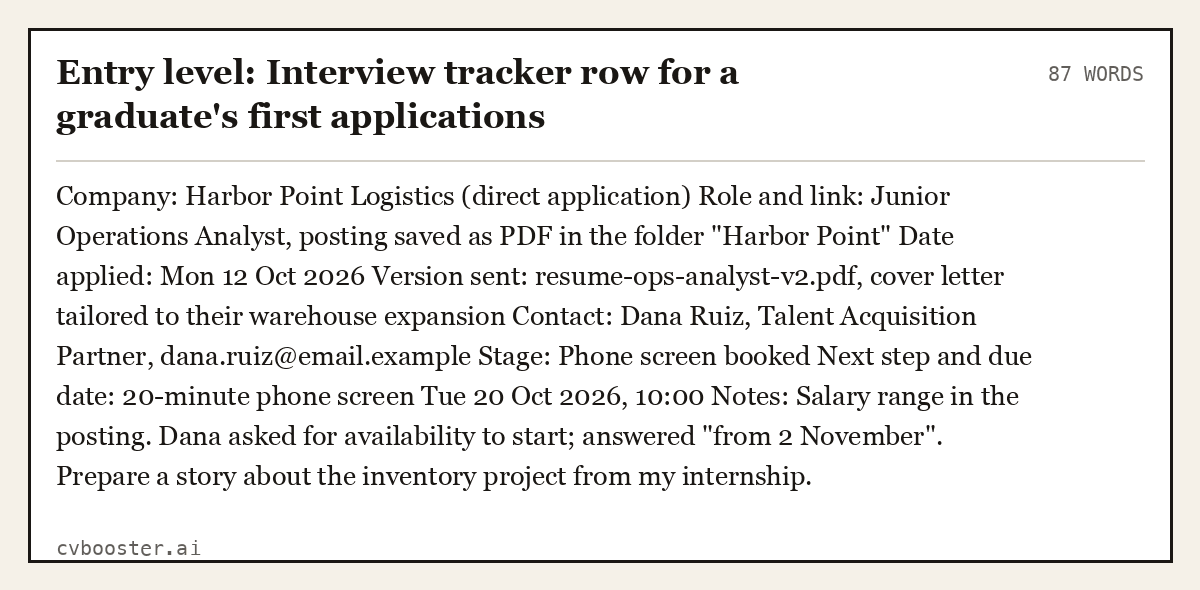
Entry level: Interview tracker row for a graduate's first applications (87 words)
Company: Harbor Point Logistics (direct application) Role and link: Junior Operations Analyst, posting saved as PDF in the folder "Harbor Point" Date applied: Mon 12 Oct 2026 Version sent: resume-ops-analyst-v2.pdf, cover letter tailored to their warehouse expansion Contact: Dana Ruiz, Talent Acquisition Partner, dana.ruiz@email.example Stage: Phone screen booked Next step and due date: 20-minute phone screen Tue 20 Oct 2026, 10:00 Notes: Salary range in the posting. Dana asked for availability to start; answered "from 2 November". Prepare a story about the inventory project from my internship.
How to keep track of job applications and interviews each week
A tracker you open once a fortnight is a list of regrets. Use a short routine instead.
- Same day: add a row for every application, and update the stage and next step after every call or email.
- Every Monday: sort by "next step and due date" and do everything due this week, starting with follow-ups.
- After each interview: write the interviewers' names and the questions you were asked within the hour, while you remember them.
- Every Friday: mark anything with no reply after two to three weeks as "no response" so the active list stays short.
The notes column pays for itself in the second round. When the hiring manager asks "what did you think of what Sam said about the team?", you will know who Sam was.
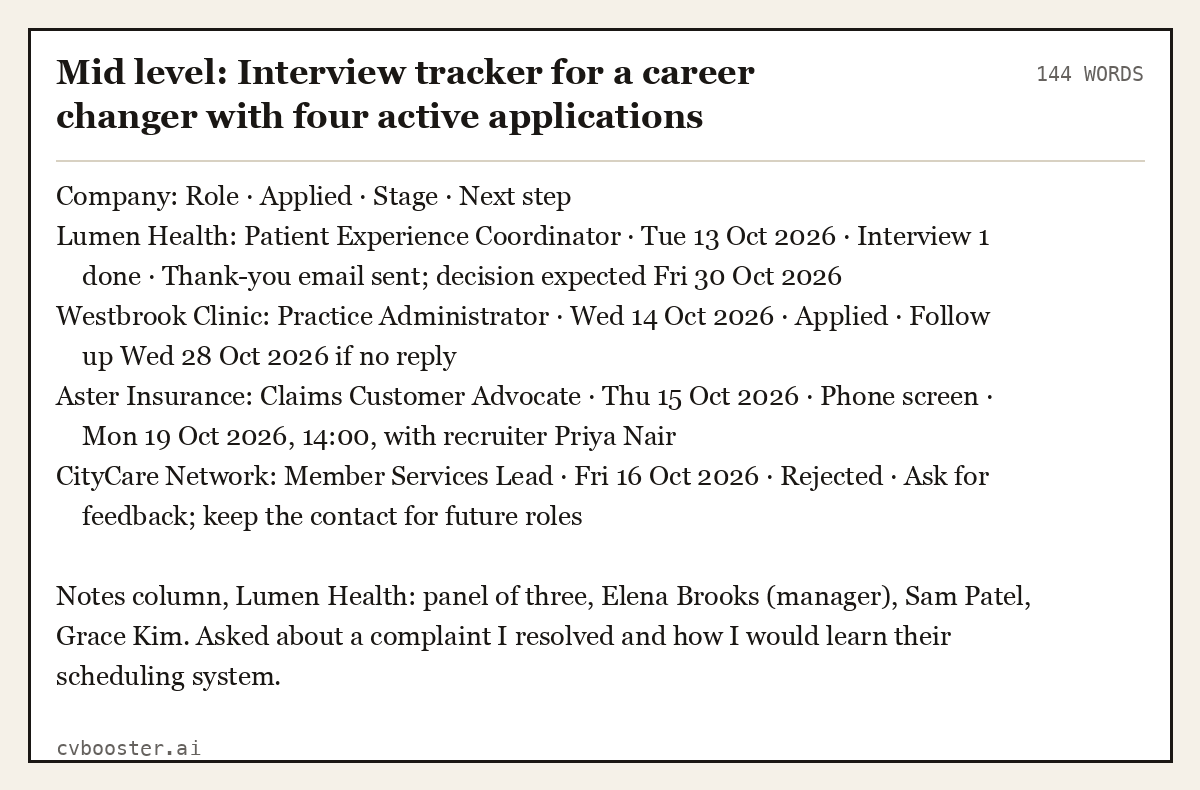
Mid level: Interview tracker for a career changer with four active applications (144 words)
| Company | Role | Applied | Stage | Next step |
|---|---|---|---|---|
| Lumen Health | Patient Experience Coordinator | Tue 13 Oct 2026 | Interview 1 done | Thank-you email sent; decision expected Fri 30 Oct 2026 |
| Westbrook Clinic | Practice Administrator | Wed 14 Oct 2026 | Applied | Follow up Wed 28 Oct 2026 if no reply |
| Aster Insurance | Claims Customer Advocate | Thu 15 Oct 2026 | Phone screen | Mon 19 Oct 2026, 14:00, with recruiter Priya Nair |
| CityCare Network | Member Services Lead | Fri 16 Oct 2026 | Rejected | Ask for feedback; keep the contact for future roles |
Notes column, Lumen Health: panel of three, Elena Brooks (manager), Sam Patel, Grace Kim. Asked about a complaint I resolved and how I would learn their scheduling system.
Interview tracker examples for different searches
The basic template stays the same, but a few searches need one extra column or a different emphasis.
Working with recruiters. Add a column for the agency and the recruiter, and note which companies each agency has sent your resume to. Two agencies sending the same resume to the same employer can cost you the job.
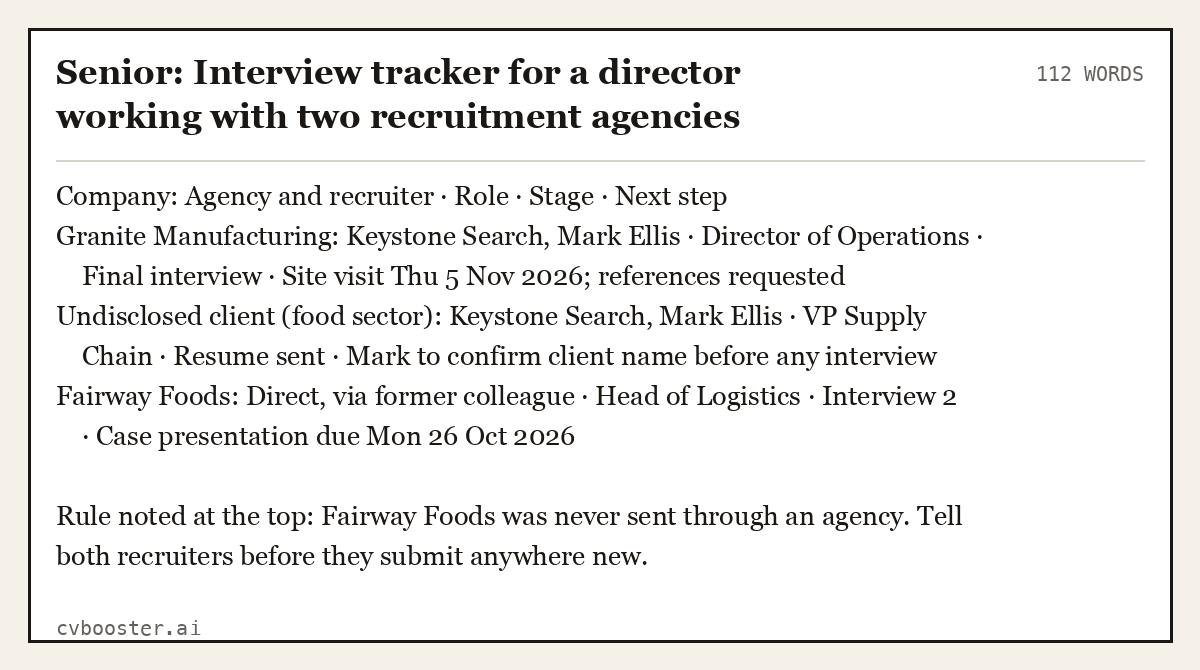
Senior: Interview tracker for a director working with two recruitment agencies (112 words)
| Company | Agency and recruiter | Role | Stage | Next step |
|---|---|---|---|---|
| Granite Manufacturing | Keystone Search, Mark Ellis | Director of Operations | Final interview | Site visit Thu 5 Nov 2026; references requested |
| Undisclosed client (food sector) | Keystone Search, Mark Ellis | VP Supply Chain | Resume sent | Mark to confirm client name before any interview |
| Fairway Foods | Direct, via former colleague | Head of Logistics | Interview 2 | Case presentation due Mon 26 Oct 2026 |
Rule noted at the top: Fairway Foods was never sent through an agency. Tell both recruiters before they submit anywhere new.
Government and long hiring processes. Public sector hiring can take months, with several status updates on the way. Add a column for the announcement or reference number and the date each status changed.
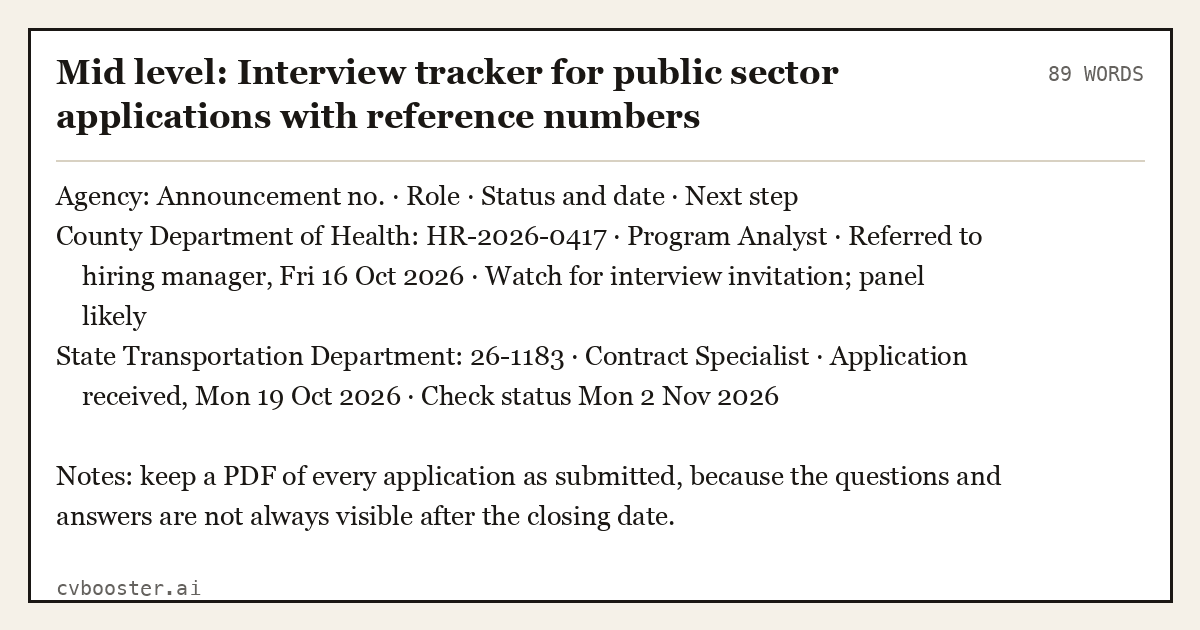
Mid level: Interview tracker for public sector applications with reference numbers (89 words)
| Agency | Announcement no. | Role | Status and date | Next step |
|---|---|---|---|---|
| County Department of Health | HR-2026-0417 | Program Analyst | Referred to hiring manager, Fri 16 Oct 2026 | Watch for interview invitation; panel likely |
| State Transportation Department | 26-1183 | Contract Specialist | Application received, Mon 19 Oct 2026 | Check status Mon 2 Nov 2026 |
Notes: keep a PDF of every application as submitted, because the questions and answers are not always visible after the closing date.
If you claim unemployment: the work search record
Many states require people claiming benefits to keep a record of their job search, and a good interview tracker covers most of it. The New York State Department of Labor lists what its record should contain: "The record should include information such as dates, names, addresses (mail, email, or web address) and telephone numbers of employers contacted, names and/or job titles of specific people contacted, contact methods used, position or job title applied for or a description of other work search efforts (attending job fairs or workshops, etc.)."
Rules differ by state, so check your own state's agency; USA.gov's unemployment page links to each one and says: "Unemployment insurance pays you money if you lose your job through no fault of your own." Add the columns your state asks for, such as contact method and address, so one table does both jobs.
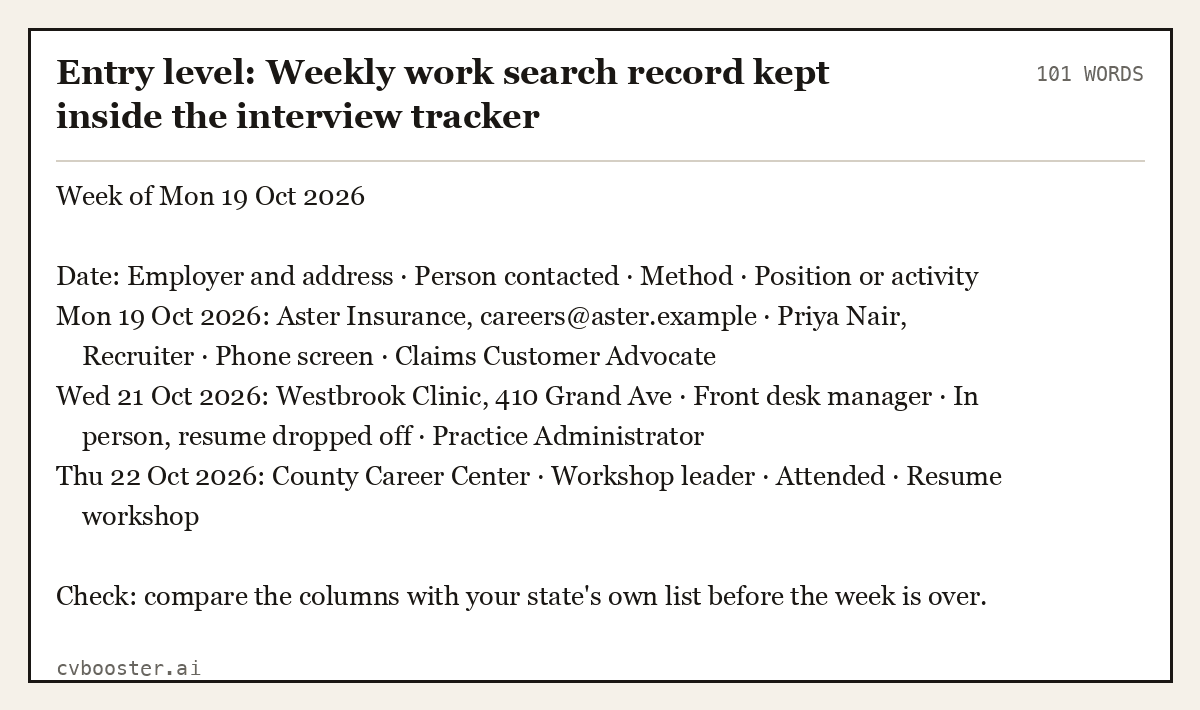
Entry level: Weekly work search record kept inside the interview tracker (101 words)
Week of Mon 19 Oct 2026
| Date | Employer and address | Person contacted | Method | Position or activity |
|---|---|---|---|---|
| Mon 19 Oct 2026 | Aster Insurance, careers@aster.example | Priya Nair, Recruiter | Phone screen | Claims Customer Advocate |
| Wed 21 Oct 2026 | Westbrook Clinic, 410 Grand Ave | Front desk manager | In person, resume dropped off | Practice Administrator |
| Thu 22 Oct 2026 | County Career Center | Workshop leader | Attended | Resume workshop |
Check: compare the columns with your state's own list before the week is over.
Use the tracker to spot job scams
A tracker also protects you. When an "employer" you never applied to offers an interview by text, or asks you to pay for training before you start, the empty row tells you something is off. The Federal Trade Commission's job scams page is direct: "Honest employers, including the federal government, will never ask you to pay to get a job. Anyone who does is a scammer." Add a stage called "suspicious" and do not send personal documents to anyone in it.
What to do with the data after a month
After four weeks the tracker starts answering questions. If you get screens but no second interviews, practice the interview itself with our guide on how to prepare for an interview. If you get no replies at all, the problem is usually the resume or the roles you are choosing; our job search strategies guide covers both. If you need to move or drop an interview you have booked, see how to cancel an interview politely, and keep the row so you know the contact.
Write down the questions you are asked in the notes column too. After a few interviews you will see the same five come back, and you can prepare them properly, along with your own questions to ask in an interview. If the question that keeps coming back is why your last job ended, our guide on how to explain getting fired in an interview has five full answers.
Frequently asked questions
What should an interview tracker include?
At minimum: company, role with a saved copy of the posting, date applied, the resume version you sent, the contact person, the current stage, the next step with its due date, and notes on interviewers and questions. If you claim unemployment, add the contact method and employer address your state requires.
Is it better to use a spreadsheet or an app to track interviews?
Either works. A spreadsheet is free, private and easy to sort by due date. Job tracker apps and browser extensions save postings with one click and can be faster if you apply to many jobs. Choose the one you will actually open every day; the routine matters more than the tool.
How many applications should I track at once?
Track every application you send, but keep the active list short by marking roles with no reply after two to three weeks as no response. Many people find that ten to fifteen live applications are the most they can follow up properly and still prepare well for each interview.
When should I follow up after an interview?
Send a short thank-you email within one working day, then follow up once if you have not heard back by the date the interviewer gave you, or after about a week if they gave none. Put both dates in the next step column the day of the interview so the follow-up does not depend on memory.
Can I use my interview tracker as my unemployment work search log?
Often yes, if it contains every field your state requires, such as dates, employer names and addresses, the people you contacted and the method you used. Check your state agency's rules, keep the record for each week you claim, and be ready to hand over a copy if asked.
Related articles
- Accountancy CV Example: 6 UK Accounts CVs by Career Level
- Accounting Interview Questions and Answers: 7 Full Examples
- Activity Resume Example: 6 Samples for College Applications
- Administration CV Example: 6 Admin CVs from Entry to Senior
More articles
- Irish CV Conventions: Referees, Garda Vetting and Permits
- Java Interview Questions and Answers: 8 Worked Examples
- Email for Job Application: 7 UK Templates and Examples
Looking for a worked example for your job title? Browse the resume examples by job title.