Medical Motivation Letter Sample: 5 Letters for Medicine
By Mustafa Tarabya, founder of CVBooster · Published · Updated
11 min read
A medical motivation letter sample shows you how to answer one question in about a page: why medicine, why you, and why this program. The constraint is length. The AAMC, which runs the US medical school application, gives its essay a limit of 5,300 characters and asks that it "relates to your reasons for choosing medicine, and describes why you believe you will be successful as a physician." Programs that ask for a motivation letter often set their own, shorter limit, so check the program page first. Below are five complete letters, for medical school, graduate entry, a medical master's, a clinical observership and residency, with notes on what each paragraph does. Written by Mustafa Tarabya, who hired for his own company, read every application himself and now writes CVBooster's guides.
Every admissions reader has met the applicant who wanted to be a doctor since the age of four. The four year old was very convincing. The committee would like to hear from the adult.
What a motivation letter for medicine has to prove
The AAMC's Personal Comments Essay guidance lists the questions to answer, starting with "Why have you selected the field of medicine?" and "What motivates you to learn more about medicine?" A motivation letter is the same exercise, aimed at one program instead of every school at once. It has to prove three things:
- Exposure. You have seen the work up close: shadowing, volunteering, a care job, research, or clinical work if you are already qualified.
- Reflection. You can say what that exposure taught you about medicine and about yourself, not just list it.
- Fit. You know why this program, this country or this specialty, in a sentence nobody else could paste into their letter.
Keep it to one page, about 350 to 450 words, unless the program states a limit. If it states a limit in characters, count with spaces.
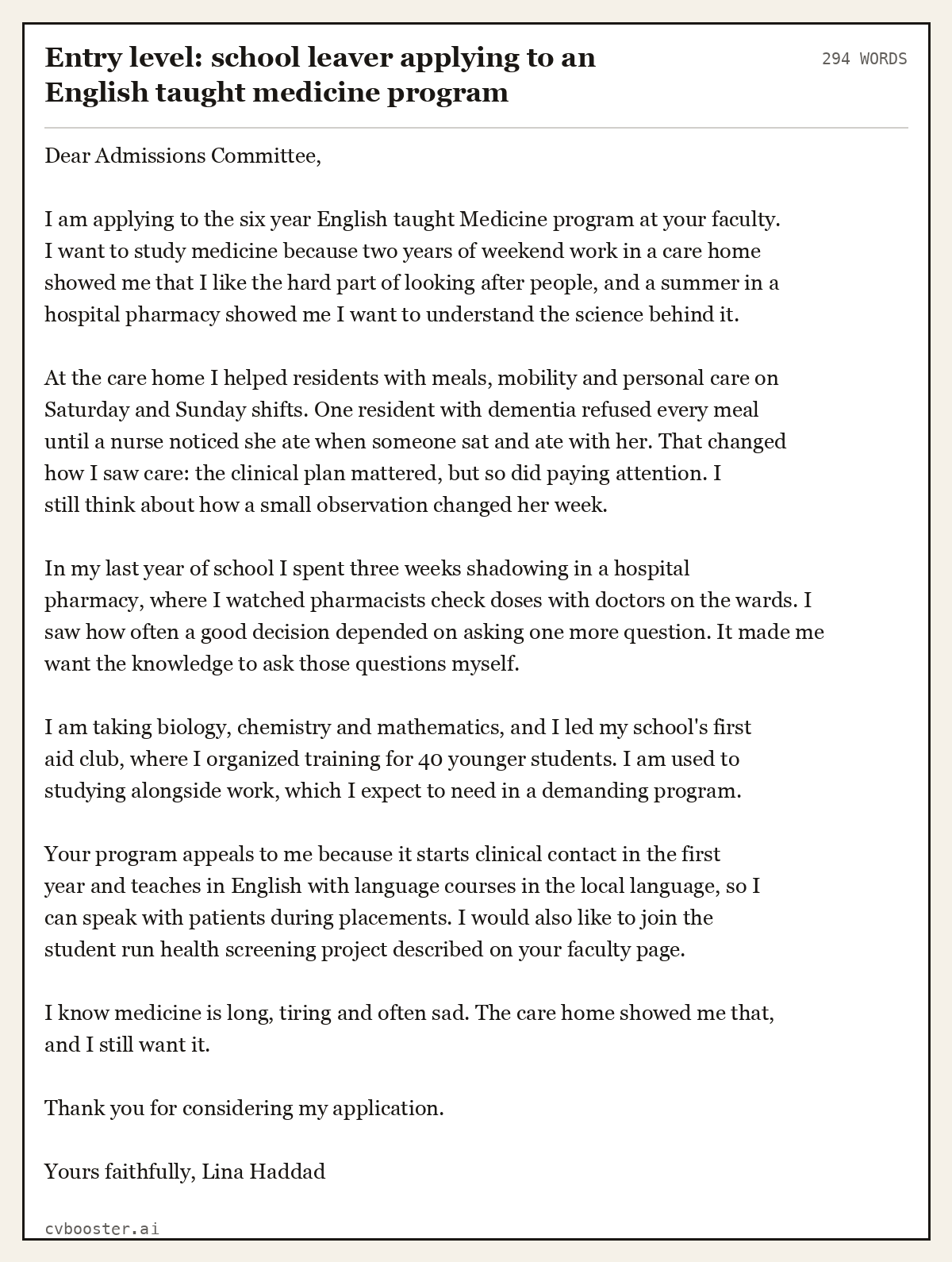
Entry level: school leaver applying to an English taught medicine program (294 words)
Dear Admissions Committee,
I am applying to the six year English taught Medicine program at your faculty. I want to study medicine because two years of weekend work in a care home showed me that I like the hard part of looking after people, and a summer in a hospital pharmacy showed me I want to understand the science behind it.
At the care home I helped residents with meals, mobility and personal care on Saturday and Sunday shifts. One resident with dementia refused every meal until a nurse noticed she ate when someone sat and ate with her. That changed how I saw care: the clinical plan mattered, but so did paying attention. I still think about how a small observation changed her week.
In my last year of school I spent three weeks shadowing in a hospital pharmacy, where I watched pharmacists check doses with doctors on the wards. I saw how often a good decision depended on asking one more question. It made me want the knowledge to ask those questions myself.
I am taking biology, chemistry and mathematics, and I led my school's first aid club, where I organized training for 40 younger students. I am used to studying alongside work, which I expect to need in a demanding program.
Your program appeals to me because it starts clinical contact in the first year and teaches in English with language courses in the local language, so I can speak with patients during placements. I would also like to join the student run health screening project described on your faculty page.
I know medicine is long, tiring and often sad. The care home showed me that, and I still want it.
Thank you for considering my application.
Yours faithfully, Lina Haddad
What each paragraph does. The opening answers "why medicine" in one sentence with two real experiences. The second paragraph shows reflection through one patient, without a name or identifying detail. The fourth names the program features she actually looked up. The last line is the honesty committees look for: she knows what the job costs.
Motivation letter for graduate entry medicine
Graduate entry applicants have more evidence and less excuse. Lead with what you did after your first degree and why it pointed to medicine rather than a nearby career.
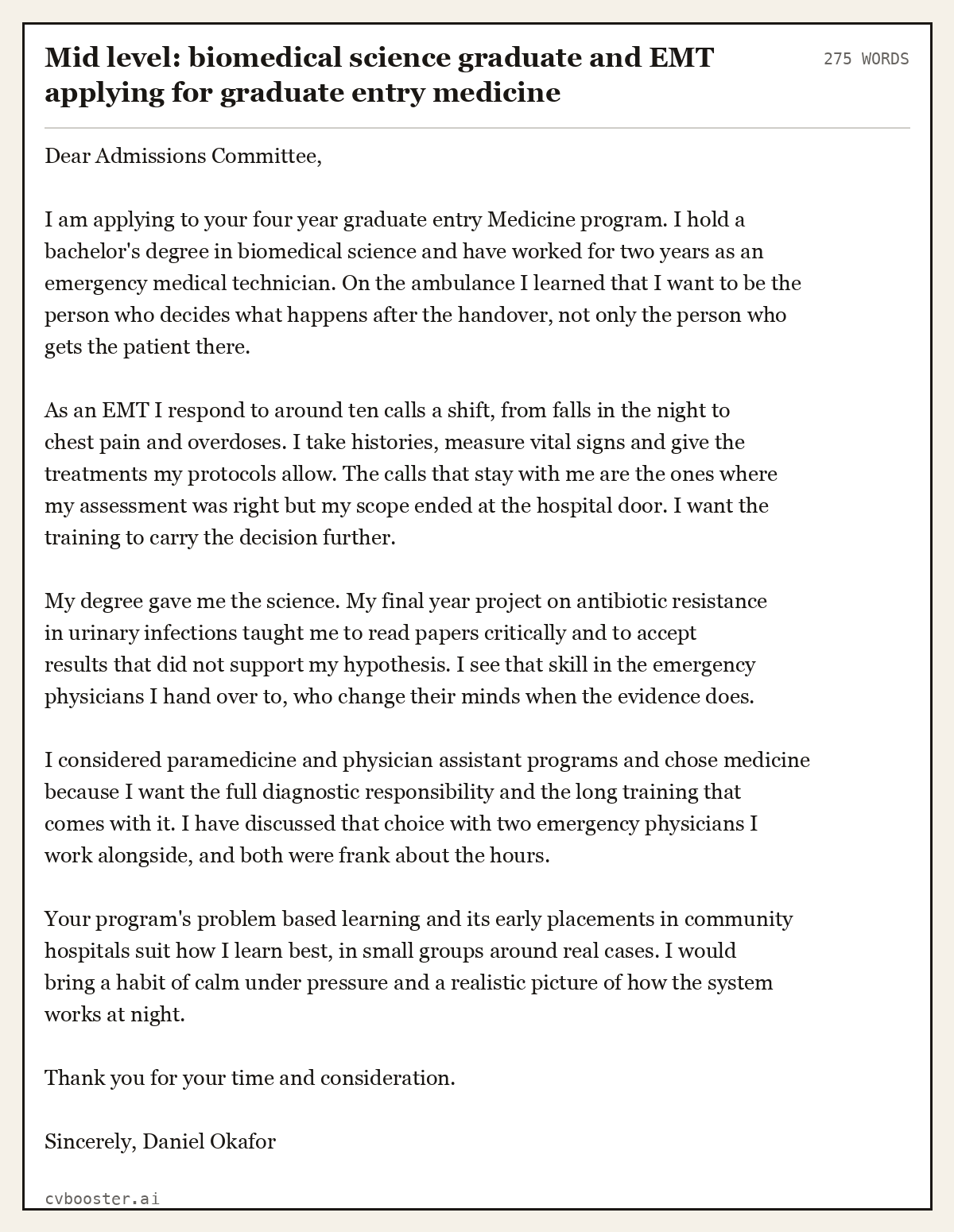
Mid level: biomedical science graduate and EMT applying for graduate entry medicine (275 words)
Dear Admissions Committee,
I am applying to your four year graduate entry Medicine program. I hold a bachelor's degree in biomedical science and have worked for two years as an emergency medical technician. On the ambulance I learned that I want to be the person who decides what happens after the handover, not only the person who gets the patient there.
As an EMT I respond to around ten calls a shift, from falls in the night to chest pain and overdoses. I take histories, measure vital signs and give the treatments my protocols allow. The calls that stay with me are the ones where my assessment was right but my scope ended at the hospital door. I want the training to carry the decision further.
My degree gave me the science. My final year project on antibiotic resistance in urinary infections taught me to read papers critically and to accept results that did not support my hypothesis. I see that skill in the emergency physicians I hand over to, who change their minds when the evidence does.
I considered paramedicine and physician assistant programs and chose medicine because I want the full diagnostic responsibility and the long training that comes with it. I have discussed that choice with two emergency physicians I work alongside, and both were frank about the hours.
Your program's problem based learning and its early placements in community hospitals suit how I learn best, in small groups around real cases. I would bring a habit of calm under pressure and a realistic picture of how the system works at night.
Thank you for your time and consideration.
Sincerely, Daniel Okafor
Motivation letter for a medical master's program
A motivation letter for a medical master's, such as global health, public health or clinical research, is read by academics. They want a research question in your head and a plan for using the degree.
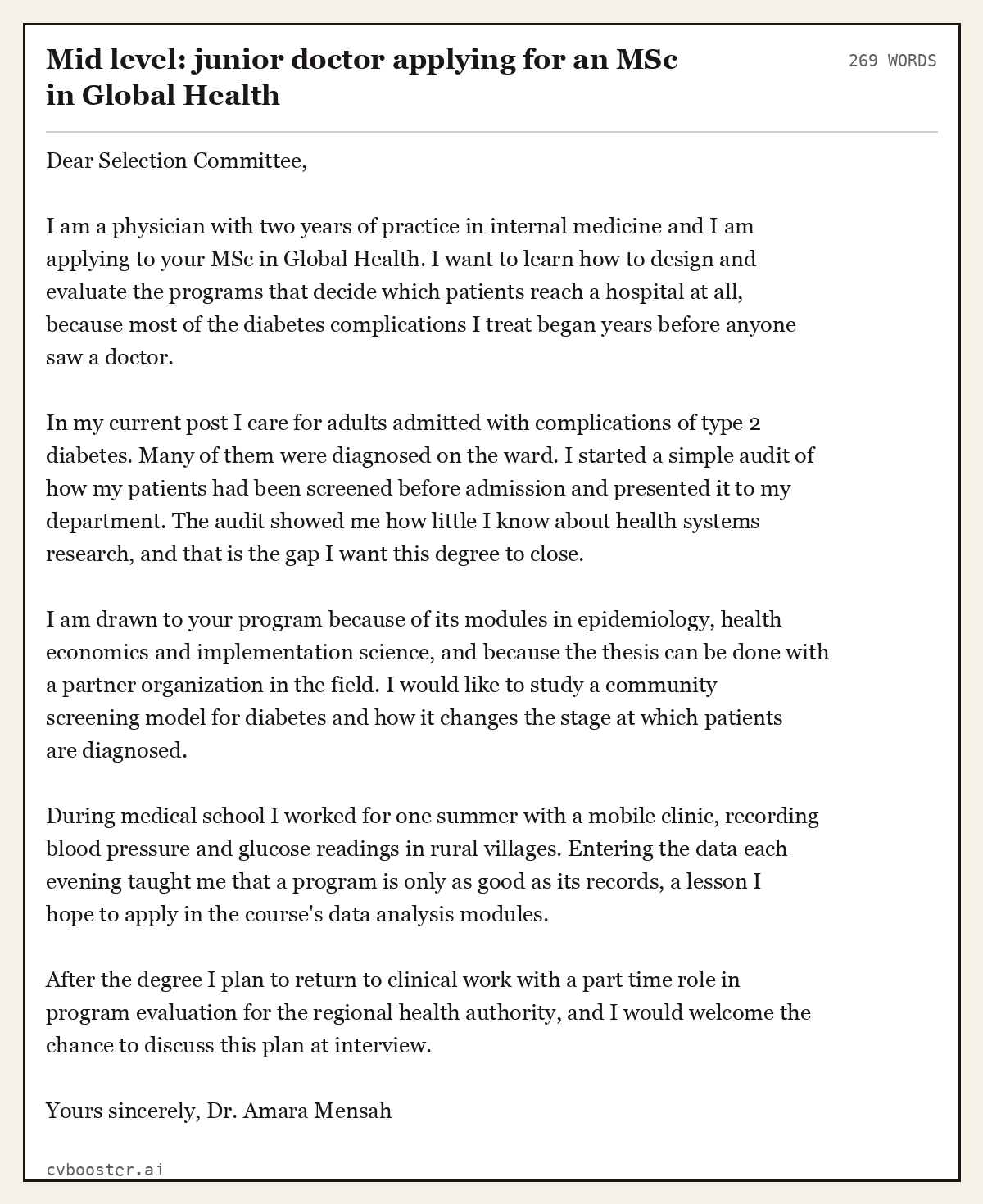
Mid level: junior doctor applying for an MSc in Global Health (269 words)
Dear Selection Committee,
I am a physician with two years of practice in internal medicine and I am applying to your MSc in Global Health. I want to learn how to design and evaluate the programs that decide which patients reach a hospital at all, because most of the diabetes complications I treat began years before anyone saw a doctor.
In my current post I care for adults admitted with complications of type 2 diabetes. Many of them were diagnosed on the ward. I started a simple audit of how my patients had been screened before admission and presented it to my department. The audit showed me how little I know about health systems research, and that is the gap I want this degree to close.
I am drawn to your program because of its modules in epidemiology, health economics and implementation science, and because the thesis can be done with a partner organization in the field. I would like to study a community screening model for diabetes and how it changes the stage at which patients are diagnosed.
During medical school I worked for one summer with a mobile clinic, recording blood pressure and glucose readings in rural villages. Entering the data each evening taught me that a program is only as good as its records, a lesson I hope to apply in the course's data analysis modules.
After the degree I plan to return to clinical work with a part time role in program evaluation for the regional health authority, and I would welcome the chance to discuss this plan at interview.
Yours sincerely, Dr. Amara Mensah
Motivation letter for a clinical observership or elective
International medical graduates and medical students often need a motivation letter for an observership, elective or clinical attachment. The reader is a busy department, so the letter is shorter and practical: dates, goals and what you will not need from them.
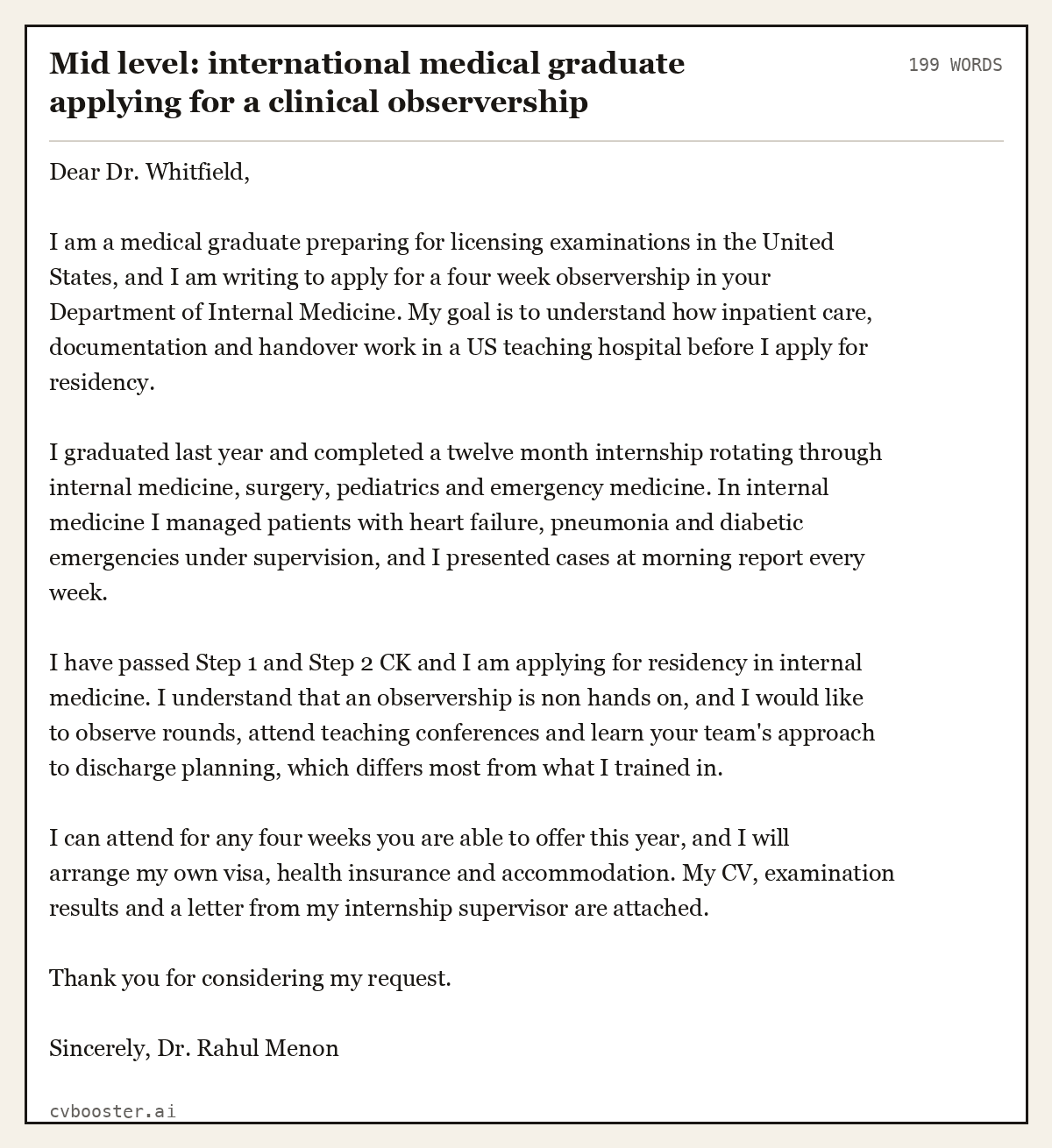
Mid level: international medical graduate applying for a clinical observership (199 words)
Dear Dr. Whitfield,
I am a medical graduate preparing for licensing examinations in the United States, and I am writing to apply for a four week observership in your Department of Internal Medicine. My goal is to understand how inpatient care, documentation and handover work in a US teaching hospital before I apply for residency.
I graduated last year and completed a twelve month internship rotating through internal medicine, surgery, pediatrics and emergency medicine. In internal medicine I managed patients with heart failure, pneumonia and diabetic emergencies under supervision, and I presented cases at morning report every week.
I have passed Step 1 and Step 2 CK and I am applying for residency in internal medicine. I understand that an observership is non hands on, and I would like to observe rounds, attend teaching conferences and learn your team's approach to discharge planning, which differs most from what I trained in.
I can attend for any four weeks you are able to offer this year, and I will arrange my own visa, health insurance and accommodation. My CV, examination results and a letter from my internship supervisor are attached.
Thank you for considering my request.
Sincerely, Dr. Rahul Menon
Motivation letter for residency or specialty training
At the residency and specialty level, motivation is shown through choices you have already made: rotations, research, teaching and what you did when a case went badly.
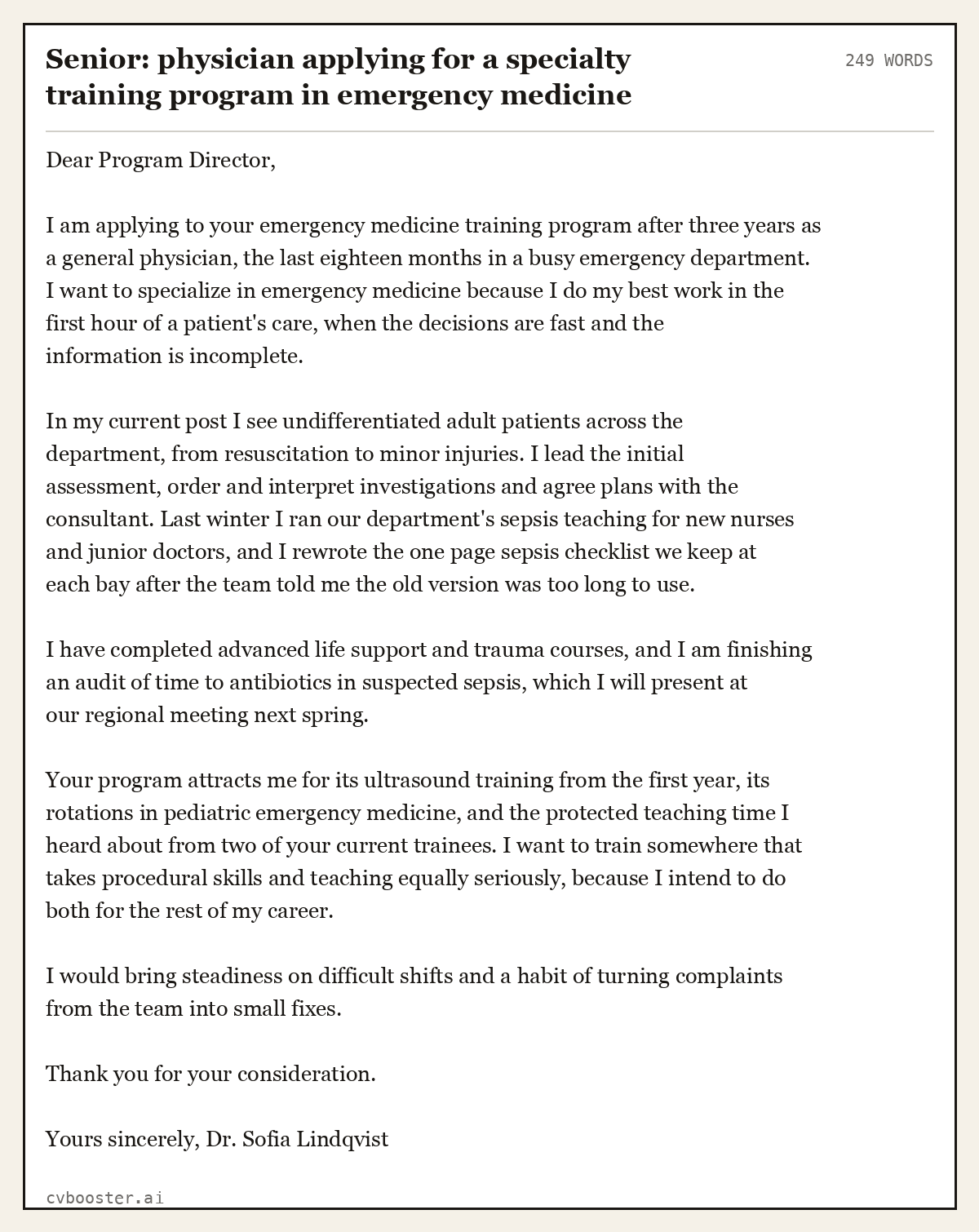
Senior: physician applying for a specialty training program in emergency medicine (249 words)
Dear Program Director,
I am applying to your emergency medicine training program after three years as a general physician, the last eighteen months in a busy emergency department. I want to specialize in emergency medicine because I do my best work in the first hour of a patient's care, when the decisions are fast and the information is incomplete.
In my current post I see undifferentiated adult patients across the department, from resuscitation to minor injuries. I lead the initial assessment, order and interpret investigations and agree plans with the consultant. Last winter I ran our department's sepsis teaching for new nurses and junior doctors, and I rewrote the one page sepsis checklist we keep at each bay after the team told me the old version was too long to use.
I have completed advanced life support and trauma courses, and I am finishing an audit of time to antibiotics in suspected sepsis, which I will present at our regional meeting next spring.
Your program attracts me for its ultrasound training from the first year, its rotations in pediatric emergency medicine, and the protected teaching time I heard about from two of your current trainees. I want to train somewhere that takes procedural skills and teaching equally seriously, because I intend to do both for the rest of my career.
I would bring steadiness on difficult shifts and a habit of turning complaints from the team into small fixes.
Thank you for your consideration.
Yours sincerely, Dr. Sofia Lindqvist
Common mistakes in medical motivation letters
- The childhood calling. One line is enough. The committee is admitting the adult.
- A list of experiences without reflection. The AAMC's tips ask what "personal values" have "influenced your desire to enter the medical profession." Every experience needs a sentence on what it taught you.
- Patient stories that identify the patient. Leave out names, dates and details that someone could recognize.
- A letter that fits every program. Name one feature of the program you checked yourself.
- Ignoring the limit. UCAS, the UK admissions service, tells applicants how to "make the most of the 4,000 characters" in its personal statement guide. Limits are part of the test.
The AAMC's premed competencies are a useful checklist. Service Orientation, for example, "Shows a commitment to something larger than oneself." If your letter shows that through one real experience, it does more than a paragraph of adjectives.
For the job letters that follow a degree, see our medical cover letter examples. Research posts after a PhD use a different letter, covered in the postdoc motivation letter guide, and if a referee is writing for your residency application, share the residency recommendation letter samples. Students building a CV for the same application can start with the medical student resume examples. CVBooster helps with the CV that goes with the letter: you need an account, the free plan lets you fill in your CV by hand and see your ATS score and missing keywords, and the AI writing, templates and the finished file are Pro.
Frequently asked questions
How long should a motivation letter for medical school be?
One page, about 350 to 450 words, unless the program gives a limit. If it gives a character limit, count with spaces and stay under it. The AAMC essay for US medical schools allows 5,300 characters, but many programs abroad that ask for a motivation letter expect a shorter, single page letter.
What should I write in a motivation letter for medicine?
Why you chose medicine, shown through two or three real experiences such as care work, shadowing or research; what each taught you; why you will cope with the training; and why this program. End with one honest sentence about the demands of the career and a polite close.
Is a motivation letter the same as a personal statement for medicine?
They answer the same question, why medicine, but a personal statement usually goes to many schools at once, while a motivation letter is written for one program. That means the motivation letter should name the program, its structure and what you will do there.
How do I start a medical motivation letter?
Start with the program you are applying to and your reason for medicine in the same opening paragraph, based on something you did. "I want to study medicine because two years of care work showed me..." is stronger than a quotation or a childhood memory.
Can I mention a patient in my motivation letter?
Yes, if you remove anything that identifies them: no names, dates, places or rare details. Use the patient to show what you noticed and what you learned, and keep the focus on your reflection rather than on the medical drama of the case.
Related articles
- Application Letter for Student: 5 Full Samples to Copy
- Application Letter Format in Word: UK Layout and 5 Letters
- Cover Letter for Artist Jobs: 6 Samples by Art Career
- Cabin Crew Cover Letter: 6 Examples for Airline Jobs
More articles
- Medical Sample Resume: 6 Examples From Front Desk to Nurse
- Microsoft Word Resume Templates: How to Find & Use Them
- Military Reference Letter: 7 Samples and What to Include
Looking for a worked example for your job title? Browse the resume examples by job title.