Medical Student Resume Examples: the lines they read
Medical Student Resume: A Complete Sample for Residency and Research
By Mustafa Tarabya, founder of CVBooster · Published · Updated
The resume of a medical student written out in full, with clerkship wording, research and leadership sections, and the order residency screeners expect.
Sample resumes for a medical student
The same medical student content laid out in three CVBooster templates, so you can see what the finished document looks like before you write a word.
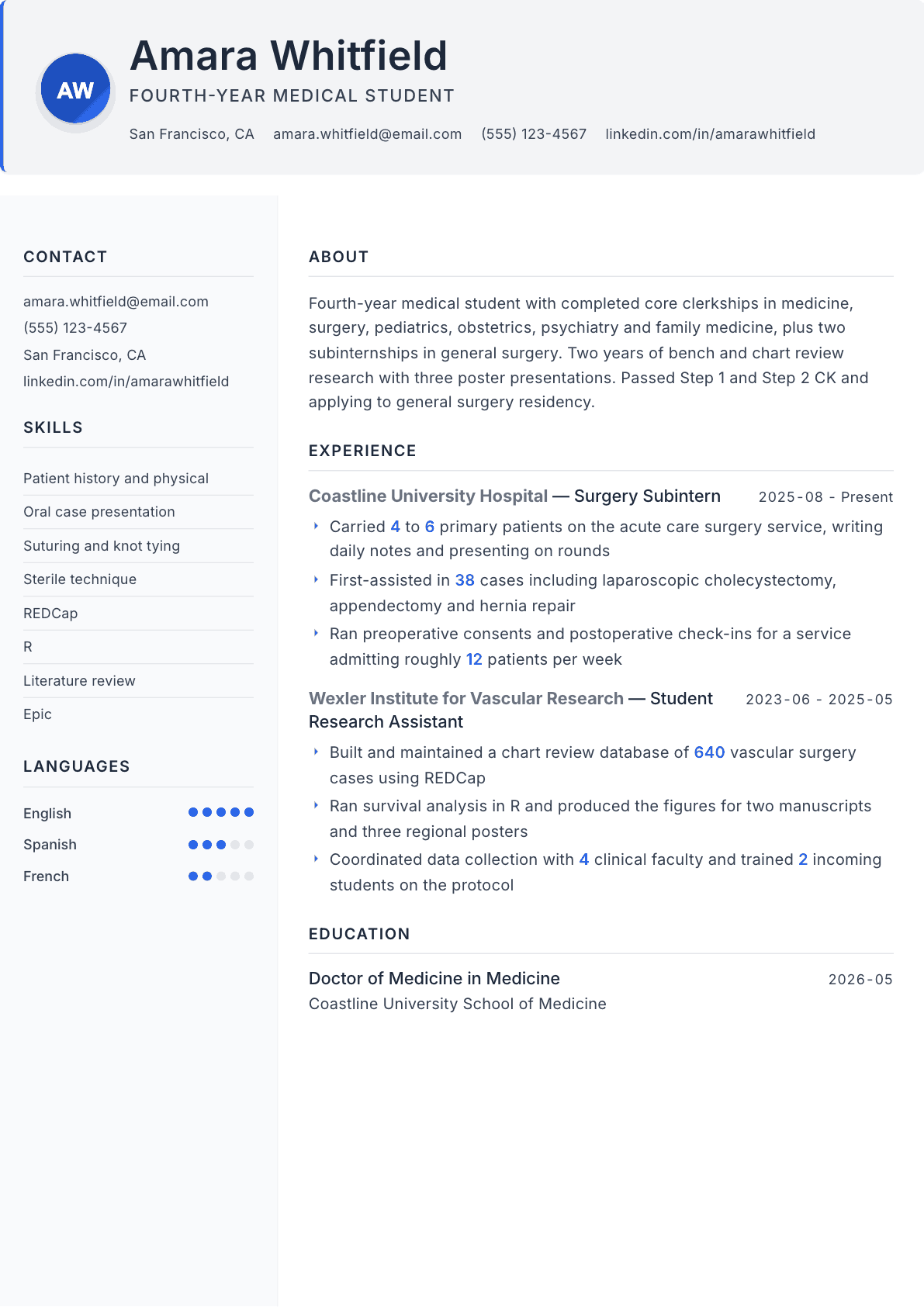
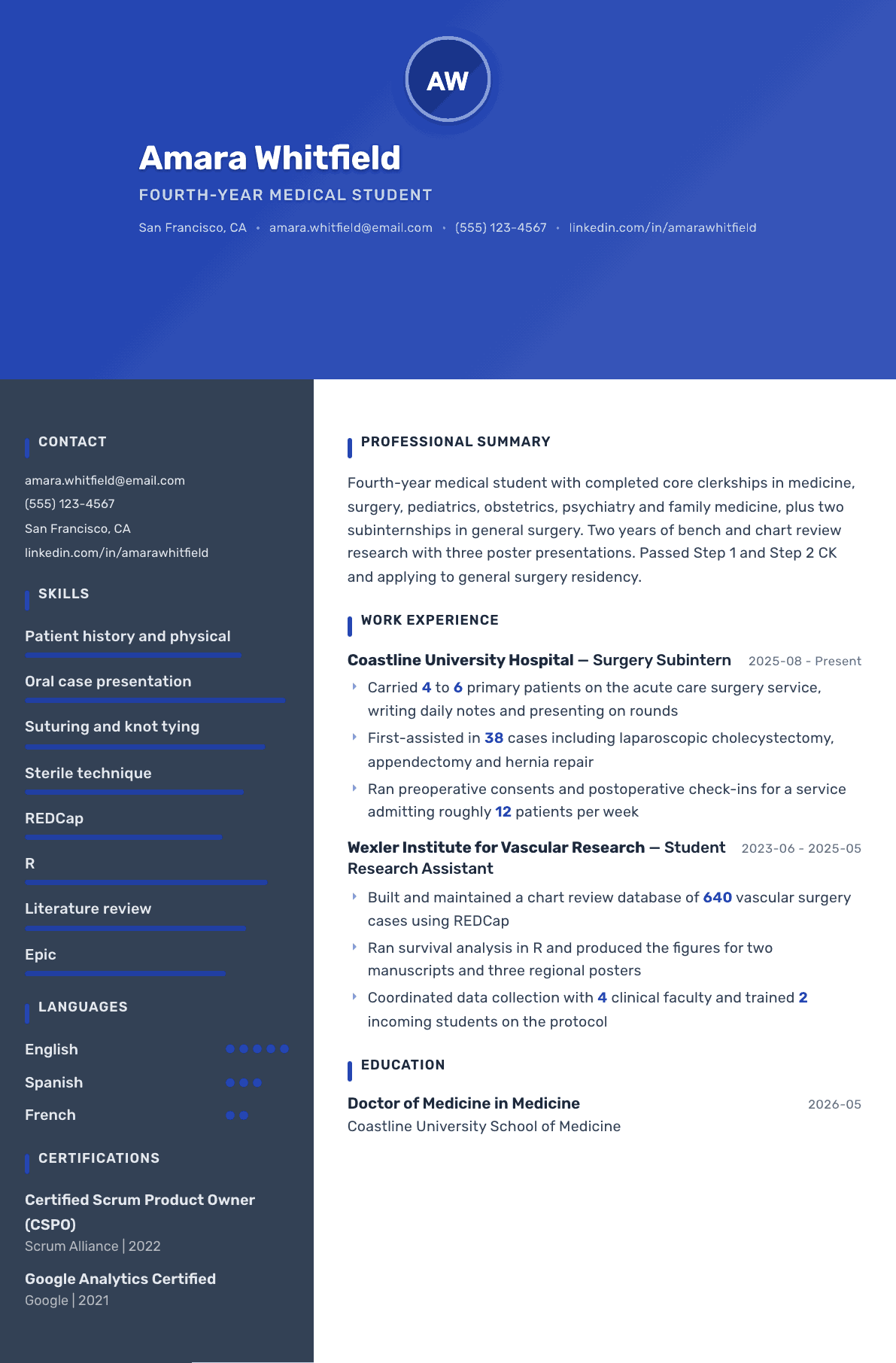
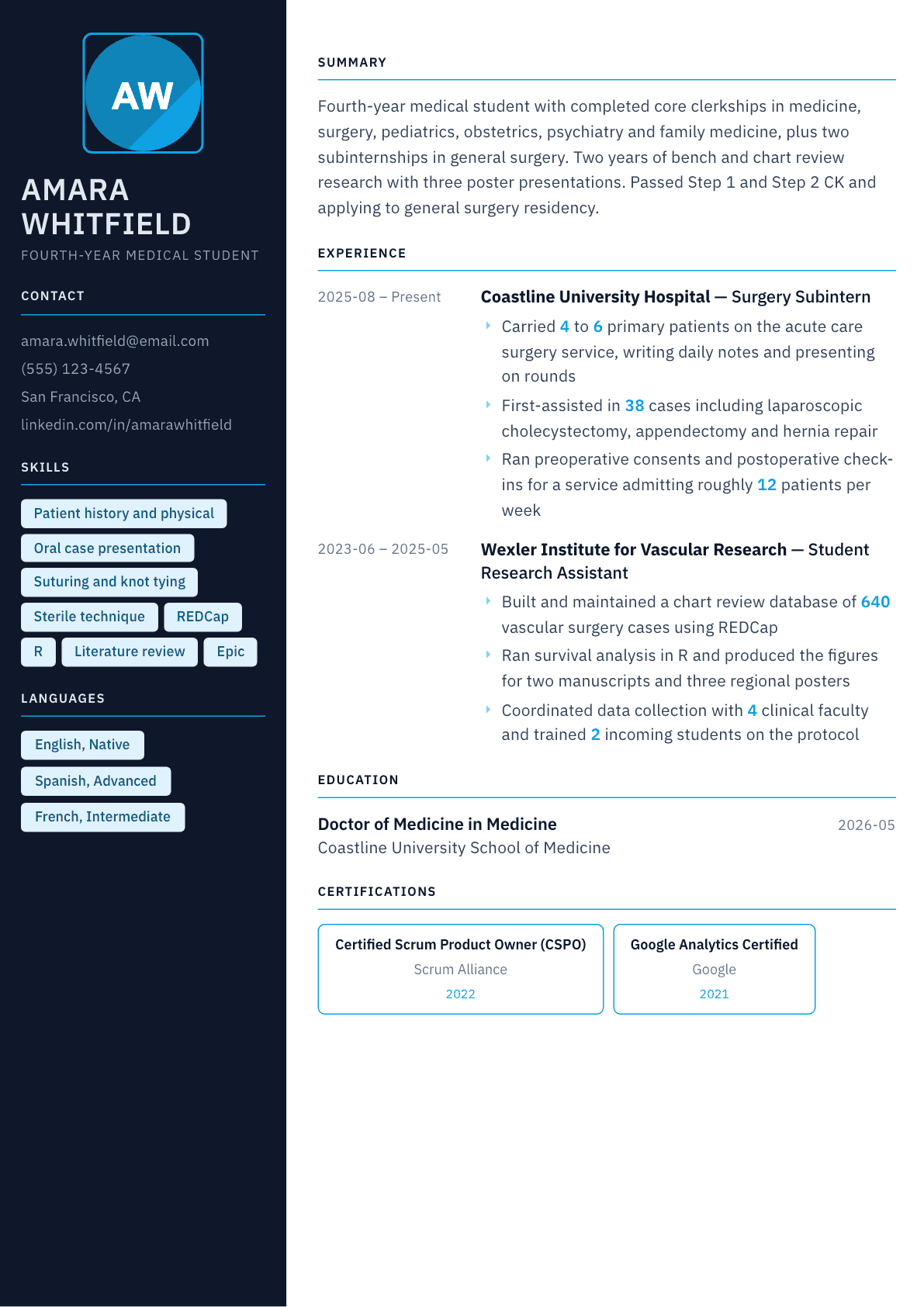
Example Medical Student summary
Fourth-year medical student with all core clerkships complete and two general surgery subinternships at a university hospital. Two years of vascular outcomes research producing three regional posters and one submitted manuscript. Volunteer clinical coordinator at a student-run free clinic serving uninsured patients, and a certified peer tutor in anatomy. Applying to categorical general surgery residency.
Skills to list on a Medical Student resume
- History and physical examination
- Oral case presentation
- Differential diagnosis
- Progress note documentation
- Suturing and knot tying
- Sterile technique
- Basic Life Support
- Epic
- REDCap
- Statistical analysis in R
- Literature review
- Poster presentation
- Peer tutoring
- Free clinic volunteering
What actually gets this resume read
- Put education first with your school, expected graduation date and any degree program such as MD or DO.
- Describe clerkships by service, site and length rather than listing every rotation with no detail attached.
- Give research entries a role, a method and an output such as a poster, abstract or manuscript submission.
- List volunteering and free clinic work with hours and the responsibility you held, not only the organization name.
- Keep leadership and teaching in one section, because residency reviewers score those separately from clinical exposure.
- Use a single citation style for every publication and presentation so the reader can scan the list quickly.
How to write a medical student resume
A medical student resume is judged by people who already know what medical school involves. Nobody is impressed that you took anatomy or that you saw patients on a clerkship, because every applicant did. What a residency reviewer, a research mentor or a summer program director wants is the part that varies: which subinternships you chose, what you produced in the lab, what you ran rather than attended.
The document also has a second life. Away rotations, scholarships, student leadership applications and research positions all ask for it, and each reader weighs the sections differently. Build one strong file with clear headings, then reorder the sections for the specific ask instead of rewriting from scratch.
What follows is a complete sample of the resume of a medical student in the third year, the section order reviewers expect, how to describe clerkships so they carry information, how to present research at every stage of completion, and the questions students ask most while assembling the file.
Format: education first, because you are still a student
Put education at the top with your school, degree program, expected graduation month and any dual degree or research year. Undergraduate education follows on one line. Everything clinical comes next, then research, then teaching, leadership and service.
One page is enough for a preclinical student. Two pages is normal once clerkships, research and leadership have accumulated. Keep it single column with standard headings, since application portals and program coordinators often paste the text into other systems.
- Header: name, degree candidacy, school, expected graduation, email and phone.
- Section order: education, exams, clinical experience, research, teaching, leadership, service, skills.
- Give every entry a month and year range so a reviewer can follow the timeline without asking.
Clinical experience: name the service, the site and what you carried
List core clerkships in a compact block with the specialty, the site and the length. Then give subinternships and electives their own entries with real bullets, because those are the rotations that signal specialty commitment and the ones a program director reads.
A useful subinternship bullet says how many primary patients you carried, what you documented, what you presented and what you assisted with. Writing that you observed procedures adds nothing. Writing that you first-assisted in 38 cases including laparoscopic cholecystectomy and hernia repair gives the reader a picture of your hands.
Longitudinal clinical work such as a student-run free clinic belongs here too, with your role and the responsibility level. A student who ran the intake process for a Saturday clinic has operational experience worth naming.
Research: role, method, output, in that order
Every research entry needs three things: what you personally did, the method or dataset you used, and what came out of it. A student who built a chart review database in REDCap, ran survival analysis in R and produced the figures for two manuscripts has said more in one sentence than a paragraph about assisting a lab.
Keep publications, abstracts and presentations in a separate list from the research positions themselves. Use one citation format, list your name as it appears in the index, and label the stage of anything unpublished so nobody mistakes a submitted draft for a printed paper.
- Position entries: lab or group, mentor, dates, and bullets describing your specific contribution.
- Output list: peer-reviewed articles, then submitted manuscripts, then abstracts, then posters and oral presentations.
- Name the software and statistical method you used, since research mentors screen for it.
Teaching, leadership and service: scope beats titles
A committee title with no description is invisible. Replace it with the size of what you handled: the number of students you tutored, the budget line you managed, the event you organized and how many people came. Reviewers score leadership on responsibility, not on the name of the office.
Service entries should show sustained commitment rather than a list of single-day events. One volunteer role held for two years with growing responsibility reads far better than six brief entries, and it gives an interviewer something to ask about.
Resume of a medical student: a complete third year sample
Here is the resume of a medical student written out in the order above, for an invented third year student applying for an away rotation in internal medicine. Swap in your own school, rotations and output, and keep the order and the level of detail.
- Header: Nadia Farrokh, MD Candidate, Ridgeline School of Medicine, expected graduation May, email and phone.
- Education: MD candidate, Ridgeline School of Medicine. BS in Biochemistry, Calloway University, magna cum laude.
- Exams: Step 1 passed. Basic Life Support and Advanced Cardiac Life Support, current.
- Clinical experience: core clerkships in internal medicine, surgery, pediatrics, obstetrics and gynecology, psychiatry and family medicine at Ridgeline University Hospital. Carried up to four patients on the internal medicine clerkship, wrote daily progress notes and presented on rounds.
- Longitudinal clinic: intake coordinator, student-run free clinic, two years. Trained 20 first year students on intake and scheduled the Saturday volunteer roster.
- Research: student researcher, hospital medicine group. Built a REDCap database for a chart review of 600 heart failure admissions and ran the readmission analysis in R. One abstract presented at a regional meeting, one manuscript submitted.
- Teaching and leadership: anatomy peer tutor for two cohorts, internal medicine interest group treasurer managing the group budget and speaker series.
- Skills and languages: Epic charting, REDCap, R, venipuncture and IV placement, Spanish at a professional working level.
Exams, skills and languages: short, factual, at the bottom
Keep a compact block for exam status, certifications such as Basic Life Support, technical skills and languages with a stated proficiency level. Note passing status for the licensing steps your school requires and leave numeric scores off unless a specific application asks for them.
Skills for a medical student means procedures you have actually performed, the electronic record you have charted in, and research tools you can use unaided. Personal traits belong in a letter, not in a skills list where they cannot be checked.
Medical Student resume summary examples
Second-year student
Second-year medical student with preclinical coursework complete and a longitudinal preceptorship in family medicine. Research assistant on a vascular outcomes chart review, trained in REDCap and basic survival analysis. Peer tutor in anatomy for 12 first-year students and volunteer intake coordinator at a student-run free clinic.
Third-year student
Third-year medical student with core clerkships in medicine, surgery, pediatrics, obstetrics and psychiatry complete at a university teaching hospital. Presented two regional posters on vascular surgery outcomes and passed Step 1. Elected class curriculum representative, and applying for a surgical subinternship at an outside institution.
Fourth-year applicant
Fourth-year medical student with two general surgery subinternships, 38 cases first-assisted, and all core clerkships honored or high pass. First author on one submitted manuscript and three regional posters from a 640-case chart review. Applying to categorical general surgery residency with an interest in vascular practice.
Work experience bullets: before and after
Before: Completed a surgery rotation at a university hospital.
After: Carried four to six primary patients on the acute care surgery service, wrote daily progress notes, presented on morning rounds and first-assisted in 38 operative cases.
The patient load, documentation duty and case count replace a rotation label with evidence of what you did.
Before: Worked in a research lab for two years.
After: Built and maintained a 640-case vascular surgery chart review database in REDCap, ran survival analysis in R, and produced the figures for two manuscripts and three regional posters.
A dataset size, a named tool and concrete outputs show independent contribution rather than lab attendance.
Before: Volunteered at a free clinic.
After: Coordinated Saturday intake at a student-run free clinic serving uninsured patients, scheduling roughly 25 visits per session and training six new student volunteers on the registration workflow.
Volume plus a training responsibility turns volunteering into an operational role a reviewer can weigh.
Before: Tutored classmates in anatomy.
After: Led a weekly anatomy review session for 12 first-year students across one semester and wrote a practical exam question bank now used by the course.
The audience size, cadence and a lasting resource make teaching measurable instead of anecdotal.
Before: Member of the student curriculum committee.
After: Elected class representative to the curriculum committee, collected feedback from 160 classmates each block and presented two proposals that changed the preclinical exam schedule.
Naming the constituency and the outcome shows influence, where a membership line shows only presence.
Hard skills
- History and physical examination
- Oral case presentation
- Differential diagnosis
- Progress and admission note documentation
- Suturing and knot tying
- Sterile technique
- Venipuncture
- Epic
- REDCap
- Statistical analysis in R
- Systematic literature review
- Poster and abstract preparation
Soft skills
- Receiving feedback on rounds
- Working across rotating teams
- Patient communication
- Time management across blocks
- Peer teaching
- Professional written correspondence
Certifications worth listing
- Basic Life Support (BLS) (American Heart Association)
- Advanced Cardiovascular Life Support (ACLS) (American Heart Association)
- Human Subjects Research Certification (CITI Program) (CITI Program)
Mistakes that cost medical student candidates the interview
- Listing every core clerkship with a full bullet set, which buries the subinternships and electives that actually signal your specialty.
- Describing research as assisted with a project instead of naming the dataset, the method and what was produced.
- Padding the leadership section with titles that carry no described responsibility or scope.
- Reporting licensing exam scores when no application asked for them, which invites comparison you cannot control.
- Writing shadowing hours as clinical experience, when reviewers read shadowing as observation and count it separately.
- Using a designed two-column layout that a program coordinator cannot copy cleanly into an application system.
- Leaving the expected graduation date off the education block, which forces the reader to guess your training stage.
Medical Student resume questions
How long should a medical student resume be?
One page through the preclinical years and two pages once clerkships, research and leadership accumulate. Length is never the problem by itself. A second page earns its place only when every entry carries a described role and an outcome.
Should I list shadowing on a medical student resume?
List it in its own short block with hours and specialty if you are early in training, and drop it once you have clerkship and subinternship experience. Reviewers treat shadowing as observation, so it never belongs under clinical experience.
How do I show research when nothing is published?
Separate the position from the output. Describe your contribution under the lab entry, then list abstracts, posters and submitted manuscripts with their exact status. Honest labeling of an active pipeline reads far better than an inflated publication list.
What should the resume of a medical student include?
Education with expected graduation, exam status, clinical experience by rotation, research with your role and output, teaching and leadership with scope, and a short skills and languages block. Keep skills factual: procedures performed, the record you charted in and research software, never personal traits.
How should I reorder the resume for a research application?
Move the research positions and the publication list directly under education, and compress core clerkships into a single block. A principal investigator is reading for method, dataset and output first, and for clinical exposure only as background.