Strength Based Interviewing: Questions and 7 Sample Answers
By Mustafa Tarabya, founder of CVBooster · Published · Updated
10 min read
Strength based interviewing asks what you enjoy, what you do well and what you do often, instead of asking you to prove you have done the job before. The questions are short and fast ("What energises you at work?", "Do you prefer starting tasks or finishing them?"), and the interviewer listens to how you answer as much as to what you say. The one constraint is that a rehearsed answer scores worse than an honest one, so preparation means knowing yourself, not memorising a script. The definitions below are quoted from the UK Civil Service Success Profiles, and the page has seven full sample answers. Written by Mustafa Tarabya, who hired for his own company, read every application himself and now writes CVBooster's guides.
You prepared four competency stories with a situation, a task, an action and a result. Then the first question was "What did you enjoy most as a child?" Nobody prepared a STAR answer for that, which is exactly the point.
How strength based interviewing works
The Civil Service Strengths page defines a strength in one line: "Strengths are the things that we do regularly, do well and that motivate us." It then names three tests for whether something counts: "Performance - you can perform an activity/behaviour to a high level of capability", "Engagement - you feel motivated, enthused and empowered when doing the activity" and "Use - you do the activity regularly and as often as possible."
That third test is the one candidates forget. A skill you are good at but avoid is not a strength in this format. The interviewer is trying to find work you will still want to do in month eighteen, not work you can survive in week one.
Here is what a typical opening question and a good answer sound like.
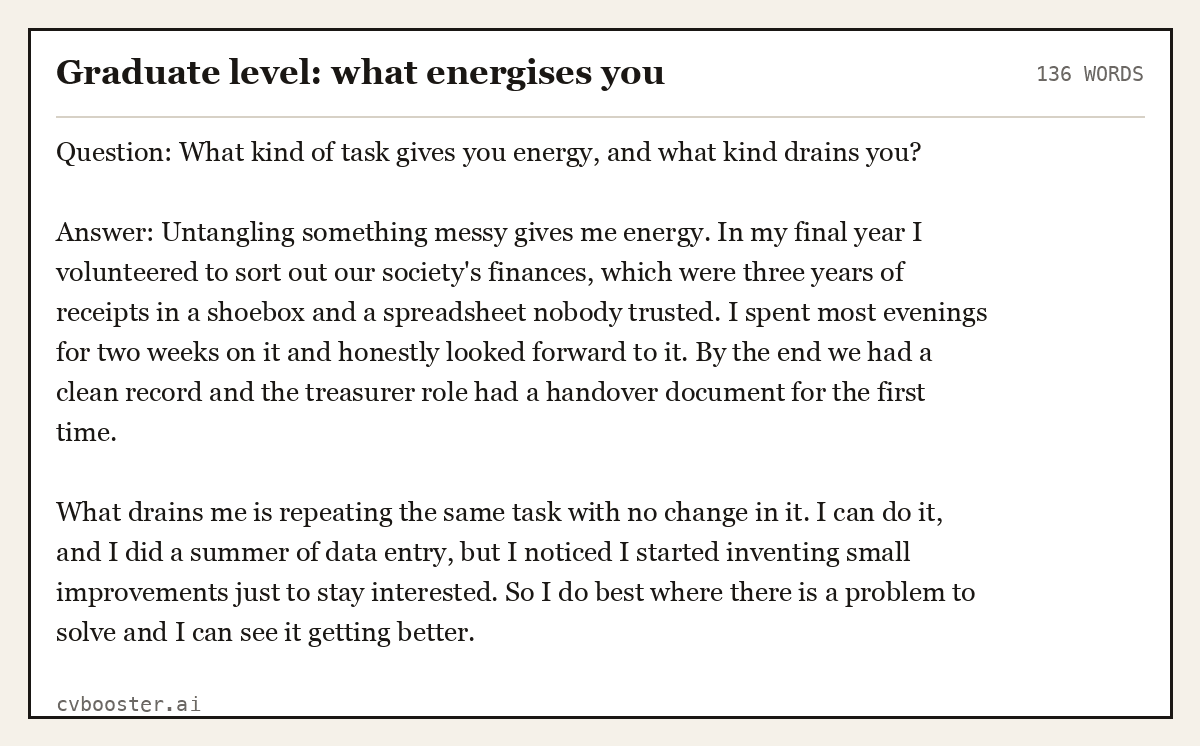
Graduate level: what energises you (136 words)
Question: What kind of task gives you energy, and what kind drains you?
Answer: Untangling something messy gives me energy. In my final year I volunteered to sort out our society's finances, which were three years of receipts in a shoebox and a spreadsheet nobody trusted. I spent most evenings for two weeks on it and honestly looked forward to it. By the end we had a clean record and the treasurer role had a handover document for the first time.
What drains me is repeating the same task with no change in it. I can do it, and I did a summer of data entry, but I noticed I started inventing small improvements just to stay interested. So I do best where there is a problem to solve and I can see it getting better.
How a strengths interview is scored
The interviewer has a short list of strengths the role needs, taken from the job advert. The Civil Service Strengths page lists 36 named strengths, from Adaptable to Visionary, and the candidate overview is clear that "you will never be expected to demonstrate them all for one job."
They listen for three things in each answer:
- Energy. Your pace, your detail and whether you sound like you enjoyed it. This is why strength questions often follow each other quickly.
- Evidence of use. A real example from your life, any part of it, not only paid work.
- Fit. Whether the thing you love doing is what the job needs most days.
The Civil Service guidance says it directly: "Do not rehearse your answers - because we are looking for your initial response." That does not mean walking in cold. It means arriving with a clear picture of your own strengths so that your first instinct is a true and specific answer.
Strength based interview questions about how you work
These questions test the "use" part of a strength: how you naturally go about things when nobody is directing you.
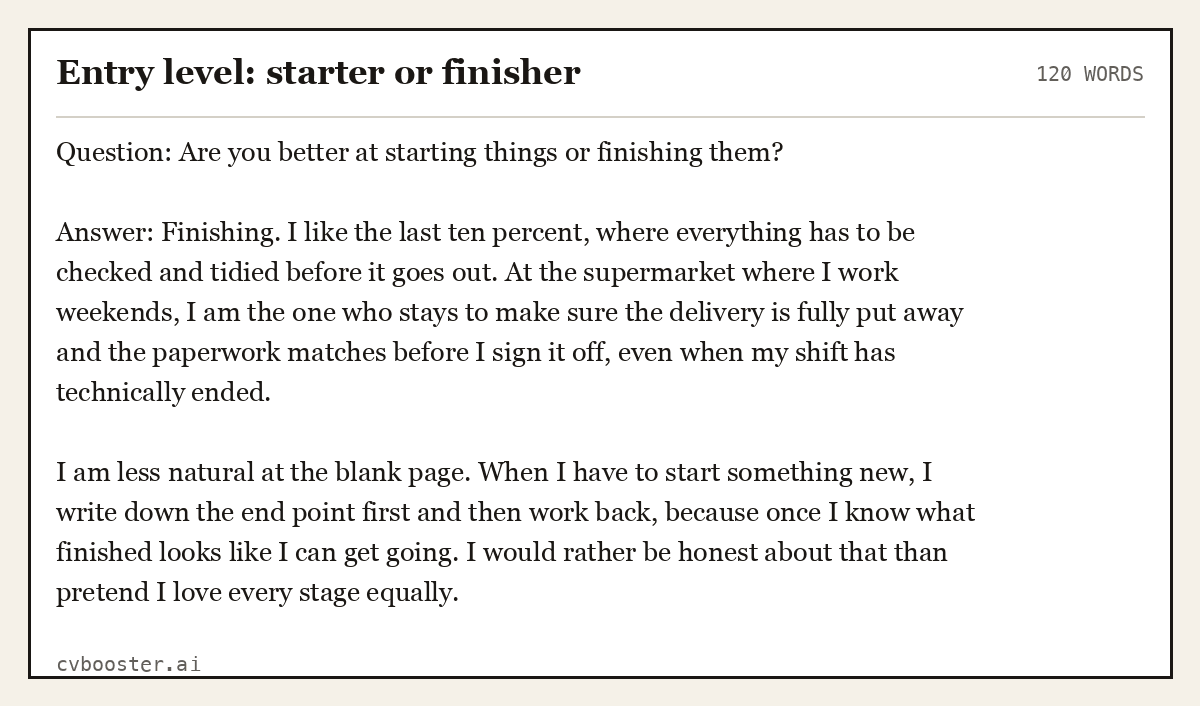
Entry level: starter or finisher (120 words)
Question: Are you better at starting things or finishing them?
Answer: Finishing. I like the last ten percent, where everything has to be checked and tidied before it goes out. At the supermarket where I work weekends, I am the one who stays to make sure the delivery is fully put away and the paperwork matches before I sign it off, even when my shift has technically ended.
I am less natural at the blank page. When I have to start something new, I write down the end point first and then work back, because once I know what finished looks like I can get going. I would rather be honest about that than pretend I love every stage equally.
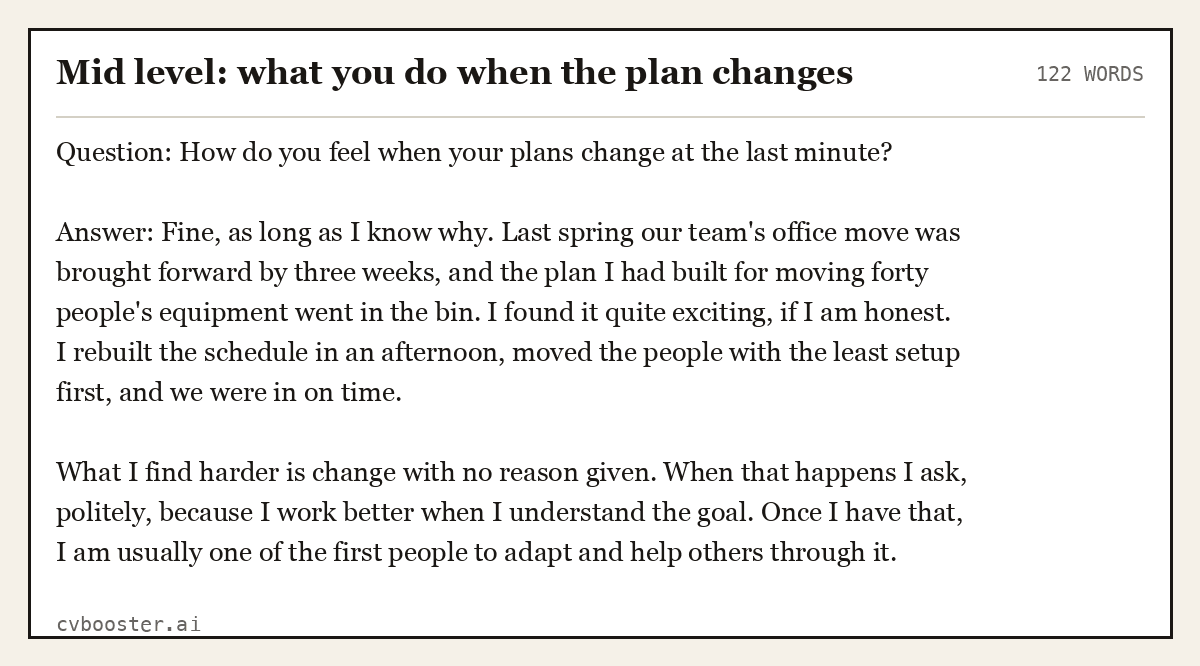
Mid level: what you do when the plan changes (122 words)
Question: How do you feel when your plans change at the last minute?
Answer: Fine, as long as I know why. Last spring our team's office move was brought forward by three weeks, and the plan I had built for moving forty people's equipment went in the bin. I found it quite exciting, if I am honest. I rebuilt the schedule in an afternoon, moved the people with the least setup first, and we were in on time.
What I find harder is change with no reason given. When that happens I ask, politely, because I work better when I understand the goal. Once I have that, I am usually one of the first people to adapt and help others through it.
Strength based interview questions about people
Most strength based interviewing includes questions about how you work with others, because the role nearly always needs a particular mix: the person who calms things down, the person who pushes, the person who explains.
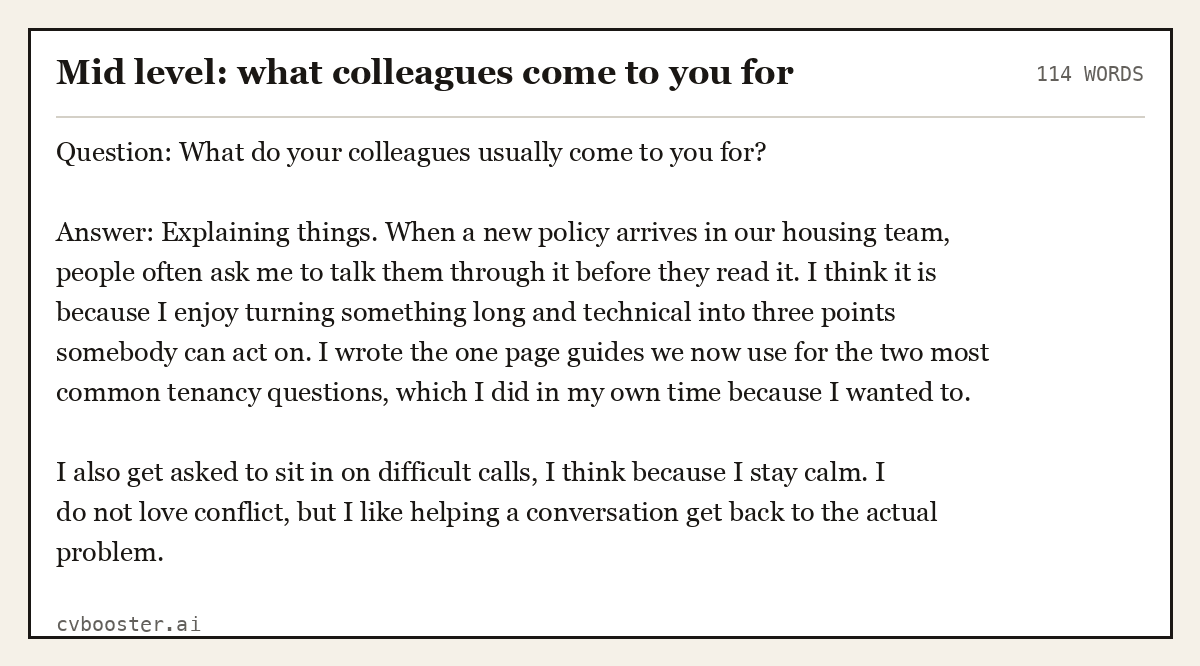
Mid level: what colleagues come to you for (114 words)
Question: What do your colleagues usually come to you for?
Answer: Explaining things. When a new policy arrives in our housing team, people often ask me to talk them through it before they read it. I think it is because I enjoy turning something long and technical into three points somebody can act on. I wrote the one page guides we now use for the two most common tenancy questions, which I did in my own time because I wanted to.
I also get asked to sit in on difficult calls, I think because I stay calm. I do not love conflict, but I like helping a conversation get back to the actual problem.
The Civil Service definition of the strength in that answer is: "You communicate thoughts and ideas, verbally or in writing. You simplify complexities and adapt communication so others can understand." The candidate never used the word "Explainer", and did not need to.
Strength based interview questions for managers
Manager level questions focus on what motivates you about leading, because someone who leads out of duty and someone who leads because they enjoy developing people make different managers.
Senior level: what you enjoy about managing (140 words)
Question: What part of managing people do you enjoy most?
Answer: Watching someone do something they did not think they could. Two years ago I had a team member who was excellent with customers but refused to present at our monthly review. I did not push her into it. I asked her to co-present one slide with me, then two, then to take the section on customer feedback alone.
Last quarter she led the whole review. That moment is the best part of my job, and I find myself looking for the next person who is ready for that step.
The part I enjoy less is the admin around it. I am disciplined about it, because it matters to people when their reviews are on time, but I am honest that it is not what gets me out of bed.
Senior level: a time you did something you love (123 words)
Question: Tell me about the last time you lost track of time at work.
Answer: It was building our team's first proper workload model. We had always allocated cases by gut feeling and some people were carrying twice the load of others. I pulled six months of case data into a spreadsheet one Friday afternoon, meaning to spend an hour, and looked up at eight in the evening.
I enjoy that kind of work because I can see the unfairness disappear as the numbers get clearer. We now allocate cases using that model, and sickness in the team has dropped since. I think I am at my best when I can use evidence to make things fairer for the people doing the work.
How to prepare without rehearsing
The National Careers Service explains what the format is for: "A potential employer may not be expecting you to have done the job before, but they'll be looking for relevant experience or strengths." So preparation is about finding the evidence in your own life.
- List ten moments you enjoyed. At work, study, volunteering or home. Next to each, write what you were actually doing: organising, fixing, persuading, explaining.
- Find the pattern. Three or four verbs will repeat. Those are your strengths.
- Match them to the advert. Prospects suggests you "Pick three or four attributes desired by the employer in the person specification", and adds that "you must be able to evidence them with examples."
- Know what drains you. You will almost certainly be asked. An honest answer that is not central to the job is the safest one.
- Keep one example per strength. Short, specific and true.
If the same interview also has behaviour questions, the competency based interview questions guide and the STAR interview questions page show the structured format those need. For Civil Service roles specifically, the Civil Service strengths examples page works through the named strengths one by one.
Mistakes that cost marks in a strengths interview
- Answering what you think they want. If you say you love detailed checking and your face says otherwise, the interviewer notices.
- Turning every answer into a STAR story. Strength questions want a quick, honest reaction first; a short example can follow.
- Choosing a weakness that is the job. Telling a call centre panel that phone work drains you ends the conversation. The weaknesses for job interviews guide shows how to pick one honestly.
- Only using work examples. Strengths show up everywhere. Running a five a side team or organising a family move is fair evidence.
- Saying "I enjoy everything". Nobody does, and it tells the interviewer nothing about fit.
A strength answer for a career changer
Career changer: moving from retail to an office role (112 words)
Question: What would your friends say you are best at?
Answer: Organising people. I am the one who plans the group holiday, sorts the dates and makes sure everyone has paid. At work it is the same: in eight years in retail I became the person who built the rota, because I genuinely enjoy fitting people's needs together like a puzzle.
That is a big part of why I am applying for this coordinator role. The job advert talks about scheduling across three teams, and that is the part of my week I already look forward to most. I would like to do it every day, not just on a Tuesday afternoon.
Frequently asked questions
What is strength based interviewing?
Strength based interviewing is an interview style that asks what you enjoy, what you do well and what you do often. Instead of asking you to prove past performance with a detailed story, it uses quick questions about your preferences and energy. Employers use it to find people who will be motivated by the work the role involves most days.
What is the difference between a strengths and a competency interview?
A competency interview asks you to describe a past situation in detail, usually in STAR form, to prove you can do something. A strengths interview asks what you enjoy and do naturally, and listens for energy as well as evidence. Many employers, including the Civil Service, combine both in one interview, so prepare for each.
How do I prepare for a strength based interview?
List moments you enjoyed at work, study or home, and note what you were doing in each. Find the three or four activities that repeat, match them to the job advert, and keep one short, true example for each. Also decide what drains you, because that question is common. Do not script word for word answers.
What are common strength based interview questions?
Common questions include what energises you, what drains you, whether you prefer starting or finishing tasks, what colleagues come to you for, when you last lost track of time, and what you would do with a free day at work. Questions often come quickly, one after another, so the interviewer hears your first, honest reaction.
Can you fail a strength based interview?
You can be unsuccessful, but not because of a wrong answer. The Civil Service guidance says there are no right or wrong answers. You score lower when your strengths do not match what the role needs, or when your answers sound rehearsed or vague. Honest, specific answers give the panel the clearest picture of fit.
Related articles
- Accountancy CV Example: 6 UK Accounts CVs by Career Level
- Accounting Interview Questions and Answers: 7 Full Examples
- Activity Resume Example: 6 Samples for College Applications
- Administration CV Example: 6 Admin CVs from Entry to Senior
More articles
- Application Letter for Supervisor Position: 6 Examples
- Supervisor Resume Examples: 6 Samples From First Shift Lead
- Cover Letter for a Support Worker: 6 UK Examples That Work
Looking for a worked example for your job title? Browse the resume examples by job title.