Civil Service Strengths Examples: 10 Worked Answers
By Mustafa Tarabya, founder of CVBooster · Published · Updated
11 min read
Civil service strengths examples are short, fast and unrehearsed, which is the opposite of a behaviour statement. That is the constraint: a strength answer that sounds prepared scores worse than one that sounds true, because the panel is marking what you actually enjoy and do often. The thirty-six strengths and their definitions are published on the Success Profiles strengths page on gov.uk, and the same dictionary appears in the National Crime Agency publications library. Ten worked answers follow, each one built on a named strength with its gov.uk definition quoted above it. Written by Mustafa Tarabya, who hired for his own company, read every application himself and now writes CVBooster's guides. Updated September 2026.
What a strength is, in gov.uk's own words
gov.uk defines strengths as "the things that we do regularly, do well and that motivate us" and adds that "Civil Service strengths are not defined by job grade". A junior officer and a Grade 7 can be marked on the same strength. Strengths are one of the five elements in Success Profiles.
Three tests decide whether something counts. gov.uk lists them:
- Performance - "you can perform an activity/behaviour to a high level of capability"
- Engagement - "you feel motivated, enthused and empowered when doing the activity"
- Use - "you do the activity regularly and as often as possible"
Most candidates can pass the first test. The answers that score pass all three, and they show it by naming something recent and ordinary.
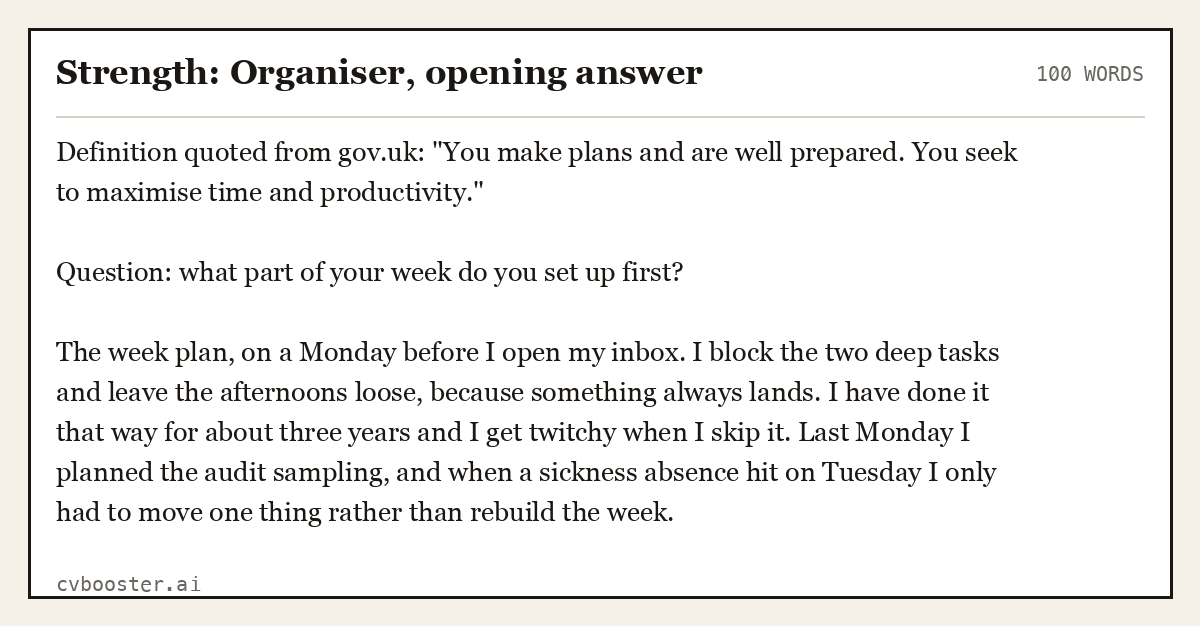
Strength: Organiser, opening answer (100 words)
Definition quoted from gov.uk: "You make plans and are well prepared. You seek to maximise time and productivity."
Question: what part of your week do you set up first?
The week plan, on a Monday before I open my inbox. I block the two deep tasks and leave the afternoons loose, because something always lands. I have done it that way for about three years and I get twitchy when I skip it. Last Monday I planned the audit sampling, and when a sickness absence hit on Tuesday I only had to move one thing rather than rebuild the week.
How strengths are scored
Strengths are not marked on structure. gov.uk is explicit: "It is important to remember that there are no right or wrong answers to these questions" and "Do not rehearse your answers - because we are looking for your initial response."
What the panel is reading is energy and authenticity. In practice that means three things:
- Speed of response. A pause of ten seconds before you say what you enjoy reads as a manufactured answer.
- Specificity of the everyday. "Last Thursday" beats "in my current role".
- Consistency with the rest of the interview. If you claim Precise and your behaviour example has no checking step in it, the two answers cancel out.
The assessments and interviews guidance puts it the same way: strengths questions "help the interview panel assess your strengths and preferred style of working". gov.uk also lists how strengths can be assessed: "interviews", "recorded video interviews", "bespoke situational strengths test", "simulation assessment" and "personality test". So the strength element may never appear as a question at all. It may arrive as a test before you reach the panel.
Reasonable adjustments apply to all of these. gov.uk tells candidates to "tell us when you submit your application that you need an adjustment and how it will help".
Ten worked strength answers
Each answer is 60 to 100 words, because that is about how long a genuine one runs when spoken. The definition above each block is quoted from the gov.uk strengths dictionary.
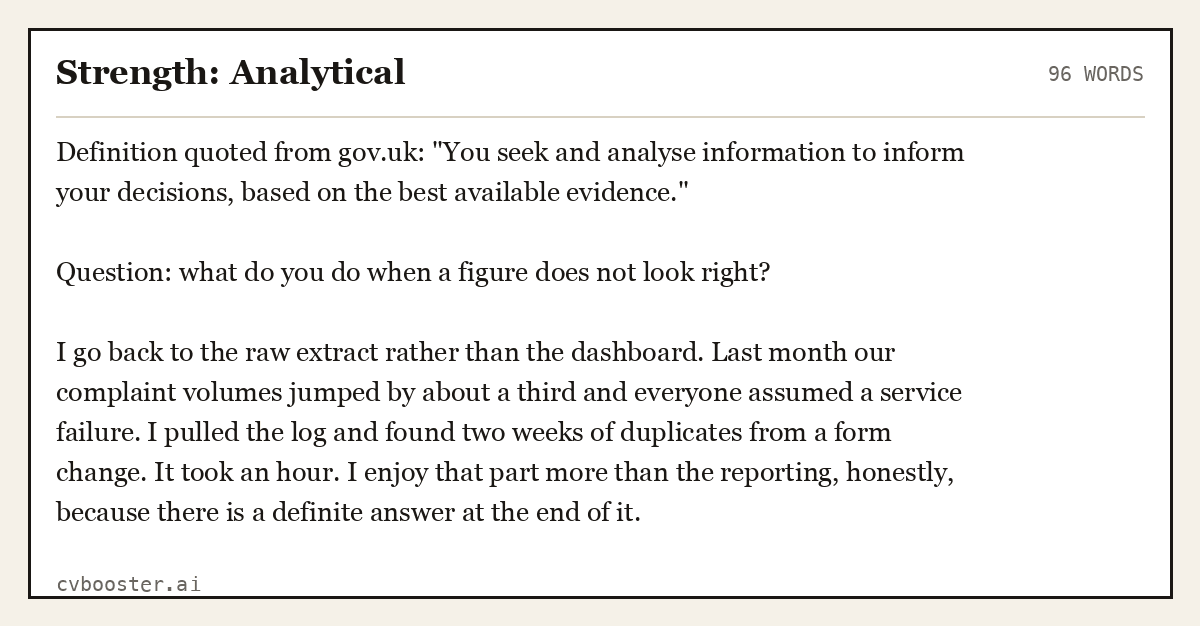
Strength: Analytical (96 words)
Definition quoted from gov.uk: "You seek and analyse information to inform your decisions, based on the best available evidence."
Question: what do you do when a figure does not look right?
I go back to the raw extract rather than the dashboard. Last month our complaint volumes jumped by about a third and everyone assumed a service failure. I pulled the log and found two weeks of duplicates from a form change. It took an hour. I enjoy that part more than the reporting, honestly, because there is a definite answer at the end of it.
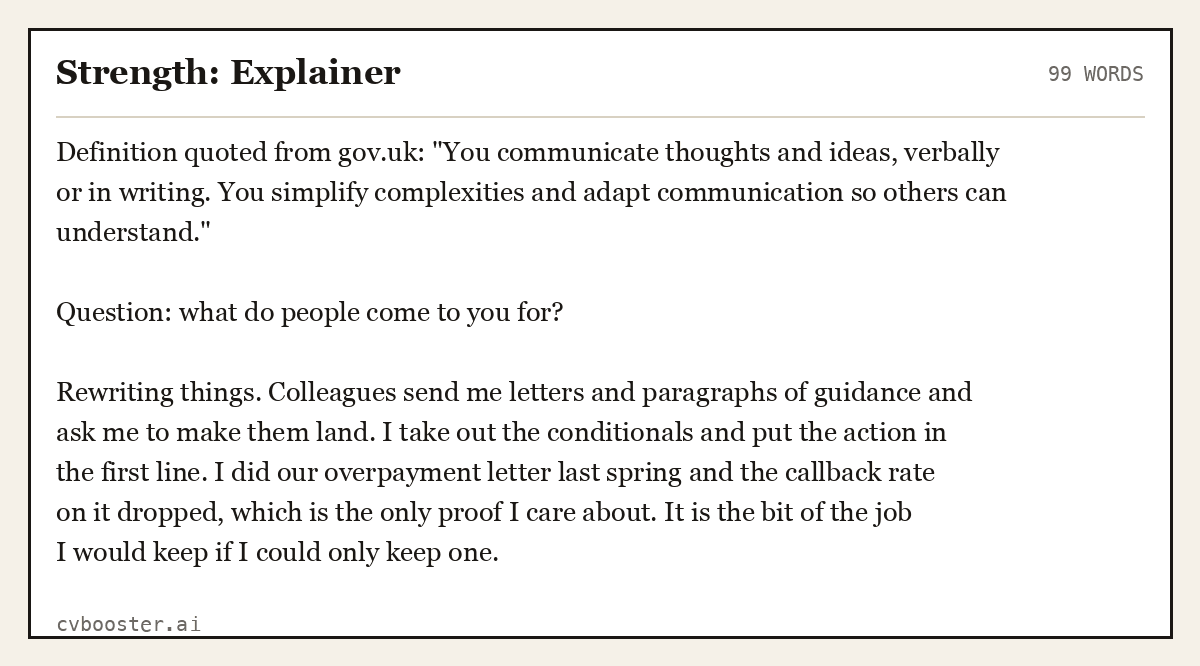
Strength: Explainer (99 words)
Definition quoted from gov.uk: "You communicate thoughts and ideas, verbally or in writing. You simplify complexities and adapt communication so others can understand."
Question: what do people come to you for?
Rewriting things. Colleagues send me letters and paragraphs of guidance and ask me to make them land. I take out the conditionals and put the action in the first line. I did our overpayment letter last spring and the callback rate on it dropped, which is the only proof I care about. It is the bit of the job I would keep if I could only keep one.
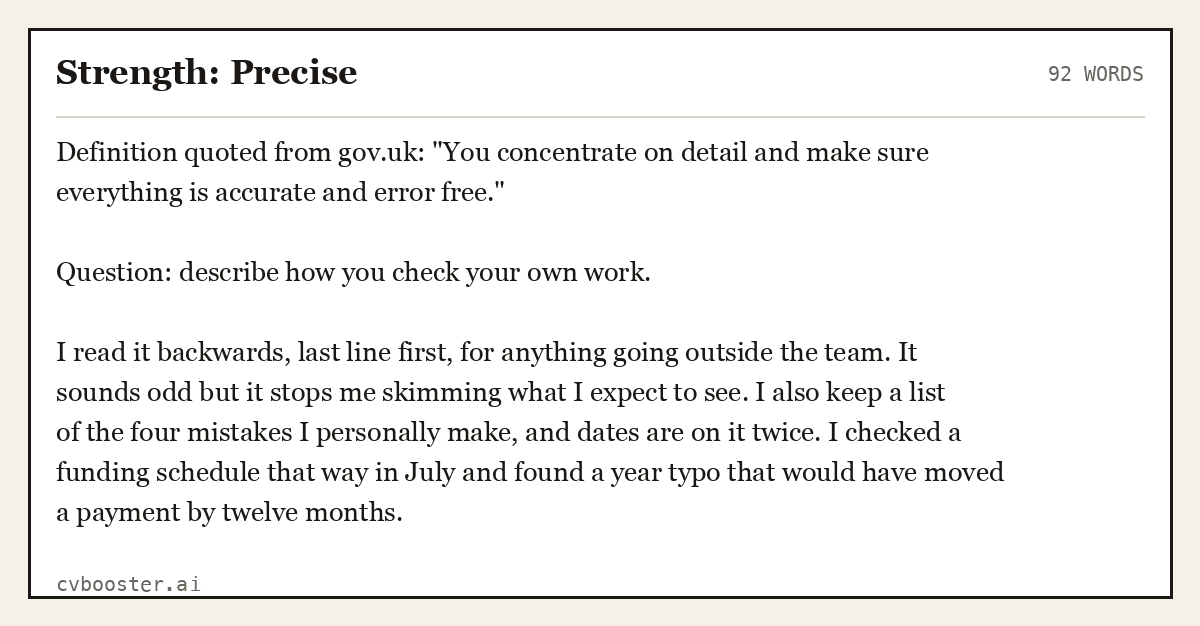
Strength: Precise (92 words)
Definition quoted from gov.uk: "You concentrate on detail and make sure everything is accurate and error free."
Question: describe how you check your own work.
I read it backwards, last line first, for anything going outside the team. It sounds odd but it stops me skimming what I expect to see. I also keep a list of the four mistakes I personally make, and dates are on it twice. I checked a funding schedule that way in July and found a year typo that would have moved a payment by twelve months.
Strength: Preventer (95 words)
Definition quoted from gov.uk: "You think ahead to anticipate, identify and address risks or problems before they happen."
Question: what worries you about the week ahead?
The single points of failure. There is one person in our team who knows the reconciliation, and she is on leave in October. I have already asked to sit with her twice before then and I am writing the steps down as she talks. I am not naturally a firefighter. I get much more satisfaction from the fire that did not start, even though nobody thanks you for it.
Strength: Relationship builder (94 words)
Definition quoted from gov.uk: "You quickly establish mutual respect and trust, building long lasting relationships with others."
Question: who outside your team would vouch for you?
The two caseworkers in the appeals unit. We used to email each other formally and get nowhere, so I started phoning instead, and now they tell me about a problem file before it reaches us. It costs me about twenty minutes a week. I like the work better when I know who is at the other end of it, and the queue moves faster as a side effect.
Strength: Adaptable (102 words)
Definition quoted from gov.uk: "You can adapt to variations in work or environment. Your effectiveness is not affected by change. You are flexible and versatile. You act as an advocate for change."
Question: how did you find the last system change?
Fine, genuinely. We moved case management platforms in March and I volunteered for the first cohort, partly because being early means you get the trainers' attention. I was slower for a fortnight and then faster than before. I do not enjoy change for its own sake, but I would rather be in the first group than the last one being dragged.
Strength: Resilient (91 words)
Definition quoted from gov.uk: "You have inner composure, recover quickly from setbacks and learn from them."
Question: tell us about a knock back and what you did next.
I missed out on a promotion board in 2025 and it stung for about a week. I asked for the feedback, which said my examples were all from one year. So I went and got different ones, deliberately, by asking for the audit liaison job nobody wanted. I do not pretend it did not bother me. I just do not stay there long.
Strength: Service focused (95 words)
Definition quoted from gov.uk: "You look for ways to serve customers putting their needs at the heart of everything you do."
Question: what do you do that is not in your job description?
I listen to two recorded calls a week. Nobody asks me to. It is the only way I hear what the guidance sounds like from the other side, and twice it has made me change a template. The last one was a woman being told her form was invalid without being told which box was wrong. We fixed the wording that afternoon.
Strength: Learner (87 words)
Definition quoted from gov.uk: "You are inquisitive, seek out new information and look for new ways to develop yourself."
Question: what have you taught yourself recently?
Pivot tables, properly, rather than copying someone else's. I did it because our monthly return took me four hours and I suspected it should take one. It now takes about forty minutes. I learn by breaking a real thing rather than by doing a course, and I keep a scrappy file of what went wrong so I do not repeat it.
Strength: Mediator (97 words)
Definition quoted from gov.uk: "You provide stability and cohesion within teams, finding common ground and purpose. You enjoy working with others towards a shared goal."
Question: what is your role when a team disagrees?
I am usually the one who says out loud what both sides actually want, because it is often the same thing said differently. Two colleagues spent a fortnight arguing about a spreadsheet format when they both wanted the totals visible without scrolling. I do not enjoy conflict. I do enjoy the ten minutes after it, when people can get on with it again.
How to spot which strengths the advert wants
gov.uk tells you where to look: "The job advert will describe the qualities you need for the role." It also says the advert "will tell you which elements you need for the role and the selection method(s) we will use." Work it in four steps.
- Read the job summary for verbs, not nouns. "Explaining complex rules to customers" points at Explainer and Service focused. "Spotting errors before submission" points at Precise and Preventer.
- Check the named behaviours. gov.uk publishes a mapping of strengths to behaviours. Managing a Quality Service maps to Disciplined, Efficient, Organiser, Precise and Preventer. Delivering at Pace maps to Adaptable, Catalyst, Focused, Organiser, Resilient and Responsible.
- Read the team description. A team described as newly formed wants Relationship builder and Change agent. A team described as high volume wants Organiser and Resilient.
- Shortlist six, not thirty-six. Then find one recent ordinary thing for each. Do not write a script for them.
The behaviour and strength mapping matters because the same advert often assesses both. The behaviours framework page has the behaviour side, and the Success Profiles guide shows how the five elements fit together.
The same answer, before and after
Strength answers fail in predictable ways. Here are four, each rewritten.
Before: "I would say one of my key strengths is attention to detail, which I have developed throughout my career." After: "I read anything going outside the team backwards, last line first. It caught a wrong year on a payment schedule in July."
Before: "I am very much a people person and I get on with everybody." After: "I phone the appeals unit instead of emailing them. Now they warn me about a problem file before it lands."
Before: "I thrive under pressure and I always deliver." After: "I do not love pressure, but I do the triage first. Last Tuesday I moved one task, not the whole week."
Before: "I am passionate about public service and helping the taxpayer." After: "I listen to two recorded calls a week that nobody asked me to listen to. Twice it changed a template."
Notice what changed. Each rewrite names a frequency and a recent instance, which is how you evidence the Use test without saying the word evidence. That is also the difference between a strength answer and a behaviour statement, and if you are writing the latter the behaviour statement examples hub is the page you want.
Frequently asked questions
What is your 3 strengths best answer?
Name three strengths from the gov.uk dictionary that your advert actually asks for, and give one recent ordinary example of each. A strong trio for a caseworking role is Explainer, Precise and Service focused. Do not pick three that sound impressive if your examples are thin. The panel marks whether you do the thing often, so frequency beats scale every time.
What are 5 examples of strengths?
Five from the published Civil Service list, quoted from gov.uk: Analytical, "You seek and analyse information to inform your decisions"; Organiser, "You make plans and are well prepared"; Precise, "You concentrate on detail"; Resilient, "You have inner composure, recover quickly from setbacks"; and Explainer, "You simplify complexities". There are thirty-six in total on the gov.uk strengths page.
What are 5 strengths for a job interview?
For a Civil Service panel, pick from the published dictionary rather than a generic list, because the panel scores against it. Outside the Civil Service the same five work well: analytical, organised, resilient, clear communicator and customer focused. In both cases the strength is worth nothing without a recent, unremarkable example that shows you do it weekly.
What are your 10 strengths and weaknesses?
The Civil Service strength element does not ask for weaknesses. It asks what you enjoy and do well, because gov.uk frames the purpose as fit: "we want to know if you are a good fit with the organisation or job role". If a weakness question does come up, it belongs to the behaviour or motivation part of the interview, not the strengths part.
How are strengths assessed in a Civil Service interview?
By your first response, not by a structured story. gov.uk lists five assessment methods: interviews, recorded video interviews, a bespoke situational strengths test, simulation assessment and personality test. In a live interview the panel asks short questions about what you enjoy and how you prefer to work. The full interview question set covers how strengths sit alongside behaviour questions on the day.
More in this series: Civil Service applications
- Changing and Improving Civil Service Example: AO to G7
- Civil Service Behaviours Framework: All 9, Level by Level
- Civil Service Behaviours: 9 Examples, One Per Behaviour
- Civil Service Interview Questions and 15 Full Answers
- Civil Service Judgement Test: 8 Questions and Answers
- Civil Service Success Profiles: the Five Elements, Explained
- Communicating and Influencing: 4 Civil Service Examples
- Delivering at Pace: 4 Civil Service Examples, EO to G7
- Developing Self and Others: 4 Civil Service Examples
- Leadership Civil Service Example: 4 Statements, EO to G7
- Making Effective Decisions: 4 Civil Service Examples
- Managing a Quality Service: 4 Worked Examples, EO to G7
- Seeing the Big Picture Civil Service Example: AO to G7
- Statement of Suitability Civil Service Example: EO and HEO
- Working Together Civil Service Example: AO to Grade 7
Related articles
- Civil Service Interview Questions and 15 Full Answers
- Changing and Improving Civil Service Example: AO to G7
- Civil Service Behaviours Framework: All 9, Level by Level
- Civil Service Judgement Test: 8 Questions and Answers
More articles
- Civil Service Success Profiles: the Five Elements, Explained
- Clearances on an Australian Resume: WWCC, Police, Visa
- Clerical Officer Competency Examples: 6 Full Answers
Looking for a worked example for your job title? Browse the resume examples by job title.