Actuary Salary, Career Path and CV
By CVBooster TeamPublished Updated
The median actuary salary in the United States is $130,000 a year, or $62.50 an hour, according to the U.S. Bureau of Labor Statistics (BLS), OEWS May 2025. That is the national middle: states, employers and hours move it, and BLS publishes nothing by years of experience. Here the exam count is the career ladder: BLS says advancement usually depends on performance and on how many actuarial exams you have passed.
Below: a check of your own pay, the pay percentiles, hourly pay, pay by state, the top-paying metro areas, what actuaries do, how to become an actuary, the skills that go on a CV, and a CV example.
- Median annual pay
- $130,000
- Median hourly pay
- $62.50
- Employed, May 2025
- 26,670
Am I underpaid as an actuary?
Pick your state and type your pay. You get your place in the BLS pay range for actuaries there, as a percentile.
Actuary salary in the United States
The BLS counts actuaries in the occupation Actuaries (SOC 15-2011). Half of them earn less than $130,000 a year and half earn more. The average, which a few very high earners pull up, is $141,480. The lowest-paid tenth earn $78,570 or less, and the highest-paid tenth earn $215,100 or more, which is about 2.7 times as much. The ratio is our arithmetic on two BLS figures.
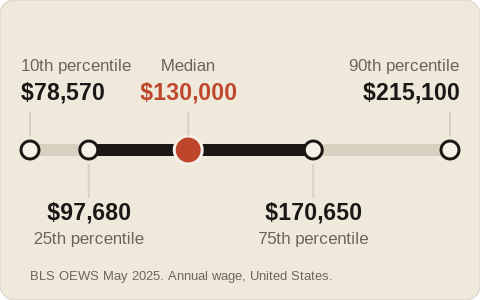
| Measure | Annual wage |
|---|---|
| 10th percentile | $78,570 |
| 25th percentile | $97,680 |
| Median (50th) | $130,000 |
| Mean (average) | $141,480 |
| 75th percentile | $170,650 |
| 90th percentile | $215,100 |
Source: U.S. Bureau of Labor Statistics, Occupational Employment and Wage Statistics (OEWS), May 2025, Actuaries, retrieved 23 to 25 November 2026 from the BLS OEWS May 2025 national, state and metropolitan area files.
Actuary hourly pay
The median hourly wage for actuaries is $62.50, as published by BLS for May 2025. That is the hourly view of the same national middle as the $130,000 annual median above, so use it when an employer quotes you a rate and not a salary. Annual pay for a job with part-time or shift work depends on the hours you are given, which no national table can tell you.
| Measure | Per hour |
|---|---|
| 10th percentile | $37.77 |
| 25th percentile | $46.96 |
| Median (BLS hourly figure) | $62.50 |
| 75th percentile | $82.04 |
| 90th percentile | $103.41 |
For actuaries the median is the hourly wage BLS publishes. The other rows are our division of the BLS annual percentiles by 2,080 hours, the full-time year BLS uses to turn hourly pay into annual pay.
Actuary salary by state
Where you work changes the number more than most things. The highest published median is in Connecticut, at $166,800. The lowest published median is in Louisiana, at $80,860, a gap of $85,940 a year between two states. The gap is our subtraction of two BLS state medians. All figures below are the annual median wage in each state for May 2025.
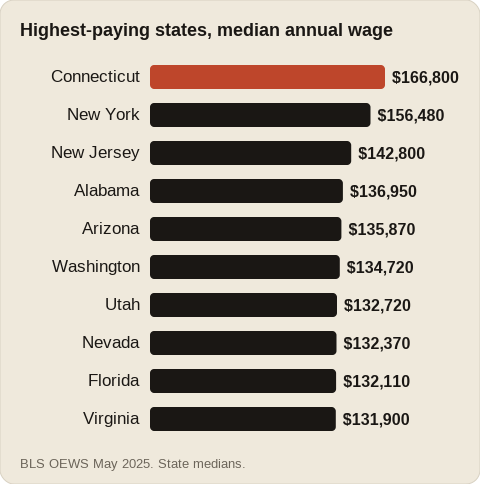
Top-paying states for actuaries
| Rank | State | Median wage | vs US median |
|---|---|---|---|
| 1 | Connecticut | $166,800 | +$36,800 |
| 2 | New York | $156,480 | +$26,480 |
| 3 | New Jersey | $142,800 | +$12,800 |
| 4 | Alabama | $136,950 | +$6,950 |
| 5 | Arizona | $135,870 | +$5,870 |
| 6 | Washington | $134,720 | +$4,720 |
| 7 | Utah | $132,720 | +$2,720 |
| 8 | Nevada | $132,370 | +$2,370 |
| 9 | Florida | $132,110 | +$2,110 |
| 10 | Virginia | $131,900 | +$1,900 |
Actuary salary by state
| State | Median annual wage |
|---|---|
| Connecticut | $166,800 |
| New York | $156,480 |
| New Jersey | $142,800 |
| Alabama | $136,950 |
| Arizona | $135,870 |
| Washington | $134,720 |
| Utah | $132,720 |
| Nevada | $132,370 |
| Florida | $132,110 |
| Virginia | $131,900 |
| Wisconsin | $131,640 |
| California | $130,510 |
| Oregon | $130,380 |
| Missouri | $129,220 |
| North Carolina | $128,730 |
| Iowa | $128,690 |
| Minnesota | $128,100 |
| Maryland | $126,950 |
| Massachusetts | $126,040 |
| Pennsylvania | $125,040 |
| Kansas | $125,010 |
| Colorado | $120,440 |
| Kentucky | $120,400 |
| Maine | $119,620 |
| Illinois | $115,430 |
| Rhode Island | $111,090 |
| Ohio | $110,980 |
| Oklahoma | $109,760 |
| Tennessee | $108,930 |
| Mississippi | $106,210 |
| Texas | $105,020 |
| Nebraska | $102,790 |
| Indiana | $100,690 |
| Michigan | $100,640 |
| Louisiana | $80,860 |
| Alaska | Not published by BLS |
| Arkansas | Not published by BLS |
| Delaware | Not published by BLS |
| Georgia | Not published by BLS |
| Hawaii | Not published by BLS |
| Idaho | Not published by BLS |
| Montana | Not published by BLS |
| New Hampshire | Not published by BLS |
| New Mexico | Not published by BLS |
| North Dakota | Not published by BLS |
| South Carolina | Not published by BLS |
| South Dakota | Not published by BLS |
| Vermont | Not published by BLS |
| West Virginia | Not published by BLS |
| Wyoming | Not published by BLS |
BLS does not publish a figure for Alaska, Arkansas, Delaware, Georgia, Hawaii, Idaho, Montana, New Hampshire, New Mexico, North Dakota, South Carolina, South Dakota, Vermont, West Virginia, Wyoming, usually because there are too few actuaries in the survey sample to report one safely.
Top-paying metro areas for actuaries
| Metro area | Median wage | Employed |
|---|---|---|
| Bridgeport-Stamford-Danbury, CT | $194,130 | 220 |
| San Francisco-Oakland-Fremont, CA | $175,330 | 220 |
| Hartford-West Hartford-East Hartford, CT | $166,800 | 960 |
| Las Vegas-Henderson-North Las Vegas, NV | $163,350 | 80 |
| New York-Newark-Jersey City, NY-NJ | $161,460 | 2,780 |
| Washington-Arlington-Alexandria, DC-VA-MD-WV | $144,680 | 520 |
| Waterbury-Shelton, CT | $143,430 | 30 |
| Raleigh-Cary, NC | $142,180 | 120 |
| New Haven, CT | $141,020 | 40 |
| Miami-Fort Lauderdale-West Palm Beach, FL | $139,810 | 310 |
BLS publishes the actuary median for 72 metro areas; the national median is $130,000. 3 of these ten count fewer than 100 actuaries or have no published headcount, so treat them as rough. Source: U.S. Bureau of Labor Statistics, OEWS May 2025, metropolitan area estimates.
Compare actuary pay
Put two states side by side, or set actuaries next to another job. Every figure is from BLS OEWS May 2025.
| Measure | Connecticut | Louisiana |
|---|---|---|
| Median annual wage | $166,800 | $80,860 |
| Median hourly wage | $80.19 | $38.88 |
| 10th percentile | $99,430 | $69,790 |
| 25th percentile | $129,170 | $78,570 |
| 75th percentile | $198,260 | $120,460 |
| 90th percentile | $228,810 | $206,870 |
| Employed, May 2025 | 1,380 | 40 |
The Connecticut median is $85,940 a year higher. That difference is our subtraction of two BLS state medians. n/a means this page has only the BLS median for that state so far, or BLS released no figure for it. Source: BLS OEWS May 2025, Actuaries.
Starting pay for actuaries
BLS does not publish pay by years of experience, so nobody can honestly quote an official entry-level actuary salary. What the data gives is the bottom of the market. One in ten actuaries earns $78,570 or less, and one in four earns $97,680 or less. Read those as the low end of the national range, not as what a new graduate will be offered, because older workers sit in the bottom tenth too.
The exams are the job ladder
For actuaries, the exam record carries the career. BLS says many employers expect a candidate to have passed one or two certification exams before graduation, that the associate-level certification may take up to 7 years, and that fellowship typically takes several more. Advancement usually depends on job performance and the number of exams passed.
The good news is that employers usually carry part of the load. BLS says most support their actuaries through certification, for example by paying for exams and study materials or giving paid study time, and some pay raises or bonuses for each exam passed. BLS does not name the bodies that run the exams; it points readers to CareerOneStop for the certifications.
Five fellowship tracks, plus the pension license
Fellowship comes in five tracks: life and annuities, group and health benefits, retirement benefits, quantitative finance and investments, and corporate finance/enterprise risk management. Pension work adds a separate step. BLS says pension actuaries typically must be licensed by the Joint Board for the Enrollment of Actuaries, run by the U.S. Department of Labor and the U.S. Department of the Treasury, and must meet experience requirements and pass exams to become enrolled actuaries.
BLS does not publish pay by exam level or track, so the figures on this page cover students and fellows together. The industry medians sit close: finance and insurance $131,450, management of companies $129,810, government $129,650 and professional, scientific and technical services $124,130.
Connecticut, New York and the accountant comparison
Connecticut has the highest state median at $166,800, and Hartford-West Hartford-East Hartford, CT counts about 960 jobs. New York-Newark-Jersey City, NY-NJ has the most actuaries on the top-paying list, about 2,780, at $161,460. BLS publishes a state median for 35 states only.
BLS lists accountants and auditors as a similar occupation. Their median is $83,680, so the actuary median of $130,000 is $46,320 higher by our subtraction. The hourly median for actuaries is $62.50.
Related jobs
- Accountant salary and career path: On the BLS similar occupations list, and actuaries work with accountants to price security offerings.
- Software Developer salary and career path: BLS says actuaries must know programming languages and build spreadsheets, databases and statistical tools.
What actuaries do
Actuaries use mathematics, statistics and financial theory to put a price on risk and uncertainty. They estimate how likely an event such as death, sickness, an accident or a natural disaster is and what it would cost, and they help businesses and clients build policies that keep that cost down. In insurance they help design policies and set premiums that are profitable yet competitive.
Insurance actuaries usually specialize: health, life, or property and casualty. Outside insurance, BLS names enterprise risk management actuaries, pension and retirement benefits actuaries, and public sector actuaries, who at the federal level may evaluate changes to Social Security or Medicare and at the state level may examine and regulate the rates insurers charge. Consulting actuaries often audit the work of in-house actuaries or cover insurers too small to keep their own.
Duties BLS lists
- Compile and analyze statistical data and other information
- Estimate the probability and likely economic cost of events such as death, sickness, accidents or natural disasters
- Design and test insurance policies, investments and other business strategies to reduce risk and raise profitability
- Calculate the cash reserves needed to cover payouts and claims on existing policies and liabilities
- Produce charts, tables and reports that explain calculations and proposals
- Explain findings and proposals to executives, government officials, shareholders and clients
A typical day
The core of the day is data and models: database software to pull the information together, statistical and modeling software to forecast how likely an event is, what it would cost, and whether the company has enough money for future claims. Then the results go into charts, tables and reports for people without an actuarial background. Work is usually in teams with accounting, underwriting and finance staff. For a trainee, the first tasks are basic ones such as compiling data, with research and report writing added over time, often alongside study for the next exam.
Where they work
- Actuaries held about 31,200 jobs in 2025. Finance and insurance employed 78 percent, professional, scientific and technical services 13 percent, management of companies and enterprises 3 percent and government 3 percent.
- They usually work in an office. Actuaries at consulting firms may travel to meet clients.
- Most actuaries work full time, and BLS says some put in more than 40 hours a week.
Source: U.S. Bureau of Labor Statistics, Occupational Outlook Handbook, Actuaries, read 25 November 2026. BLS counted about 31,200 jobs in 2025 and projects 9% growth from 2025 to 2035, much faster than the average for all occupations.
How to become an actuary: the career path
Typical entry-level education, according to BLS: bachelor's degree. BLS says it may take up to 7 years to earn the associate-level certification, and several more years after that to reach fellowship status. Each step below comes from the BLS Occupational Outlook Handbook, and the last step is the pay.
- 1Study
Bachelor's degree in an analytical field
Mathematics, actuarial science, statistics, business or another analytical field. Certification programs expect coursework in economics, finance and mathematical statistics during college, and BLS stresses computer science, programming, spreadsheets, databases and statistical tools.
- 2Certify
First exams before graduation
Many employers expect new hires to have passed at least one or two certification exams before they graduate. Internships can help students choose a track among health, life, pension and casualty.
- 3Start
Trainee on a team of experienced actuaries
Trainees start with basic tasks such as compiling data and move on to research and reports. Most employers support the exams, for example by paying exam and study material costs or giving paid study time, and some give raises or bonuses for each exam passed.
- 4Credential
Associate-level certification
Candidates pass a series of exams and take seminars on professionalism. Because of the long preparation, the associate level may take up to 7 years.
- 5Credential
Fellowship
Typically several more years after associate. Fellowship is offered in five tracks: life and annuities, group and health benefits, retirement benefits, quantitative finance and investments, and corporate finance/enterprise risk management. Pension actuaries typically must also be licensed by the Joint Board for the Enrollment of Actuaries as enrolled actuaries.
- 6Advance
Supervising actuary, then executive
Fellows often supervise other actuaries and advise senior management. Actuaries with broad risk management knowledge may become top executives such as chief risk officers or chief financial officers.
- 7Pay
Median $130,000 a year
BLS median annual wage for actuaries. The lowest-paid tenth earn $78,570 or less and the highest-paid tenth earn $215,100 or more.
Steps 1 to 6 for actuaries: U.S. Bureau of Labor Statistics, Occupational Outlook Handbook, Actuaries, "How to Become One", read 25 November 2026. Pay step: U.S. Bureau of Labor Statistics, OEWS May 2025.
Actuary skills and certifications
These come from the CVBooster actuary resume guide, which lists what employers look for on a actuary CV. Put the ones you really have near the top of your CV, in the words the job ad uses.
Core skills
People skills
Licenses and certifications
- Associate of the Society of Actuaries (ASA), Society of Actuaries
- Fellow of the Society of Actuaries (FSA), Society of Actuaries
- Associate of the Casualty Actuarial Society (ACAS), Casualty Actuarial Society
- Fellow of the Casualty Actuarial Society (FCAS), Casualty Actuarial Society
- Member of the American Academy of Actuaries (MAAA), American Academy of Actuaries
Actuary salary questions
How much do actuaries make?
The BLS median for actuaries is $130,000 a year, $62.50 an hour, in May 2025. The mean is $141,480. A tenth earn $78,570 or less and a tenth earn $215,100 or more. The industry medians BLS lists are much tighter, all between $124,130 and $131,450.
How many exams does it take to become an actuary?
BLS does not give a number. It says candidates must pass a series of exams and take seminars on professionalism, that many employers want one or two exams passed before graduation, and that the associate-level certification may take up to 7 years. Fellowship takes several more years.
Do employers pay for actuarial exams?
Usually they help. BLS says most employers support their actuaries through the certification process, for example by paying the cost of exams and study materials or by giving paid time to study. Some give raises or bonuses for each exam passed.
Which state pays actuaries the most?
Connecticut leads at $166,800, then New York at $156,480 and New Jersey at $142,800. BLS published a median for 35 states. The rest have no published figure and are missing from the state table above.
What degree do you need to be an actuary?
A bachelor's degree in mathematics, actuarial science, statistics, business or another analytical field. BLS adds coursework in economics, applied statistics and corporate finance, plus programming, spreadsheets, databases and statistical analysis tools.
Where do actuaries work?
Mostly insurance. BLS counts 78 percent in finance and insurance and 13 percent in professional, scientific and technical services. BLS says consulting actuaries work for clients on a contract basis and may travel to meet them. Government employs 3 percent, where actuaries may evaluate Social Security or Medicare changes or regulate insurance rates.
Sources and method
- Pay: U.S. Bureau of Labor Statistics, Occupational Employment and Wage Statistics (OEWS), May 2025, Actuaries (SOC 15-2011), national, state and metro area estimates, retrieved 23 to 25 November 2026 from the BLS OEWS May 2025 national, state and metropolitan area files. Wages are before tax. BLS defines what its wage figure includes and leaves out in the OEWS technical notes.
- The job, the route in and the outlook: U.S. Bureau of Labor Statistics, Occupational Outlook Handbook, Actuaries, read 25 November 2026.
- Skills and certifications: the CVBooster actuary resume guide.
- Where we subtract or divide two BLS figures on this actuary page, the page says so. The pay check is an estimate between the published BLS percentiles for actuaries and says so. Nothing else here is estimated.
Actuary CV example
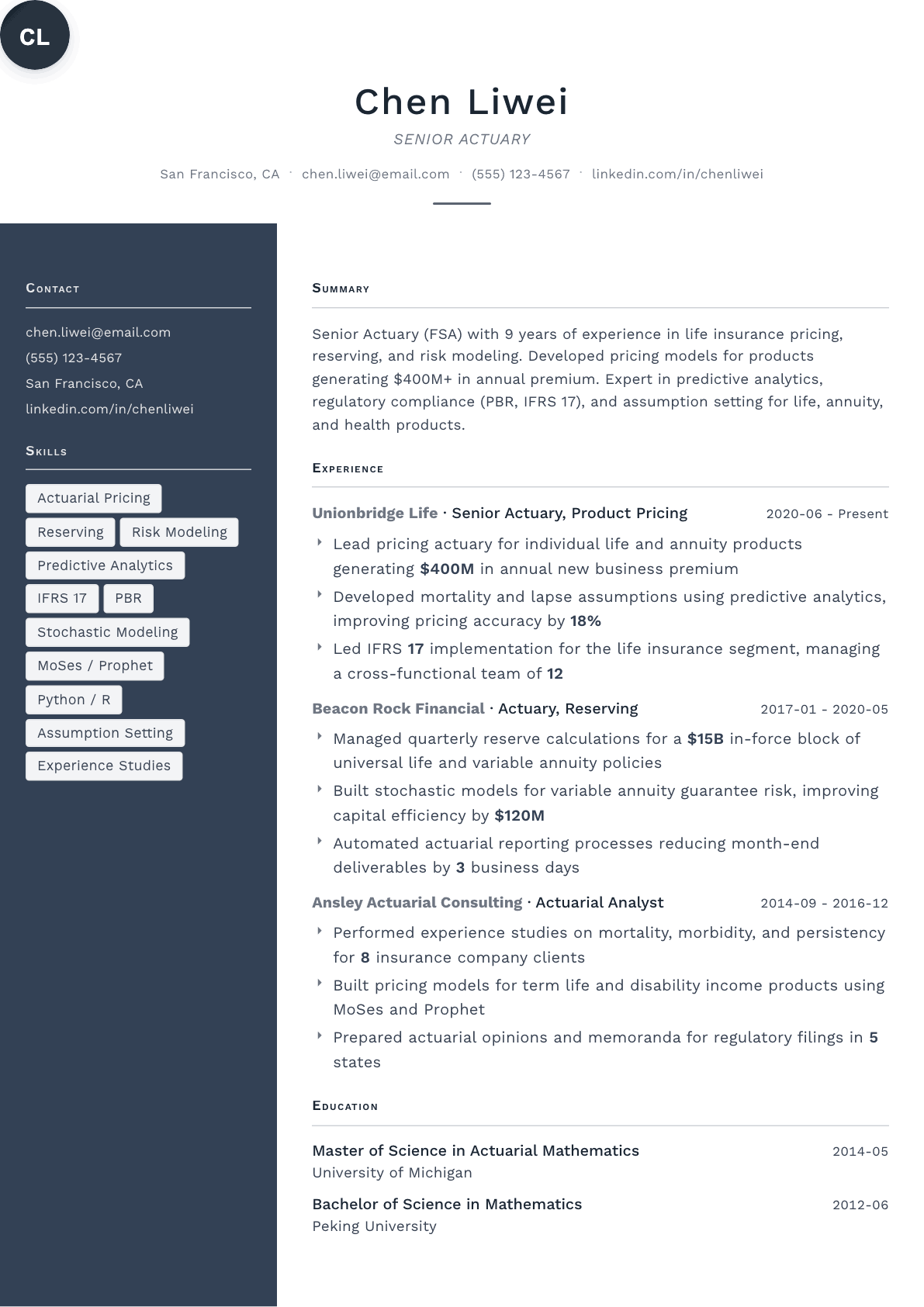
The CVBooster actuary resume guide has a finished example, three written summaries, before and after bullets and answers to the questions people ask.
Build your actuary CV
Create my CV