HVAC Technician Salary, Career Path and CV
By CVBooster TeamPublished Updated
The median HVAC technician salary in the United States is $61,010 a year, or $29.33 an hour, according to the U.S. Bureau of Labor Statistics (BLS), OEWS May 2025. That is the national middle: states, employers and hours move it, and BLS publishes nothing by years of experience. BLS calls the job heating, air conditioning and refrigeration mechanic and installer. A broken furnace in January does not wait for Monday, and the EPA refrigerant card is the one credential nearly every technician needs.
Below: a check of your own pay, the pay percentiles, hourly pay, pay in every state, the top-paying metro areas, what HVAC technicians do, how to become an HVAC technician, the skills that go on a CV, and a CV example.
- Median annual pay
- $61,010
- Median hourly pay
- $29.33
- Employed, May 2025
- 409,670
Am I underpaid as an HVAC technician?
Pick your state and type your pay. You get your place in the BLS pay range for HVAC technicians there, as a percentile.
HVAC Technician salary in the United States
The BLS counts HVAC technicians in the occupation Heating, Air Conditioning, and Refrigeration Mechanics and Installers (SOC 49-9021). Half of them earn less than $61,010 a year and half earn more. The average, which a few very high earners pull up, is $64,780. The lowest-paid tenth earn $40,050 or less, and the highest-paid tenth earn $95,210 or more, which is about 2.4 times as much. The ratio is our arithmetic on two BLS figures.
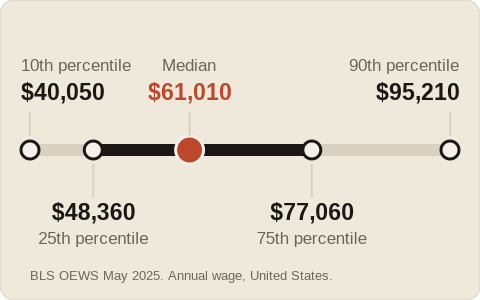
| Measure | Annual wage |
|---|---|
| 10th percentile | $40,050 |
| 25th percentile | $48,360 |
| Median (50th) | $61,010 |
| Mean (average) | $64,780 |
| 75th percentile | $77,060 |
| 90th percentile | $95,210 |
Source: U.S. Bureau of Labor Statistics, Occupational Employment and Wage Statistics (OEWS), May 2025, Heating, Air Conditioning, and Refrigeration Mechanics and Installers, retrieved 23 to 25 November 2026 from the BLS OEWS May 2025 national, state and metropolitan area files.
HVAC Technician hourly pay
The median hourly wage for HVAC technicians is $29.33, as published by BLS for May 2025. That is the hourly view of the same national middle as the $61,010 annual median above, so use it when an employer quotes you a rate and not a salary. Annual pay for a job with part-time or shift work depends on the hours you are given, which no national table can tell you.
| Measure | Per hour |
|---|---|
| 10th percentile | $19.25 |
| 25th percentile | $23.25 |
| Median (BLS hourly figure) | $29.33 |
| 75th percentile | $37.05 |
| 90th percentile | $45.77 |
For HVAC technicians the median is the hourly wage BLS publishes. The other rows are our division of the BLS annual percentiles by 2,080 hours, the full-time year BLS uses to turn hourly pay into annual pay.
HVAC Technician salary by state
Where you work changes the number more than most things. The highest median is in Alaska, at $77,430. The lowest published median is in Arkansas, at $48,110, a gap of $29,320 a year between two states. The gap is our subtraction of two BLS state medians. All figures below are the annual median wage in each state for May 2025.
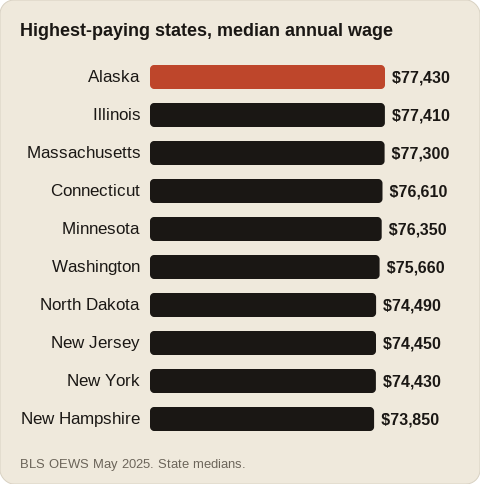
Top-paying states for HVAC technicians
| Rank | State | Median wage | vs US median |
|---|---|---|---|
| 1 | Alaska | $77,430 | +$16,420 |
| 2 | Illinois | $77,410 | +$16,400 |
| 3 | Massachusetts | $77,300 | +$16,290 |
| 4 | Connecticut | $76,610 | +$15,600 |
| 5 | Minnesota | $76,350 | +$15,340 |
| 6 | Washington | $75,660 | +$14,650 |
| 7 | North Dakota | $74,490 | +$13,480 |
| 8 | New Jersey | $74,450 | +$13,440 |
| 9 | New York | $74,430 | +$13,420 |
| 10 | New Hampshire | $73,850 | +$12,840 |
HVAC Technician salary in all 50 states
| State | Median annual wage |
|---|---|
| Alaska | $77,430 |
| Illinois | $77,410 |
| Massachusetts | $77,300 |
| Connecticut | $76,610 |
| Minnesota | $76,350 |
| Washington | $75,660 |
| North Dakota | $74,490 |
| New Jersey | $74,450 |
| New York | $74,430 |
| New Hampshire | $73,850 |
| California | $72,560 |
| Maryland | $70,020 |
| Rhode Island | $67,370 |
| Hawaii | $65,450 |
| Colorado | $65,200 |
| Maine | $63,170 |
| Oregon | $62,940 |
| Ohio | $62,510 |
| Pennsylvania | $62,400 |
| Delaware | $62,320 |
| Vermont | $62,150 |
| Wisconsin | $61,710 |
| South Dakota | $61,390 |
| Michigan | $60,850 |
| Montana | $60,850 |
| Iowa | $60,680 |
| Nevada | $60,510 |
| Kansas | $60,460 |
| Indiana | $60,430 |
| Missouri | $59,950 |
| Nebraska | $59,850 |
| Virginia | $59,730 |
| Arizona | $59,400 |
| Utah | $58,730 |
| Louisiana | $58,650 |
| Kentucky | $58,620 |
| Texas | $57,760 |
| Oklahoma | $57,560 |
| North Carolina | $57,260 |
| Florida | $56,670 |
| South Carolina | $56,610 |
| Georgia | $56,390 |
| Idaho | $56,240 |
| Tennessee | $55,490 |
| Wyoming | $54,700 |
| New Mexico | $50,270 |
| West Virginia | $48,850 |
| Mississippi | $48,680 |
| Alabama | $48,370 |
| Arkansas | $48,110 |
Top-paying metro areas for HVAC technicians
| Metro area | Median wage | Employed |
|---|---|---|
| Fairbanks-College, AK | $93,820 | 90 |
| Anchorage, AK | $85,620 | 330 |
| Napa, CA | $84,570 | 70 |
| San Jose-Sunnyvale-Santa Clara, CA | $82,050 | 1,740 |
| Seattle-Tacoma-Bellevue, WA | $80,100 | 3,940 |
| Santa Rosa-Petaluma, CA | $79,510 | 560 |
| Peoria, IL | $78,710 | 370 |
| Santa Maria-Santa Barbara, CA | $78,640 | 260 |
| Boston-Cambridge-Newton, MA-NH | $78,530 | 6,050 |
| San Francisco-Oakland-Fremont, CA | $78,490 | 3,980 |
BLS publishes the HVAC technician median for 389 metro areas; the national median is $61,010. 2 of these ten count fewer than 100 HVAC technicians or have no published headcount, so treat them as rough. Source: U.S. Bureau of Labor Statistics, OEWS May 2025, metropolitan area estimates.
Compare HVAC technician pay
Put two states side by side, or set HVAC technicians next to another job. Every figure is from BLS OEWS May 2025.
| Measure | Alaska | Arkansas |
|---|---|---|
| Median annual wage | $77,430 | $48,110 |
| Median hourly wage | $37.23 | $23.13 |
| 10th percentile | $48,580 | $37,040 |
| 25th percentile | $58,700 | $42,830 |
| 75th percentile | $102,170 | $59,760 |
| 90th percentile | $105,140 | $69,290 |
| Employed, May 2025 | 610 | 4,960 |
The Alaska median is $29,320 a year higher. That difference is our subtraction of two BLS state medians. n/a means this page has only the BLS median for that state so far, or BLS released no figure for it. Source: BLS OEWS May 2025, Heating, Air Conditioning, and Refrigeration Mechanics and Installers.
Starting pay for HVAC technicians
BLS does not publish pay by years of experience, so nobody can honestly quote an official entry-level HVAC technician salary. What the data gives is the bottom of the market. One in ten HVAC technicians earns $40,050 or less, and one in four earns $48,360 or less. Read those as the low end of the national range, not as what a new graduate will be offered, because older workers sit in the bottom tenth too.
Contractor or wholesaler, and the seasons
BLS publishes two industry medians for HVAC technicians: $71,190 in wholesale trade and $60,030 at plumbing, heating and air-conditioning contractors. The contractors employ 68 percent of the workforce, so the contractor figure is close to what most technicians see, and the wholesale jobs, only 3 percent of the total, pay more.
The other lever is time. BLS says technicians may be on call for emergencies and sometimes work overtime or irregular schedules in the peak heating and cooling seasons. It does not publish overtime pay, so how much a busy summer adds depends on the employer and the local climate.
Where HVAC pays most
The state medians at the top are tight: Alaska at $77,430, Illinois at $77,410 and Massachusetts at $77,300. At the bottom, Arkansas is at $48,110.
The best-paying metro is Fairbanks-College, AK at $93,820. Fairbanks-College, AK and Napa, CA have fewer than a hundred technicians in the BLS count, and metro medians for groups that small are estimates. A sturdier figure is Boston-Cambridge-Newton, MA-NH, with about 6,050 technicians and a median of $78,530.
HVAC or electrician
BLS lists electricians as a similar occupation, and HVAC work already includes installing electrical components and wiring. The electrician median is $63,190, which is $2,180 above the HVAC median of $61,010, by our subtraction. The routes differ: BLS lists a high school diploma as the electrician entry level, while the usual HVAC entry is a postsecondary nondegree award.
For HVAC that school route is short, 6 months to 2 years, and the hourly median is $29.33. Growth is the strong part: BLS projects 11 percent from 2025 to 2035 and about 40,600 openings a year, driven by commercial construction including data centers, home building and the need to retrofit or replace existing systems.
Related jobs
- Electrician salary and career path: BLS lists it as a similar occupation; HVAC work already includes electrical components and wiring.
- Lineman salary and career path: Another repair trade that BLS says needs long-term on-the-job training, with a much higher median.
What HVAC technicians do
HVAC technicians work on heating, ventilation, air conditioning and refrigeration (HVACR) systems, which control the temperature, humidity and air quality in buildings. Some focus on installing new systems, others mainly on repair and maintenance.
Specialties include radiant heating, testing and balancing, and commercial refrigeration in places such as grocery stores, hotels and restaurants. Technicians on residential work may sell service contracts for periodic maintenance: inspecting the system, cleaning ducts, replacing filters and checking refrigerant levels. Any work on air conditioning or refrigeration has to follow the rules on conserving, recovering and recycling refrigerants.
Duties BLS lists
- Install, maintain and repair HVACR systems
- Install electrical components and wiring
- Inspect and test systems and components
- Talk through system malfunctions with customers
- Repair or replace worn or defective parts
- Recommend maintenance that improves system performance
- Keep records of the work done
A typical day
The day may be one jobsite or a list of service calls in homes, schools, hospitals and offices. At each stop the technician hears out the customer, tests the system, finds the fault and repairs or replaces the part, then records the time and parts used. Much of it happens in awkward or cramped spaces, sometimes in a building that is uncomfortable precisely because its heating or cooling has failed, and some work is outdoors in any weather. In peak heating and cooling seasons the hours can stretch, with evening, weekend and on-call work.
Where they work
- Plumbing, heating and air-conditioning contractors employed 68 percent of HVAC technicians, 6 percent were self-employed and 3 percent worked in wholesale trade.
- BLS says HVAC technicians have one of the highest rates of injuries and illnesses of all occupations: burns from electrical parts or chemicals, and strains or sprains from heavy equipment.
- Refrigerants are hazardous, so protective equipment such as special clothing, safety goggles or masks is needed when handling them.
- Most work full time. Schedules can include evenings and weekends, on-call emergency work and overtime in peak seasons.
Source: U.S. Bureau of Labor Statistics, Occupational Outlook Handbook, Heating, Air Conditioning, and Refrigeration Mechanics and Installers, read 25 November 2026. BLS counted about 440,900 jobs in 2025 and projects 11% growth from 2025 to 2035, much faster than the average for all occupations.
How to become an HVAC technician: the career path
Typical entry-level education, according to BLS: postsecondary nondegree award. HVACR programs at trade schools and community colleges generally last from 6 months to 2 years and lead to a certificate or an associate's degree, followed by a long stretch of on-the-job training. Each step below comes from the BLS Occupational Outlook Handbook, and the last step is the pay.
- 1Study
HVACR certificate or associate degree
Technical and trade schools and community colleges offer heating, air conditioning and refrigeration programs of 6 months to 2 years, leading to a certificate or an associate's degree. Some employers consider applicants with only a high school diploma.
- 2Certify
EPA refrigerant handling certification
The U.S. Environmental Protection Agency (EPA) requires nearly all HVAC technicians to be certified in proper refrigerant handling. The exam is typically included in a postsecondary HVACR program.
- 3Train
On the job beside experienced technicians
New hires start with basic tasks such as insulating refrigerant lines or cleaning furnaces, then move on to cutting and soldering pipes and checking electrical circuits.
- 4Or train
Apprenticeship
Some technicians train through an apprenticeship of several years, with paid on-the-job training and technical instruction each year in safety, blueprint reading, heating and cooling systems and tools.
- 5License
State or local license, driver's license
Some states and localities require HVAC technicians to be licensed. Manufacturer and industry certifications are mostly optional, though some employers prefer or require them, and a driver's license may be needed to reach jobsites.
- 6Pay
Median $61,010 a year
BLS median annual wage for HVAC technicians. The lowest-paid tenth earn $40,050 or less and the highest-paid tenth earn $95,210 or more.
Steps 1 to 5 for HVAC technicians: U.S. Bureau of Labor Statistics, Occupational Outlook Handbook, Heating, Air Conditioning, and Refrigeration Mechanics and Installers, "How to Become One", read 25 November 2026. Pay step: U.S. Bureau of Labor Statistics, OEWS May 2025.
HVAC Technician skills and certifications
These come from the CVBooster HVAC technician resume guide, which lists what employers look for on a HVAC technician CV. Put the ones you really have near the top of your CV, in the words the job ad uses.
Core skills
People skills
Licenses and certifications
- EPA Section 608 Universal Certification, United States Environmental Protection Agency
- EPA Section 609 Motor Vehicle Air Conditioning, United States Environmental Protection Agency
- NATE Certification, North American Technician Excellence
- HVAC Excellence Certification, ESCO Institute
- OSHA 10-Hour Construction, OSHA Training Institute
HVAC Technician salary questions
How much do HVAC technicians make?
The BLS median for heating, air conditioning and refrigeration mechanics and installers was $61,010 in May 2025, and the mean was $64,780. A tenth earned less than $40,050 and a tenth more than $95,210. Wholesale trade pays a higher median than contracting.
How much do HVAC techs make an hour?
The hourly median is $29.33. Most HVAC technicians work full time, and peak heating and cooling seasons can bring overtime and irregular hours. BLS does not publish rates for overtime or on-call work, so the hourly median tells you nothing about them.
Do HVAC technicians need EPA certification?
Nearly all do. The U.S. Environmental Protection Agency requires nearly all HVAC technicians to be certified in proper refrigerant handling. Certification means passing an exam, and that exam is typically part of finishing a postsecondary HVACR program, so for most it comes with the training.
How long does it take to become an HVAC technician?
HVACR programs generally last from 6 months to 2 years and lead to a certificate or associate's degree. After hiring comes a lengthy period of on-the-job training. Apprenticeships, another route in, usually last several years, with paid training and instruction each year.
Which state pays HVAC technicians the most?
Alaska has the highest state median at $77,430, a whisker ahead of Illinois at $77,410 and Massachusetts at $77,300. The lowest published median is Arkansas at $48,110.
Is HVAC a dangerous job?
BLS says HVAC technicians have one of the highest rates of injuries and illnesses of all occupations. The risks include burns from electrical parts or chemicals and strains or sprains from lifting heavy equipment. Proper lifting technique and protective gear such as goggles and masks reduce them.
Sources and method
- Pay: U.S. Bureau of Labor Statistics, Occupational Employment and Wage Statistics (OEWS), May 2025, Heating, Air Conditioning, and Refrigeration Mechanics and Installers (SOC 49-9021), national, state and metro area estimates, retrieved 23 to 25 November 2026 from the BLS OEWS May 2025 national, state and metropolitan area files. Wages are before tax. BLS defines what its wage figure includes and leaves out in the OEWS technical notes.
- The job, the route in and the outlook: U.S. Bureau of Labor Statistics, Occupational Outlook Handbook, Heating, Air Conditioning, and Refrigeration Mechanics and Installers, read 25 November 2026.
- Skills and certifications: the CVBooster HVAC technician resume guide.
- Where we subtract or divide two BLS figures on this HVAC technician page, the page says so. The pay check is an estimate between the published BLS percentiles for HVAC technicians and says so. Nothing else here is estimated.
HVAC Technician CV example
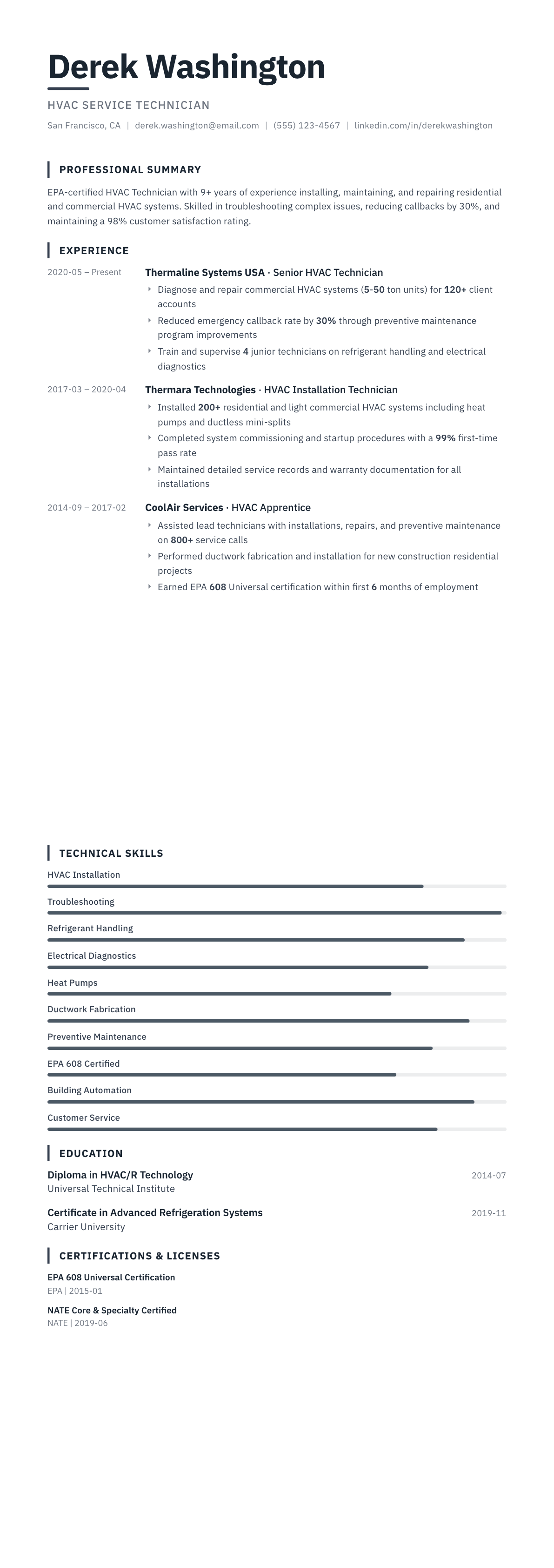
The CVBooster HVAC technician resume guide has a finished example, three written summaries, before and after bullets and answers to the questions people ask.
- HVAC technician resume examples
- HVAC service technician resume examples
- Refrigeration technician resume examples
Build your HVAC technician CV
Create my CV