Police Officer Salary, Career Path and CV
By CVBooster TeamPublished Updated
The median police officer salary in the United States is $76,210 a year, or $36.64 an hour, according to the U.S. Bureau of Labor Statistics (BLS), OEWS May 2025. That is the national middle: states, employers and hours move it, and BLS publishes nothing by years of experience. BLS calls the job police and sheriff's patrol officer. Its OOH page also covers detectives, fish and game wardens and transit police; the pay and job counts here are for patrol officers unless a sentence says the whole group. Nearly every officer works for a government, and paid overtime, which BLS calls common, comes on top of the base.
Below: a check of your own pay, the pay percentiles, hourly pay, pay in every state, the top-paying metro areas, what police officers do, how to become a police officer, the skills that go on a CV, and a CV example.
- Median annual pay
- $76,210
- Median hourly pay
- $36.64
- Employed, May 2025
- 670,520
Am I underpaid as a police officer?
Pick your state and type your pay. You get your place in the BLS pay range for police officers there, as a percentile.
Police Officer salary in the United States
The BLS counts police officers in the occupation Police and Sheriff's Patrol Officers (SOC 33-3051). Half of them earn less than $76,210 a year and half earn more. The average, which a few very high earners pull up, is $79,200. The lowest-paid tenth earn $47,510 or less, and the highest-paid tenth earn $115,120 or more, which is about 2.4 times as much. The ratio is our arithmetic on two BLS figures.
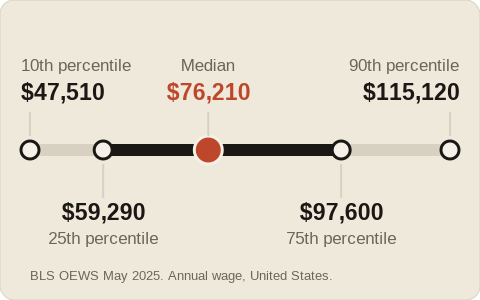
| Measure | Annual wage |
|---|---|
| 10th percentile | $47,510 |
| 25th percentile | $59,290 |
| Median (50th) | $76,210 |
| Mean (average) | $79,200 |
| 75th percentile | $97,600 |
| 90th percentile | $115,120 |
Source: U.S. Bureau of Labor Statistics, Occupational Employment and Wage Statistics (OEWS), May 2025, Police and Sheriff's Patrol Officers, retrieved 23 to 25 November 2026 from the BLS OEWS May 2025 national, state and metropolitan area files.
Police Officer hourly pay
The median hourly wage for police officers is $36.64, as published by BLS for May 2025. That is the hourly view of the same national middle as the $76,210 annual median above, so use it when an employer quotes you a rate and not a salary. Annual pay for a job with part-time or shift work depends on the hours you are given, which no national table can tell you.
| Measure | Per hour |
|---|---|
| 10th percentile | $22.84 |
| 25th percentile | $28.50 |
| Median (BLS hourly figure) | $36.64 |
| 75th percentile | $46.92 |
| 90th percentile | $55.35 |
For police officers the median is the hourly wage BLS publishes. The other rows are our division of the BLS annual percentiles by 2,080 hours, the full-time year BLS uses to turn hourly pay into annual pay.
Police Officer salary by state
Where you work changes the number more than most things. The highest median is in California, at $118,880. The lowest published median is in Mississippi, at $46,140, a gap of $72,740 a year between two states. The gap is our subtraction of two BLS state medians. All figures below are the annual median wage in each state for May 2025.
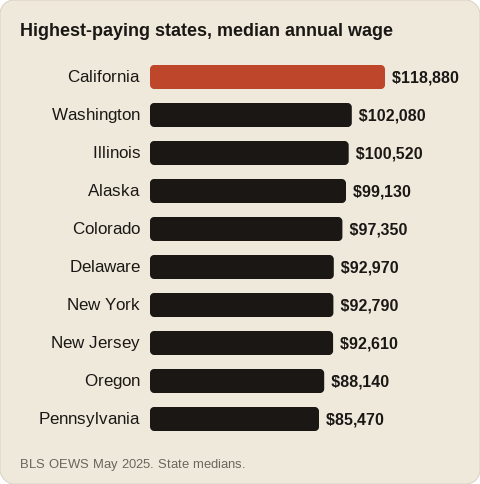
Top-paying states for police officers
| Rank | State | Median wage | vs US median |
|---|---|---|---|
| 1 | California | $118,880 | +$42,670 |
| 2 | Washington | $102,080 | +$25,870 |
| 3 | Illinois | $100,520 | +$24,310 |
| 4 | Alaska | $99,130 | +$22,920 |
| 5 | Colorado | $97,350 | +$21,140 |
| 6 | Delaware | $92,970 | +$16,760 |
| 7 | New York | $92,790 | +$16,580 |
| 8 | New Jersey | $92,610 | +$16,400 |
| 9 | Oregon | $88,140 | +$11,930 |
| 10 | Pennsylvania | $85,470 | +$9,260 |
Police Officer salary in all 50 states
| State | Median annual wage |
|---|---|
| California | $118,880 |
| Washington | $102,080 |
| Illinois | $100,520 |
| Alaska | $99,130 |
| Colorado | $97,350 |
| Delaware | $92,970 |
| New York | $92,790 |
| New Jersey | $92,610 |
| Oregon | $88,140 |
| Pennsylvania | $85,470 |
| Hawaii | $83,820 |
| Minnesota | $83,360 |
| Connecticut | $82,170 |
| Massachusetts | $78,940 |
| Arizona | $78,880 |
| Nevada | $78,140 |
| Wisconsin | $78,090 |
| Maryland | $77,970 |
| Utah | $77,310 |
| Rhode Island | $77,230 |
| Ohio | $77,020 |
| Texas | $75,900 |
| Nebraska | $74,620 |
| North Dakota | $74,500 |
| Florida | $74,470 |
| Iowa | $74,470 |
| Michigan | $73,730 |
| Indiana | $73,370 |
| New Hampshire | $71,640 |
| Montana | $70,050 |
| New Mexico | $69,180 |
| Vermont | $68,910 |
| Maine | $67,050 |
| Idaho | $66,990 |
| Wyoming | $66,140 |
| Virginia | $65,870 |
| South Dakota | $60,740 |
| Kentucky | $60,490 |
| Oklahoma | $59,700 |
| Missouri | $59,460 |
| North Carolina | $59,300 |
| Tennessee | $59,280 |
| Kansas | $59,230 |
| Georgia | $58,120 |
| South Carolina | $58,070 |
| West Virginia | $56,960 |
| Alabama | $51,270 |
| Louisiana | $48,380 |
| Arkansas | $47,670 |
| Mississippi | $46,140 |
Top-paying metro areas for police officers
| Metro area | Median wage | Employed |
|---|---|---|
| San Jose-Sunnyvale-Santa Clara, CA | $136,140 | 2,590 |
| San Francisco-Oakland-Fremont, CA | $132,000 | 7,990 |
| Carson City, NV | $131,210 | 110 |
| Vallejo, CA | $129,900 | 690 |
| Napa, CA | $127,310 | 300 |
| Santa Rosa-Petaluma, CA | $125,910 | 590 |
| Santa Cruz-Watsonville, CA | $122,970 | 400 |
| Los Angeles-Long Beach-Anaheim, CA | $121,980 | 24,720 |
| Santa Maria-Santa Barbara, CA | $120,900 | 730 |
| Oxnard-Thousand Oaks-Ventura, CA | $119,640 | 1,330 |
BLS publishes the police officer median for 386 metro areas; the national median is $76,210. Source: U.S. Bureau of Labor Statistics, OEWS May 2025, metropolitan area estimates.
Compare police officer pay
Put two states side by side, or set police officers next to another job. Every figure is from BLS OEWS May 2025.
| Measure | California | Mississippi |
|---|---|---|
| Median annual wage | $118,880 | $46,140 |
| Median hourly wage | $57.15 | $22.18 |
| 10th percentile | $76,300 | $33,230 |
| 25th percentile | $97,280 | $37,270 |
| 75th percentile | $126,780 | $54,450 |
| 90th percentile | $153,190 | $61,550 |
| Employed, May 2025 | 65,940 | 8,070 |
The California median is $72,740 a year higher. That difference is our subtraction of two BLS state medians. n/a means this page has only the BLS median for that state so far, or BLS released no figure for it. Source: BLS OEWS May 2025, Police and Sheriff's Patrol Officers.
Starting pay for police officers
BLS does not publish pay by years of experience, so nobody can honestly quote an official entry-level police officer salary. What the data gives is the bottom of the market. One in ten police officers earns $47,510 or less, and one in four earns $59,290 or less. Read those as the low end of the national range, not as what a new graduate will be offered, because older workers sit in the bottom tenth too.
Overtime, extras and the benefits
BLS calls paid overtime common for police, and shift work is necessary because someone has to cover every hour. It does not publish how much overtime adds, so two officers on the same base salary can end the year with quite different pay.
There are extras around the base, too. BLS says many agencies give officers a uniform allowance, extensive benefits and the option to retire younger than the typical retirement age, and some departments pay more to bilingual officers or to those with college degrees. None of that shows in the median, which is wages only.
California pays far more
California has the highest state median at $118,880, $16,800 above Washington in second place at $102,080, by our subtraction. At the other end, Mississippi is at $46,140, so the same patrol job pays more than twice as much in the top state as in the bottom one.
9 of the 10 highest-paying metro areas are in California, led by San Jose-Sunnyvale-Santa Clara, CA at $136,140. Los Angeles-Long Beach-Anaheim is the big one on the list, with about 24,720 patrol officers and a median of $121,980. BLS says demand for officers varies by location, driven largely by local and state budgets.
Patrol, detective, or the fire station
Inside the BLS group, detectives and criminal investigators have a median of $93,790 and transit and railroad police $90,230, against $76,210 for patrol officers. Detectives typically start as police officers, and BLS projects almost no growth for them: 0 percent, about 200 jobs, from 2025 to 2035.
Firefighters, listed by BLS as a similar occupation, have a national median of $59,280, which is $16,930 less than patrol officers, by our subtraction. The patrol hourly median is $36.64.
Related jobs
- Firefighter salary and career path: A similar occupation per BLS that also answers emergencies, at a lower national median.
- Forensic Scientist salary and career path: BLS lists forensic science technicians as similar: they analyze the evidence officers secure at scenes.
- EMT salary and career path: BLS lists EMTs and paramedics as similar; police recruits also train in first aid and emergency response.
What police officers do
Police and sheriff's patrol officers are the most common kind of police, with general law enforcement duties. They wear uniforms so the public can recognize them, patrol assigned areas watching people and activities, and answer emergency and nonemergency calls.
The law requires them to write detailed reports and keep meticulous records, and most carry radios, handcuffs and guns. Some work only on one type of crime, such as narcotics, and in large departments officers can join special units such as mounted, motorcycle or SWAT, usually after a set number of years on patrol.
Duties BLS lists
- Respond to emergency and nonemergency calls
- Patrol assigned areas, observing people and activities
- Make traffic stops and issue citations
- Search restricted-access databases for vehicle records and warrants
- Obtain and serve warrants for arrests, searches and other purposes
- Arrest people suspected of crimes
- Collect and secure evidence at crime scenes
- Write detailed reports, prepare cases and testify in court
A typical day
A shift is a patrol of an assigned area, broken up by calls, from emergencies to routine complaints, and by traffic stops and database checks on vehicles and warrants. Some calls lead to an arrest, evidence to secure at a scene, or a warrant to serve. Officers stay alert for the whole shift, and much of the job is paperwork: every incident needs a detailed report, and some cases end with the officer testifying in court. Because police cover every hour, shifts include nights, weekends and holidays, and paid overtime is common.
Where they work
- Police and sheriff's patrol officers held about 693,200 of the 824,200 police and detective jobs in 2025. Government employed 96 percent of the whole group and educational services 3 percent.
- BLS says patrol officers have some of the highest rates of injuries and illnesses of all occupations, from conflicts with criminals and other high-risk situations.
- The work is physically demanding, stressful and dangerous, and officers regularly see crime and accident scenes, suffering and the results of violence.
- Most work full time, shift work is needed to cover every hour, and paid overtime is common.
Source: U.S. Bureau of Labor Statistics, Occupational Outlook Handbook, Police and Detectives, read 25 November 2026. BLS counted about 693,200 jobs in 2025 and projects 3% growth from 2025 to 2035, about as fast as the average for all occupations.
How to become a police officer: the career path
Typical entry-level education, according to BLS: a high school diploma at least, and some agencies require college coursework or a degree. BLS gives no academy length. Most recruits graduate from their agency's training academy, then complete a period of on-the-job training, and promotion usually waits until a probationary period is over. Each step below comes from the BLS Occupational Outlook Handbook, and the last step is the pay.
- 1Requirements
Age, citizenship and record
Candidates usually must be at least 21 and meet rigorous physical and personal qualifications. Most states and local jurisdictions require U.S. citizenship, though some do not; federal officers must be citizens. A felony conviction or drug use may disqualify a candidate.
- 2Study
High school diploma, often some college
Applicants need at least a high school diploma or equivalent; some departments and federal agencies require college coursework or a degree. Many entry-level applicants have some college and a significant number are graduates, commonly in security and protective service or social science.
- 3Or train
Cadet program before 21
Some departments run cadet programs for people under the minimum age. Cadets, usually at least 18 with a driver's license, do clerical work and attend classes until they can apply to the regular force, after physical and written exams, interviews and possibly polygraph and drug tests.
- 4Train
Training academy and on-the-job training
Recruits attend a training academy: state and local law, constitutional law, civil rights and police ethics in the classroom, plus supervised training in patrol, traffic control, firearms, self-defense, first aid and emergency response. A period of on-the-job training follows.
- 5Advance
Corporal to captain, or detective
After a probationary period, promotion to corporal, sergeant, lieutenant and captain usually depends on a written exam and job performance. A bachelor's degree may be required for lieutenant or higher. In large departments officers may become detectives.
- 6Pay
Median $76,210 a year
BLS median annual wage for police officers. The lowest-paid tenth earn $47,510 or less and the highest-paid tenth earn $115,120 or more.
The next pay step
Detective
$93,790 median a year
+$17,580 a year vs the police officer median
BLS says detectives typically begin their careers as police officers, and large departments may promote officers to detective.
Sergeant, lieutenant or captain
$106,040 median a year
+$29,830 a year vs the police officer median
BLS says promotions to corporal, sergeant, lieutenant and captain usually follow written exam scores and on-the-job performance.
Pay: U.S. Bureau of Labor Statistics, OEWS May 2025, Detectives and Criminal Investigators and First-Line Supervisors of Police and Detectives, set against Police and Sheriff's Patrol Officers. Each difference is our subtraction of two BLS national medians, the next job's minus the police officer median.
Steps 1 to 5 for police officers: U.S. Bureau of Labor Statistics, Occupational Outlook Handbook, Police and Detectives, "How to Become One", read 25 November 2026. Pay step: U.S. Bureau of Labor Statistics, OEWS May 2025.
Police Officer skills and certifications
These come from the CVBooster police officer resume guide, which lists what employers look for on a police officer CV. Put the ones you really have near the top of your CV, in the words the job ad uses.
Core skills
People skills
Licenses and certifications
- Crisis Intervention Team (CIT) Training, CIT International
- Standardized Field Sobriety Testing (SFST), National Highway Traffic Safety Administration
- Drug Recognition Expert (DRE), International Association of Chiefs of Police
- Emergency Medical Responder, National Registry of Emergency Medical Technicians
- Basic Life Support (BLS), American Heart Association
More guides
Police Officer salary questions
How much do police officers make a year?
Police and sheriff's patrol officers had a median of $76,210 in May 2025, with a mean of $79,200. A tenth earned $47,510 or less and a tenth $115,120 or more. Paid overtime is common, and BLS does not publish how much it adds.
How much do cops make an hour?
The BLS hourly median for patrol officers is $36.64. Departments run shifts around the clock, so nights, weekends and holidays are normal, and overtime is paid on top. BLS does not say what overtime or shift premiums are worth.
How old do you have to be to become a police officer?
BLS says candidates usually must be at least 21. Some departments run cadet programs for people who do not yet meet the age requirement: cadets, usually at least 18, do clerical work and attend classes until they are old enough to apply to the regular force.
Do you need a degree to be a cop?
Not always. The minimum is a high school diploma or equivalent, but some police departments and federal agencies require college coursework or a degree. BLS says many entry-level applicants have some college and a significant number are graduates, and a bachelor's degree may be needed to reach lieutenant.
Which state pays police officers the most?
California, at a median of $118,880. Washington is next at $102,080 and Illinois third at $100,520. The lowest published state median is Mississippi at $46,140.
Do you have to be a U.S. citizen to be a police officer?
Usually. BLS says most states and local jurisdictions require candidates to be U.S. citizens, but some do not. Federal officers must be citizens. A felony conviction or drug use may also disqualify a candidate, and applicants face physical and personal qualifications.
Sources and method
- Pay: U.S. Bureau of Labor Statistics, Occupational Employment and Wage Statistics (OEWS), May 2025, Police and Sheriff's Patrol Officers (SOC 33-3051), national, state and metro area estimates, retrieved 23 to 25 November 2026 from the BLS OEWS May 2025 national, state and metropolitan area files. Wages are before tax. BLS defines what its wage figure includes and leaves out in the OEWS technical notes.
- The job, the route in and the outlook: U.S. Bureau of Labor Statistics, Occupational Outlook Handbook, Police and Detectives, read 25 November 2026.
- Skills and certifications: the CVBooster police officer resume guide.
- Where we subtract or divide two BLS figures on this police officer page, the page says so. The pay check is an estimate between the published BLS percentiles for police officers and says so. Nothing else here is estimated.
Police Officer CV example
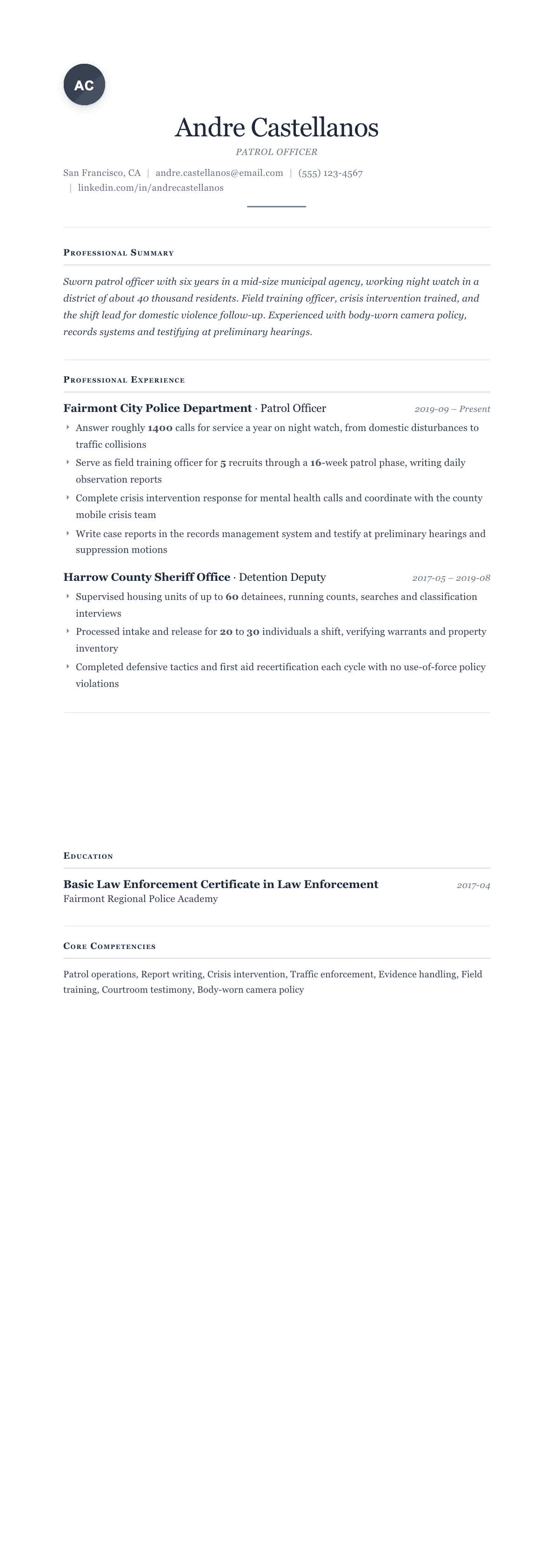
The CVBooster police officer resume guide has a finished example, three written summaries, before and after bullets and answers to the questions people ask.
- Police officer resume examples
- Sheriff deputy resume examples
- Police sergeant resume examples
- Police officer cover letter examples
Build your police officer CV
Create my CV