Radiation Therapist Salary, Career Path and CV
By CVBooster TeamPublished Updated
The median radiation therapist salary in the United States is $105,310 a year, or $50.63 an hour, according to the U.S. Bureau of Labor Statistics (BLS), OEWS May 2025. That is the national middle: states, employers and hours move it, and BLS publishes nothing by years of experience. It is a small field with a six-figure median on an associate's degree, and a regular weekday schedule because treatments are booked ahead.
Below: a check of your own pay, the pay percentiles, hourly pay, pay in every state, the top-paying metro areas, what radiation therapists do, how to become a radiation therapist, the skills that go on a CV, and a CV example.
- Median annual pay
- $105,310
- Median hourly pay
- $50.63
- Employed, May 2025
- 17,070
Am I underpaid as a radiation therapist?
Pick your state and type your pay. You get your place in the BLS pay range for radiation therapists there, as a percentile.
Radiation Therapist salary in the United States
The BLS counts radiation therapists in the occupation Radiation Therapists (SOC 29-1124). Half of them earn less than $105,310 a year and half earn more. The average, which a few very high earners pull up, is $114,990. The lowest-paid tenth earn $80,560 or less, and the highest-paid tenth earn $156,710 or more, which is about 1.9 times as much. The ratio is our arithmetic on two BLS figures.
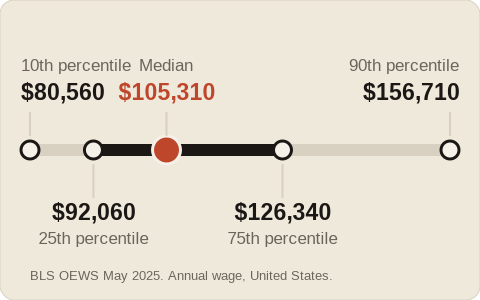
| Measure | Annual wage |
|---|---|
| 10th percentile | $80,560 |
| 25th percentile | $92,060 |
| Median (50th) | $105,310 |
| Mean (average) | $114,990 |
| 75th percentile | $126,340 |
| 90th percentile | $156,710 |
Source: U.S. Bureau of Labor Statistics, Occupational Employment and Wage Statistics (OEWS), May 2025, Radiation Therapists, retrieved 23 to 25 November 2026 from the BLS OEWS May 2025 national, state and metropolitan area files.
Radiation Therapist hourly pay
The median hourly wage for radiation therapists is $50.63, as published by BLS for May 2025. That is the hourly view of the same national middle as the $105,310 annual median above, so use it when an employer quotes you a rate and not a salary. Annual pay for a job with part-time or shift work depends on the hours you are given, which no national table can tell you.
| Measure | Per hour |
|---|---|
| 10th percentile | $38.73 |
| 25th percentile | $44.26 |
| Median (BLS hourly figure) | $50.63 |
| 75th percentile | $60.74 |
| 90th percentile | $75.34 |
For radiation therapists the median is the hourly wage BLS publishes. The other rows are our division of the BLS annual percentiles by 2,080 hours, the full-time year BLS uses to turn hourly pay into annual pay.
Radiation Therapist salary by state
Where you work changes the number more than most things. The highest median is in California, at $166,450. The lowest published median is in West Virginia, at $71,590, a gap of $94,860 a year between two states. The gap is our subtraction of two BLS state medians. All figures below are the annual median wage in each state for May 2025.
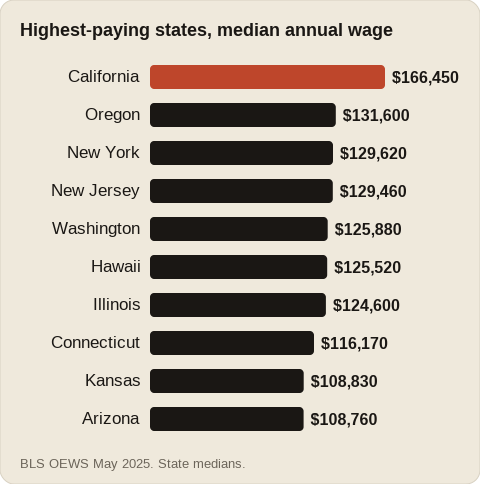
Top-paying states for radiation therapists
| Rank | State | Median wage | vs US median |
|---|---|---|---|
| 1 | California | $166,450 | +$61,140 |
| 2 | Oregon | $131,600 | +$26,290 |
| 3 | New York | $129,620 | +$24,310 |
| 4 | New Jersey | $129,460 | +$24,150 |
| 5 | Washington | $125,880 | +$20,570 |
| 6 | Hawaii | $125,520 | +$20,210 |
| 7 | Illinois | $124,600 | +$19,290 |
| 8 | Connecticut | $116,170 | +$10,860 |
| 9 | Kansas | $108,830 | +$3,520 |
| 10 | Arizona | $108,760 | +$3,450 |
Radiation Therapist salary in all 50 states
| State | Median annual wage |
|---|---|
| California | $166,450 |
| Oregon | $131,600 |
| New York | $129,620 |
| New Jersey | $129,460 |
| Washington | $125,880 |
| Hawaii | $125,520 |
| Illinois | $124,600 |
| Connecticut | $116,170 |
| Kansas | $108,830 |
| Arizona | $108,760 |
| Colorado | $108,020 |
| Utah | $107,660 |
| Maryland | $107,120 |
| Massachusetts | $106,300 |
| New Hampshire | $106,270 |
| Texas | $105,770 |
| Montana | $105,400 |
| Virginia | $103,310 |
| Maine | $101,980 |
| Vermont | $101,060 |
| Florida | $100,920 |
| South Carolina | $100,790 |
| Pennsylvania | $100,540 |
| New Mexico | $100,010 |
| Missouri | $99,890 |
| Idaho | $99,660 |
| North Carolina | $99,250 |
| Nebraska | $98,670 |
| Ohio | $98,650 |
| Oklahoma | $98,390 |
| Minnesota | $98,000 |
| Kentucky | $97,760 |
| South Dakota | $97,470 |
| Indiana | $96,690 |
| Michigan | $95,890 |
| Louisiana | $94,710 |
| Georgia | $94,460 |
| Wisconsin | $93,600 |
| Nevada | $92,990 |
| Mississippi | $88,100 |
| Alabama | $87,330 |
| Tennessee | $83,520 |
| Iowa | $81,610 |
| Arkansas | $78,950 |
| West Virginia | $71,590 |
| Alaska | Not published by BLS |
| Delaware | Not published by BLS |
| North Dakota | Not published by BLS |
| Rhode Island | Not published by BLS |
| Wyoming | Not published by BLS |
BLS does not publish a figure for Alaska, Delaware, North Dakota, Rhode Island, Wyoming, usually because there are too few radiation therapists in the survey sample to report one safely.
Top-paying metro areas for radiation therapists
| Metro area | Median wage | Employed |
|---|---|---|
| San Jose-Sunnyvale-Santa Clara, CA | $206,350 | 130 |
| San Francisco-Oakland-Fremont, CA | $205,670 | 220 |
| Sacramento-Roseville-Folsom, CA | $182,240 | 110 |
| San Diego-Chula Vista-Carlsbad, CA | $171,500 | 140 |
| Los Angeles-Long Beach-Anaheim, CA | $169,150 | 480 |
| New York-Newark-Jersey City, NY-NJ | $135,550 | 960 |
| Seattle-Tacoma-Bellevue, WA | $133,410 | 250 |
| Riverside-San Bernardino-Ontario, CA | $130,800 | n/a |
| Portland-Vancouver-Hillsboro, OR-WA | $128,650 | 130 |
| Urban Honolulu, HI | $125,520 | n/a |
BLS publishes the radiation therapist median for 75 metro areas; the national median is $105,310. 2 of these ten count fewer than 100 radiation therapists or have no published headcount, so treat them as rough. Source: U.S. Bureau of Labor Statistics, OEWS May 2025, metropolitan area estimates.
Compare radiation therapist pay
Put two states side by side, or set radiation therapists next to another job. Every figure is from BLS OEWS May 2025.
| Measure | California | West Virginia |
|---|---|---|
| Median annual wage | $166,450 | $71,590 |
| Median hourly wage | $80.02 | $34.42 |
| 10th percentile | $130,150 | $54,880 |
| 25th percentile | $131,570 | $54,880 |
| 75th percentile | $182,140 | $104,900 |
| 90th percentile | $208,100 | $106,140 |
| Employed, May 2025 | 1,720 | 120 |
The California median is $94,860 a year higher. That difference is our subtraction of two BLS state medians. n/a means this page has only the BLS median for that state so far, or BLS released no figure for it. Source: BLS OEWS May 2025, Radiation Therapists.
Starting pay for radiation therapists
BLS does not publish pay by years of experience, so nobody can honestly quote an official entry-level radiation therapist salary. What the data gives is the bottom of the market. One in ten radiation therapists earns $80,560 or less, and one in four earns $92,060 or less. Read those as the low end of the national range, not as what a new graduate will be offered, because older workers sit in the bottom tenth too.
Outpatient centers pay the most, hospitals hire the most
BLS gives radiation therapist medians for three settings. Outpatient care centers lead at $127,680, offices of physicians follow at $110,610, and hospitals pay $104,260.
The order runs opposite to the jobs. Hospitals employ 60 percent of radiation therapists and outpatient centers only 5 percent, so the best-paying setting is also the hardest to get into by sheer numbers. The outpatient premium over a hospital is $23,420 a year at the median, by our subtraction. BLS does not say what drives it.
California pays in a different league
California has the top state median at $166,450, $34,850 above second-placed Oregon. Of the ten best-paying metro areas, 6 are in California. The top three are San Jose-Sunnyvale-Santa Clara, CA ($206,350, about 130 employed), San Francisco-Oakland-Fremont, CA ($205,670, about 220 employed) and Sacramento-Roseville-Folsom, CA ($182,240, about 110 employed).
These are small workforces. With 17,400 jobs in the whole country, a metro median can rest on a hundred or so therapists and move noticeably from one year to the next. BLS published a state median for 45 states, not all of them.
Treating with radiation or imaging with it
Radiologic technologists also start with an associate's degree, and BLS lists them as a similar occupation, but they take diagnostic images while radiation therapists deliver treatment. The radiologic technologist median is $80,110, which puts radiation therapists $25,200 ahead by our subtraction.
The trade-off is the size of the field. BLS projects about 700 openings a year for radiation therapists and growth of 3 percent, and notes that more efficient techniques, which let patients finish in fewer visits, may limit demand. The step up BLS names is medical dosimetrist, with a median of $147,470 and a bachelor's degree as the usual entry.
Related jobs
- Radiology Tech salary and career path: Radiologic technologists are on the BLS similar list: the same associate's degree entry, with imaging instead of treatment.
- Ultrasound Tech salary and career path: Diagnostic medical sonographers are also on the BLS similar list, an associate's degree job in imaging.
- Respiratory Therapist salary and career path: Another associate's degree therapy job BLS lists as similar to radiation therapists.
What radiation therapists do
Radiation therapists give doses of radiation to patients who have cancer or other serious diseases. They run machines such as linear accelerators that aim concentrated radiation at the region of the tumor, treatment that may shrink or eliminate it.
They work on oncology teams alongside medical dosimetrists, who calculate the dose, medical physicists, who help plan treatments and check that radiation output is accurate, oncology nurses, and radiation oncologists, the physicians who specialize in radiation therapy.
Duties BLS lists
- Explain the treatment plan to the patient and answer questions about treatment
- Protect patients and themselves from improper exposure to radiation
- Locate the tumor so the patient is positioned correctly for each treatment
- Calibrate and operate the machine that delivers the radiation
- Monitor the patient for unusual reactions to the treatment
- Keep detailed records of each treatment
A typical day
Treatments are planned in advance, so the day runs to a booked list. For each patient the therapist checks the plan, answers questions, uses the tumor location to get the positioning right, calibrates the machine and then delivers the dose from a separate room while watching for any unusual reaction. Every session goes into a detailed record. Patients come back over multiple weeks, so the same people return day after day.
Where they work
- Hospitals employed 60 percent of radiation therapists, offices of physicians 28 percent and outpatient care centers 5 percent.
- Safety procedures keep the therapist in a different room while radiation is delivered, and a film badge dosimeter tracks each therapist's exposure.
- The job means standing for long periods, and you may need to lift or turn patients.
- Most work full time on a regular schedule, because radiation therapy procedures are usually planned in advance.
Source: U.S. Bureau of Labor Statistics, Occupational Outlook Handbook, Radiation Therapists, read 25 November 2026. BLS counted about 17,400 jobs in 2025 and projects 3% growth from 2025 to 2035, about as fast as the average for all occupations.
How to become a radiation therapist: the career path
Typical entry-level education, according to BLS: associate's degree. BLS says most radiation therapists hold an associate's or bachelor's degree in radiation therapy, and most states then require a license or certification, which often means passing a national certification exam. Each step below comes from the BLS Occupational Outlook Handbook, and the last step is the pay.
- 1Study
Associate's or bachelor's degree in radiation therapy
Employers usually prefer a degree in radiation therapy or a related healthcare or science field, and some positions accept a certificate program. Courses cover radiation therapy procedures, human anatomy and physiology, physics and algebra, often with clinical experience.
- 2Certify
Certification exam
Certification typically requires an associate's or higher degree from an approved radiation therapy program, adherence to ethical standards and a pass on the exam, which covers radiation protection, treatment planning, and patient care and education.
- 3License
State license or certification
Most states require one. Requirements vary but may include graduating from an accredited program and passing an exam or earning certification from a professional organization.
- 4Requirements
CPR or basic life support
Many jobs also require cardiopulmonary resuscitation (CPR) or basic life support (BLS) certification.
- 5Advance
Medical dosimetrist
With additional education and certification, therapists may become medical dosimetrists, who calculate the correct dose of radiation used to treat cancer.
- 6Pay
Median $105,310 a year
BLS median annual wage for radiation therapists. The lowest-paid tenth earn $80,560 or less and the highest-paid tenth earn $156,710 or more.
The next pay step
Medical dosimetrist
$147,470 median a year
+$42,160 a year vs the radiation therapist median
BLS says radiation therapists may become medical dosimetrists with additional education and certification.
Pay: U.S. Bureau of Labor Statistics, OEWS May 2025, Medical Dosimetrists, set against Radiation Therapists. Each difference is our subtraction of two BLS national medians, the next job's minus the radiation therapist median.
Steps 1 to 5 for radiation therapists: U.S. Bureau of Labor Statistics, Occupational Outlook Handbook, Radiation Therapists, "How to Become One", read 25 November 2026. Pay step: U.S. Bureau of Labor Statistics, OEWS May 2025.
Radiation Therapist skills and certifications
These come from the BLS Occupational Outlook Handbook description of the job, because CVBooster has no radiation therapist resume guide yet. Put the ones you really have near the top of your CV, in the words the job ad uses.
Core skills
People skills
Licenses and certifications
- Radiation therapy certification exam, professional certifying organization
- State license or certification, state licensing agency, required in most states
- CPR or Basic Life Support (BLS), required by many employers
Radiation Therapist salary questions
How much does a radiation therapist make a year?
The BLS median for radiation therapists is $105,310 a year in May 2025, and the mean is $114,990. The lowest tenth earn $80,560 or less and the highest tenth $156,710 or more, a wide range for a job entered with an associate's degree.
How much do radiation therapists make an hour?
$50.63 an hour at the national median. Most radiation therapists work full time on a regular schedule, BLS says, because treatments are planned in advance, so the hours behind a yearly figure are fairly predictable.
Which state pays radiation therapists the most?
Of the 45 states with a published BLS median, California is highest at $166,450, then Oregon at $131,600 and New York at $129,620. BLS did not publish a median for the others, so they are missing from the state tables.
What degree do you need to be a radiation therapist?
Typically an associate's or bachelor's degree in radiation therapy, though some positions accept a certificate program. Most states also require a license or certification, often through a national certification exam on radiation protection, treatment planning, and patient care and education.
Is radiation therapy a safe job?
BLS says therapists must know the risks of working with radiation and radioactive materials and follow safety procedures. Those procedures put the therapist in a different room while the radiation is given and require a film badge dosimeter to track exposure.
Is radiation therapist a growing career?
Slowly. BLS projects jobs to go from 17,400 in 2025 to 17,900 in 2035, a rise of 500 or 3 percent, with about 700 openings a year. An aging population raises demand, while treatments that need fewer visits may hold it back.
Sources and method
- Pay: U.S. Bureau of Labor Statistics, Occupational Employment and Wage Statistics (OEWS), May 2025, Radiation Therapists (SOC 29-1124), national, state and metro area estimates, retrieved 23 to 25 November 2026 from the BLS OEWS May 2025 national, state and metropolitan area files. Wages are before tax. BLS defines what its wage figure includes and leaves out in the OEWS technical notes.
- The job, the route in and the outlook: U.S. Bureau of Labor Statistics, Occupational Outlook Handbook, Radiation Therapists, read 25 November 2026.
- Skills and certifications: the OOH page above. CV example: the CVBooster radiologic technologist resume guide.
- Where we subtract or divide two BLS figures on this radiation therapist page, the page says so. The pay check is an estimate between the published BLS percentiles for radiation therapists and says so. Nothing else here is estimated.
Radiation Therapist CV example

CVBooster has no radiation therapist resume guide yet. The radiologic technologist guide is the closest, with a finished example, three written summaries, before and after bullets and answers to the questions people ask.
Build your radiation therapist CV
Create my CV