Electrical Power Engineer Resume Examples: free score
Charge Up Your Electrical Power Engineer Resume
By Mustafa Tarabya, founder of CVBooster · Published · Updated
Build an electrical power engineer resume showcasing power systems design, protection engineering, and grid integration expertise with templates designed for utility and engineering firms.
Sample resumes for a electrical power engineer
The same electrical power engineer content laid out in three CVBooster templates, so you can see what the finished document looks like before you write a word.
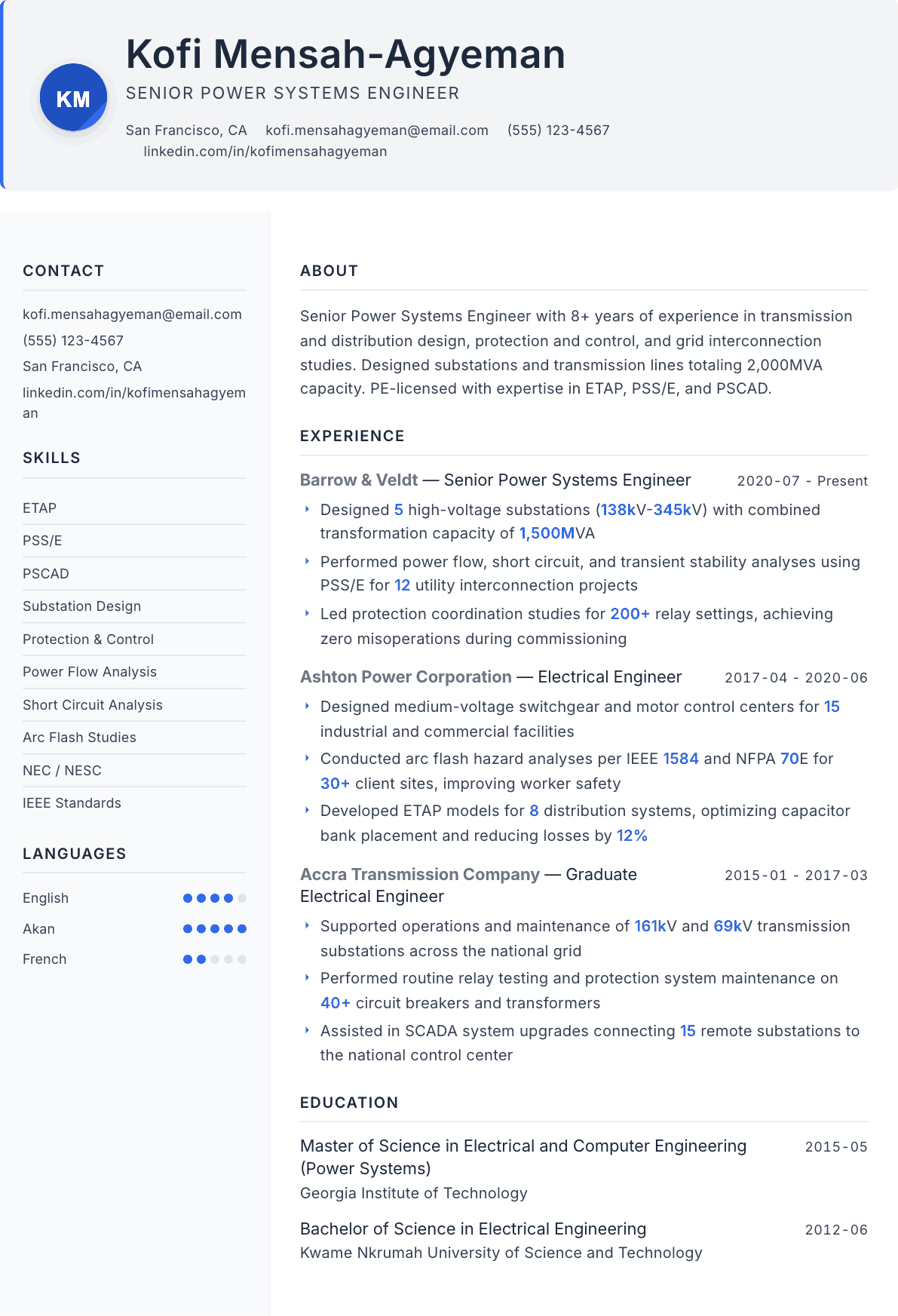
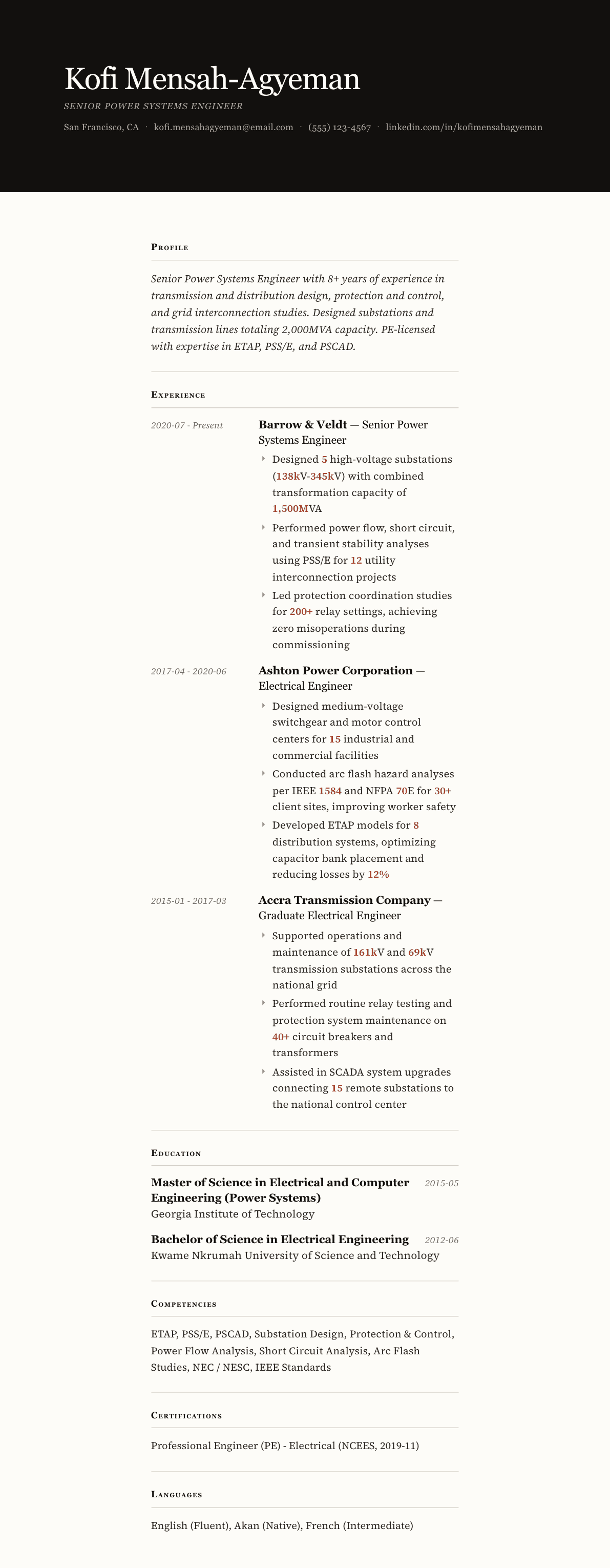
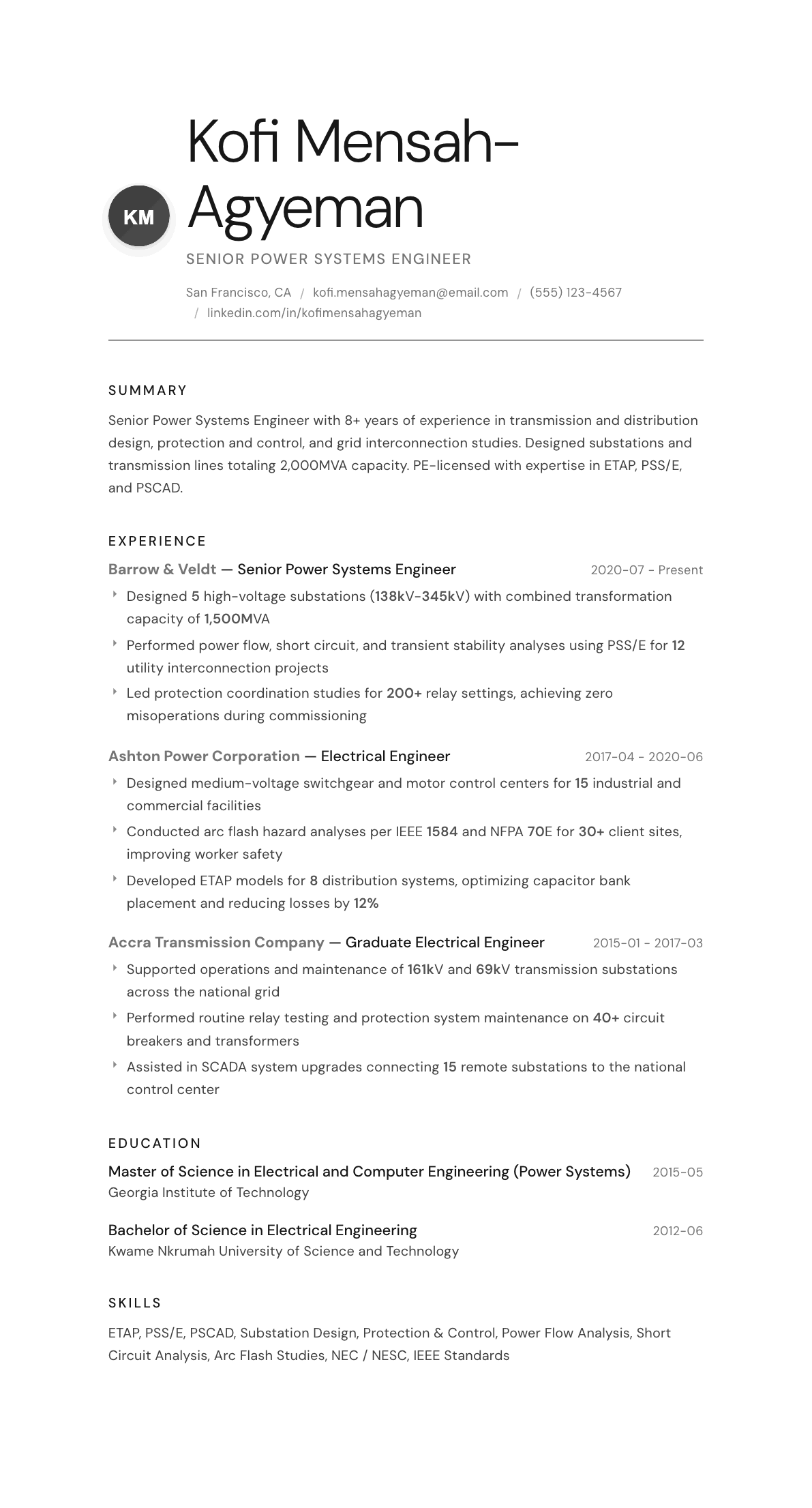
Example Electrical Power Engineer summary
PE-licensed Electrical Power Engineer with 8+ years in transmission, distribution, and substation design. Designed systems totaling 2,000MVA using ETAP, PSS/E, and PSCAD. Expert in protection coordination, arc flash analysis, and grid interconnection studies. IEEE Senior Member with international utility experience.
Skills to list on a Electrical Power Engineer resume
- ETAP
- PSS/E
- PSCAD
- Substation Design
- Protection Engineering
- Power Flow Analysis
- Short Circuit Analysis
- Arc Flash (IEEE 1584)
- Transmission Line Design
- NEC / NESC
- IEEE Standards
- SCADA / EMS
What actually gets this resume read
- List power systems software prominently: ETAP, PSS/E, PSCAD, SKM, EasyPower, CYME.
- Quantify system capacity: MVA, kV levels, and number of substations or feeders designed.
- Include IEEE and NEC/NESC standards referenced in your work.
- Highlight PE license and any specialized certifications near the top of your resume.
- Describe protection engineering experience: relay coordination, arc flash, and fault analysis.
How to write a electrical power engineer resume
Power engineering hiring runs on voltage class, study type and license. A utility transmission group, an industrial owner, an engineering procurement and construction contractor and a renewable developer all post for an electrical power engineer, and each one is checking a different list. The utility wants relay settings and interconnection studies. The industrial owner wants arc flash, coordination and plant distribution. The contractor wants substation packages produced on schedule.
The resume that gets a callback answers three questions in the first fifteen seconds: what voltages have you worked at, which study software do you drive, and are you licensed. Everything else supports those answers.
What follows is the structure hiring managers in transmission, distribution, substation and industrial power expect, three summaries covering a graduate engineer through a lead, before and after bullets built from studies and design packages, and the questions power engineers ask when they move between utility, consulting and industrial work.
Format: voltage class and license before anything else
Put PE and the states you are registered in immediately after your name, because a large share of power postings will not advance an unlicensed candidate past the screen for senior roles. Underneath, give the voltage range you have worked at: low voltage distribution, medium voltage plant systems, or transmission at the kV classes you have designed and studied.
One page while you are a study engineer, two once you are leading packages. Keep the layout single column and plain, because utility and contractor recruiting systems mangle tables and sidebars, and a dropped registration line costs you the interview.
- Header: name, PE and states, voltage classes, location, phone, email.
- Order: summary, licensure, technical skills and software, engineering experience, key projects and studies, education.
- Add NERC or utility standard experience as its own line if you have worked in a bulk electric system environment.
Summary: system, study type, and the scale in MVA or kV
Say what part of the system you own. Generation interconnection, transmission line design, substation physical and protection design, distribution planning, industrial plant power, or protection and control commissioning. Then name the studies you personally run and the capacity you have designed for, expressed the way the industry writes it, in kV and MVA.
Add one line on the environment. Working inside a utility with internal standards, working for a consultant across many utility standards, or working for an owner in a continuous process plant are three different disciplines, and hiring managers screen for the one they run.
Experience: studies, settings, and drawing packages
Lead each role with the studies you produced. Load flow and voltage drop, short circuit and equipment duty, protective device coordination, arc flash incident energy per IEEE 1584, motor starting, harmonic analysis against IEEE 519 limits, transient stability, ground grid design to IEEE 80, and interconnection studies including feasibility, system impact and facilities studies.
Then show protection and control work in concrete terms: relay families you have set and tested such as SEL, GE or Schweitzer replacements, the settings files you produced, coordination curves you plotted, relay logic you wrote, and commissioning support you gave in the field. Protection engineers who have stood at a panel during testing are scarce and should say so.
Finish with design deliverables. Single line and three line diagrams, protection and metering schematics, control schematics, panel layouts, conduit and cable schedules, grounding and lightning protection plans, and bills of material. Give sheet counts or package sizes so a reviewer knows whether you produced a small retrofit or a full substation package.
Software and standards: the two lists recruiters filter on
Name the analysis platforms individually because postings screen on them by name: ETAP, SKM PowerTools, EasyPower, CYME, PSS/E, PSCAD, ASPEN OneLiner, DIgSILENT PowerFactory, CDEGS for grounding, and PLS-CADD for line design. State which ones you build models in versus which ones you have only reviewed output from, since an interviewer will find out either way.
Standards deserve their own line: NEC and NESC for installation and clearances, the IEEE standards for arc flash, grounding, harmonics and protection, NFPA 70E for electrical safety programs, and NERC reliability standards if you have worked on the bulk system. These are the exact phrases screening filters use.
Education, exams and field credibility
Give the ABET accredited degree, the FE and the PE with the Power depth exam named, because that depth choice tells a utility you sat the right exam. Graduate work in power systems is worth a line naming the topic if it involved modeling or protection.
Add safety and field credentials that a plant or utility values: NFPA 70E training, arc flash and switching qualification, confined space or substation entry training, and any utility specific qualification card you have held. In this discipline, field access credentials remove a real barrier to putting you on a project.
Electrical Power Engineer resume summary examples
Graduate power engineer
Electrical engineering graduate with a power systems focus and 1 year in a consulting studies group. Built ETAP models for 12 industrial facilities, ran load flow and short circuit cases, and produced arc flash incident energy tables and equipment labels for a 480 V plant distribution system.
Protection engineer, six years
PE licensed power engineer with 6 years in substation protection and control at 69 kV and 138 kV. Produced relay settings for 40 line and transformer terminals, wrote coordination and fault studies in ASPEN, and supported commissioning and end to end testing on 9 substation projects.
Lead substation engineer
Lead electrical power engineer registered in 5 states with 13 years across transmission and substation design up to 345 kV. Leads 6 engineers, owns interconnection and facilities studies in PSS/E and PSCAD, and has delivered 20 substation packages from conceptual layout to as built turnover.
Work experience bullets: before and after
Before: Performed power system studies using ETAP.
After: Built and validated ETAP models for a 3 substation industrial campus, ran load flow, short circuit and motor starting cases, and identified 2 breakers exceeding interrupting duty that were replaced before a plant expansion energized.
The model scope, the case types and a finding with a consequence turn tool use into engineering.
Before: Did arc flash analysis for a client.
After: Completed an arc flash study to IEEE 1584 across 640 buses, adjusted instantaneous settings to reduce incident energy at 12 motor control centers, and issued the label set and an NFPA 70E boundary schedule.
Bus count, the mitigation you designed and the deliverables show the full study rather than a report title.
Before: Set relays for substation projects.
After: Produced protective relay settings for 22 SEL terminals covering line distance, transformer differential and bus protection, plotted coordination curves against upstream utility devices and supported end to end testing during commissioning.
Naming relay families, protection functions and the testing stage proves hands on protection work.
Before: Worked on transmission line design.
After: Designed 11 miles of 138 kV single circuit line in PLS-CADD: structure spotting, conductor sag and tension over varied terrain, clearance checks to NESC and foundation loading for the structural group.
Line length, voltage, software and the clearance code define exactly what part of the design you owned.
Before: Supported the interconnection process for renewable projects.
After: Ran system impact studies for 4 solar and storage interconnections totaling 300 MW in PSS/E and PSCAD, including steady state contingency screening, reactive capability checks and a dynamic model validation against the inverter vendor data.
Study type, capacity and the dynamic modeling detail are what an interconnection group screens on.
Hard skills
- ETAP modeling
- SKM PowerTools and EasyPower
- PSS/E and PSCAD
- ASPEN OneLiner
- Load flow and short circuit analysis
- Protective relay coordination and settings
- Arc flash analysis to IEEE 1584
- Substation physical and protection design
- Ground grid design to IEEE 80
- Harmonic analysis to IEEE 519
- Transmission line design in PLS-CADD
- NEC and NESC application
- SCADA and energy management interfaces
- Generation interconnection studies
Soft skills
- Utility standard interpretation
- Commissioning coordination with field crews
- Client and owner engineer communication
- Checking and sealing the work of others
- Schedule ownership on multi discipline packages
Certifications worth listing
- Professional Engineer (PE), Electrical and Computer with Power depth (State board of professional engineers, exam by NCEES)
- Engineer in Training (EIT) after the FE exam (NCEES and the state licensing board)
- NERC System Operator Certification (North American Electric Reliability Corporation)
- Certified Energy Manager (CEM) (Association of Energy Engineers)
- NFPA 70E Electrical Safety Training (National Fire Protection Association)
Mistakes that cost electrical power engineer candidates the interview
- Leaving out voltage classes, which forces a transmission hiring manager to assume your experience stops at building distribution.
- Listing every study platform without saying which ones you build models in and which ones you only read reports from.
- Describing design work without sheet counts or package scope, so a contractor cannot judge your production rate.
- Omitting commissioning and field support, the experience that separates a study engineer from a project engineer.
- Referring to codes generically instead of naming NEC, NESC, NFPA 70E and the relevant IEEE standards that screening filters look for.
- Burying the PE registration states at the bottom when interstate consulting work depends on them.
Electrical Power Engineer resume questions
Which voltage levels should I put on my resume?
List the highest class you have designed or studied at and the range beneath it, because a utility screening for transmission work will discard a resume that only mentions low voltage. Be honest about the difference between designing at a level and reviewing someone else's work at it.
Is the PE license required for power engineering jobs?
Consulting and utility design roles above the entry level almost always require it, since drawings and studies are sealed. Industrial plant and manufacturer application roles often do not, though the license still moves you up the pile when two candidates are otherwise equal.
How do I show protection and control experience if I mostly ran studies?
Separate the study work from the settings work and be precise. Coordination studies, fault current calculations and relay setting sheets are protection deliverables you can claim. Commissioning and testing you only observed should be described as support rather than execution.
How do I move from consulting into a utility, or the other way?
Name the standards environment in your summary. Moving into a utility, stress that you have worked to multiple utility standards and can adopt theirs quickly. Moving into consulting, stress billable throughput, concurrent projects and client facing deliverables rather than internal process.
Should renewable interconnection work go under experience or projects?
Both. Keep the employer bullets about the study process you own, then add a short project list naming each interconnection by technology and capacity in MW. Developers and independent system operators screen on capacity and technology, so make those numbers easy to find.
Related resume examples
- Solar Energy Engineer Resume example
- Power Plant Operator Resume example
- Utility Manager Resume example
- Power Systems Engineer Resume example
- Electrical Design Engineer Resume example
- Electrical Engineer Resume example