Forensic Scientist Salary, Career Path and CV
By CVBooster TeamPublished Updated
The median forensic scientist salary in the United States is $72,060 a year, or $34.65 an hour, according to the U.S. Bureau of Labor Statistics (BLS), OEWS May 2025. That is the national middle: states, employers and hours move it, and BLS publishes nothing by years of experience. BLS calls the job forensic science technician, and the figures cover crime scene and laboratory work together. Almost every paycheck in this field comes from a state or local government, so the agency and the state matter more than any private employer.
Below: a check of your own pay, the pay percentiles, hourly pay, pay by state, the top-paying metro areas, what forensic scientists do, how to become a forensic scientist, the skills that go on a CV, and a CV example.
- Median annual pay
- $72,060
- Median hourly pay
- $34.65
- Employed, May 2025
- 19,120
Am I underpaid as a forensic scientist?
Pick your state and type your pay. You get your place in the BLS pay range for forensic scientists there, as a percentile.
Forensic Scientist salary in the United States
The BLS counts forensic scientists in the occupation Forensic Science Technicians (SOC 19-4092). Half of them earn less than $72,060 a year and half earn more. The average, which a few very high earners pull up, is $79,200. The lowest-paid tenth earn $48,250 or less, and the highest-paid tenth earn $117,250 or more, which is about 2.4 times as much. The ratio is our arithmetic on two BLS figures.
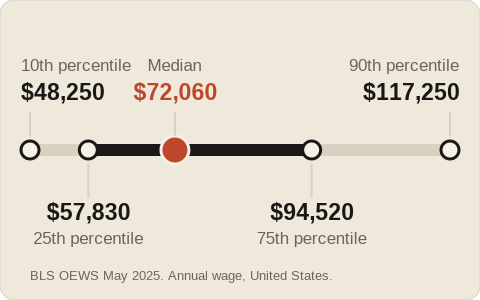
| Measure | Annual wage |
|---|---|
| 10th percentile | $48,250 |
| 25th percentile | $57,830 |
| Median (50th) | $72,060 |
| Mean (average) | $79,200 |
| 75th percentile | $94,520 |
| 90th percentile | $117,250 |
Source: U.S. Bureau of Labor Statistics, Occupational Employment and Wage Statistics (OEWS), May 2025, Forensic Science Technicians, retrieved 23 to 25 November 2026 from the BLS OEWS May 2025 national, state and metropolitan area files.
Forensic Scientist hourly pay
The median hourly wage for forensic scientists is $34.65, as published by BLS for May 2025. That is the hourly view of the same national middle as the $72,060 annual median above, so use it when an employer quotes you a rate and not a salary. Annual pay for a job with part-time or shift work depends on the hours you are given, which no national table can tell you.
| Measure | Per hour |
|---|---|
| 10th percentile | $23.20 |
| 25th percentile | $27.80 |
| Median (BLS hourly figure) | $34.65 |
| 75th percentile | $45.44 |
| 90th percentile | $56.37 |
For forensic scientists the median is the hourly wage BLS publishes. The other rows are our division of the BLS annual percentiles by 2,080 hours, the full-time year BLS uses to turn hourly pay into annual pay.
Forensic Scientist salary by state
Where you work changes the number more than most things. The highest published median is in Illinois, at $124,790. The lowest published median is in Arkansas, at $44,670, a gap of $80,120 a year between two states. The gap is our subtraction of two BLS state medians. All figures below are the annual median wage in each state for May 2025.
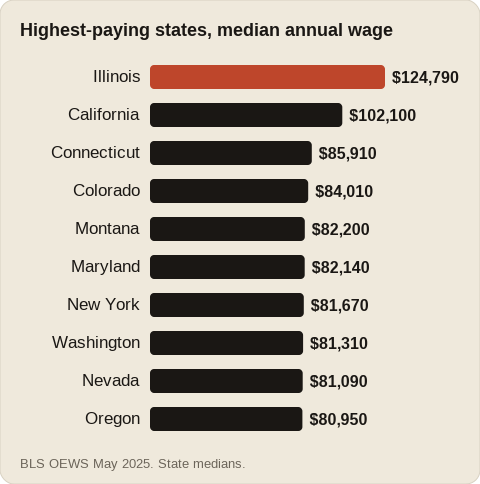
Top-paying states for forensic scientists
| Rank | State | Median wage | vs US median |
|---|---|---|---|
| 1 | Illinois | $124,790 | +$52,730 |
| 2 | California | $102,100 | +$30,040 |
| 3 | Connecticut | $85,910 | +$13,850 |
| 4 | Colorado | $84,010 | +$11,950 |
| 5 | Montana | $82,200 | +$10,140 |
| 6 | Maryland | $82,140 | +$10,080 |
| 7 | New York | $81,670 | +$9,610 |
| 8 | Washington | $81,310 | +$9,250 |
| 9 | Nevada | $81,090 | +$9,030 |
| 10 | Oregon | $80,950 | +$8,890 |
Forensic Scientist salary by state
| State | Median annual wage |
|---|---|
| Illinois | $124,790 |
| California | $102,100 |
| Connecticut | $85,910 |
| Colorado | $84,010 |
| Montana | $82,200 |
| Maryland | $82,140 |
| New York | $81,670 |
| Washington | $81,310 |
| Nevada | $81,090 |
| Oregon | $80,950 |
| Massachusetts | $79,320 |
| Minnesota | $76,960 |
| Vermont | $74,110 |
| Wisconsin | $72,280 |
| Idaho | $71,160 |
| North Dakota | $71,090 |
| Maine | $70,870 |
| Tennessee | $70,500 |
| Virginia | $68,900 |
| Iowa | $67,060 |
| Utah | $66,780 |
| Indiana | $66,520 |
| Oklahoma | $65,940 |
| Nebraska | $65,920 |
| New Mexico | $65,570 |
| Florida | $64,140 |
| Georgia | $63,600 |
| West Virginia | $63,330 |
| Arizona | $63,250 |
| New Jersey | $63,220 |
| Missouri | $62,750 |
| Pennsylvania | $61,580 |
| Kentucky | $61,470 |
| Texas | $59,870 |
| Alabama | $59,560 |
| North Carolina | $59,240 |
| Mississippi | $52,850 |
| Wyoming | $52,100 |
| South Carolina | $51,830 |
| South Dakota | $51,690 |
| Arkansas | $44,670 |
| Alaska | Not published by BLS |
| Delaware | Not published by BLS |
| Hawaii | Not published by BLS |
| Kansas | Not published by BLS |
| Louisiana | Not published by BLS |
| Michigan | Not published by BLS |
| New Hampshire | Not published by BLS |
| Ohio | Not published by BLS |
| Rhode Island | Not published by BLS |
BLS does not publish a figure for Alaska, Delaware, Hawaii, Kansas, Louisiana, Michigan, New Hampshire, Ohio, Rhode Island, usually because there are too few forensic scientists in the survey sample to report one safely.
Top-paying metro areas for forensic scientists
| Metro area | Median wage | Employed |
|---|---|---|
| San Jose-Sunnyvale-Santa Clara, CA | $137,280 | 140 |
| Chicago-Naperville-Elgin, IL-IN | $112,790 | 260 |
| San Francisco-Oakland-Fremont, CA | $109,930 | 330 |
| Akron, OH | $106,330 | 80 |
| San Diego-Chula Vista-Carlsbad, CA | $105,320 | 220 |
| Los Angeles-Long Beach-Anaheim, CA | $104,410 | 1,170 |
| Oxnard-Thousand Oaks-Ventura, CA | $102,810 | 80 |
| Sacramento-Roseville-Folsom, CA | $101,780 | 160 |
| New Haven, CT | $98,250 | 70 |
| Seattle-Tacoma-Bellevue, WA | $95,460 | 230 |
BLS publishes the forensic scientist median for 92 metro areas; the national median is $72,060. 3 of these ten count fewer than 100 forensic scientists or have no published headcount, so treat them as rough. Source: U.S. Bureau of Labor Statistics, OEWS May 2025, metropolitan area estimates.
Compare forensic scientist pay
Put two states side by side, or set forensic scientists next to another job. Every figure is from BLS OEWS May 2025.
| Measure | Illinois | Arkansas |
|---|---|---|
| Median annual wage | $124,790 | $44,670 |
| Median hourly wage | $60.00 | $21.48 |
| 10th percentile | $65,780 | $38,470 |
| 25th percentile | $79,190 | $41,280 |
| 75th percentile | $129,590 | $50,520 |
| 90th percentile | $148,790 | $66,440 |
| Employed, May 2025 | 370 | 100 |
The Illinois median is $80,120 a year higher. That difference is our subtraction of two BLS state medians. n/a means this page has only the BLS median for that state so far, or BLS released no figure for it. Source: BLS OEWS May 2025, Forensic Science Technicians.
Starting pay for forensic scientists
BLS does not publish pay by years of experience, so nobody can honestly quote an official entry-level forensic scientist salary. What the data gives is the bottom of the market. One in ten forensic scientists earns $48,250 or less, and one in four earns $57,830 or less. Read those as the low end of the national range, not as what a new graduate will be offered, because older workers sit in the bottom tenth too.
Crime scene or laboratory: two different jobs
BLS counts both under one title, but the working life differs. Crime scene technicians travel through their jurisdiction, may work outdoors in any weather, and may work staggered day, evening or night shifts plus overtime, because someone must be ready to collect evidence at all hours. Some of them are sworn police officers who entered through a police academy.
Lab technicians usually keep a standard workweek, with on-call duty when a case needs immediate work, and they specialize: DNA, toxicology, ballistics and similar fields learned on the job. Before working cases alone, a technician may need to pass a state proficiency exam or be approved by a lab or accrediting body. BLS does not publish separate pay for the two sides.
A public sector job, with private labs paying less
Local government employs 64 percent and state government 27 percent, so about 91 percent of forensic science technicians work for the public sector, by our addition. State government pays the highest industry median, $74,740, and local government pays $70,050. The national median is $72,060.
Outside government the medians fall: educational services $61,680, testing laboratories $49,600 and healthcare and social assistance $44,770. BLS expects state and local governments to keep hiring to process high caseloads, and projects 13 percent growth from 2025 to 2035.
Illinois, California and the police comparison
Illinois has the highest state median at $124,790, well ahead of California at $102,100. California holds 6 of the 10 best paid metro areas, and Los Angeles-Long Beach-Anaheim, CA has the largest group among them, about 1,170 technicians at $104,410. Several top metros count under a few hundred workers, so their medians are rough. BLS publishes a state median for 41 states.
BLS lists police and detectives as a similar occupation. The police officer median is $76,210, $4,150 above the forensic median, by our subtraction. The hourly median for forensic science technicians is $34.65.
Related jobs
- Police Officer salary and career path: BLS lists police and detectives as a similar occupation, and some crime scene investigators are sworn officers.
- Lawyer salary and career path: Forensic technicians explain their reports to lawyers and may testify in court about their findings.
What forensic scientists do
Forensic scientists help criminal investigations by collecting and analyzing evidence, and most lean toward one of two sides. At the scene they decide what to collect and how, photograph and sketch it, and keep the chain of custody intact. In the lab they run chemical, biological and microscopic analyses and use computers to match DNA and other evidence to people, vehicles or weapons.
Whichever side they work on, they write reports of their findings and methods, explain them to lawyers, detectives and other law enforcement officials, and may be called to testify in court. BLS gives a ballistics example: a technician compares spent cartridge cases with images in a national database and refers possible matches to a forensic scientist for confirmation.
Duties BLS lists
- At the scene: judge what evidence to collect and how
- Photograph and sketch the crime scene
- Record observations such as the location and position of evidence
- Collect evidence, including weapons, fingerprints and bodily fluids
- Catalog and preserve evidence for transfer to crime labs, and reconstruct crime scenes
- In the lab: run chemical, biological and microscopic analyses on evidence
- Examine DNA results from hair, skin cells and other evidence for their meaning to a case
- Consult experts in fields such as toxicology and odontology
- Prepare technical reports, including statistical analyses of evidence
- Operate, maintain and clean lab facilities and equipment
A typical day
For a crime scene technician, the day starts when a call comes in: travel across the jurisdiction, possibly outside in bad weather, then photographs, sketches, fingerprints and evidence bags, each logged for the chain of custody. For a lab technician it is microscopes, chemicals and DNA comparisons on a more standard workweek, with on-call time if a case needs immediate work. Both end at the report, and sometimes at a witness stand.
Where they work
- Forensic science technicians held about 20,100 jobs in 2025. Local government employed 64 percent and state government 27 percent. Healthcare and social assistance, educational services, and testing laboratories employed 2 percent each.
- Some time is spent in an office. Some technicians work outside in all types of weather, others spend many hours in laboratories, and crime scene technicians may travel throughout their jurisdictions.
- Most work full time. Crime scene technicians may work staggered day, evening or night shifts and overtime, because someone must be available at all times. Lab technicians may work a standard week but be on call outside business hours.
Source: U.S. Bureau of Labor Statistics, Occupational Outlook Handbook, Forensic Science Technicians, read 25 November 2026. BLS counted about 20,100 jobs in 2025 and projects 13% growth from 2025 to 2035, much faster than the average for all occupations.
How to become a forensic scientist: the career path
Typical entry-level education, according to BLS: bachelor's degree. BLS says a bachelor's degree is the typical entry, an associate's degree may be enough for some positions, and on-the-job training for a laboratory specialty usually takes less than a year. Each step below comes from the BLS Occupational Outlook Handbook, and the last step is the pay.
- 1Study
Bachelor's degree in a natural science or forensic science
Typical fields are physical science, biology or forensic science, and forensic programs may specialize in toxicology, pathology or DNA. An associate's degree may be enough for some positions.
- 2Or train
Police academy route for some crime scene roles
Some crime scene investigators at police departments are sworn police officers who met the educational requirements to enter a police academy.
- 3Train
On-the-job training
New crime scene technicians may work under experienced staff who teach evidence collection and documentation. Lab specialties are learned on the job, usually in less than a year depending on the specialty.
- 4Certify
Proficiency exam for independent casework
To handle cases independently, technicians may need to pass a proficiency exam through their state government or be approved by a laboratory or accrediting body. Exams may test reading and writing comprehension, laboratory science and pattern recognition.
- 5Credential
Optional certifications
A range of licenses and certifications exists. They are typically not required to enter the job but can show a specific skill. BLS points to CareerOneStop for details.
- 6Pay
Median $72,060 a year
BLS median annual wage for forensic scientists. The lowest-paid tenth earn $48,250 or less and the highest-paid tenth earn $117,250 or more.
Steps 1 to 5 for forensic scientists: U.S. Bureau of Labor Statistics, Occupational Outlook Handbook, Forensic Science Technicians, "How to Become One", read 25 November 2026. Pay step: U.S. Bureau of Labor Statistics, OEWS May 2025.
Forensic Scientist skills and certifications
These come from the CVBooster forensic scientist resume guide, which lists what employers look for on a forensic scientist CV. Put the ones you really have near the top of your CV, in the words the job ad uses.
Core skills
People skills
Licenses and certifications
- Diplomate or Fellow in Criminalistics, American Board of Criminalistics
- Certified Latent Print Examiner, International Association for Identification
- Certified Forensic Toxicologist, American Board of Forensic Toxicology
- AFTE Certification in Firearm and Toolmark Identification, Association of Firearm and Tool Mark Examiners
- GIAC Certified Forensic Examiner (GCFE), Global Information Assurance Certification
Forensic Scientist salary questions
How much does a forensic scientist make?
BLS puts the median for forensic science technicians at $72,060 a year, or $34.65 an hour, in May 2025. A tenth earn $48,250 or less and a tenth $117,250 or more. State government pays the highest industry median, $74,740.
Which state pays forensic scientists the most?
Illinois leads at $124,790, then California at $102,100 and Connecticut at $85,910. BLS has a published median for 41 states, so the state table above does not cover the whole country.
Is a forensic scientist the same as a crime scene investigator?
BLS treats crime scene technicians as one kind of forensic science technician: the ones who collect, document and store evidence at the scene. Others work mainly in laboratories. Some crime scene investigators at police departments are sworn police officers.
What degree do you need to be a forensic scientist?
Typically a bachelor's degree, in physical science, biology or forensic science. BLS says an associate's degree may be enough for some positions. Forensic programs may specialize in toxicology, pathology or DNA, and lab specialties are then learned on the job.
Do forensic scientists testify in court?
They may. BLS says forensic science technicians write reports on their findings and methods, explain the details to lawyers, detectives and other officials, and may be called to testify in court about their findings and methods.
Is forensic science a growing field?
BLS projects 13 percent growth from 2025 to 2035, much faster than the average, with about 2,800 openings a year. It points to high caseloads in state and local governments and to advances that make forensic evidence more useful in trials.
Sources and method
- Pay: U.S. Bureau of Labor Statistics, Occupational Employment and Wage Statistics (OEWS), May 2025, Forensic Science Technicians (SOC 19-4092), national, state and metro area estimates, retrieved 23 to 25 November 2026 from the BLS OEWS May 2025 national, state and metropolitan area files. Wages are before tax. BLS defines what its wage figure includes and leaves out in the OEWS technical notes.
- The job, the route in and the outlook: U.S. Bureau of Labor Statistics, Occupational Outlook Handbook, Forensic Science Technicians, read 25 November 2026.
- Skills and certifications: the CVBooster forensic scientist resume guide.
- Where we subtract or divide two BLS figures on this forensic scientist page, the page says so. The pay check is an estimate between the published BLS percentiles for forensic scientists and says so. Nothing else here is estimated.
Forensic Scientist CV example
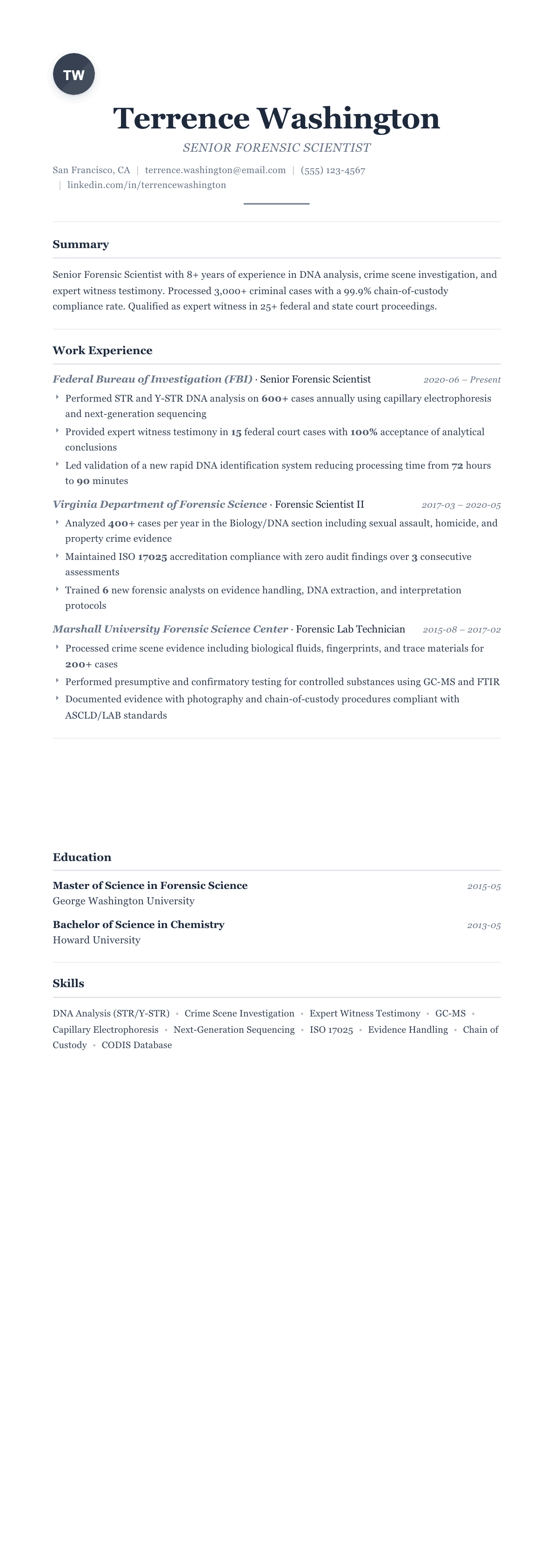
The CVBooster forensic scientist resume guide has a finished example, three written summaries, before and after bullets and answers to the questions people ask.
Build your forensic scientist CV
Create my CV