Optometrist Salary, Career Path and CV
By CVBooster TeamPublished Updated
The median optometrist salary in the United States is $136,570 a year, or $65.66 an hour, according to the U.S. Bureau of Labor Statistics (BLS), OEWS May 2025. That is the national middle: states, employers and hours move it, and BLS publishes nothing by years of experience. Where an optometrist works moves the pay more than you might expect: BLS puts outpatient care centers at $207,030 and offices of optometrists at $129,250, against a national median of $136,570.
Below: a check of your own pay, the pay percentiles, hourly pay, pay in every state, the top-paying metro areas, what optometrists do, how to become an optometrist, the skills that go on a CV, and a CV example.
- Median annual pay
- $136,570
- Median hourly pay
- $65.66
- Employed, May 2025
- 42,790
Am I underpaid as an optometrist?
Pick your state and type your pay. You get your place in the BLS pay range for optometrists there, as a percentile.
Optometrist salary in the United States
The BLS counts optometrists in the occupation Optometrists (SOC 29-1041). Half of them earn less than $136,570 a year and half earn more. The average, which a few very high earners pull up, is $141,550. The lowest-paid tenth earn $74,870 or less, and the highest-paid tenth earn $202,180 or more, which is about 2.7 times as much. The ratio is our arithmetic on two BLS figures.
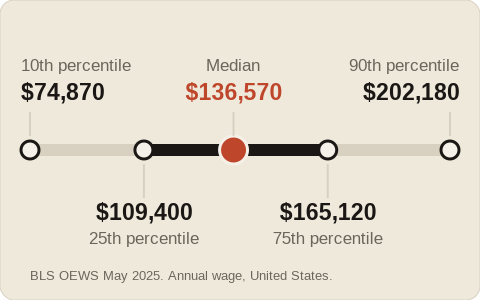
| Measure | Annual wage |
|---|---|
| 10th percentile | $74,870 |
| 25th percentile | $109,400 |
| Median (50th) | $136,570 |
| Mean (average) | $141,550 |
| 75th percentile | $165,120 |
| 90th percentile | $202,180 |
Source: U.S. Bureau of Labor Statistics, Occupational Employment and Wage Statistics (OEWS), May 2025, Optometrists, retrieved 23 to 25 November 2026 from the BLS OEWS May 2025 national, state and metropolitan area files.
Optometrist hourly pay
The median hourly wage for optometrists is $65.66, as published by BLS for May 2025. That is the hourly view of the same national middle as the $136,570 annual median above, so use it when an employer quotes you a rate and not a salary. Annual pay for a job with part-time or shift work depends on the hours you are given, which no national table can tell you.
| Measure | Per hour |
|---|---|
| 10th percentile | $36.00 |
| 25th percentile | $52.60 |
| Median (BLS hourly figure) | $65.66 |
| 75th percentile | $79.38 |
| 90th percentile | $97.20 |
For optometrists the median is the hourly wage BLS publishes. The other rows are our division of the BLS annual percentiles by 2,080 hours, the full-time year BLS uses to turn hourly pay into annual pay.
Optometrist salary by state
Where you work changes the number more than most things. The highest median is in Alaska, at $170,310. The lowest published median is in Oklahoma, at $97,350, a gap of $72,960 a year between two states. The gap is our subtraction of two BLS state medians. All figures below are the annual median wage in each state for May 2025.
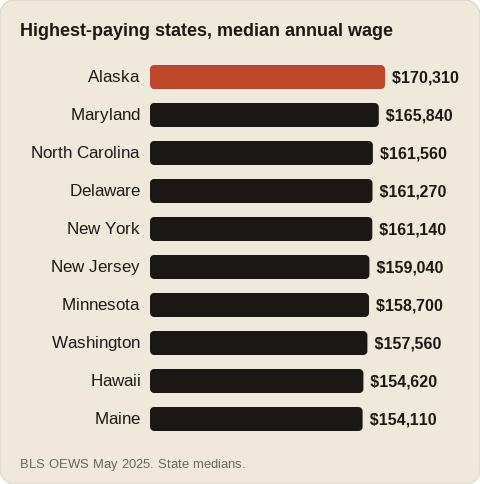
Top-paying states for optometrists
| Rank | State | Median wage | vs US median |
|---|---|---|---|
| 1 | Alaska | $170,310 | +$33,740 |
| 2 | Maryland | $165,840 | +$29,270 |
| 3 | North Carolina | $161,560 | +$24,990 |
| 4 | Delaware | $161,270 | +$24,700 |
| 5 | New York | $161,140 | +$24,570 |
| 6 | New Jersey | $159,040 | +$22,470 |
| 7 | Minnesota | $158,700 | +$22,130 |
| 8 | Washington | $157,560 | +$20,990 |
| 9 | Hawaii | $154,620 | +$18,050 |
| 10 | Maine | $154,110 | +$17,540 |
Optometrist salary in all 50 states
| State | Median annual wage |
|---|---|
| Alaska | $170,310 |
| Maryland | $165,840 |
| North Carolina | $161,560 |
| Delaware | $161,270 |
| New York | $161,140 |
| New Jersey | $159,040 |
| Minnesota | $158,700 |
| Washington | $157,560 |
| Hawaii | $154,620 |
| Maine | $154,110 |
| Colorado | $152,000 |
| Massachusetts | $151,730 |
| Florida | $151,670 |
| Connecticut | $150,340 |
| South Carolina | $145,950 |
| Illinois | $145,620 |
| Alabama | $145,090 |
| New Mexico | $144,660 |
| Wisconsin | $139,720 |
| Kansas | $138,580 |
| Vermont | $137,290 |
| California | $136,300 |
| Michigan | $135,650 |
| Nevada | $135,650 |
| Indiana | $135,500 |
| Pennsylvania | $135,400 |
| Ohio | $134,850 |
| Rhode Island | $134,520 |
| Tennessee | $134,170 |
| Missouri | $133,810 |
| North Dakota | $132,110 |
| Oregon | $132,020 |
| Virginia | $131,570 |
| Kentucky | $128,860 |
| Georgia | $128,830 |
| Texas | $126,000 |
| New Hampshire | $125,560 |
| Iowa | $125,380 |
| Nebraska | $125,040 |
| Arkansas | $124,470 |
| Arizona | $122,250 |
| Utah | $119,070 |
| Louisiana | $118,060 |
| West Virginia | $118,010 |
| Wyoming | $111,400 |
| Mississippi | $108,070 |
| Montana | $104,280 |
| Idaho | $103,390 |
| South Dakota | $102,320 |
| Oklahoma | $97,350 |
Top-paying metro areas for optometrists
| Metro area | Median wage | Employed |
|---|---|---|
| La Crosse-Onalaska, WI-MN | $175,810 | 40 |
| Asheville, NC | $167,980 | 40 |
| Seattle-Tacoma-Bellevue, WA | $167,810 | 420 |
| Anchorage, AK | $167,000 | 30 |
| Durham-Chapel Hill, NC | $166,880 | 40 |
| Peoria, IL | $166,600 | 50 |
| Albuquerque, NM | $165,810 | 70 |
| Dover, DE | $165,660 | 30 |
| Buffalo-Cheektowaga, NY | $165,640 | 160 |
| Santa Rosa-Petaluma, CA | $165,360 | 80 |
BLS publishes the optometrist median for 183 metro areas; the national median is $136,570. 8 of these ten count fewer than 100 optometrists or have no published headcount, so treat them as rough. Source: U.S. Bureau of Labor Statistics, OEWS May 2025, metropolitan area estimates.
Compare optometrist pay
Put two states side by side, or set optometrists next to another job. Every figure is from BLS OEWS May 2025.
| Measure | Alaska | Oklahoma |
|---|---|---|
| Median annual wage | $170,310 | $97,350 |
| Median hourly wage | $81.88 | $46.80 |
| 10th percentile | $98,530 | $59,990 |
| 25th percentile | $134,480 | $76,690 |
| 75th percentile | $203,510 | $149,660 |
| 90th percentile | $218,180 | $174,620 |
| Employed, May 2025 | 60 | 570 |
The Alaska median is $72,960 a year higher. That difference is our subtraction of two BLS state medians. n/a means this page has only the BLS median for that state so far, or BLS released no figure for it. Source: BLS OEWS May 2025, Optometrists.
Starting pay for optometrists
BLS does not publish pay by years of experience, so nobody can honestly quote an official entry-level optometrist salary. What the data gives is the bottom of the market. One in ten optometrists earns $74,870 or less, and one in four earns $109,400 or less. Read those as the low end of the national range, not as what a new graduate will be offered, because older workers sit in the bottom tenth too.
Employer type sets the pay
The OOH gives optometrist medians by industry for May 2025, and the range is wide: outpatient care centers $207,030, retail trade $159,250, offices of physicians $145,630 and offices of optometrists $129,250. The setting where most optometrists work, an optometry office with 61 percent of jobs, is the lowest paying of the four.
So a job inside a medical practice or an outpatient center tends to pay more than the classic private eye clinic, and retail pays more than the optometry office too. BLS does not say why, and these are medians, so plenty of single offers will not follow the pattern.
Optometrist, ophthalmologist or optician
BLS separates three eye jobs. Ophthalmologists are physicians who, like optometrists, treat eye disease, examine eyes and prescribe lenses, but do a wider range of surgeries. Opticians fit and adjust eyeglasses and in some states fill contact lens prescriptions. Optometrists sit in the middle, with a doctoral degree but not a medical degree.
The pay follows the training. The optometrist page gives no ophthalmologist median, but it lists $275,930 for physicians and surgeons as a whole and $47,260 for opticians. Optometrists, at $136,570, also earn $34,380 less than general dentists, another doctoral job on the BLS similar occupations list.
States, metros and demand
BLS published a median in 50 states. Alaska leads at $170,310, then Maryland at $165,840; Oklahoma is lowest at $97,350. Top metros include La Crosse-Onalaska, WI-MN ($175,810; 40 optometrists), Asheville, NC ($167,980; 40 optometrists) and Seattle-Tacoma-Bellevue, WA ($167,810; 420 optometrists); where only a few dozen optometrists are counted, the median is an estimate. The middle half of optometrists nationally earn $109,400 to $165,120.
BLS projects 10 percent job growth from 2025 to 2035 and about 2,000 openings a year. It points to an aging population prone to cataracts and macular degeneration, more myopia, digital eye strain from screens, and rising diabetes, which is linked to diabetic retinopathy.
Related jobs
- Dentist salary and career path: Another doctoral health route on the BLS similar occupations list, diagnosing and treating problems of the mouth.
- Veterinarian salary and career path: Listed by BLS as similar to optometry: a doctoral degree, then clinical care, for animals.
What optometrists do
Optometrists diagnose, manage and treat conditions and diseases of the eye and visual system. They examine eyes, prescribe corrective lenses, and refer patients to other specialists when a health condition, such as an autoimmune disease, could lead to serious eye problems.
Some give specialized care on top of general eye care, for example to patients with low vision (partial sight), or to one group such as infants and children. All states let optometrists prescribe medication, but states differ on which medications, and on whether optometrists may do surgery or other procedures such as vaccinations.
Duties BLS lists
- Perform vision tests and analyze the results
- Diagnose vision problems such as nearsightedness or farsightedness, and eye diseases such as glaucoma
- Prescribe eyeglasses, contact lenses and other visual aids
- Perform minor surgical procedures and prescribe medications, as state law permits
- Provide vision therapy or low-vision rehabilitation
- Give pre- and postoperative care to patients having eye surgery
- Check for other conditions such as diabetes or high blood pressure, and refer patients as needed
- Counsel patients on eye health and general health
A typical day
An optometrist spends the day in an exam room, running vision tests and using instruments to find each patient's prescription. Some visits end with glasses or contact lenses; others turn up signs of glaucoma, diabetes or high blood pressure and lead to treatment or a referral. There may be follow-up care for patients before or after eye surgery, and advice such as how quitting smoking lowers cataract risk. Evening and weekend hours are part of some schedules.
Where they work
- Optometrists held about 45,100 jobs in 2025.
- The largest employers were offices of optometrists (61 percent), offices of physicians (14 percent), retail trade (13 percent), self-employment (5 percent) and outpatient care centers (4 percent).
- The work is office based, in optometry or physician offices, and also in retail settings such as stores that sell eyeglasses.
- Most optometrists work full time, but part-time work is common, and schedules may include evenings and weekends.
Source: U.S. Bureau of Labor Statistics, Occupational Outlook Handbook, Optometrists, read 25 November 2026. BLS counted about 45,100 jobs in 2025 and projects 10% growth from 2025 to 2035, much faster than the average for all occupations.
How to become an optometrist: the career path
Typical entry-level education, according to BLS: doctoral or professional degree. BLS says the Doctor of Optometry (O.D.) program takes 4 years, and applicants need at least 3 years of college first, though most enter with a bachelor's degree. Each step below comes from the BLS Occupational Outlook Handbook, and the last step is the pay.
- 1Study
Undergraduate science
O.D. programs require at least 3 years of undergraduate study, and most applicants hold a bachelor's degree in a field such as biology or physical science. Programs without a set major may still want chemistry, physics and calculus.
- 2Prepare
Optometry entrance exam
Applicants take an entrance exam covering four areas: natural sciences, reading comprehension, physics and quantitative reasoning.
- 3Study
Doctor of Optometry (O.D.), 4 years
Coursework covers anatomy, visual science and the diagnosis and treatment of diseases and disorders of the visual system, with supervised clinical training in settings such as hospitals and private practice.
- 4License
State optometry license
Every state requires a license. You need an O.D. from an accredited school and must pass all sections of a qualifying exam; some states add an exam on clinical skills or optometry law. Licenses are renewed periodically with continuing education.
- 5Specialize
Optional residency year
After the O.D., some optometrists take 1 year of advanced clinical training in an area such as primary care, cornea and contact lenses, or ocular disease.
- 6Certify
Board certification (optional)
Optometrists may earn an optional credential to become board certified, which requires passing an examination.
- 7Pay
Median $136,570 a year
BLS median annual wage for optometrists. The lowest-paid tenth earn $74,870 or less and the highest-paid tenth earn $202,180 or more.
Steps 1 to 6 for optometrists: U.S. Bureau of Labor Statistics, Occupational Outlook Handbook, Optometrists, "How to Become One", read 25 November 2026. Pay step: U.S. Bureau of Labor Statistics, OEWS May 2025.
Optometrist skills and certifications
These come from the CVBooster optometrist resume guide, which lists what employers look for on a optometrist CV. Put the ones you really have near the top of your CV, in the words the job ad uses.
Core skills
People skills
Licenses and certifications
- Doctor of Optometry license, State board of optometry
- Therapeutic Pharmaceutical Agent certification, State licensing board
- Diplomate, American Board of Optometry, American Board of Optometry
- Fellow of the American Academy of Optometry (FAAO), American Academy of Optometry
- Fellow of the Scleral Lens Education Society, Scleral Lens Education Society
More guides
Optometrist salary questions
How much does an optometrist make a year?
The national median for optometrists is $136,570 and the mean is $141,550. The lowest 10 percent earn under $74,870 and the highest 10 percent over $202,180, according to BLS OEWS for May 2025.
How much do optometrists make an hour?
BLS reports a median of $65.66 an hour. Part-time work is common in this job, which makes the hourly figure a fair way to compare offers, and some schedules include evenings and weekends.
How many years does it take to become an optometrist?
The O.D. program is 4 years, after at least 3 years of college; most students finish a bachelor's degree first. An optional year of advanced clinical training can follow for a specialty such as cornea and contact lenses or ocular disease.
Is an optometrist a doctor?
Yes, in the sense BLS uses: optometrists are doctors who focus on eyes and vision, and they hold a Doctor of Optometry degree. They are not physicians. Ophthalmologists are the physicians who treat eye disease and perform a wider range of surgeries.
Where do optometrists earn the most?
By employer, outpatient care centers pay the highest BLS median, $207,030. By state, Alaska leads at $170,310, followed by Maryland at $165,840. The state table above lists every published figure.
Can optometrists prescribe medication?
All states allow it, but the type of medication allowed varies by state. States also differ on whether optometrists may perform surgery or other procedures, such as giving vaccinations. Check the licensing board in the state where you plan to work.
Sources and method
- Pay: U.S. Bureau of Labor Statistics, Occupational Employment and Wage Statistics (OEWS), May 2025, Optometrists (SOC 29-1041), national, state and metro area estimates, retrieved 23 to 25 November 2026 from the BLS OEWS May 2025 national, state and metropolitan area files. Wages are before tax. BLS defines what its wage figure includes and leaves out in the OEWS technical notes.
- The job, the route in and the outlook: U.S. Bureau of Labor Statistics, Occupational Outlook Handbook, Optometrists, read 25 November 2026.
- Skills and certifications: the CVBooster optometrist resume guide.
- Where we subtract or divide two BLS figures on this optometrist page, the page says so. The pay check is an estimate between the published BLS percentiles for optometrists and says so. Nothing else here is estimated.
Optometrist CV example
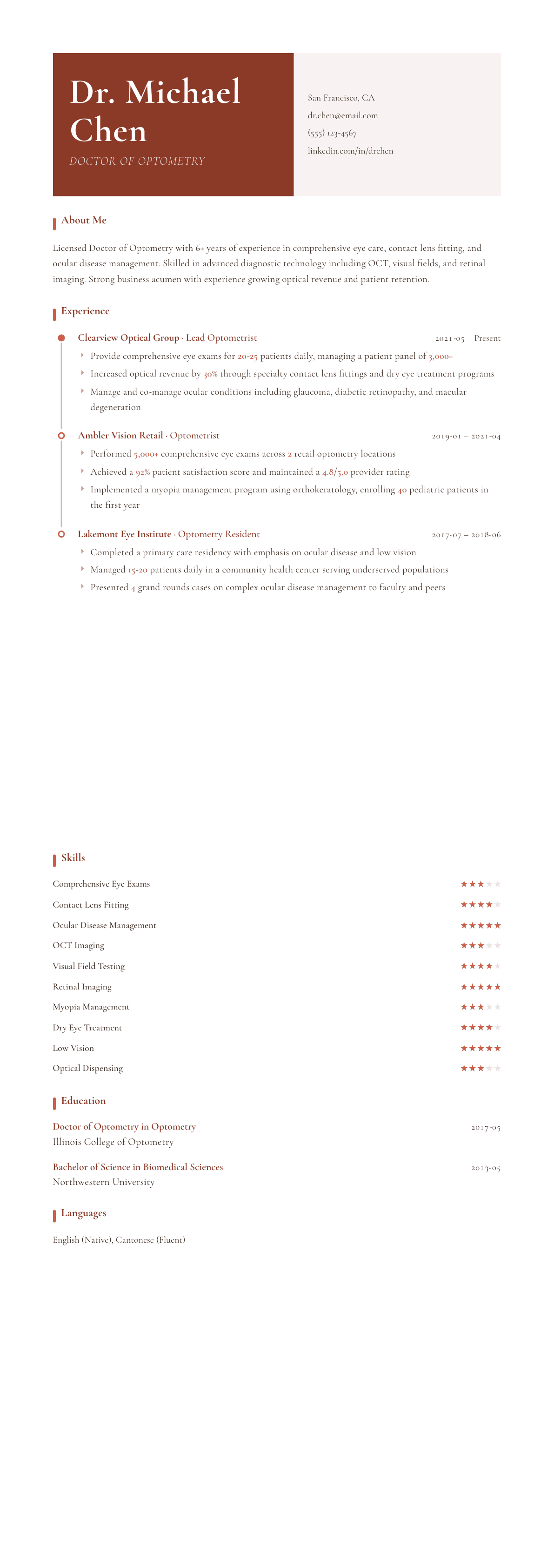
The CVBooster optometrist resume guide has a finished example, three written summaries, before and after bullets and answers to the questions people ask.
Build your optometrist CV
Create my CV