Biomedical Engineer Salary, Career Path and CV
By CVBooster TeamPublished Updated
The median biomedical engineer salary in the United States is $109,370 a year, or $52.58 an hour, according to the U.S. Bureau of Labor Statistics (BLS), OEWS May 2025. That is the national middle: states, employers and hours move it, and BLS publishes nothing by years of experience. BLS counts the job as bioengineers and biomedical engineers, so bioengineer pay is in the same figures. The same degree can lead to a device factory, a hospital or a university lab, and BLS shows those three paying very different medians.
Below: a check of your own pay, the pay percentiles, hourly pay, pay by state, the top-paying metro areas, what biomedical engineers do, how to become a biomedical engineer, the skills that go on a CV, and a CV example.
- Median annual pay
- $109,370
- Median hourly pay
- $52.58
- Employed, May 2025
- 23,480
Am I underpaid as a biomedical engineer?
Pick your state and type your pay. You get your place in the BLS pay range for biomedical engineers there, as a percentile.
Biomedical Engineer salary in the United States
The BLS counts biomedical engineers in the occupation Bioengineers and Biomedical Engineers (SOC 17-2031). Half of them earn less than $109,370 a year and half earn more. The average, which a few very high earners pull up, is $116,890. The lowest-paid tenth earn $71,850 or less, and the highest-paid tenth earn $168,180 or more, which is about 2.3 times as much. The ratio is our arithmetic on two BLS figures.
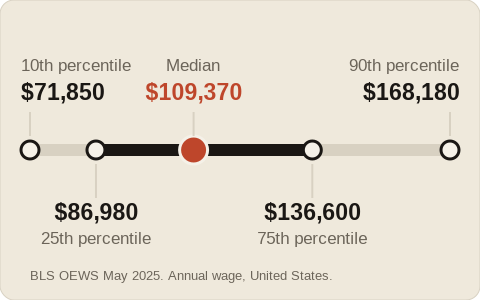
| Measure | Annual wage |
|---|---|
| 10th percentile | $71,850 |
| 25th percentile | $86,980 |
| Median (50th) | $109,370 |
| Mean (average) | $116,890 |
| 75th percentile | $136,600 |
| 90th percentile | $168,180 |
Source: U.S. Bureau of Labor Statistics, Occupational Employment and Wage Statistics (OEWS), May 2025, Bioengineers and Biomedical Engineers, retrieved 23 to 25 November 2026 from the BLS OEWS May 2025 national, state and metropolitan area files.
Biomedical Engineer hourly pay
The median hourly wage for biomedical engineers is $52.58, as published by BLS for May 2025. That is the hourly view of the same national middle as the $109,370 annual median above, so use it when an employer quotes you a rate and not a salary. Annual pay for a job with part-time or shift work depends on the hours you are given, which no national table can tell you.
| Measure | Per hour |
|---|---|
| 10th percentile | $34.54 |
| 25th percentile | $41.82 |
| Median (BLS hourly figure) | $52.58 |
| 75th percentile | $65.67 |
| 90th percentile | $80.86 |
For biomedical engineers the median is the hourly wage BLS publishes. The other rows are our division of the BLS annual percentiles by 2,080 hours, the full-time year BLS uses to turn hourly pay into annual pay.
Biomedical Engineer salary by state
Where you work changes the number more than most things. The highest published median is in Arizona, at $141,230. The lowest published median is in Arkansas, at $67,850, a gap of $73,380 a year between two states. The gap is our subtraction of two BLS state medians. All figures below are the annual median wage in each state for May 2025.
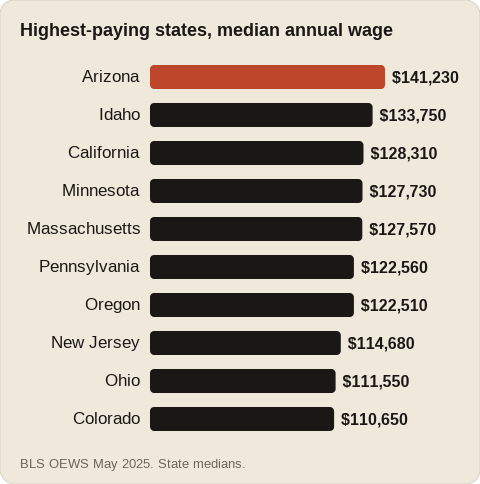
Top-paying states for biomedical engineers
| Rank | State | Median wage | vs US median |
|---|---|---|---|
| 1 | Arizona | $141,230 | +$31,860 |
| 2 | Idaho | $133,750 | +$24,380 |
| 3 | California | $128,310 | +$18,940 |
| 4 | Minnesota | $127,730 | +$18,360 |
| 5 | Massachusetts | $127,570 | +$18,200 |
| 6 | Pennsylvania | $122,560 | +$13,190 |
| 7 | Oregon | $122,510 | +$13,140 |
| 8 | New Jersey | $114,680 | +$5,310 |
| 9 | Ohio | $111,550 | +$2,180 |
| 10 | Colorado | $110,650 | +$1,280 |
Biomedical Engineer salary by state
| State | Median annual wage |
|---|---|
| Arizona | $141,230 |
| Idaho | $133,750 |
| California | $128,310 |
| Minnesota | $127,730 |
| Massachusetts | $127,570 |
| Pennsylvania | $122,560 |
| Oregon | $122,510 |
| New Jersey | $114,680 |
| Ohio | $111,550 |
| Colorado | $110,650 |
| Wisconsin | $110,430 |
| Oklahoma | $109,340 |
| Indiana | $108,030 |
| Tennessee | $106,470 |
| Virginia | $106,140 |
| Maryland | $105,090 |
| New York | $104,010 |
| Connecticut | $103,500 |
| Florida | $101,730 |
| Michigan | $100,940 |
| South Carolina | $99,130 |
| Georgia | $96,920 |
| Mississippi | $96,710 |
| Kentucky | $95,360 |
| New Hampshire | $94,890 |
| North Carolina | $94,790 |
| Texas | $92,600 |
| Utah | $90,870 |
| Illinois | $89,520 |
| Missouri | $89,480 |
| Nevada | $87,850 |
| Alabama | $85,720 |
| Louisiana | $84,320 |
| Nebraska | $83,890 |
| Iowa | $81,710 |
| Arkansas | $67,850 |
| Alaska | Not published by BLS |
| Delaware | Not published by BLS |
| Hawaii | Not published by BLS |
| Kansas | Not published by BLS |
| Maine | Not published by BLS |
| Montana | Not published by BLS |
| New Mexico | Not published by BLS |
| North Dakota | Not published by BLS |
| Rhode Island | Not published by BLS |
| South Dakota | Not published by BLS |
| Vermont | Not published by BLS |
| Washington | Not published by BLS |
| West Virginia | Not published by BLS |
| Wyoming | Not published by BLS |
BLS does not publish a figure for Alaska, Delaware, Hawaii, Kansas, Maine, Montana, New Mexico, North Dakota, Rhode Island, South Dakota, Vermont, Washington, West Virginia, Wyoming, usually because there are too few biomedical engineers in the survey sample to report one safely.
Top-paying metro areas for biomedical engineers
| Metro area | Median wage | Employed |
|---|---|---|
| Phoenix-Mesa-Chandler, AZ | $141,230 | 450 |
| San Francisco-Oakland-Fremont, CA | $140,660 | 650 |
| San Jose-Sunnyvale-Santa Clara, CA | $136,450 | 270 |
| Cincinnati, OH-KY-IN | $131,170 | 280 |
| Milwaukee-Waukesha, WI | $129,640 | 90 |
| Boulder, CO | $129,030 | 120 |
| Waterbury-Shelton, CT | $128,940 | n/a |
| Boston-Cambridge-Newton, MA-NH | $128,550 | 4,040 |
| Sacramento-Roseville-Folsom, CA | $128,300 | 130 |
| San Diego-Chula Vista-Carlsbad, CA | $128,270 | 410 |
BLS publishes the biomedical engineer median for 65 metro areas; the national median is $109,370. 2 of these ten count fewer than 100 biomedical engineers or have no published headcount, so treat them as rough. Source: U.S. Bureau of Labor Statistics, OEWS May 2025, metropolitan area estimates.
Compare biomedical engineer pay
Put two states side by side, or set biomedical engineers next to another job. Every figure is from BLS OEWS May 2025.
| Measure | Arizona | Arkansas |
|---|---|---|
| Median annual wage | $141,230 | $67,850 |
| Median hourly wage | $67.90 | $32.62 |
| 10th percentile | $99,630 | $46,720 |
| 25th percentile | $124,330 | $48,880 |
| 75th percentile | $163,560 | $84,610 |
| 90th percentile | $170,560 | $119,010 |
| Employed, May 2025 | 610 | 30 |
The Arizona median is $73,380 a year higher. That difference is our subtraction of two BLS state medians. n/a means this page has only the BLS median for that state so far, or BLS released no figure for it. Source: BLS OEWS May 2025, Bioengineers and Biomedical Engineers.
Starting pay for biomedical engineers
BLS does not publish pay by years of experience, so nobody can honestly quote an official entry-level biomedical engineer salary. What the data gives is the bottom of the market. One in ten biomedical engineers earns $71,850 or less, and one in four earns $86,980 or less. Read those as the low end of the national range, not as what a new graduate will be offered, because older workers sit in the bottom tenth too.
Device makers pay more than hospitals and universities
BLS industry medians for biomedical engineers run from $130,340 in navigational, measuring, electromedical and control instruments manufacturing to $75,040 in educational services. In between sit research and development at $125,160, medical equipment and supplies manufacturing at $107,550 and healthcare and social assistance at $103,170.
So a university post pays far below the $109,370 national median, while an instruments maker pays well above it. Research and development is both the largest employer, at 22 percent of jobs, and the second best payer. BLS does not say why educational services pay so much less than the other four industries.
Where a second degree changes the job
The BLS page for this job names routes out of engineering altogether: medicine, dentistry, law and management. Leading a research team typically needs a graduate degree. Some bioengineers go to medical or dental school, others take an MBA into management.
The law route is specific: patent attorney. The BLS median for lawyers is $159,670, which is $50,300 above the biomedical engineer median, by our subtraction. BLS does not say how many bioengineers make that move or how long the law degree takes.
Arizona on top, Boston for numbers
Arizona has the highest state median at $141,230, and Phoenix-Mesa-Chandler, AZ leads the metro list at $141,230 with about 450 jobs. The largest group on the top-paying list is Boston-Cambridge-Newton, MA-NH, about 4,040 biomedical engineers at $128,550.
BLS publishes a state median for only 36 states, and several top metros count a few hundred workers or fewer, so their medians are estimates that can move from one year to the next. The national hourly median is $52.58.
Related jobs
- Mechanical Engineer salary and career path: A BLS similar occupation; BLS notes that mechanical engineering students can move toward this field by adding biological science courses.
- Electrical Engineer salary and career path: Also on the BLS similar list, and close to the bioinstrumentation work of building tools from electronics.
- Lawyer salary and career path: BLS says some bioengineers earn law degrees and become patent attorneys.
What biomedical engineers do
Biomedical engineers combine engineering with the life sciences to design equipment, devices, computer systems and software for health care. BLS gives examples: software that runs medical equipment, computer simulations that test new drug therapies, artificial hip and knee joints, materials for replacement parts and rehabilitative exercise equipment.
The field splits into many specialties. BLS lists biochemical, bioinstrumentation, biomaterials, biomechanics, clinical, genetic and rehabilitation engineers, plus systems physiologists. Much of the work sits in research and development or quality assurance, and some biomedical engineers work in sales.
Duties BLS lists
- Design equipment and devices such as artificial internal organs, replacement body parts and machines that diagnose medical problems
- Install, maintain or give technical support for biomedical equipment
- Work with manufacturing staff on the safety and effectiveness of the equipment
- Train clinicians and others to use biomedical equipment properly
- Research with scientists how engineering principles apply to biological systems
- Build statistical models or simulations in statistical or modeling software
- Write procedures, technical reports and research papers
- Present findings to scientists, clinicians, managers, other engineers and the public
- Design or run followup experiments when needed
A typical day
Where the day happens depends on the project. One week can be modeling and test design at a computer, the next writing a technical report or presenting results to clinicians. BLS gives the example of an engineer who has built a new device spending hours in a hospital to check that it works as planned, then going back to the manufacturing side to suggest changes if it needs adjusting.
Where they work
- Bioengineers and biomedical engineers held about 23,800 jobs in 2025. Research and development in the physical, engineering and life sciences employed 22 percent, medical equipment and supplies manufacturing 10 percent, healthcare and social assistance 10 percent, educational services 9 percent, and navigational, measuring, electromedical and control instruments manufacturing 8 percent.
- They work in laboratory and clinical settings, on teams with scientists, healthcare workers or other engineers.
- The usual schedule is full time, and for some biomedical engineers the week runs past 40 hours.
Source: U.S. Bureau of Labor Statistics, Occupational Outlook Handbook, Bioengineers and Biomedical Engineers, read 25 November 2026. BLS counted about 23,800 jobs in 2025 and projects 8% growth from 2025 to 2035, much faster than the average for all occupations.
How to become a biomedical engineer: the career path
Typical entry-level education, according to BLS: bachelor's degree. BLS says the job typically takes a bachelor's degree in bioengineering, biomedical engineering or a related engineering field, and some positions require a graduate degree. Each step below comes from the BLS Occupational Outlook Handbook, and the last step is the pay.
- 1Prepare
Sciences and math in high school
BLS suggests chemistry, physics and biology, plus algebra, geometry, trigonometry and calculus. Drafting, mechanical drawing and computer programming help where a school offers them.
- 2Study
Bachelor's degree in bioengineering or biomedical engineering
Programs combine engineering and biological sciences, with lab and classroom courses in fluid and solid mechanics, circuit design and biomaterials, and substantial training in engineering design. Students in mechanical or electrical engineering can add biological science courses instead.
- 3Experience
Co-op or internship
Students may get co-ops or internships with hospitals and with medical device and pharmaceutical manufacturers.
- 4Specialize
Graduate degree for research leadership
Some positions require a graduate degree, and BLS says leading a research team typically takes one.
- 5Advance
Medical scientist, patent attorney or manager
Those drawn to basic research may become medical scientists. Some go to medical or dental school, some earn law degrees and work as patent attorneys, and some earn an MBA and move into management.
- 6Pay
Median $109,370 a year
BLS median annual wage for biomedical engineers. The lowest-paid tenth earn $71,850 or less and the highest-paid tenth earn $168,180 or more.
The next pay step
Architectural and engineering manager
$171,270 median a year
+$61,900 a year vs the biomedical engineer median
BLS says some bioengineers earn an MBA and move into managerial positions, pointing to the architectural and engineering managers profile.
Lawyer
$159,670 median a year
+$50,300 a year vs the biomedical engineer median
BLS says some bioengineers earn law degrees and work as patent attorneys.
Lawyer salary and career path
Pay: U.S. Bureau of Labor Statistics, OEWS May 2025, Architectural and Engineering Managers and Lawyers, set against Bioengineers and Biomedical Engineers. Each difference is our subtraction of two BLS national medians, the next job's minus the biomedical engineer median.
Steps 1 to 5 for biomedical engineers: U.S. Bureau of Labor Statistics, Occupational Outlook Handbook, Bioengineers and Biomedical Engineers, "How to Become One", read 25 November 2026. Pay step: U.S. Bureau of Labor Statistics, OEWS May 2025.
Biomedical Engineer skills and certifications
These come from the CVBooster biomedical engineer resume guide, which lists what employers look for on a biomedical engineer CV. Put the ones you really have near the top of your CV, in the words the job ad uses.
Core skills
People skills
Licenses and certifications
- Certified Biomedical Equipment Technician (CBET), AAMI Credentials Institute
- Certified Healthcare Technology Manager (CHTM), AAMI Credentials Institute
- Regulatory Affairs Certification (RAC), Regulatory Affairs Professionals Society
- Certified Quality Engineer (CQE), American Society for Quality
- Certified Six Sigma Green Belt (CSSGB), American Society for Quality
Biomedical Engineer salary questions
How much does a biomedical engineer make?
The BLS median for bioengineers and biomedical engineers is $109,370 a year, $52.58 an hour, in May 2025. A tenth earn $71,850 or less and a tenth earn $168,180 or more. Instruments manufacturing pays the highest industry median BLS lists, $130,340.
Which state pays biomedical engineers the most?
Arizona, at $141,230, then Idaho at $133,750. Those are the top two of 36 states where BLS published a median for this job. For the other states BLS has no published figure, so the state table above is not a full map of the country.
Do biomedical engineers need a master's degree?
Not to start. BLS says the typical entry is a bachelor's degree in bioengineering, biomedical engineering or a related engineering field. Some positions require a graduate degree, and leading a research team typically takes one.
Do biomedical engineers earn more than mechanical or electrical engineers?
More than mechanical, less than electrical, on BLS medians. Biomedical engineers sit at $109,370, mechanical engineers at $104,110 and electrical engineers at $120,630. Both are on the BLS list of similar occupations for this job.
Do biomedical engineers work in hospitals?
Some do. Healthcare and social assistance employs 10 percent of them, at a median of $103,170. BLS also describes engineers from device makers spending hours in hospitals to check that new equipment works, and training clinicians to use it.
Is biomedical engineering in demand?
BLS projects 8 percent growth from 2025 to 2035, much faster than the average, with about 1,200 openings a year. It links the demand to more biomedical devices and procedures, such as hip and knee replacements, and to more people seeking biomedical solutions to health problems.
Sources and method
- Pay: U.S. Bureau of Labor Statistics, Occupational Employment and Wage Statistics (OEWS), May 2025, Bioengineers and Biomedical Engineers (SOC 17-2031), national, state and metro area estimates, retrieved 23 to 25 November 2026 from the BLS OEWS May 2025 national, state and metropolitan area files. Wages are before tax. BLS defines what its wage figure includes and leaves out in the OEWS technical notes.
- The job, the route in and the outlook: U.S. Bureau of Labor Statistics, Occupational Outlook Handbook, Bioengineers and Biomedical Engineers, read 25 November 2026.
- Skills and certifications: the CVBooster biomedical engineer resume guide.
- Where we subtract or divide two BLS figures on this biomedical engineer page, the page says so. The pay check is an estimate between the published BLS percentiles for biomedical engineers and says so. Nothing else here is estimated.
Biomedical Engineer CV example
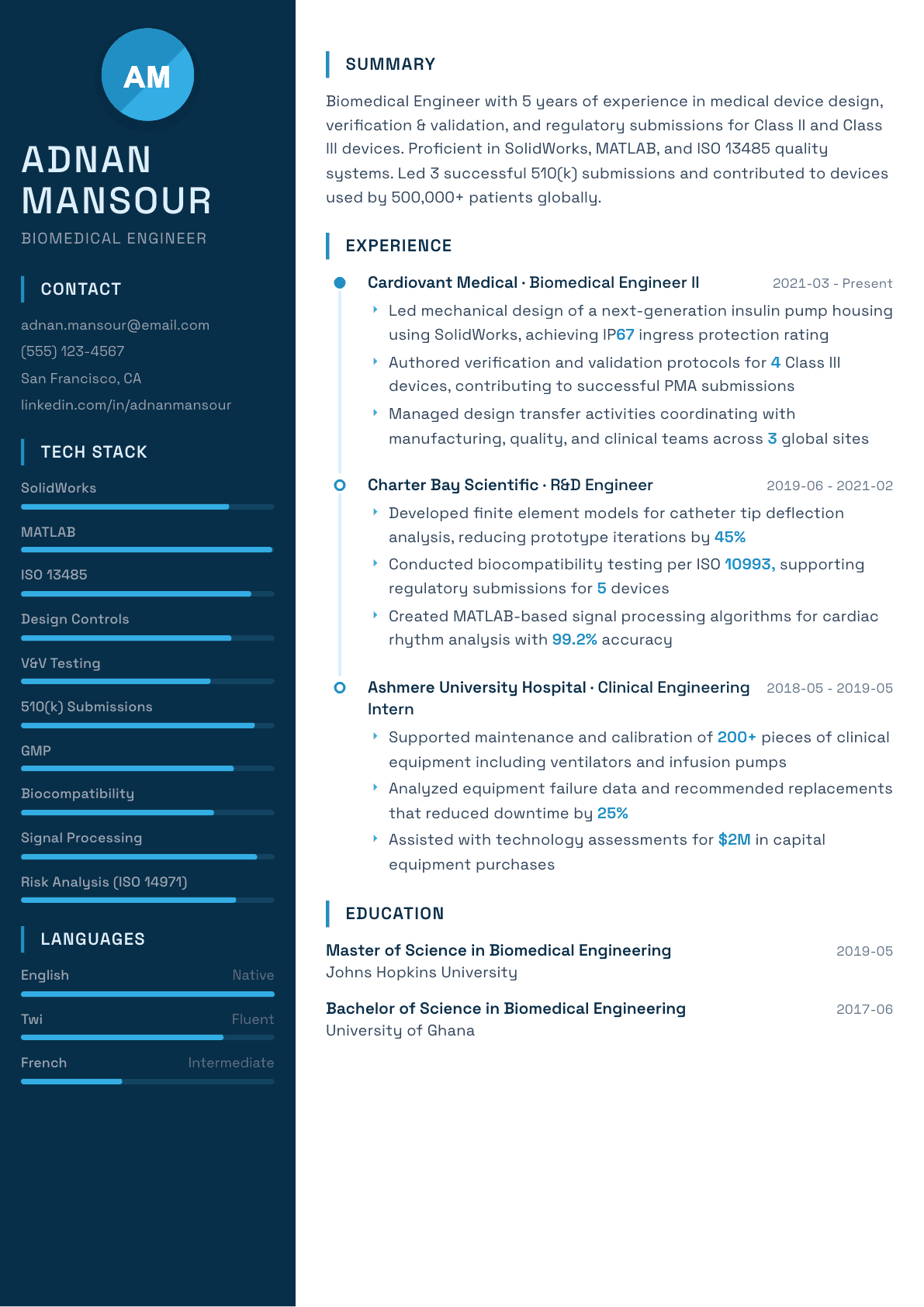
The CVBooster biomedical engineer resume guide has a finished example, three written summaries, before and after bullets and answers to the questions people ask.
Build your biomedical engineer CV
Create my CV