Veterinarian Salary, Career Path and CV
By CVBooster TeamPublished Updated
The median veterinarian salary in the United States is $130,100 a year, or $62.55 an hour, according to the U.S. Bureau of Labor Statistics (BLS), OEWS May 2025. That is the national middle: states, employers and hours move it, and BLS publishes nothing by years of experience. If you are a pre-vet student counting the cost of four more years of school, that median sits $82,720 above the vet techs you will one day supervise.
Below: a check of your own pay, the pay percentiles, hourly pay, pay in every state, the top-paying metro areas, what veterinarians do, how to become a veterinarian, the skills that go on a CV, and a CV example.
- Median annual pay
- $130,100
- Median hourly pay
- $62.55
- Employed, May 2025
- 83,900
Am I underpaid as a veterinarian?
Pick your state and type your pay. You get your place in the BLS pay range for veterinarians there, as a percentile.
Veterinarian salary in the United States
The BLS counts veterinarians in the occupation Veterinarians (SOC 29-1131). Half of them earn less than $130,100 a year and half earn more. The average, which a few very high earners pull up, is $142,680. The lowest-paid tenth earn $73,920 or less, and the highest-paid tenth earn $215,700 or more, which is about 2.9 times as much. The ratio is our arithmetic on two BLS figures.
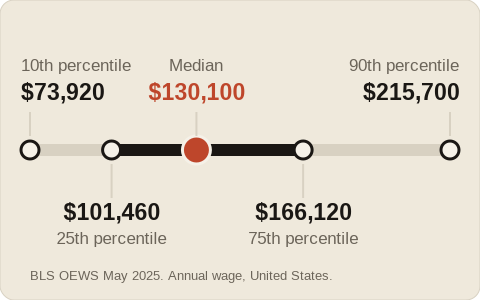
| Measure | Annual wage |
|---|---|
| 10th percentile | $73,920 |
| 25th percentile | $101,460 |
| Median (50th) | $130,100 |
| Mean (average) | $142,680 |
| 75th percentile | $166,120 |
| 90th percentile | $215,700 |
Source: U.S. Bureau of Labor Statistics, Occupational Employment and Wage Statistics (OEWS), May 2025, Veterinarians, retrieved 23 to 25 November 2026 from the BLS OEWS May 2025 national, state and metropolitan area files.
Veterinarian hourly pay
The median hourly wage for veterinarians is $62.55, as published by BLS for May 2025. That is the hourly view of the same national middle as the $130,100 annual median above, so use it when an employer quotes you a rate and not a salary. Annual pay for a job with part-time or shift work depends on the hours you are given, which no national table can tell you.
| Measure | Per hour |
|---|---|
| 10th percentile | $35.54 |
| 25th percentile | $48.78 |
| Median (BLS hourly figure) | $62.55 |
| 75th percentile | $79.87 |
| 90th percentile | $103.70 |
For veterinarians the median is the hourly wage BLS publishes. The other rows are our division of the BLS annual percentiles by 2,080 hours, the full-time year BLS uses to turn hourly pay into annual pay.
Veterinarian salary by state
Where you work changes the number more than most things. The highest median is in California, at $163,920. The lowest published median is in South Dakota, at $88,650, a gap of $75,270 a year between two states. The gap is our subtraction of two BLS state medians. All figures below are the annual median wage in each state for May 2025.
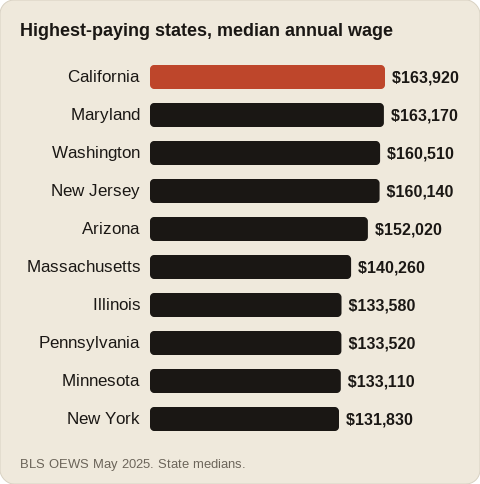
Top-paying states for veterinarians
| Rank | State | Median wage | vs US median |
|---|---|---|---|
| 1 | California | $163,920 | +$33,820 |
| 2 | Maryland | $163,170 | +$33,070 |
| 3 | Washington | $160,510 | +$30,410 |
| 4 | New Jersey | $160,140 | +$30,040 |
| 5 | Arizona | $152,020 | +$21,920 |
| 6 | Massachusetts | $140,260 | +$10,160 |
| 7 | Illinois | $133,580 | +$3,480 |
| 8 | Pennsylvania | $133,520 | +$3,420 |
| 9 | Minnesota | $133,110 | +$3,010 |
| 10 | New York | $131,830 | +$1,730 |
Veterinarian salary in all 50 states
| State | Median annual wage |
|---|---|
| California | $163,920 |
| Maryland | $163,170 |
| Washington | $160,510 |
| New Jersey | $160,140 |
| Arizona | $152,020 |
| Massachusetts | $140,260 |
| Illinois | $133,580 |
| Pennsylvania | $133,520 |
| Minnesota | $133,110 |
| New York | $131,830 |
| Vermont | $131,820 |
| Florida | $131,660 |
| Texas | $131,330 |
| Colorado | $130,840 |
| Maine | $130,600 |
| Hawaii | $130,120 |
| New Mexico | $129,390 |
| North Carolina | $129,240 |
| West Virginia | $128,990 |
| Oregon | $128,880 |
| New Hampshire | $128,190 |
| Virginia | $126,730 |
| Georgia | $126,590 |
| Rhode Island | $126,570 |
| Connecticut | $126,190 |
| Nevada | $125,550 |
| Michigan | $125,390 |
| Ohio | $125,060 |
| Iowa | $124,610 |
| Indiana | $124,530 |
| Louisiana | $124,370 |
| Tennessee | $124,350 |
| Utah | $123,990 |
| South Carolina | $122,130 |
| Idaho | $116,170 |
| Missouri | $114,660 |
| Wisconsin | $108,780 |
| Arkansas | $107,710 |
| Kansas | $107,080 |
| Alabama | $105,630 |
| Mississippi | $105,370 |
| Kentucky | $104,100 |
| Nebraska | $103,500 |
| North Dakota | $102,180 |
| Montana | $99,390 |
| Oklahoma | $98,090 |
| Wyoming | $97,240 |
| South Dakota | $88,650 |
| Alaska | Not published by BLS |
| Delaware | Not published by BLS |
BLS does not publish a figure for Alaska, Delaware, usually because there are too few veterinarians in the survey sample to report one safely.
Top-paying metro areas for veterinarians
| Metro area | Median wage | Employed |
|---|---|---|
| San Francisco-Oakland-Fremont, CA | $208,080 | 1,350 |
| San Jose-Sunnyvale-Santa Clara, CA | $192,160 | 350 |
| Napa, CA | $172,600 | 30 |
| Sacramento-Roseville-Folsom, CA | $165,260 | 830 |
| Santa Cruz-Watsonville, CA | $164,820 | 130 |
| Atlantic City-Hammonton, NJ | $164,620 | 60 |
| Barnstable Town, MA | $164,060 | 100 |
| Seattle-Tacoma-Bellevue, WA | $163,810 | 1,330 |
| Amherst Town-Northampton, MA | $163,630 | 60 |
| Kennewick-Richland, WA | $163,520 | 60 |
BLS publishes the veterinarian median for 283 metro areas; the national median is $130,100. 4 of these ten count fewer than 100 veterinarians or have no published headcount, so treat them as rough. Source: U.S. Bureau of Labor Statistics, OEWS May 2025, metropolitan area estimates.
Compare veterinarian pay
Put two states side by side, or set veterinarians next to another job. Every figure is from BLS OEWS May 2025.
| Measure | California | South Dakota |
|---|---|---|
| Median annual wage | $163,920 | $88,650 |
| Median hourly wage | $78.81 | $42.62 |
| 10th percentile | $74,850 | $61,640 |
| 25th percentile | $125,460 | $74,860 |
| 75th percentile | $211,840 | $114,400 |
| 90th percentile | $286,330 | $128,920 |
| Employed, May 2025 | 9,170 | 280 |
The California median is $75,270 a year higher. That difference is our subtraction of two BLS state medians. n/a means this page has only the BLS median for that state so far, or BLS released no figure for it. Source: BLS OEWS May 2025, Veterinarians.
Starting pay for veterinarians
BLS does not publish pay by years of experience, so nobody can honestly quote an official entry-level veterinarian salary. What the data gives is the bottom of the market. One in ten veterinarians earns $73,920 or less, and one in four earns $101,460 or less. Read those as the low end of the national range, not as what a new graduate will be offered, because older workers sit in the bottom tenth too.
Clinic, farm or government: what the employer does to vet pay
BLS splits the median by industry. Other personal services pays the most at $135,460, veterinary services, where 83 percent of vets work, $129,990, educational services $121,890, and government $115,210. So the clinic track is the market rate, and the public jobs, including food safety and inspection work, pay less at the median.
BLS does not publish separate pay for companion animal, food animal or food safety vets, so any claim that farm work pays more or less than small animal practice is not from BLS. What it does say is that horse and food animal vets travel, work outdoors in all weather and may operate in remote places.
The licensing catch when you move states
On top of the national exam, most states set their own licensing exam covering that state's laws and regulations. BLS adds that few states accept licenses from other states, so a vet who moves usually sits another exam. That makes the state pay table below less of a free choice than it looks.
The exception is government work. Vets employed by state or federal government may not need a state license, because agencies differ in what they require.
Where vets earn the most, and the gap to the vet tech
Of the 48 states with a published median, California is highest at $163,920 and South Dakota lowest at $88,650. California holds 5 of the top 10 metros, led by San Francisco-Oakland-Fremont, CA: $208,080 from roughly 1,350 vets, then San Jose-Sunnyvale-Santa Clara, CA: $192,160 from roughly 350 vets, then Napa, CA: $172,600 from roughly 30 vets. Small metro counts make for rough estimates.
A vet tech earns a median of $47,380, so the doctorate is worth about $82,720 a year at the median, our subtraction of two BLS figures. Techs usually train for 2 years; the vet route is a bachelor's plus a 4-year DVM.
Related jobs
- Vet Tech salary and career path: Runs the tests and nursing care in the clinic under a licensed vet, after about 2 years of training.
- Dentist salary and career path: Another doctoral health job where many practitioners own or join a private practice.
What veterinarians do
Veterinarians care for the health of animals and work to protect public health. They diagnose, treat and research medical conditions and diseases in pets, livestock and other animals, with care BLS compares to what a physician gives people.
Most treat companion animals, mostly cats and dogs but also birds, ferrets and rabbits, in private clinics and hospitals. Food animal vets visit farms and ranches to treat pigs, cattle and sheep, and food safety and inspection vets test livestock and animal products and enforce government food safety rules.
Duties BLS lists
- Examine animals to judge their health and diagnose problems
- Treat and dress wounds
- Perform surgery on animals
- Test for diseases and vaccinate against them
- Run medical equipment such as x-ray and ultrasound machines
- Advise owners on general care, medical conditions and treatments
- Prescribe medication
- Euthanize animals
A typical day
In a companion animal clinic the day is a run of appointments and procedures: exams and vaccinations, a wound to dress, x rays to read, dental work or a fracture to set, and a surgery slot. Each case ends with a talk with the owner about treatment and care at home, and some end with euthanasia and an upset family. A farm vet spends much of the day driving between ranches and working outdoors in any weather. Many vets work past 40 hours and get called in for emergencies.
Where they work
- Veterinarians held about 91,100 jobs in 2025. Veterinary services employed 83 percent and 7 percent were self-employed. Government and educational services each employed 2 percent, and other personal services 1 percent.
- Most work in private clinics and hospitals. Others travel to farms or work in laboratories, classrooms or zoos, and food safety vets visit slaughterhouses and food-processing plants.
- BLS calls the work emotionally stressful: vets care for abused animals, euthanize sick ones and support anxious owners. Frightened or hurting animals can bite, kick and scratch, and diseased animals carry a risk of infection.
- Most work full time, often more than 40 hours a week. Some work nights or weekends and respond to emergencies outside scheduled hours.
Source: U.S. Bureau of Labor Statistics, Occupational Outlook Handbook, Veterinarians, read 25 November 2026. BLS counted about 91,100 jobs in 2025 and projects 9% growth from 2025 to 2035, much faster than the average for all occupations.
How to become a veterinarian: the career path
Typical entry-level education, according to BLS: doctoral or professional degree. BLS says the Doctor of Veterinary Medicine program generally takes 4 years, and most applicants come to it with a bachelor's degree in a field such as biology. Each step below comes from the BLS Occupational Outlook Handbook, and the last step is the pay.
- 1Study
Bachelor's degree and science courses
Applicants typically hold a bachelor's degree in a field such as biology. Vet schools require many science classes, including biology, chemistry and animal science, and most also want math, humanities and social science.
- 2Experience
Time around animals
Admission is competitive. Some colleges prefer candidates who studied agriculture or worked with animals on a farm, at a stable or in an animal shelter.
- 3Study
DVM or VMD degree
A Doctor of Veterinary Medicine (DVM or VMD) from an accredited college of veterinary medicine, generally 4 years. Most programs give 3 years of classroom, laboratory and clinical work, and the final year is clinical rotations in a veterinary medical center or hospital.
- 4License
National exam and state license
Every state requires an accredited program and a qualifying exam. Most states also require a state licensing exam on their own laws and regulations. Vets employed by state or federal government may not need a state license.
- 5Certify
Optional certification
Certification is not mandatory, but it lets vets show competency in animal husbandry, health and welfare, and facility administration.
- 6Pay
Median $130,100 a year
BLS median annual wage for veterinarians. The lowest-paid tenth earn $73,920 or less and the highest-paid tenth earn $215,700 or more.
Steps 1 to 5 for veterinarians: U.S. Bureau of Labor Statistics, Occupational Outlook Handbook, Veterinarians, "How to Become One", read 25 November 2026. Pay step: U.S. Bureau of Labor Statistics, OEWS May 2025.
Veterinarian skills and certifications
These come from the CVBooster veterinarian resume guide, which lists what employers look for on a veterinarian CV. Put the ones you really have near the top of your CV, in the words the job ad uses.
Core skills
People skills
Licenses and certifications
- Doctor of Veterinary Medicine (DVM or VMD) license, State Board of Veterinary Medicine
- Diplomate, American College of Veterinary Internal Medicine, American College of Veterinary Internal Medicine
- Diplomate, American College of Veterinary Surgeons, American College of Veterinary Surgeons
- Diplomate, American College of Veterinary Emergency and Critical Care, American College of Veterinary Emergency and Critical Care
- Educational Commission for Foreign Veterinary Graduates Certificate, American Veterinary Medical Association
Veterinarian salary questions
How much does a veterinarian make a year?
The BLS median for veterinarians is $130,100 a year and the mean $142,680, from OEWS for May 2025. The bottom tenth earns $73,920 or less and the top tenth $215,700 or more. Location and employer type explain much of that range.
How much do vets make an hour?
Veterinarians have a median hourly wage of $62.55. Most work full time and often more than 40 hours a week, with some nights, weekends and emergency calls, so hourly pay and take-home pay do not line up neatly.
How many years does it take to become a vet?
Most vet students first earn a bachelor's degree, often in biology, then complete a Doctor of Veterinary Medicine program that generally takes 4 years. After that come the national exam and, in most states, a state licensing exam. BLS gives no residency requirement for general practice.
Is it hard to get into vet school?
BLS says admission to veterinary programs is competitive. Colleges want many science classes, including biology, chemistry and animal science, and some prefer applicants who studied agriculture or have worked with animals on a farm, at a stable or in a shelter.
Which state pays veterinarians the most?
Of the states with a published BLS median, California leads at $163,920, with Maryland at $163,170 and Washington at $160,510 close behind. Remember that few states accept another state's license, so moving usually means another exam.
Are veterinarians in demand?
BLS projects veterinarian jobs to grow 9 percent from 2025 to 2035, much faster than average, with about 3,100 openings a year. It credits more spending on pets, a growing and aging pet population, and treatments such as cancer care and kidney transplants.
Sources and method
- Pay: U.S. Bureau of Labor Statistics, Occupational Employment and Wage Statistics (OEWS), May 2025, Veterinarians (SOC 29-1131), national, state and metro area estimates, retrieved 23 to 25 November 2026 from the BLS OEWS May 2025 national, state and metropolitan area files. Wages are before tax. BLS defines what its wage figure includes and leaves out in the OEWS technical notes.
- The job, the route in and the outlook: U.S. Bureau of Labor Statistics, Occupational Outlook Handbook, Veterinarians, read 25 November 2026.
- Skills and certifications: the CVBooster veterinarian resume guide.
- Where we subtract or divide two BLS figures on this veterinarian page, the page says so. The pay check is an estimate between the published BLS percentiles for veterinarians and says so. Nothing else here is estimated.
Veterinarian CV example
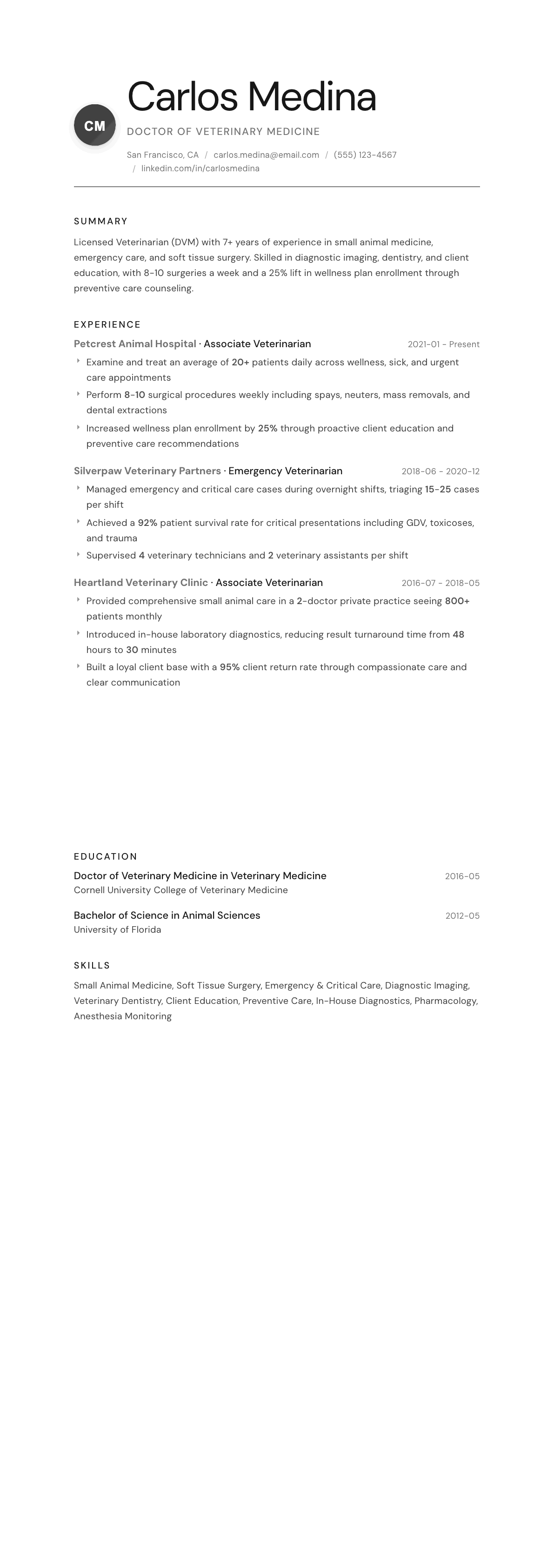
The CVBooster veterinarian resume guide has a finished example, three written summaries, before and after bullets and answers to the questions people ask.
Build your veterinarian CV
Create my CV