Optometrist Resume Examples: free ATS score and gap list
Create an Optometrist Resume That Focuses on Your Strengths
By Mustafa Tarabya, founder of CVBooster · Published · Updated
Build a polished optometrist resume with eye care templates, clinical examples, and tips tailored to OD job seekers.
Sample resumes for a optometrist
The same optometrist content laid out in three CVBooster templates, so you can see what the finished document looks like before you write a word.
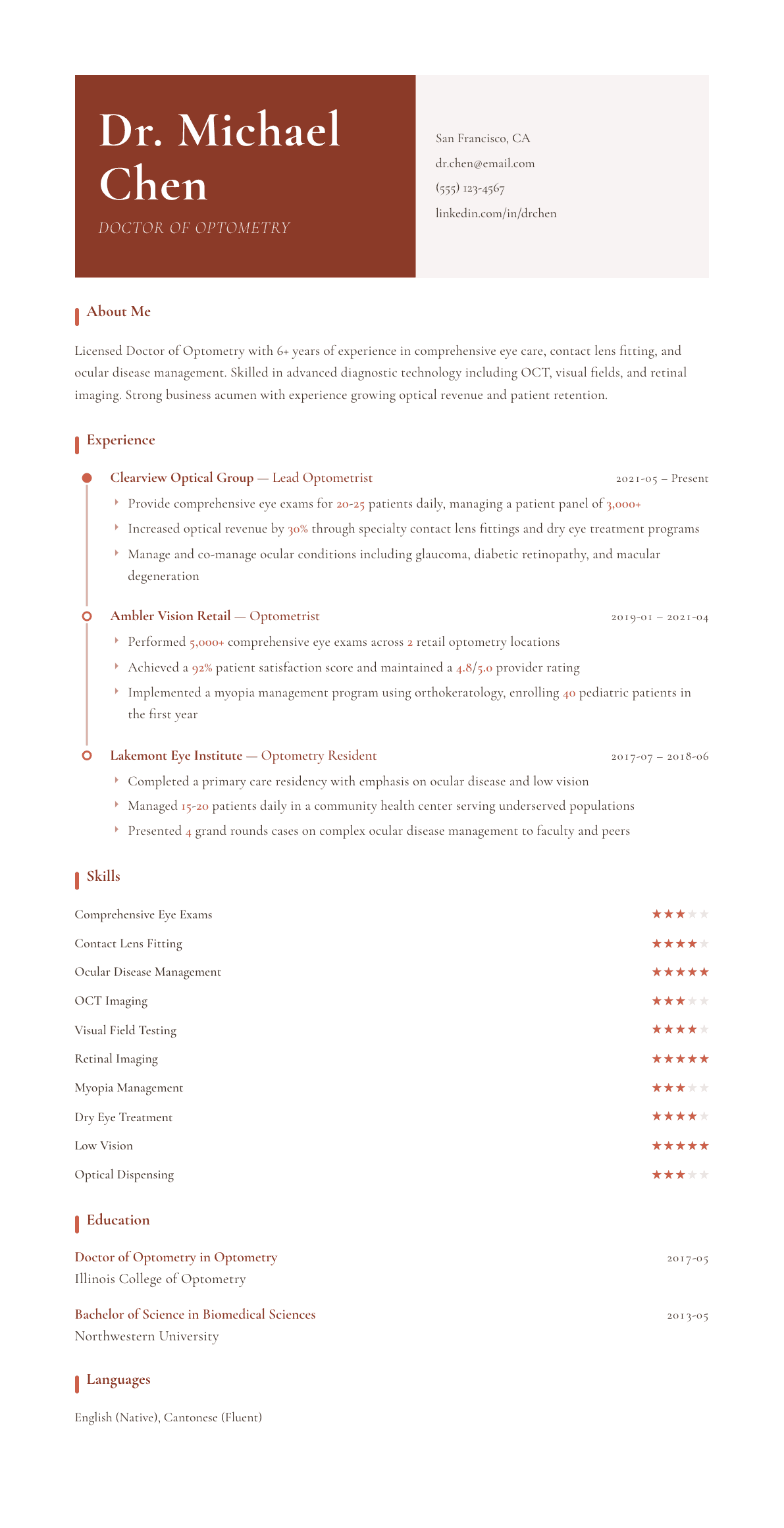
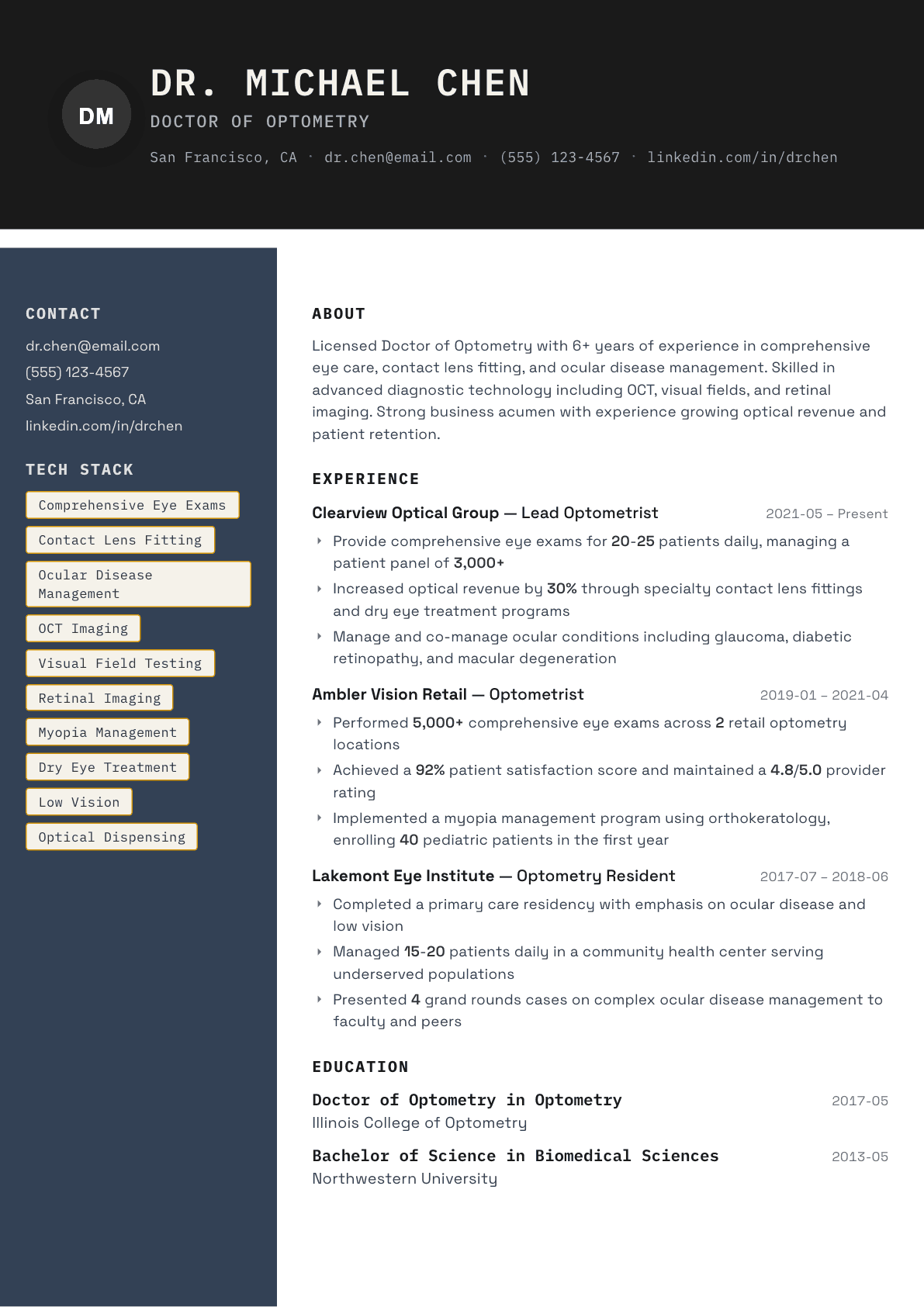
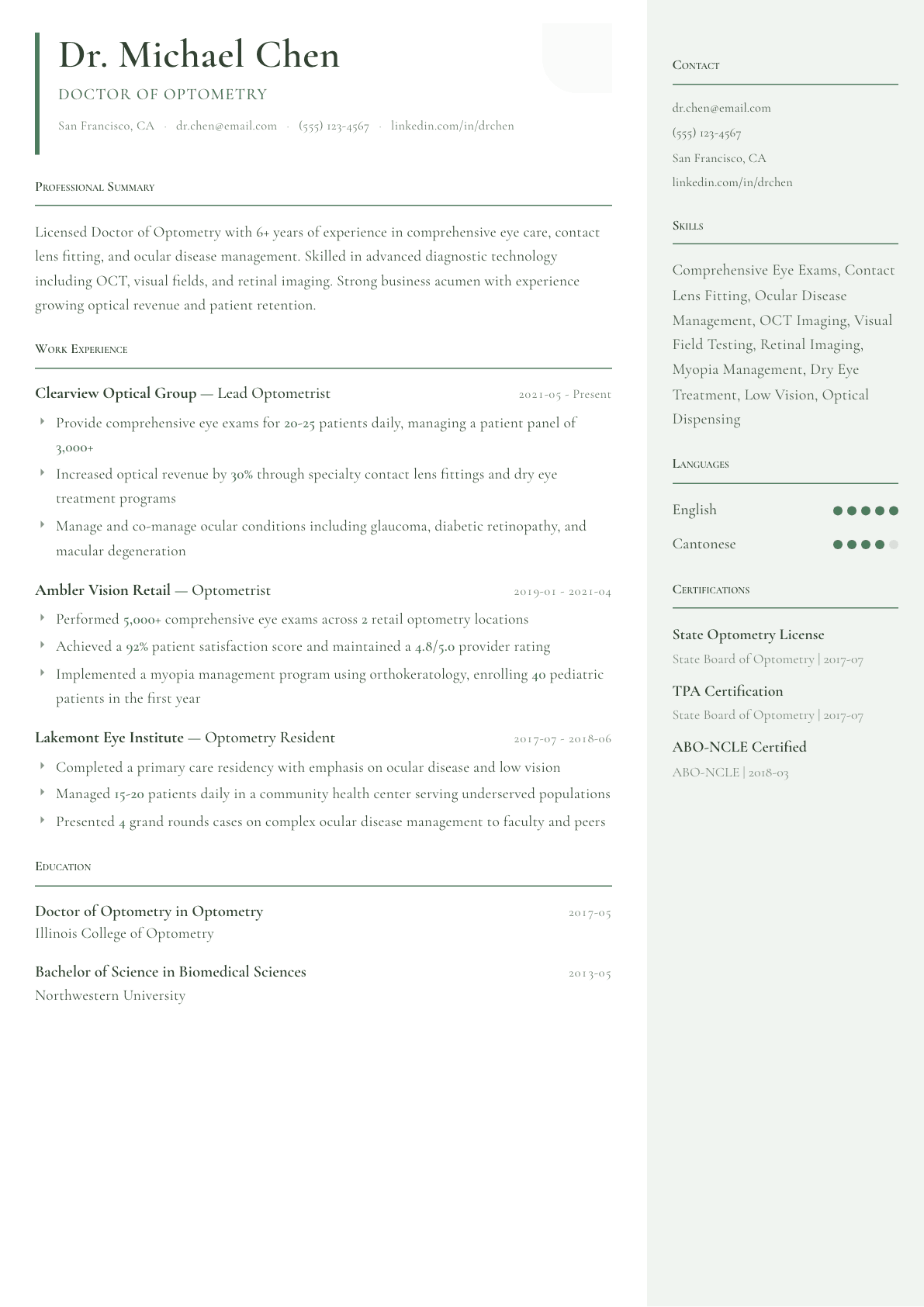
Example Optometrist summary
Licensed OD with 6 years of experience in comprehensive eye care and ocular disease management. Manage a patient panel of 3,000+ and increased optical revenue by 30% through specialty services. Seeking an optometrist position in a multi-disciplinary eye care practice.
Skills to list on a Optometrist resume
- Comprehensive Eye Exams
- Contact Lens Fitting
- Ocular Disease Management
- Glaucoma Management
- Diabetic Eye Care
- OCT Imaging
- Visual Fields
- Retinal Imaging
- Myopia Management
- Dry Eye Treatment
- Low Vision
- Pediatric Eye Care
- Optical Dispensing
- Pre/Post-Surgical Care
What actually gets this resume read
- Include your OD degree, state license, and TPA certification prominently.
- Quantify patient volumes, exam counts, and revenue contributions.
- Specify advanced diagnostic equipment you are proficient with.
- Highlight specialty areas like contact lenses, pediatrics, or low vision.
- Show business development achievements for private practice or retail roles.
- Mention any residency training and clinical presentations.
How to write a optometrist resume
An optometrist resume is read by a practice owner, a regional director for a retail chain, or a hiring partner in an ophthalmology group, and each of them screens for a different mix. All three check the license and its state first, then the therapeutic and pharmaceutical certification, then the exam volume you sustain, then the clinical scope: which ocular disease you manage yourself and where you refer.
The second half of the read is commercial, and candidates underestimate it. In a retail or optical setting the reader wants to see capture rate, specialty contact lens revenue, dry eye and myopia management programs, and patient recall. In a medical practice the reader wants to see disease management, co-management around surgery, and the imaging you interpret. Write to the setting you are applying into.
This guide covers the layout eye care employers expect, how to present licensure and certification, how to describe exam volume and clinical scope without inflating either, and the questions optometrists ask when moving between corporate optometry, private practice, hospital and ophthalmology co-management roles.
Format: a doctoral file, two pages, license block up top
Reverse chronological, two pages, with the doctorate and license prominent. Optometry is a licensed doctoral profession and the resume should read like a provider file: license, certification, clinical experience, procedures and technology, education and residency, professional activity.
Give licensure its own block: each state license with expiration, therapeutic pharmaceutical agent and oral pharmaceutical agent certification where your state issues them separately, glaucoma certification in states that require it, and any injection or laser privileges your state grants. Scope varies enormously by state and an employer needs to see yours.
- Header: name with the doctoral credential, city and state, phone, email, and the states you are licensed in.
- Sections in this order: summary, licensure and certification, clinical experience, technology and procedures, education and residency, professional memberships.
- Residency trained candidates give the residency its own entry with the site, the emphasis and the patient population.
Summary: setting, exam volume, clinical depth, commercial contribution
Four lines. Name the years, the setting, the daily exam volume and the clinical areas you own. "Optometrist with six years in a full scope practice seeing twenty to twenty five patients a day, managing glaucoma and diabetic retinopathy and running a specialty contact lens service" fits a reader's mental slot immediately.
Add one commercial sentence when applying to a retail or optical driven practice: growth in specialty lens fittings, a dry eye service you built, a myopia management program you started, or improvement in recall and rebooking. Owners hire optometrists who both practice well and keep the chair full.
Clinical experience: volume, disease management, co-management
Open each role with the practice type, the patient volume per day, and the population, then write bullets on the clinical work. Comprehensive examination and refraction volume is the baseline. What differentiates is medical eye care: glaucoma diagnosis and management with visual fields and imaging, diabetic retinopathy surveillance, macular degeneration monitoring, dry eye disease treatment, ocular surface and anterior segment disease, foreign body removal, and urgent eye care.
Co-management belongs in its own bullet if you have done it. Preoperative and postoperative care around cataract surgery and refractive surgery, and the referral relationships with retina and glaucoma specialists, show that a group practice can trust you with their surgical pipeline.
Specialty contact lenses are the other differentiator. Scleral lenses for irregular corneas, orthokeratology, multifocal fitting, keratoconus management and post-surgical fits are skills a practice can build a service line around, and they are worth naming with a rough case volume.
Technology and procedures: name every instrument
Eye care hiring is instrument specific because the equipment in the lane determines how quickly you are productive. Name the diagnostic technology you interpret daily: optical coherence tomography of the retina and the optic nerve, visual field perimetry, fundus photography and widefield imaging, corneal topography and tomography, specular microscopy, pachymetry, anterior segment imaging and meibography.
List the procedures you perform within your state scope: punctal plug insertion, foreign body and rust ring removal, epilation, lacrimal irrigation, amniotic membrane placement, intense pulsed light or thermal treatment for meibomian gland dysfunction, and any injections or laser procedures your license permits.
Add the practice management and record system you use, since a practice on the same platform reads that as a shorter ramp up, and note any experience with medical billing for eye care, which is a distinct and undersupplied skill.
The words eye care postings repeat
Optometry postings use a predictable vocabulary: comprehensive eye examination, refraction, ocular disease management, contact lens fitting, patient education, medical and vision insurance billing, pretesting workflow, optical dispensing, recall and retention, and doctor of optometry scope of practice. Mirror the exact terms once in a skills block and once inside a bullet.
Do not neglect the team side. Training technicians on pretesting, building a workup standard so the lane runs on time, and supervising opticians are the things that make a practice profitable, and few optometrist resumes mention them at all.
Optometrist resume summary examples
New graduate optometrist
Recent doctor of optometry graduate licensed with therapeutic certification, trained through rotations in a veterans hospital, a pediatric clinic and a private practice. Comfortable with comprehensive examination, contact lens fitting, glaucoma workup and anterior segment disease, and seeking a full scope associate position.
Six years in practice
Optometrist with six years in a full scope practice seeing twenty to twenty five patients daily, managing glaucoma, diabetic retinopathy and dry eye disease. Built a specialty contact lens service covering scleral and orthokeratology fits, and co-manages cataract and refractive surgery patients with two surgical groups.
Lead optometrist or practice owner
Lead optometrist with twelve years across corporate and private settings, now supervising three associates and a technician team of six. Grew the medical eye care side of the practice, standardized the pretesting workup, and mentors new graduates through their first year of independent disease management.
Work experience bullets: before and after
Before: Performed eye exams for patients.
After: Completed comprehensive eye examinations for twenty to twenty five patients daily including refraction, dilated fundus evaluation and anterior segment assessment across a mixed adult and pediatric panel.
Daily volume plus the components of the exam show the pace and depth you already sustain.
Before: Managed eye diseases.
After: Diagnosed and managed glaucoma using visual field testing and optic nerve imaging at each visit, adjusted topical therapy, and referred progressing patients to a glaucoma specialist with imaging history attached.
The diagnostics, the treatment decision and the referral threshold together describe real disease management.
Before: Fitted contact lenses including specialty lenses.
After: Fitted scleral lenses for keratoconus and post-surgical corneas and ran an orthokeratology program for pediatric myopia, enrolling forty children in the first year of the service.
Naming the lens types, the indications and the program size proves a service line rather than a skill claim.
Before: Helped grow the optical business.
After: Raised optical capture by building a dry eye treatment pathway and a specialty lens referral route from the medical side of the practice, and rebuilt the annual recall list with the front desk.
It names the levers behind the growth, which is what a practice owner is actually buying.
Before: Worked with ophthalmologists on surgical patients.
After: Provided preoperative evaluation and postoperative care for cataract and refractive surgery patients under co-management agreements with two surgical practices, following each patient through the full postoperative course.
Co-management is a trust relationship, and the specifics show you have held one.
Hard skills
- Comprehensive eye examination
- Refraction and binocular vision assessment
- Glaucoma diagnosis and management
- Diabetic retinopathy surveillance
- Dry eye and ocular surface disease treatment
- Optical coherence tomography interpretation
- Visual field interpretation
- Corneal topography
- Specialty and scleral contact lens fitting
- Orthokeratology and myopia management
- Foreign body removal and urgent eye care
- Surgical co-management
- Medical eye care billing
Soft skills
- Patient education on chronic eye disease
- Efficiency in a full lane
- Technician supervision
- Referral relationship building
- Clear explanation of test results
- Composure with urgent presentations
Certifications worth listing
- Doctor of Optometry license (State board of optometry)
- Therapeutic Pharmaceutical Agent certification (State licensing board)
- Diplomate, American Board of Optometry (American Board of Optometry)
- Fellow of the American Academy of Optometry (FAAO) (American Academy of Optometry)
- Fellow of the Scleral Lens Education Society (Scleral Lens Education Society)
- Fellow, International Academy of Orthokeratology and Myopia Control (International Academy of Orthokeratology and Myopia Control)
Mistakes that cost optometrist candidates the interview
- Leaving the state license and therapeutic certification off the front page, when scope of practice differs so much between states.
- Writing only about refraction and eyewear when applying to a medical practice that hires for disease management.
- Omitting daily exam volume, which is the productivity number every practice owner models against.
- Failing to name the diagnostic instruments you interpret, so the reader cannot judge how long training will take.
- Skipping specialty contact lens work, which is often the exact service line a practice is trying to build.
- Ignoring the commercial side entirely in a retail or optical driven application.
- Listing a residency without saying what the emphasis was or what population it served.
Optometrist resume questions
Should an optometrist resume be a CV instead?
A two page resume works for private practice, corporate and group settings. Use an academic style curriculum vitae only for faculty, residency teaching or research positions, where publications, presentations and grants are expected in full.
How do I show clinical scope when it varies by state?
List each license with its state and any separate certifications for therapeutic agents, oral medications, glaucoma or injections. Then write the procedures you actually perform, which lets an employer in another state map your experience onto their own scope.
Does a residency matter on an optometrist resume?
It matters for hospital, veterans health, academic and specialty practice roles, and it should have its own entry with the site, emphasis and patient population. In general private practice it helps but volume and disease management experience usually weigh more.
How do I move from corporate optometry into a medical practice?
Lead with medical eye care rather than refraction volume. Bring forward glaucoma management, retinal imaging interpretation, urgent eye visits, dry eye treatment and any surgical co-management, and name the instruments you use to make those decisions.
Should I include practice growth numbers?
Yes when applying to private or retail practices, expressed as ratios and program counts rather than currency. Specialty lens fittings started, capture rate change, recall completion and new service lines all show commercial contribution without exposing practice financials.