Radiologic Technologist Resume Examples: free ATS score
Radiologic Technologist Resume: Radiographer and Rad Tech Samples
By Mustafa Tarabya, founder of CVBooster · Published · Updated
Radiologic technology resume examples and radiographer resume samples for new graduates, staff and lead techs, with ARRT credentials, modalities and keywords.
Sample resumes for a radiologic technologist
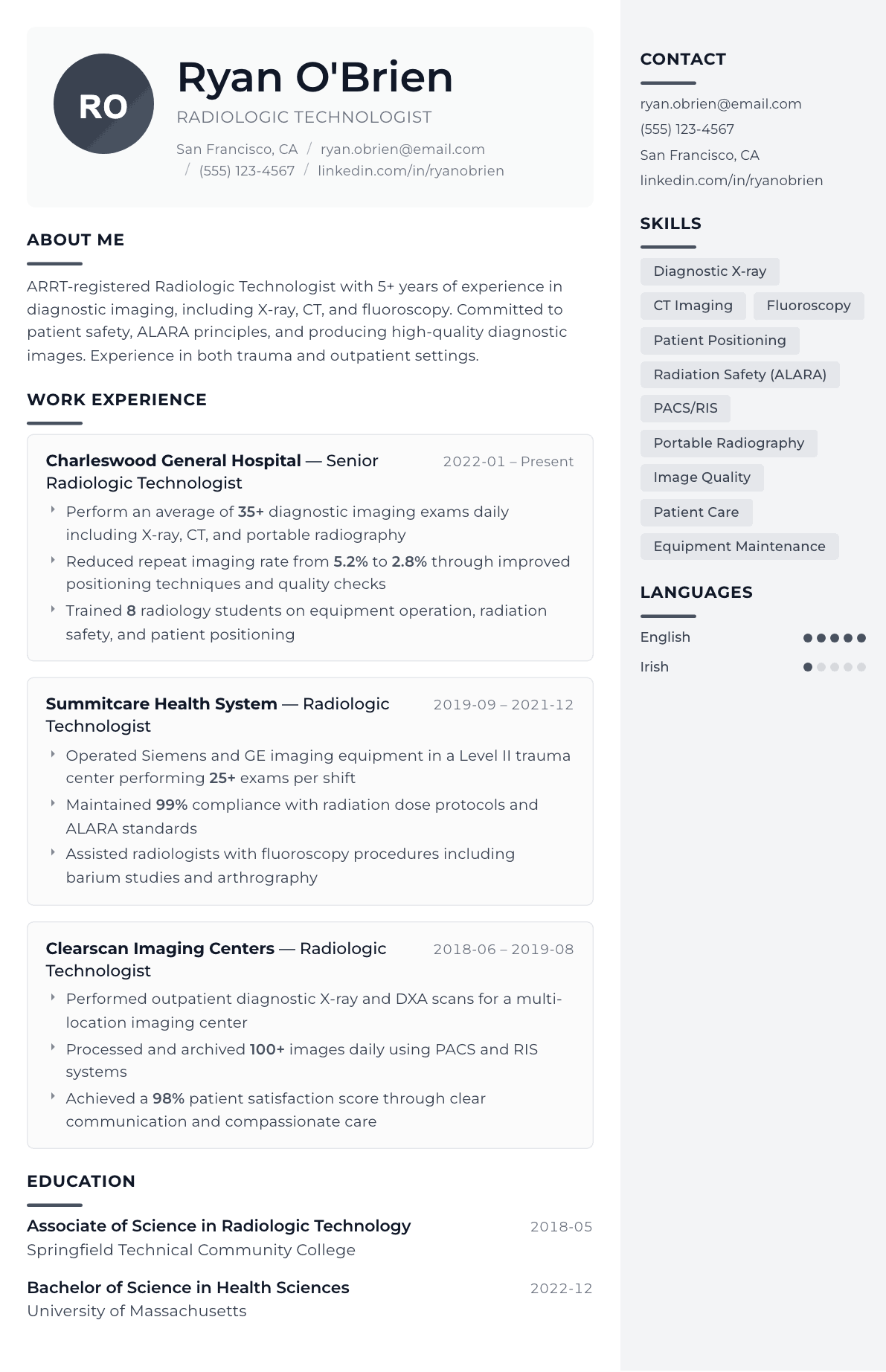
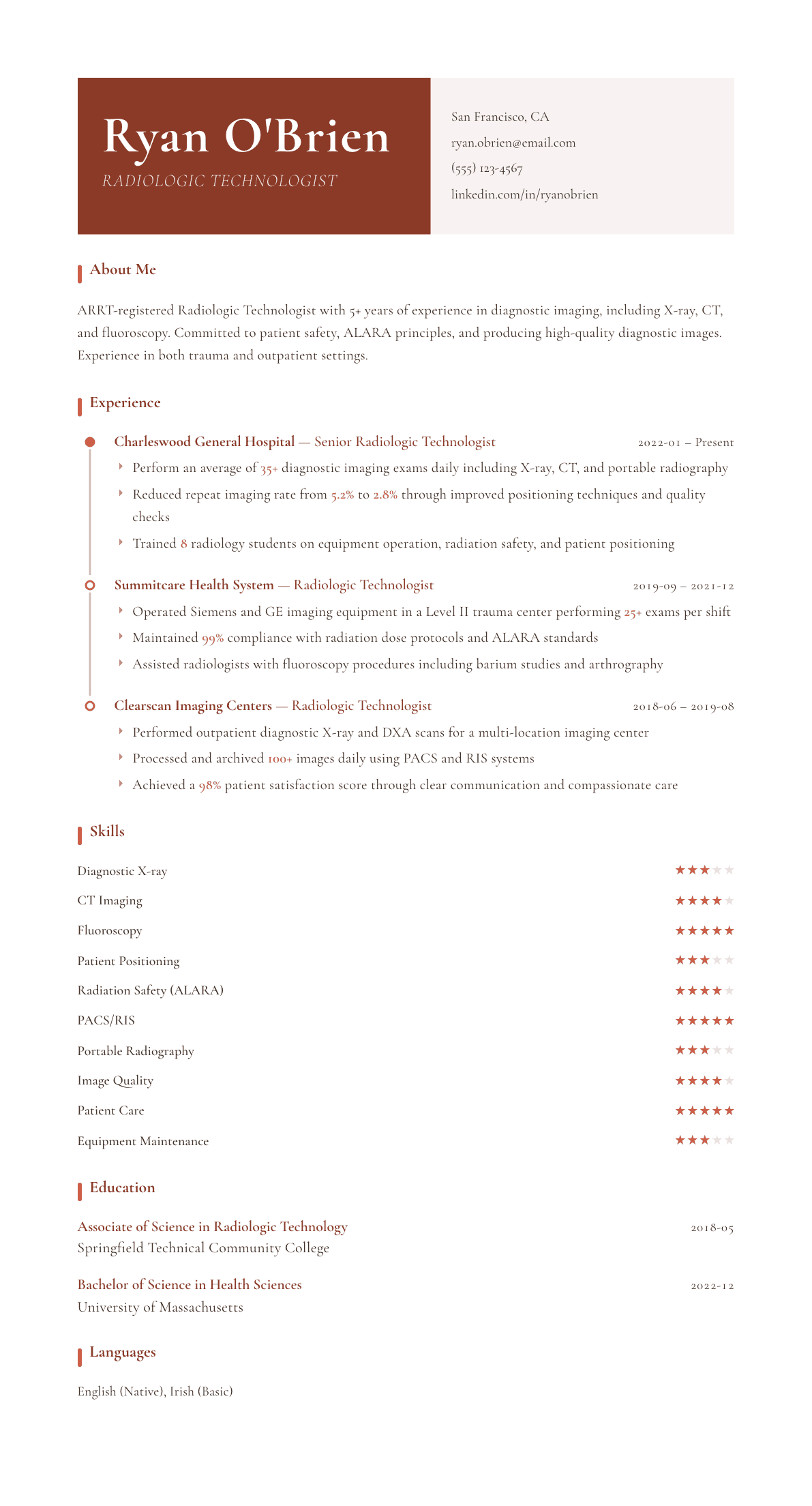
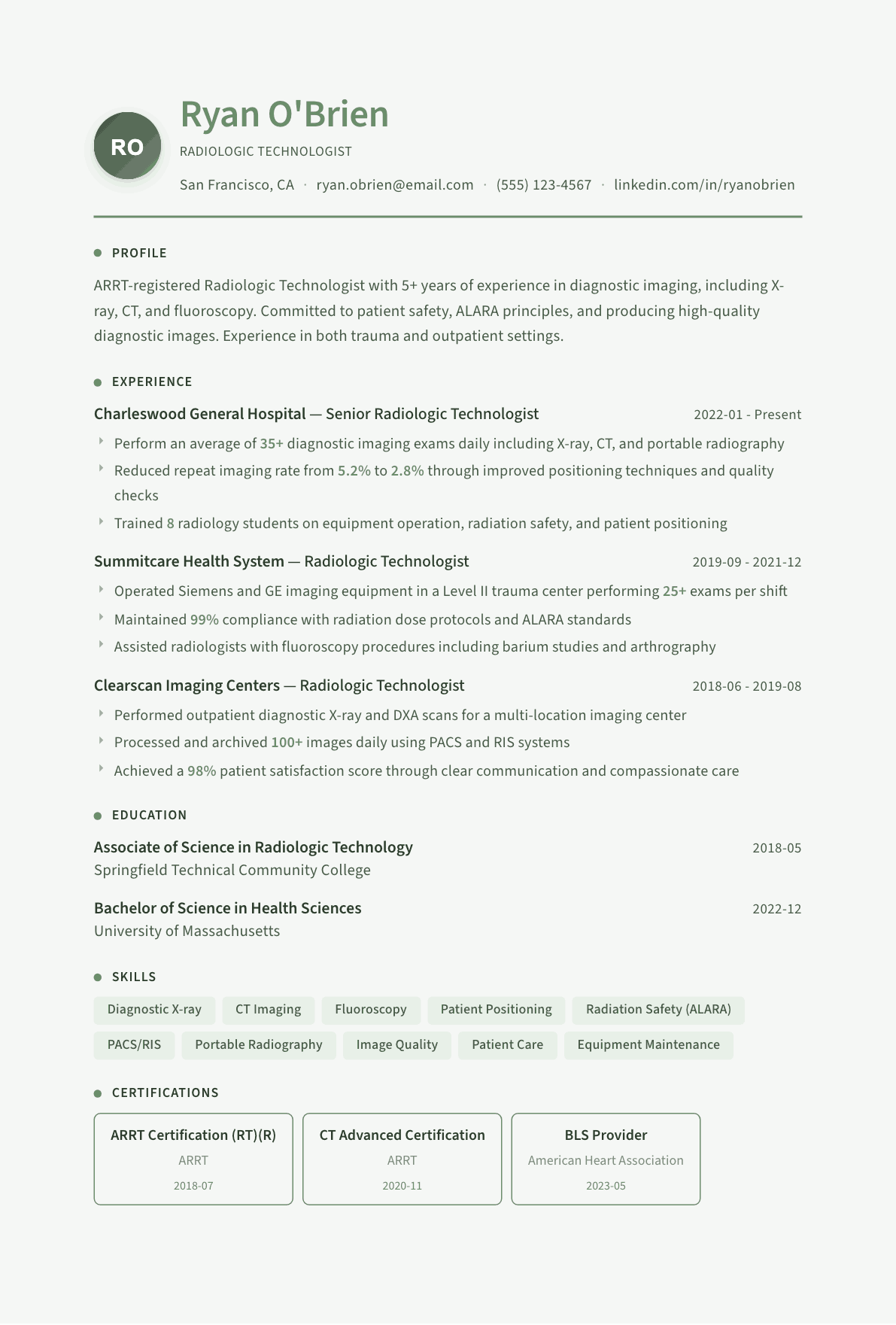
The same radiologic technologist content laid out in three CVBooster templates, so you can see what the finished document looks like before you write a word.
Example Radiologic Technologist summary
ARRT-registered Radiologic Technologist (RT)(R)(CT) with 5 years of experience in diagnostic imaging across trauma and outpatient settings. Reduced repeat imaging rates to 2.8% while performing 35+ exams daily. Seeking a senior rad tech role at an academic medical center with opportunities for advanced modality training.
Skills to list on a Radiologic Technologist resume
- Diagnostic X-ray
- CT Imaging
- Fluoroscopy
- MRI
- Patient Positioning
- Radiation Safety
- PACS/RIS
- Portable Radiography
- Contrast Administration
- Image Quality Assurance
- Patient Care
- DXA Scanning
- Equipment Calibration
- Trauma Imaging
What actually gets this resume read
- List your ARRT registration and modality certifications at the top of your resume.
- Quantify daily exam volumes, repeat rates, and patient satisfaction scores.
- Specify imaging modalities and equipment brands you have operated.
- Highlight radiation safety achievements and ALARA compliance.
- Mention PACS, RIS, and other imaging informatics systems you are proficient in.
- Include continuing education credits and advanced modality certifications.
How to write a radiologic technologist resume
A radiologic technologist resume is filtered on registry status before anything else. The recruiter looks for ARRT registration, the primary pathway plus any post-primary categories such as CT, MR, mammography or vascular interventional, and an active state license or permit where the state requires one. Miss those and the file never reaches the imaging manager.
The imaging manager reads for something different: the modalities you can be scheduled on without a preceptor, the equipment vendors you already know, the exam volume you can hold on a shift, and whether you have worked trauma. A rad tech who can float between general radiography, portables in the intensive care unit and a CT scanner is worth more on a schedule than one locked to a single room, and the resume has to make that obvious in the first ten lines.
This guide sets out the section order imaging departments expect, three summaries at different registry stages, before-and-after bullets built on repeat rates and dose, and the questions techs ask when adding a modality.
Format: registry credentials in the header, modalities near the top
One page under five years, two after that. Write your credentials the way the registry writes them, as R.T. followed by the categories in parentheses, so a manager sees your scope at a glance. A tech registered in radiography and computed tomography reads instantly as schedulable in two areas.
Add a short modalities and equipment block directly under the summary. It is the fastest way to answer the only question a scheduler has, and it doubles as the keyword block that the applicant tracking system indexes.
- Header: name, R.T. credentials with categories, city and state, phone, email, state license number status.
- Order: summary, credentials and licensure, modalities and equipment, clinical experience, education, skills.
- New graduates move the clinical education section above work history and list competency counts by exam type.
Summary: modalities, setting, volume, safety posture
Name the registry categories, the facility type, and the daily exam load. A Level I trauma center, a critical access hospital and a freestanding outpatient imaging center run at different tempos, and a manager wants to know which one you are used to before reading further.
Close with the safety line that means something in radiology: ALARA practice, dose optimization work, or a measurable improvement in repeat rate. Vague statements about patient care belong nowhere near the summary of a radiologic technologist.
Experience: rooms, exam volume, and the vendors you know
Give each job a header line with the facility, its trauma designation or outpatient type, the modalities you covered and the daily exam count. Then bullets on the specific work: portable and operating room radiography, C-arm fluoroscopy for orthopedic and pain cases, barium studies and arthrography with a radiologist, contrast administration and reactions, trauma cross-table and pediatric technique adjustments.
Name the equipment. Siemens, GE, Philips, Canon and Fujifilm consoles behave differently, and a department that runs one vendor shortens orientation for a tech who already knows it. Do the same for the picture archiving and communication system and the radiology information system, plus the dose monitoring platform if you have used one.
Skip bullets that restate the job description. Positioned patients and produced diagnostic images describes the entire profession and wastes the line a repeat rate or a protocol project should occupy.
The numbers a radiology manager actually checks
Three metrics carry weight. Repeat or reject rate, because it maps directly to dose and throughput. Exams per shift, because it maps to staffing. Protocol and dose compliance, because it maps to accreditation. If you helped rebuild positioning technique on a room and the reject rate fell, that belongs in the top bullet of that job.
Accreditation work is worth naming too: preparing a room for an American College of Radiology survey, running quality control on a mammography unit under federal inspection rules, or maintaining the phantom testing log is concrete evidence a manager can verify.
Credentials, licensure and continuing education
List ARRT registration with the primary category and the date of the current biennium, each post-primary category separately, the state license or permit, and BLS. Add the fluoroscopy permit where your state issues one, and mammography certification if you have it, because federal quality standards make those techs scarce.
Continuing education is not decoration in this field. Naming a structured education course you completed toward a post-primary category tells a manager you are already on the path to a modality they are short on.
Radiologic technology resume examples and radiographer samples
Radiographer is the title most countries outside the United States use for the same job, and some American postings use it too, so radiographer resume samples and radiologic technology resume examples follow one structure. The registry or license line goes in the header, the modalities and setting go in the summary, and each job opens with a scope line before the bullets.
The three samples below show the summary and the first lines of the current role at three stages. Copy the structure, then replace every detail with your own registry categories, rooms, volumes and vendors.
- Sample one, new graduate radiographer: Radiologic technologist, ARRT registered in radiography, state licensed, with clinical rotations in an emergency department, an outpatient center and the operating room. Completed all required clinical competencies, including portable chest and C-arm cases, and trained on Siemens and GE digital rooms.
- Sample one, first role line: Staff technologist on evenings at a community hospital, covering general radiography and portables for the emergency department and inpatient floors.
- Sample two, staff radiologic technologist: Five years in a level II trauma center, ARRT registered in radiography and computed tomography, working general, fluoroscopy and CT rooms on rotating shifts. Holds a room alone on nights and precepts first year students.
- Sample two, first role line: Rebuilt the portable exam checklist with the charge technologist after repeat images rose on night shift, and the repeat rate on portables fell back to the department target within one quarter.
- Sample three, lead radiographer: Lead technologist for a four room outpatient imaging center, ARRT registered in radiography and mammography, scheduling six technologists and owning quality control logs for accreditation surveys.
- Sample three, first role line: Led the move from computed radiography to direct digital rooms, trained every technologist on the new protocols and kept the schedule open during the changeover.
Radiologic Technologist resume summary examples
New registry graduate
ARRT-registered radiologic technologist and recent associate degree graduate with 1,600 clinical hours across general radiography, portables, surgery and trauma. Completed competencies in 45 exam categories, trained on GE and Siemens consoles, and seeking a hospital position with rotation into computed tomography.
Five years, cross-trained
Radiologic technologist registered in radiography and computed tomography with 5 years in a Level II trauma center, running 30 to 35 exams per shift across general, portable and CT. Cut room repeat rate from 5.2% to 2.8% by rebuilding positioning technique for the night team.
Lead technologist
Lead radiologic technologist with 12 years across trauma and outpatient imaging, registered in radiography, CT and mammography. Runs the schedule for 14 technologists, owns quality control and phantom testing logs, and prepared 3 rooms for American College of Radiology accreditation surveys.
Work experience bullets: before and after
Before: Performed X-ray exams on patients daily.
After: Completed 30 to 35 exams per shift across general radiography, intensive care portables and operating room C-arm cases in a Level II trauma center.
Volume, exam mix and facility level tell a scheduler exactly where you can be placed on day one.
Before: Followed radiation safety guidelines.
After: Applied ALARA technique charts by patient size and age, collimated to anatomy of interest, and held dose protocol compliance across audited chest and abdomen exams.
Naming the actual practices proves radiation safety instead of claiming it.
Before: Reduced repeat images.
After: Rebuilt lateral and cross-table positioning technique for the overnight team and brought the room repeat rate down from 5.2% to 2.8% over two quarters.
A before and after number on the metric radiology managers track is the strongest bullet a tech can write.
Before: Used PACS to send images.
After: Processed and archived roughly 100 studies daily in PACS, corrected mismatched orders in the radiology information system, and flagged critical findings to the on-call radiologist.
The systems work becomes evidence of accuracy and escalation rather than a button press.
Before: Trained students in the department.
After: Precepted 8 radiography students through clinical competencies in positioning, radiation safety and contrast handling, and signed off their trauma and portable evaluations.
The competency detail shows real supervisory responsibility instead of casual mentoring.
Hard skills
- Diagnostic radiography
- Computed tomography
- Fluoroscopy and C-arm
- Portable and operating room imaging
- Trauma positioning
- Contrast administration
- ALARA dose optimization
- Quality control and phantom testing
- PACS and RIS
- DXA bone densitometry
- Siemens, GE and Philips consoles
- Patient screening and history taking
Soft skills
- Working with combative or immobile patients
- Communication with radiologists
- Prioritizing stat and trauma orders
- Attention to detail under time pressure
- Student supervision
Certifications worth listing
- ARRT Registered Technologist in Radiography, R.T.(R) (American Registry of Radiologic Technologists)
- ARRT Computed Tomography, R.T.(CT) (American Registry of Radiologic Technologists)
- ARRT Magnetic Resonance Imaging, R.T.(MR) (American Registry of Radiologic Technologists)
- ARRT Mammography, R.T.(M) (American Registry of Radiologic Technologists)
- ARRT Vascular-Interventional Radiography, R.T.(VI) (American Registry of Radiologic Technologists)
- Basic Life Support (BLS) (American Heart Association)
Mistakes that cost radiologic technologist candidates the interview
- Burying ARRT categories at the bottom of the page, so a recruiter filtering for a CT-registered technologist never sees that you hold it.
- Listing modality names without saying which ones you can be scheduled on unsupervised and which you have only observed.
- Leaving out exam volume per shift, which is the number that decides whether you can hold a room in a busy department.
- Never naming equipment vendors or the picture archiving system, forcing the manager to assume a longer orientation.
- Writing generic care bullets when the field has hard metrics available: repeat rate, dose compliance, quality control results.
- Omitting the state license or fluoroscopy permit in states that require one, which is an automatic disqualification at screening.
Radiologic Technologist resume questions
How do I list ARRT credentials on a radiologic technologist resume?
Put them after your name in registry format, with each category shown, then repeat them in a credentials section with the registration status and your state license. Recruiters filter on the category abbreviations, so spell out the modality once as well.
Should I include my clinical competency counts as a new graduate?
Yes. Give total clinical hours and the number of completed competencies by exam category, plus the settings you rotated through such as trauma, surgery and portables. It is the only volume evidence you have before a paid position.
Is a radiographer resume the same as a radiologic technologist resume?
Yes. Radiographer is the common title outside the United States and in some American postings, and the resume follows the same order: registry or license in the header, modalities and setting in the summary, scope lines and exam volume under each job. Use the exact title from the posting in your headline so applicant tracking systems match it.
How do I show I am ready to cross-train into CT or MRI?
Name any structured education hours completed toward the post-primary category, the scanner assists you have logged, and the vendor consoles you have already used. Managers hire for the modality gap they are trying to fill next.
What quality metrics should a rad tech put on a resume?
Repeat or reject rate with a before and after figure, dose protocol compliance, and any accreditation preparation work such as phantom testing logs or an American College of Radiology survey. Those three are checked by every imaging manager who reads resumes.