Veterinarian Resume Examples: free ATS score and gap list
Build a Veterinarian Resume That Lands Your Dream Practice
By Mustafa Tarabya, founder of CVBooster · Published · Updated
Create a professional veterinarian resume with clinical examples, specialty-specific templates, and tips for DVM job seekers.
Sample resumes for a veterinarian
The same veterinarian content laid out in three CVBooster templates, so you can see what the finished document looks like before you write a word.
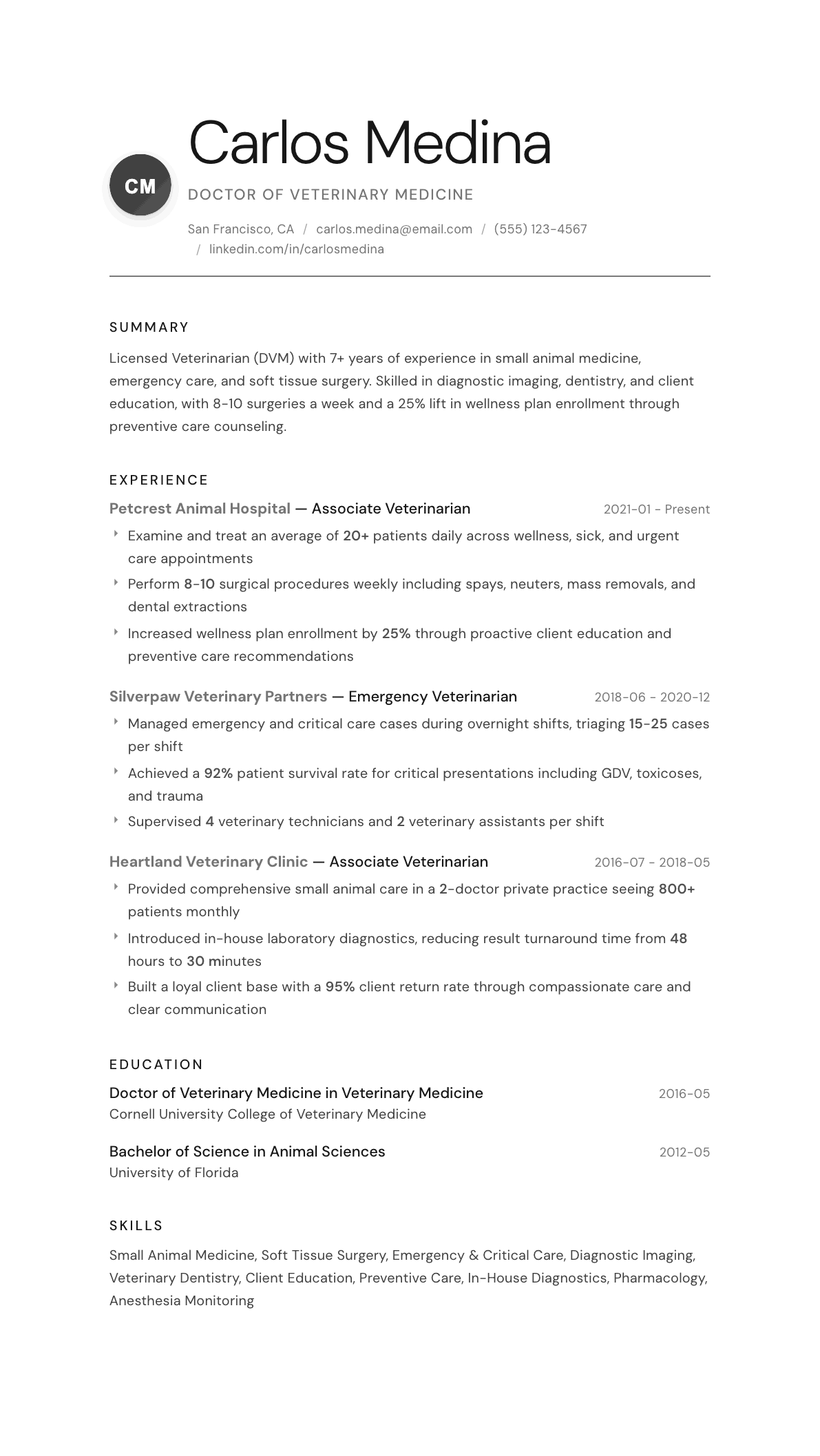
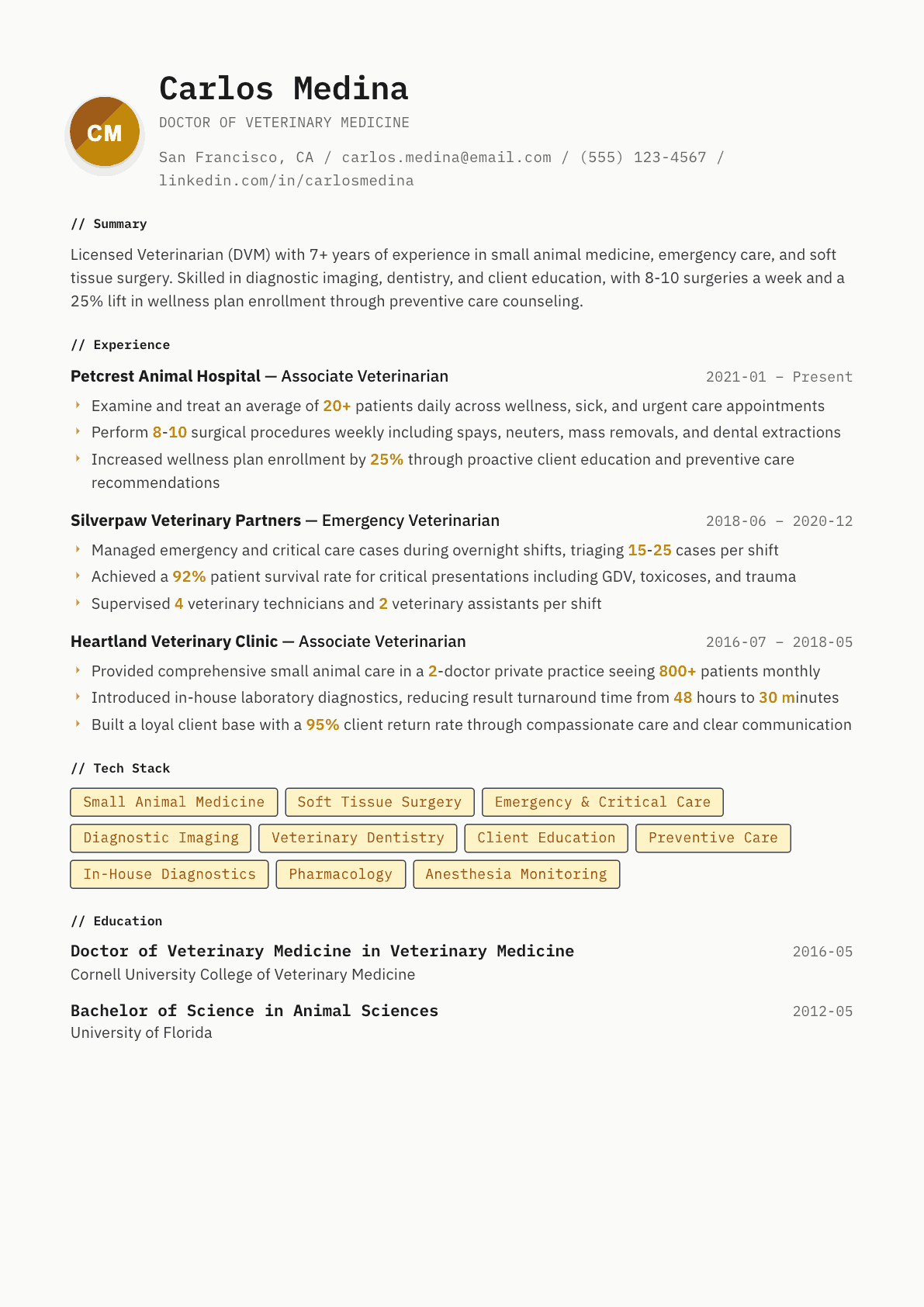
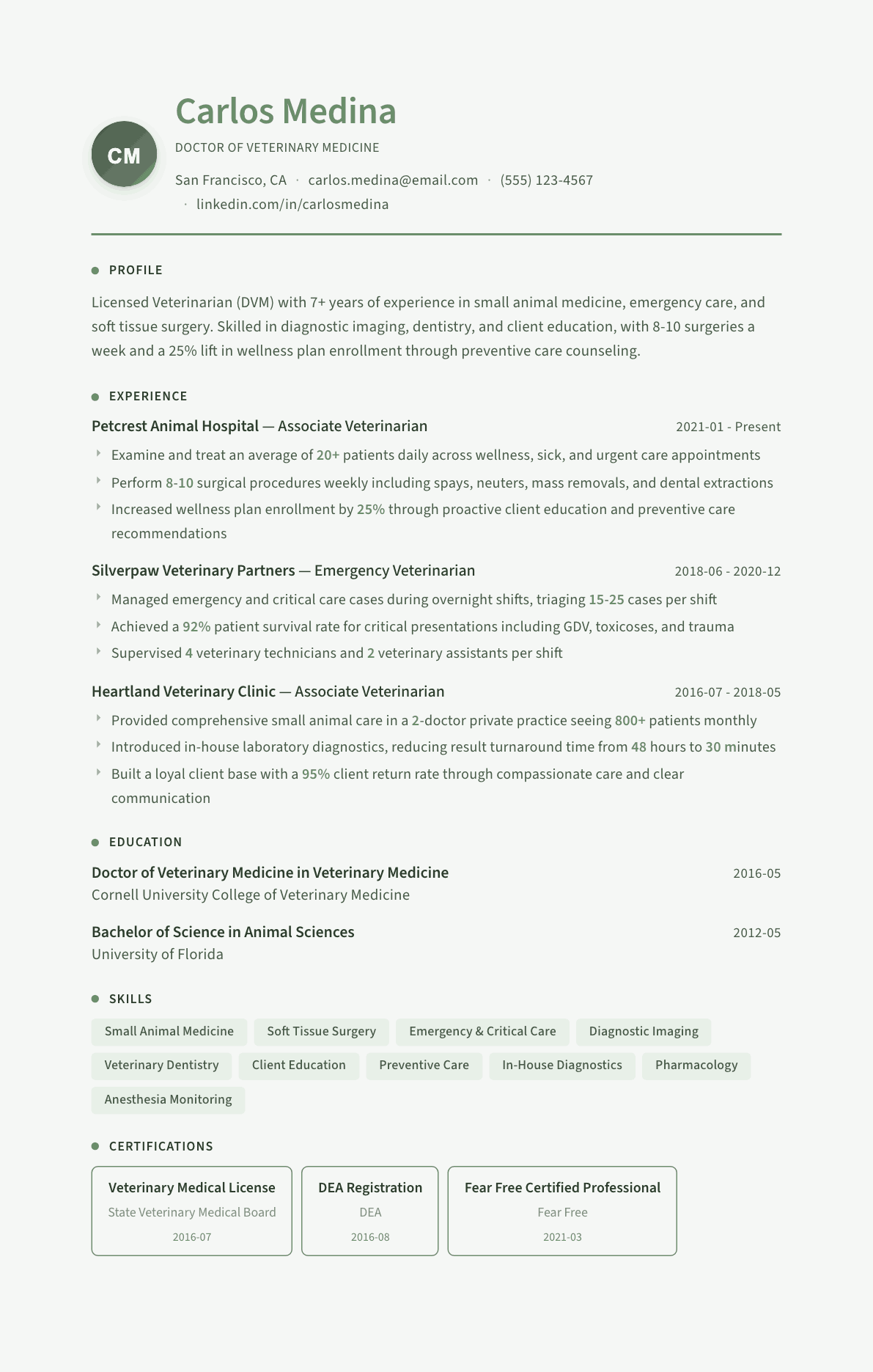
Example Veterinarian summary
Licensed DVM with 7 years of small animal experience including emergency care and soft tissue surgery. Perform 8-10 surgical procedures weekly with a 92% critical care survival rate. Seeking an associate veterinarian role in a progressive practice that values preventive medicine and client relationships.
Skills to list on a Veterinarian resume
- Small Animal Medicine
- Surgery
- Emergency Care
- Diagnostic Imaging
- Veterinary Dentistry
- Anesthesia
- Client Education
- Preventive Care
- Laboratory Diagnostics
- Pharmacology
- Large Animal Medicine
- Exotic Animal Care
- Ultrasound
- Practice Management
What actually gets this resume read
- Include your DVM degree and state license information prominently.
- Quantify patient volumes, surgical caseloads, and survival/outcome rates.
- List species and specialty areas you are experienced with.
- Highlight surgical skills and advanced procedures you can perform.
- Mention practice management software you are proficient in (e.g., Cornerstone, AVImark).
- Show client education and business development contributions.
How to write a veterinarian resume
A veterinarian resume is read by a practice owner or medical director who is thinking about a schedule and a caseload. She wants to know what species and cases you see, how many appointments you can hold in a day, which surgeries you close without help, and whether you can take emergency or overnight rotation. Those four answers decide the interview.
The credential screen is fast and absolute: a DVM or VMD degree from an accredited program, an active state veterinary license, DEA registration for controlled drugs, and for foreign graduates the educational equivalence certificate. Board certification in a specialty changes the whole conversation and belongs in the header when you have it.
This guide covers the layout practices read in, three summaries from new graduate to medical director, before-and-after bullets built on caseload and surgical volume, and the questions veterinarians ask when moving between general practice, emergency and specialty work.
Format: degree and license in the header, procedures near the top
Reverse chronological, one page for a new graduate and two once you have surgical volume, species breadth and any specialty training. Write the credential after your name as DVM or VMD, then a licensure block listing each state license, DEA registration status and controlled substance registration where the state issues one separately.
Follow the summary with a compact procedures and diagnostics block. A practice owner hiring for surgery days scans for the procedure list, not for a paragraph about your passion for animals.
- Header: name, DVM or VMD, board certification if held, city and state, phone, email, licensed states.
- Order: summary, licensure, clinical experience, surgical and diagnostic procedures, education and internships, skills.
- New graduates put clinical year rotations and any internship above employment, with species and caseload.
Summary: species, setting, caseload, surgical scope
Name the species you treat, the practice type, the years, the daily appointment volume and the surgical scope. Small animal general practice, mixed animal, equine, exotics, shelter medicine, emergency and specialty referral are genuinely different jobs, and a veterinarian resume that does not declare one in the first line makes the reader work.
Close with the scarce piece. Overnight emergency comfort, ultrasound proficiency, advanced dentistry with radiographs and extractions, orthopedic surgery, or exotics competency are the details that make a practice call today rather than next month.
Experience: appointments per day, surgeries per week, who you supervised
Head each job with the practice, the number of doctors, the species mix and the caseload. A line such as associate veterinarian, 4-doctor small animal practice, 20 to 24 appointments daily plus 8 to 10 surgeries weekly, tells a reader in one line what your day looks like.
Then bullets on the medicine. Chronic disease management in aging patients, dermatology and allergy workups, dentistry with full mouth radiographs, soft tissue surgery by procedure name, orthopedic cases, ultrasound and radiograph interpretation, in-house laboratory diagnostics, and euthanasia and end of life conversations.
Add the practice side that owners care about: supervising credentialed technicians and assistants, mentoring associates, on call rotation, preventive care and wellness plan participation, and inventory or pharmacy oversight. Leave out examined patients and prescribed medication, which is simply the definition of being a veterinarian.
Surgical and diagnostic scope: list it, do not imply it
Name what you perform independently and separate it from what you have assisted on. Ovariohysterectomy and castration, mass removals, cystotomy, enterotomy and foreign body retrieval, splenectomy, gastric dilatation volvulus correction, cesarean section, laceration repair, dental extractions with sectioning, and any orthopedic work such as cruciate repair or fracture fixation.
Do the same for diagnostics: abdominal and thoracic ultrasound, echocardiography if you have it, digital radiography and dental radiography, cytology and in-house chemistry and hematology analyzers, and endoscopy. Practices buy equipment and then look for a doctor who can use it.
The numbers a practice owner checks, and the software
Caseload per day, surgeries per week, average client transaction is one an owner will ask about even though it belongs in an interview rather than the page, and outcome measures such as survival rates for critical presentations if you worked emergency. Client retention, wellness plan enrollment and compliance on recommended diagnostics all indicate a veterinarian who builds a book of business rather than only working through a queue.
Name the practice management software. Systems such as Cornerstone, Avimark, ezyVet and Impromed are learned on the job but a doctor who already knows the one in use is running full days a week sooner.
Veterinarian resume summary examples
New graduate DVM
Licensed veterinarian and recent DVM graduate with clinical year rotations in small animal medicine, surgery, emergency, dermatology and exotics. Performed 40 supervised spay and neuter surgeries and 25 dental procedures during training, and seeking an associate position in general practice with structured mentorship.
Six years in general practice
Veterinarian with 6 years in a 4-doctor small animal practice, seeing 20 to 24 appointments daily and performing 8 to 10 surgeries weekly including mass removals, cystotomy and dental extractions. Comfortable with abdominal ultrasound, in-house diagnostics and difficult end of life conversations.
Medical director
Veterinarian and medical director with 13 years across general practice and overnight emergency, supervising 6 doctors and 14 credentialed technicians. Built the practice dentistry program with full mouth radiographs, and manages formulary, controlled drug logs and case review across two hospital locations.
Work experience bullets: before and after
Before: Examined and treated pets in a busy clinic.
After: Saw 20 to 24 appointments daily across wellness, sick and urgent care in a 4-doctor small animal practice, carrying a personal client base of long-term chronic disease patients.
Appointment volume, practice size and a personal client base tell an owner what you contribute to the schedule.
Before: Performed surgeries including spays and neuters.
After: Performed 8 to 10 surgeries weekly including ovariohysterectomy, castration, mass removal, cystotomy, foreign body retrieval and dental extraction with sectioning and radiographs.
A named procedure list is what a practice matches against the surgery days it needs covered.
Before: Worked emergency shifts and handled critical cases.
After: Triaged 15 to 25 emergency cases per overnight shift including gastric dilatation volvulus, toxicoses, hit by car trauma and respiratory distress, stabilizing and transferring to the day team at handoff.
Naming the presentations and the handoff proves emergency competence rather than emergency attendance.
Before: Improved client education about preventive care.
After: Rebuilt the wellness conversation at the annual visit around dental scoring and parasite screening, lifting preventive plan enrollment by 25% over a year without adding appointment time.
The specific change and the outcome show revenue judgment, which is what a practice owner is reading for.
Before: Supervised the technician team.
After: Supervised 4 credentialed technicians and 2 assistants per shift, wrote the anesthesia monitoring protocol they follow, and ran monthly case reviews on complications.
A written protocol and a review cadence turn supervision into leadership a director can evaluate.
Hard skills
- Small animal medicine
- Soft tissue surgery
- Dentistry and dental radiography
- Emergency and critical care triage
- Abdominal and thoracic ultrasound
- Digital radiograph interpretation
- Anesthesia protocols and monitoring
- In-house laboratory diagnostics
- Dermatology and allergy workup
- Controlled substance record keeping
- Practice management software
- Preventive care and vaccination protocols
Soft skills
- Client communication and estimates
- End of life conversations
- Team supervision
- Mentoring new graduates
- Decision making with limited budgets
- Composure in emergencies
Certifications worth listing
- Doctor of Veterinary Medicine (DVM or VMD) license (State Board of Veterinary Medicine)
- Diplomate, American College of Veterinary Internal Medicine (American College of Veterinary Internal Medicine)
- Diplomate, American College of Veterinary Surgeons (American College of Veterinary Surgeons)
- Diplomate, American College of Veterinary Emergency and Critical Care (American College of Veterinary Emergency and Critical Care)
- Educational Commission for Foreign Veterinary Graduates Certificate (American Veterinary Medical Association)
- Fear Free Certified Professional (Fear Free)
Mistakes that cost veterinarian candidates the interview
- Not declaring the species and practice type in the first line, so a mixed animal owner and a small animal owner both have to guess.
- Listing surgery without naming the procedures you close independently, which is the detail that fills a surgery day.
- Leaving off appointment volume, so nobody can tell a two appointment per hour practice from a wellness mill.
- Omitting state licenses and DEA registration status, which delays credentialing and pharmacy access.
- Writing about a passion for animals instead of the medicine, when every veterinarian in the stack shares that.
- Ignoring the business side entirely, when practice owners hire associates who understand estimates, compliance and preventive care enrollment.
Veterinarian resume questions
How long should a veterinarian resume be?
One page as a new graduate and two once you have surgical volume, several species or a specialty. Add a separate page only for publications, presentations or residency work, and never compress the procedure list to save space.
Should a new graduate veterinarian list clinical rotations?
Yes. List the clinical year rotations with the service, the length and the caseload, plus your surgical and dental case counts from training. Those numbers are your only evidence of hands-on competence until you have a year in practice.
How do I list a surgical procedure list on a vet resume?
Give it its own block and separate what you perform independently from what you have assisted on. Name each procedure rather than writing routine surgery, because practice owners are matching your list against the cases they currently refer out.
Do practice owners care about production numbers?
Many do, particularly in corporate and multi-doctor groups where compensation ties to production. Rather than quoting figures, show the drivers: appointment volume, surgeries per week, diagnostic compliance and preventive plan enrollment you personally moved.
How do I move from general practice into emergency work?
Lead with every after hours case, stabilization and critical presentation you have managed, name the emergencies by type, and say plainly in the summary that you are moving into emergency medicine. Add any advanced life support or critical care continuing education you have completed.