Animator Resume Examples: free score, then the gap list
Animator Resume and Animation Resume Examples
By Mustafa Tarabya, founder of CVBooster · Published · Updated
Animation resume examples for 3D, game and 2D animators, plus internship advice, reel and shot count tips, keywords and a full animator resume guide.
Sample resumes for a animator
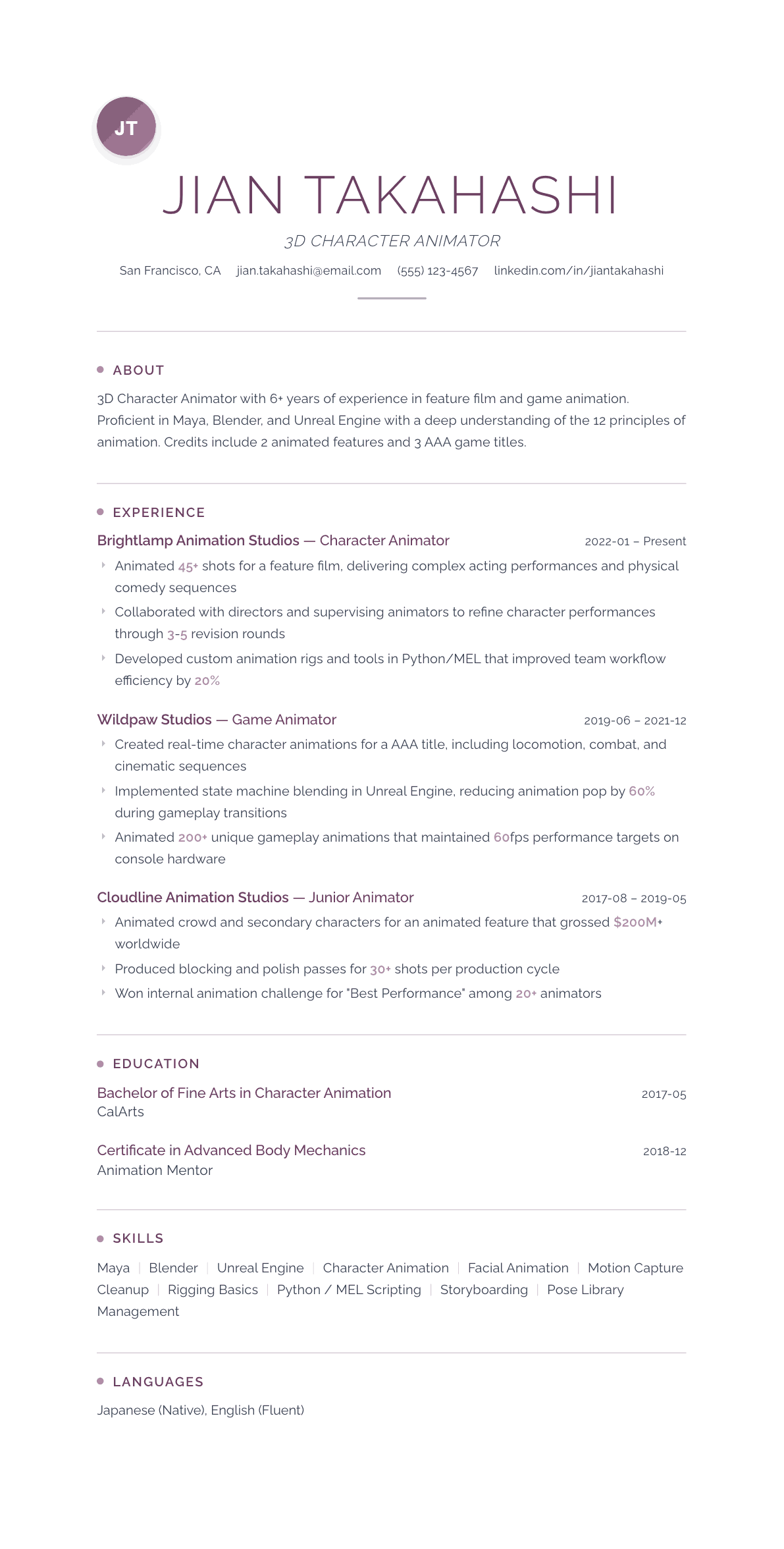
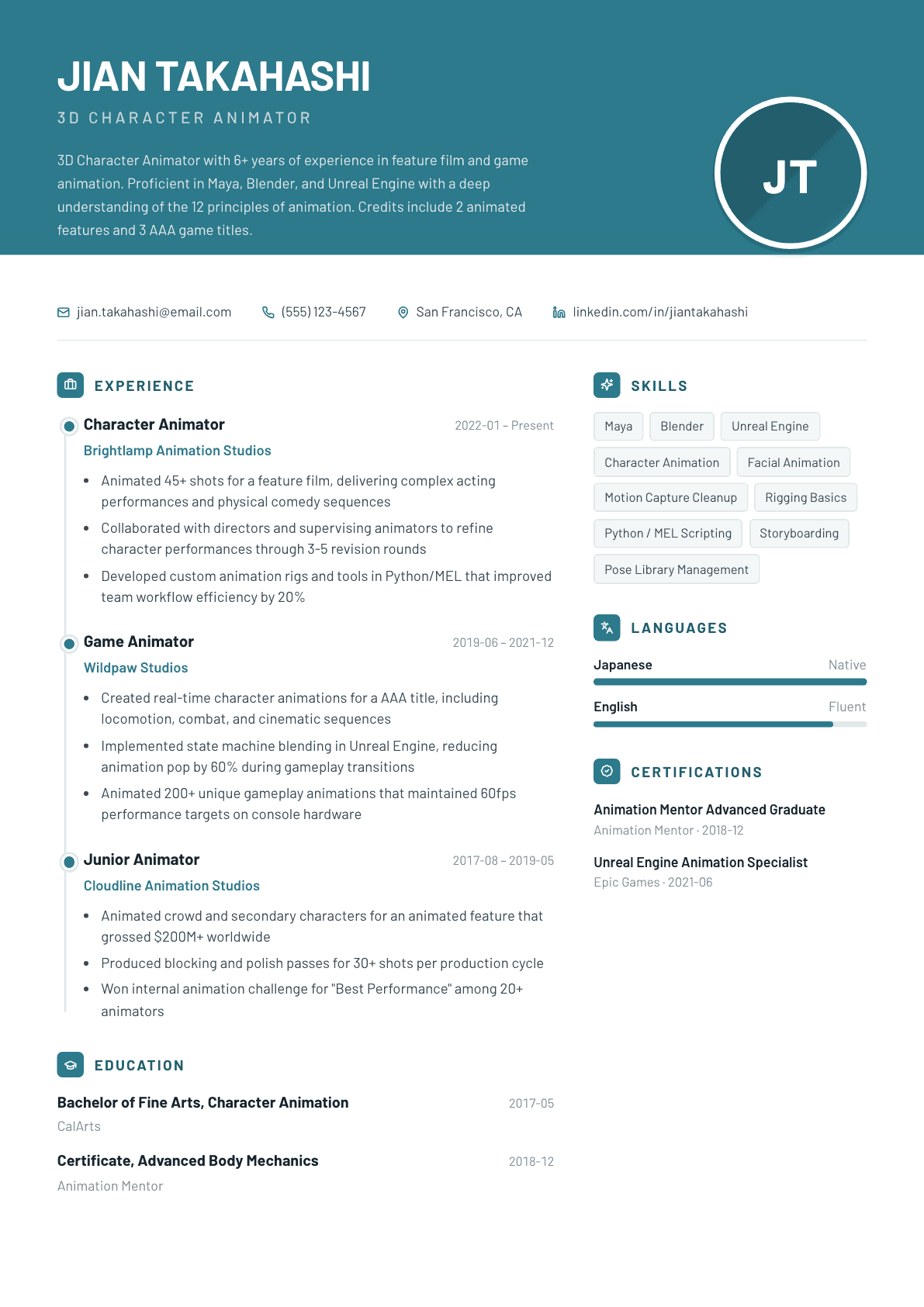
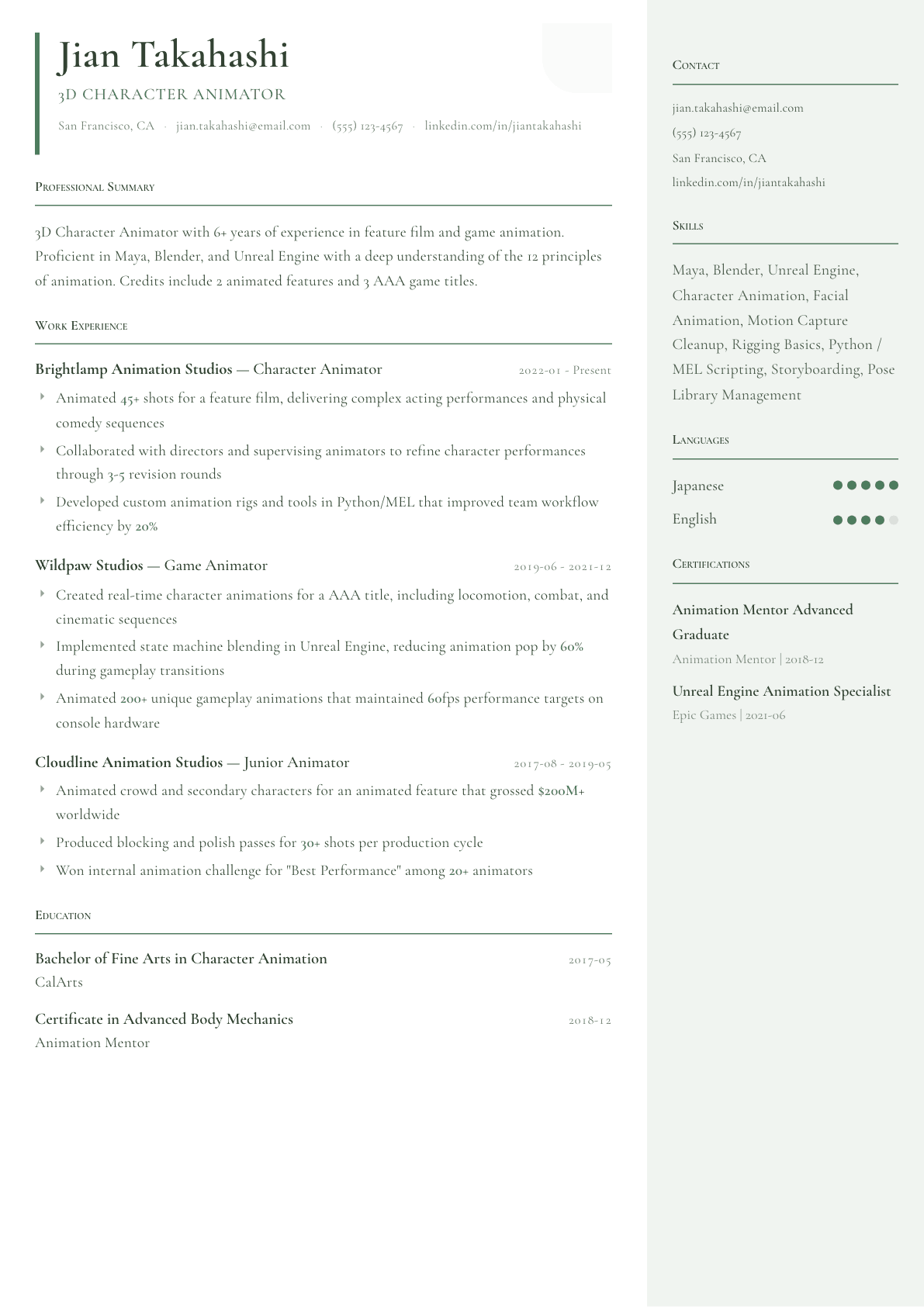
The same animator content laid out in three CVBooster templates, so you can see what the finished document looks like before you write a word.
Example Animator summary
Character Animator with 6 years across feature animation and AAA game production, working in Maya, Blender, and Unreal Engine. Delivered 45+ acting shots on a feature and 200+ gameplay animations that held 60fps on console, and wrote Python and MEL tools that lifted team throughput 20%.
Skills to list on a Animator resume
- Character Animation
- Facial Animation
- Maya
- Blender
- Unreal Engine
- Motion Capture
- Rigging
- Python / MEL
- Storyboarding
- 2D Animation
- 3D Animation
- Lip Sync
- Body Mechanics
- Acting for Animation
What actually gets this resume read
- Your demo reel is everything -- link it at the top and make sure it opens with your strongest work.
- List specific film or game credits by title so recruiters can verify your experience.
- Mention the types of animation you specialize in: character acting, creature, locomotion, facial, VFX.
- Include technical skills beyond animation: rigging, scripting, state machines, or pipeline tools.
- Quantify where possible: shots delivered, frames animated, performance targets met.
- Keep your resume to one page and let the reel do the heavy lifting.
How to write a animator resume
Animation hiring runs on the reel. An animation supervisor will watch the first fifteen seconds of yours and decide, and the resume exists to get the reel opened by the right person and to answer the questions the reel cannot: which studios, which pipeline, which discipline, how you take notes, and whether you can be trusted with a shot on a deadline.
The word animator covers work that shares almost no daily craft. Feature and episodic character animation, gameplay animation with state machines and blend trees, creature and quadruped work, facial and lip sync, motion capture editing, and two dimensional frame by frame animation are separate hiring pools. A supervisor filling a creature seat will not read a resume that says animator and leaves the rest to the reel.
This guide covers the page layout animation recruiters expect, how to write reel and shot count information, how to describe pipeline and note taking, three short animation resume examples for 3D, game and 2D work, three summaries from junior to supervising animator, before and after bullets, and the questions animators ask most when they update their resume.
Format: one page, reel link and password in the header
One page, one column, plain and legible. The header carries your name, your discipline, your location and time zone, your email, and the reel link written out in full with the password on the same line. A reel that asks a supervisor to email for a password loses views, and views are the only currency here.
Order the page the way a supervisor reads it: header, one or two line summary naming the discipline, experience with credits and shot counts, software and pipeline, education and training, then a short section for personal or short film work if it is your strongest material.
- Header: name, discipline, city and time zone, email, reel link with password, and relocation or visa status.
- Under each credit put the production type, your discipline, the shot or animation count, and the pipeline you worked in.
- Name the reel length and say a shot breakdown is included, since supervisors expect one.
Discipline: say which animator you are
Lead with the specialization the posting wants and back it with range. A gameplay animator writes locomotion sets, transitions and attack cycles that live inside a state machine and must feel responsive under player input. A feature animator carries a shot from blocking through splining to final polish under a supervisor note cycle. A creature animator studies real reference and solves weight on a body plan that does not walk on two legs. Those are different hands and the resume should say which one is yours.
If you cross disciplines, order them by strength and say where you have production hours rather than interest. Supervisors read an honest second discipline as flexibility and an inflated one as a risk, since the difference shows in the first week of dailies.
Experience: credits, shot counts, and how you took notes
Give each production its name where the credit is public, the format, the studio, and your role. Then quantify the way animation quantifies: shots delivered or seconds of final animation for film and episodic, animation count and set breadth for games, and the length of the run. A supervisor uses those numbers to calibrate your speed against their schedule.
The bullets that separate a hire from a maybe describe the work inside the shot. Blocking method and whether you work in stepped or spline, body mechanics or acting emphasis, physical performance solved, facial and lip sync passes, interaction with other characters or effects, and cleanup on captured data. Add the note cycle: how many rounds a shot typically took and whether you took notes from a supervisor, a director or both.
For game work, name the runtime side. State machines and blend trees, root motion versus in place, animation events and hit windows, retargeting across rigs, additive layers, and the engine you authored in. Gameplay animation is judged on feel under input, and none of that is visible from a reel alone.
Software, rigs and pipeline
List the animation package you are fastest in first, then engines, capture and editing tools, and any scripting you use to build your own tools. Say whether you can rig at a basic level, fix a broken rig or work only inside what a rigger hands you, because small teams need the first and large ones do not care.
Mention the production tools you have lived inside: shot tracking and review systems, playblast and dailies workflows, version control on scenes, and how you handle a publish. Supervisors hire animators who do not break the pipeline, and saying you know the review and publish process is a quiet reassurance that carries weight.
Keywords a recruiter filters on
Discipline words are the filter: character animation, body mechanics, acting, creature, quadruped, facial, lip sync, locomotion, gameplay animation, motion capture cleanup, blocking, splining, polish, retargeting, and the named packages and engines. Put the two that describe you into the summary and repeat each once inside a credit.
For two dimensional work, name the technique and the tool: frame by frame, cut out and rigged, rough and clean up, inbetweening, and the software the studio actually uses. Two dimensional and three dimensional pipelines rarely share a recruiter, so the words decide which pile you land in.
Animation resume examples: three short samples
An animation resume is read next to the reel, so the samples below keep each entry to the facts a supervisor cannot see on screen: the studio, the show or game, the shot count, the pipeline and who gave you notes. The people and studios are invented; copy the order, not the details.
- Junior 3D animator, first studio job: Animator, Bramblewood Pictures, 14 months, feature film. Animated 22 shots of body mechanics and background acting in Maya on studio rigs, took dailies notes from the sequence lead, and turned most notes around within one day.
- Game animator, mid level: Gameplay Animator, Tidepool Games, three years, action title. Built locomotion and combat sets for two playable characters, cleaned motion capture data in MotionBuilder, set up state machines in the engine with the design team, and fixed foot sliding reported by testers.
- 2D and motion design animator: Animator, Lantern Row Studio, two years, preschool series and client explainers. Rigged and animated cut out characters in Toon Boom Harmony, animated 40 seconds of finished footage per week at peak, and delivered After Effects titles for six client campaigns.
- Animation internship resume: put the reel link and your school program first, then the student film or group project with your exact role, the software, the length you animated and the mentor who gave you notes. One short project described well beats a list of every class.
Animator resume summary examples
Junior animator
Junior character animator with a reel of 6 body mechanics and acting shots built from live reference, plus a 4 month contract cleaning motion capture for a mobile title. Comfortable blocking in stepped, splining to polish, and turning around supervisor notes within a day.
Five years in
Gameplay animator with 5 years across two shipped action titles, authoring locomotion sets, traversal and combat animations for player and enemy characters. Works directly in engine on state machines, blend trees and animation events, and tunes hit windows with design and combat engineers.
Lead or supervising animator
Supervising animator with 11 years in feature and episodic production, credited on 4 features and delivering more than 300 final shots. Ran dailies for a team of 9, set the blocking standard and shot assignment plan, and mentored 3 juniors into independent shot ownership.
Work experience bullets: before and after
Before: Animated characters for a video game.
After: Authored the full traversal set for the player character, including locomotion, starts and stops, ledge grabs and landings, then tuned transitions in the blend tree so input response stayed under the design target.
Naming the animation set and the runtime tuning shows a supervisor you can make a character feel right, not just look right.
Before: Worked on feature film shots.
After: Delivered 42 final shots across a feature, weighted toward two character acting scenes, working from stepped blocking through splining and polish under a three round note cycle.
A shot count, a content type and a note cycle let a supervisor calibrate your throughput against their schedule.
Before: Cleaned up motion capture data.
After: Retargeted and cleaned captured performances onto a production rig, fixing foot slide and contact pops, then layered hand and facial animation the capture stage did not record.
Specific defects fixed and the layering work show real craft rather than button pushing on a data set.
Before: Received notes from the animation supervisor.
After: Took dailies notes on timing and silhouette readability, reshot my own reference for the difficult beats, and brought a revised block back the same day rather than defending the first pass.
How you respond to notes is what supervisors actually screen for, and this describes a process instead of a passive activity.
Before: Helped improve the animation workflow.
After: Wrote a small scene checker that flagged unbaked constraints and off model controls before publish, cutting the number of scenes kicked back by the pipeline team each week.
A concrete tool with a measurable effect on the team turns workflow help into evidence of technical value.
Hard skills
- Character animation
- Body mechanics
- Acting and performance
- Creature and quadruped animation
- Facial animation and lip sync
- Blocking, splining and polish
- Motion capture cleanup and retargeting
- Blend trees and state machines
- Animation layers and additive poses
- Rig troubleshooting
- Reference shooting and analysis
- Scripting for animation tools
Soft skills
- Taking notes without defending the shot
- Honest shot time estimates
- Dailies communication
- Reference discipline
- Steady output under a lock date
Mistakes that cost animator candidates the interview
- Sending a reel link without the password, which quietly removes you from the review session.
- Writing animator with no discipline, so a supervisor filling a creature or gameplay seat cannot read you for it.
- Leading the reel with your third best shot, when a supervisor may only watch the first fifteen seconds.
- Omitting shot counts and run length, the numbers a supervisor uses to judge speed against a schedule.
- Claiming acting range on a reel made only of ball bounces and body mechanics, which invites the wrong test.
- Leaving out the engine and runtime work on a game resume, since feel under input cannot be judged from video.
Animator resume questions
How long should an animation reel be?
One to two minutes, strongest shot first, with a breakdown listing what was yours on every shot. Supervisors watch dozens in a sitting, so cut anything you would apologize for. A shorter reel of consistent work beats a longer one with a weak middle.
Should the resume repeat what is on the reel?
No. The resume answers what the reel cannot: which studios, which pipeline, how many shots, what the note cycle was, and how you work with a supervisor. Use it to give the reel context, not to describe shots the viewer is already watching.
How do I move from motion capture cleanup into keyframe animation?
Build reel material that is unambiguously keyframed, ideally acting and body mechanics from your own reference, and label it as such. On the resume, keep the capture credits for production experience and add a line naming keyframe work you did inside those productions.
How do I write an animation internship resume?
Lead with the reel link and your animation program, then describe one or two student projects as if they were production: your role, the shots or seconds you animated, the software and the feedback rounds. Studios hire interns on the reel more than the degree, so keep education to one line and add any club, jam or festival screening.
What do I put on an animator resume with no studio credits?
Put the reel first, then treat every finished piece as production work: the brief you set, the reference you shot, the rig you used and the rounds of feedback you took from a mentor or a peer group. Add short films, game jams and contract work with the client named where you can.