ABA Therapist Resume Examples: free ATS score and gap list
ABA Therapist Resume: ABA Therapy Resume Sample and Guide
By Mustafa Tarabya, founder of CVBooster · Published · Updated
ABA therapist resume and a complete ABA therapy resume sample with caseload detail, skill acquisition programs, credential scope and hiring keywords.
Sample resumes for a aba therapist
The same aba therapist content laid out in three CVBooster templates, so you can see what the finished document looks like before you write a word.
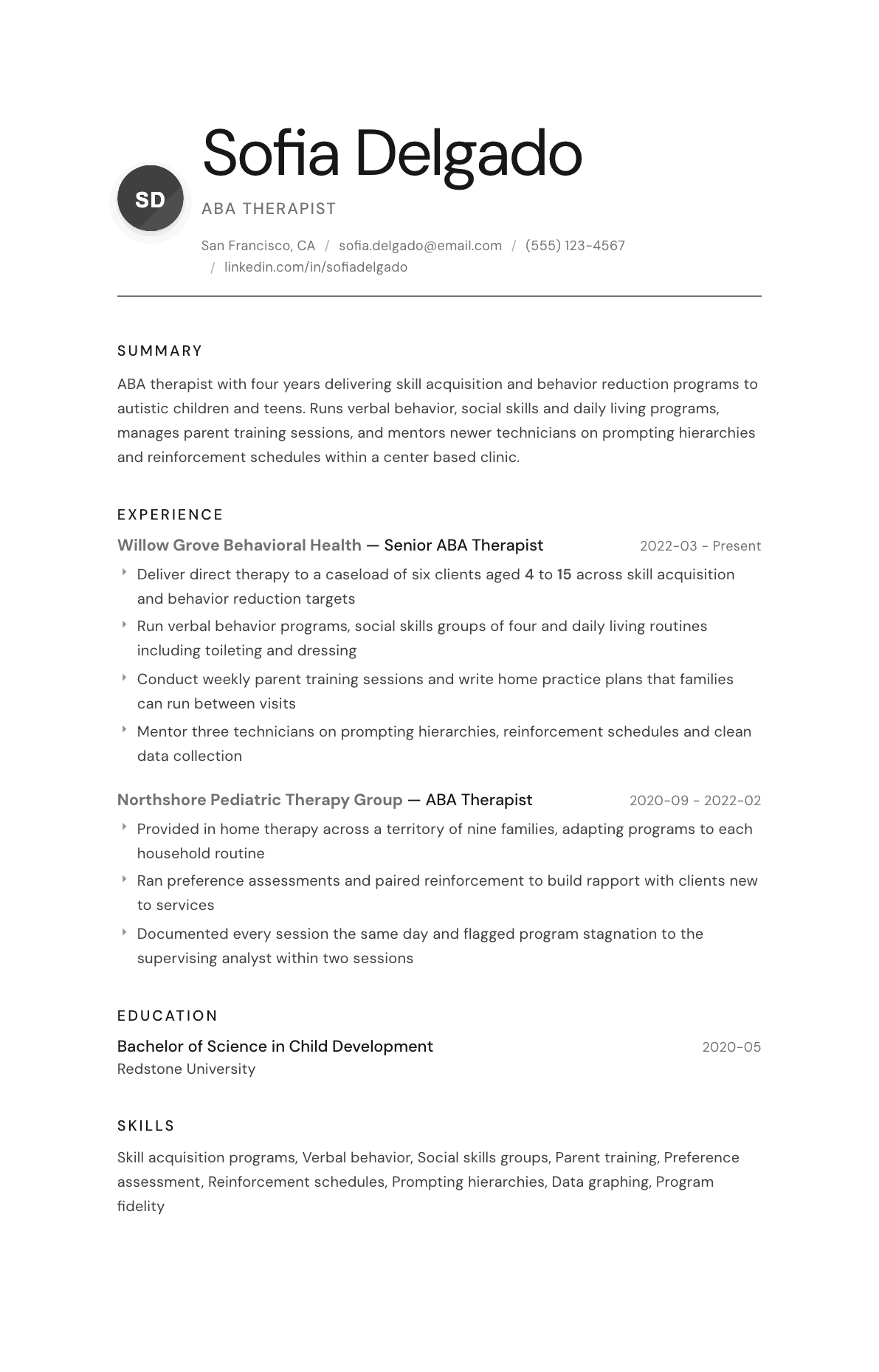
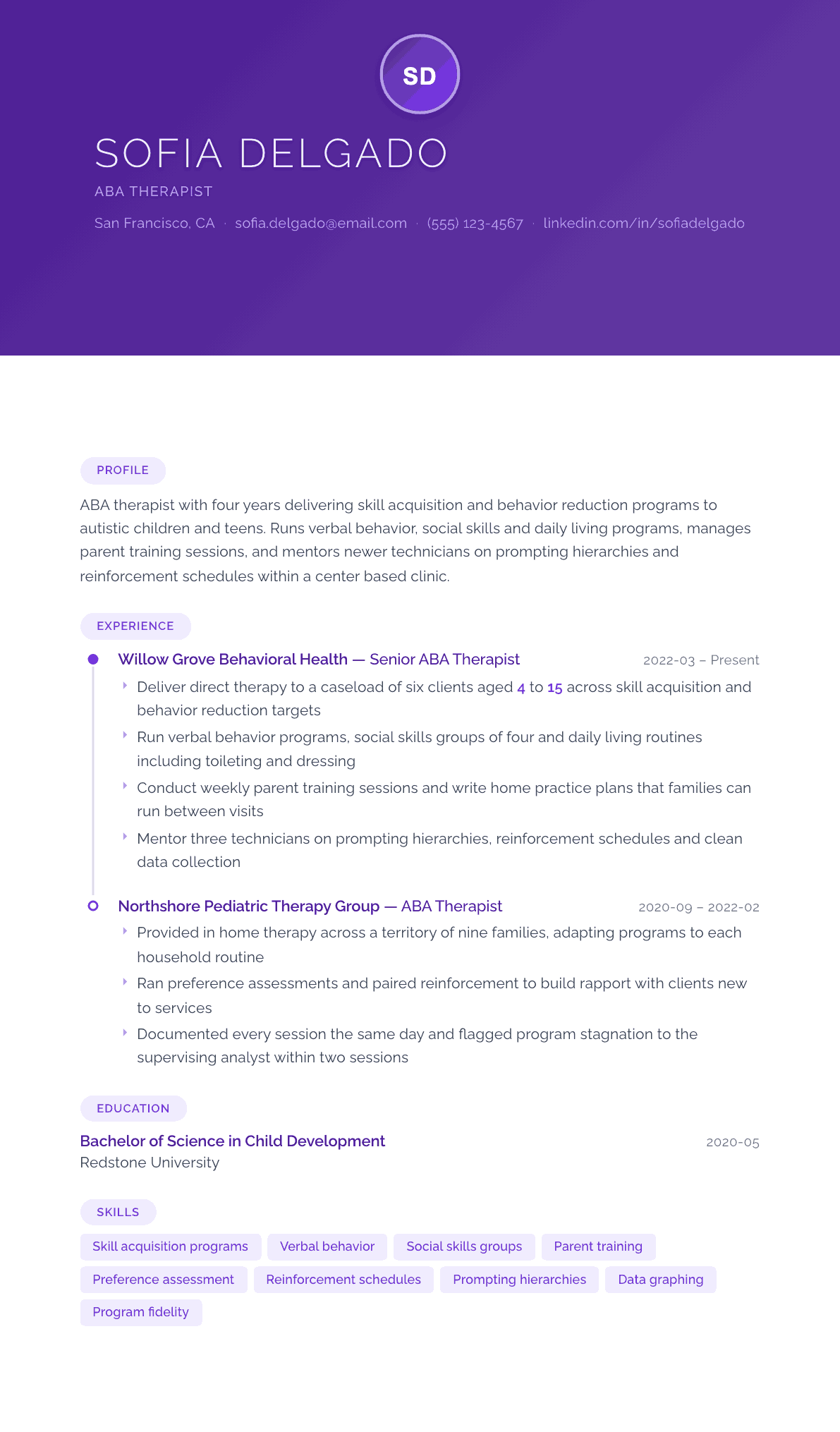
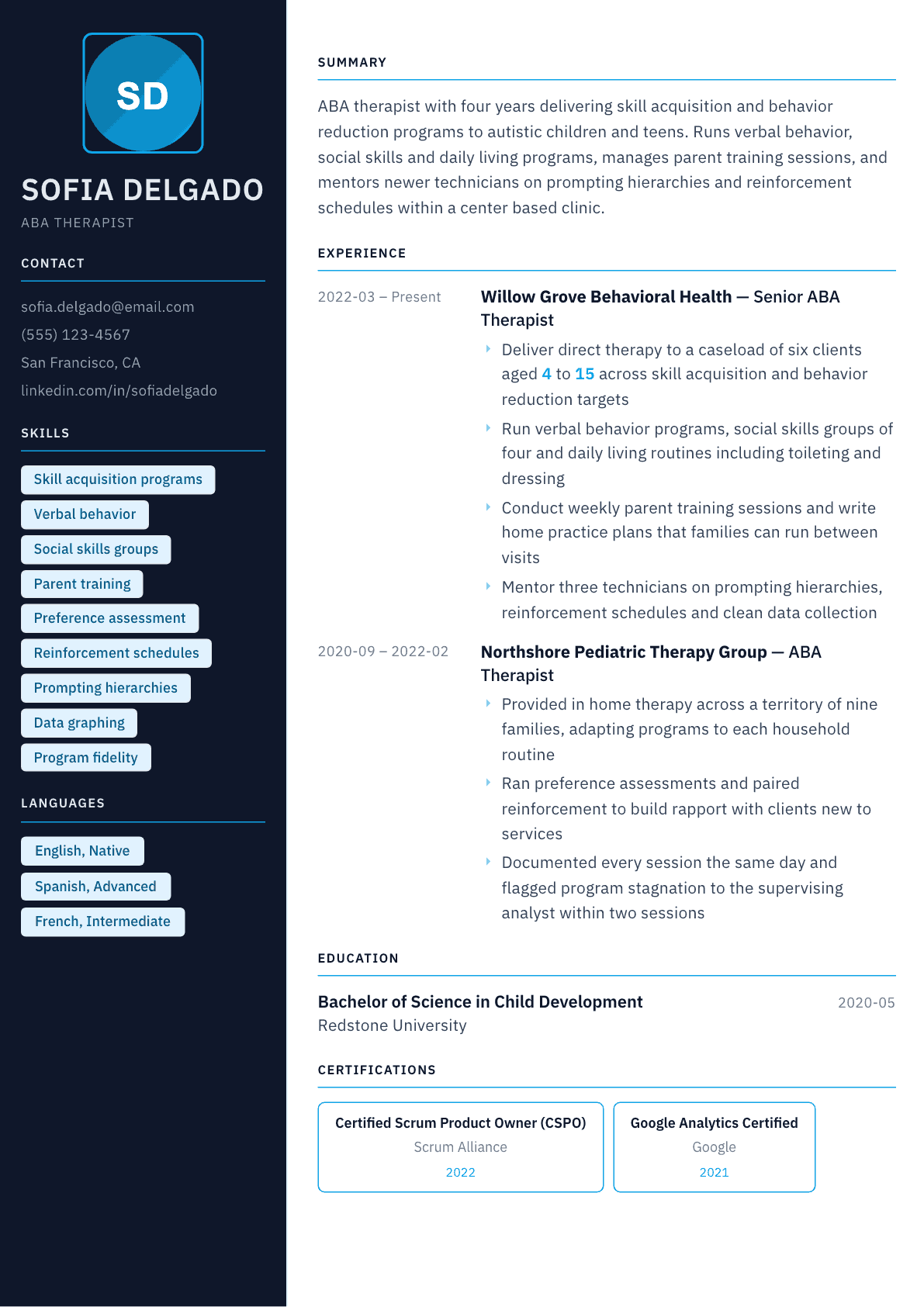
Example ABA Therapist summary
ABA therapist with four years delivering skill acquisition and behavior reduction programs to autistic children and teens in center based and in home settings. Carries a caseload of six clients aged four to fifteen, runs verbal behavior and social skills groups, and leads weekly parent training. Mentors three technicians on prompting hierarchies, reinforcement schedules and accurate session data.
Skills to list on a ABA Therapist resume
- Applied behavior analysis
- Skill acquisition programming
- Verbal behavior
- Behavior reduction
- Parent training
- Social skills instruction
- Preference assessments
- Prompting and fading
- Reinforcement systems
- Data collection and graphing
- Treatment plan implementation
- Crisis response
- Session documentation
- Team collaboration
What actually gets this resume read
- Say plainly which credential you hold and which you are pursuing, because agencies distinguish technician, therapist and analyst roles sharply.
- Give caseload size, client age range and weekly direct hours, since those three numbers describe the job better than any adjective.
- Separate skill acquisition work from behavior reduction work, because a clinic often needs strength in one more than the other.
- Highlight parent training explicitly, as it is the part of the job most candidates leave off and most supervisors want.
- Name the settings you have worked in, since in home therapy, center based sessions and school consultation demand different flexibility.
- Show mentoring or training of technicians if you have it, because that is what separates a senior therapist from an entry hire.
How to write a aba therapist resume
The title ABA therapist sits between technician and analyst, and the ambiguity is exactly what your resume has to resolve. Some clinics use it for credentialed technicians, others for master level staff carrying supervision responsibilities. Whoever reads your file needs to know in the first three lines which credential you hold, what you are permitted to do independently, and who signs off on your treatment plans.
Once that is settled, the hiring question becomes how much of the therapeutic work you own. Do you only run programs, or do you also shape them? Do you lead parent training? Do you take the cases nobody else wants, the teenager with severe self injury or the client with almost no vocal communication? Clinics staff for that kind of range and pay for it.
This guide covers how to signal scope accurately, how to organize experience by skill acquisition and behavior reduction, three summary examples from a first therapy job to a senior therapist, bullet rewrites that show real program work, and the questions therapists ask when moving between agencies or into supervision.
Format: one page, credential and scope in the first block
One page unless you carry supervision or program development responsibility, in which case two is fine. Single column, dates aligned right. Clinics screen quickly and often forward a resume straight to the clinical director as a file attachment, so keep it readable at a glance on any device.
Directly under your name, give the credential, the certifying board, and one line on scope: whether you implement plans written by a supervising analyst, whether you conduct assessments, and how supervision is arranged. That line prevents the most common misreading of this title.
- Header: name with credential, city and state, phone, email.
- Scope line: what you implement, what you assess, who supervises.
- Sections: summary, credential and training, experience, procedures, education.
Summary: caseload, ages, settings, specialty strength
Give caseload size, age range and setting, then name the strength that matches the posting. Some clinics need someone strong on early intervention language programs, others need a therapist comfortable with adolescents and severe behavior, others need parent training depth. Choose the one the job is actually about.
Where you have worked across settings, say so, because a therapist who has run center based sessions, in home programs and school consultation adapts faster than someone who has only worked in one room.
Experience: split skill acquisition from behavior reduction
Treat these as two separate categories inside each job, because clinics are usually short in one of them. Under skill acquisition, name the domains: verbal behavior and mand training, receptive and expressive language, play and social skills, daily living routines such as toileting, dressing and feeding, and academic readiness. Say how many targets a client typically runs and how you decide a target has met criteria.
Under behavior reduction, name the topographies and the approach: functional communication training as a replacement, differential reinforcement, antecedent modification, tolerance building for denied access, and the safety training that backs it up. Be explicit that plans are written by the supervising analyst and that you implement and report.
Give parent training its own bullets. Session frequency, format, the skills you teach caregivers, and how you check that the home practice is actually happening. Clinics lose families over weak parent training more often than over program design, and directors know it.
Progress, documentation and handoffs
Show how you know a program is working. Graphing daily, comparing against mastery criteria, running probes for generalization across people and settings, and raising a stalled target to supervision within a defined number of sessions are all concrete practices worth a line each.
Documentation is billing. Name the platform, say when notes are closed relative to the session, and mention any audit or quality review you have passed. If you have covered another therapist mid program, describe how you picked up the case without losing continuity, because that is a genuine skill.
- Mastery criteria and generalization probes across people and settings.
- Graphing cadence and the trigger for escalating a stalled target.
- Note platform, closing time, quality review outcomes.
- Case transfer and coverage without losing program continuity.
Keywords clinics use in postings
Expect skill acquisition, behavior reduction, verbal behavior, mand training, functional communication, differential reinforcement, generalization, mastery criteria, parent training, treatment plan implementation, data collection and clinical supervision. Add the assessment tools you have supported, such as language and skills assessments used to write programs, only where you have genuinely worked with them.
ABA therapy resume sample: one page, top to bottom
An ABA therapy resume puts the credential and scope line under the name, a summary with caseload, ages and settings, then each job split into skill acquisition, behavior reduction and caregiver work. The sample below is for a therapist with three years in a clinic and in home program. The name, clinic and numbers are invented; keep the order and replace every detail with your own.
If you are applying from a technician role, the same page works: keep the RBT credential in the header, write the scope line as implementing plans under a named supervision arrangement, and let caseload and session counts carry the experience.
- Header: Jordan Reyes, RBT. Phoenix, AZ. Phone and email. Scope line: implements skill acquisition and behavior reduction plans written by a supervising BCBA, supervised weekly, supports reassessments.
- Summary: ABA therapist with three years of center based and in home therapy for five clients aged 3 to 12, strong in early verbal behavior and toilet training, leads weekly caregiver sessions and closes session notes the same day.
- Experience, Desert Bloom Behavioral Services, ABA Therapist, three years, current role. Skill acquisition: runs mand, tact and listener responding programs with 15 to 20 active targets per client and probes for generalization with a second therapist and at home. Behavior reduction: implements functional communication training and differential reinforcement plans for elopement and aggression, records frequency data every session and flags any target flat for three sessions to the BCBA. Caregiver work: weekly 45 minute sessions on prompting and reinforcement at home, checked with short video review.
- Earlier experience, Sunrise Early Learning Center, Preschool Aide, two years. Supported an inclusion classroom of 16 children, ran visual schedules and transition routines, and logged behavior incidents for the lead teacher.
- Credential and training: Registered Behavior Technician, Behavior Analyst Certification Board. Safety-Care certification. CPR and first aid current.
- Education: Bachelor of Science in Child Development, with the university and graduation year.
ABA Therapist resume summary examples
First therapy role
Credentialed therapist entering applied behavior analysis after a child development degree and a year supporting a preschool inclusion classroom. Trained in prompting hierarchies, reinforcement systems and daily data collection, and seeking a center based caseload with weekly supervision and a path toward graduate coursework.
Four years in
ABA therapist carrying six clients aged four to fifteen across center based and in home programs. Runs verbal behavior targets, social skills groups of four and daily living routines, leads weekly caregiver training, and writes home practice plans families can run between visits without a therapist present.
Senior therapist
Senior ABA therapist taking the clinic complex cases, including adolescents with severe self injury and clients using speech generating devices. Mentors three technicians on prompting and reinforcement, rebuilt the caregiver training curriculum, and coordinates with speech and occupational therapy on shared goals each month.
Work experience bullets: before and after
Before: Provided ABA therapy to clients with autism.
After: Delivered direct therapy to a caseload of six clients aged 4 to 15, covering skill acquisition targets and behavior reduction goals across center based and in home sessions.
Caseload, ages, settings and the two work categories give the reader the shape of the job immediately.
Before: Taught communication skills.
After: Ran verbal behavior programs building mands, tacts and intraverbals, moving two clients from picture exchange to a speech generating device with a structured transfer plan.
Named program types and a concrete transition show depth rather than a general claim about communication.
Before: Did parent training sessions.
After: Held weekly caregiver training covering reinforcement delivery, prompting and following the behavior plan at home, then checked practice through short video review before the next session.
Frequency, content and a verification step turn parent training into something a clinic can rely on.
Before: Kept track of client progress.
After: Graphed targets daily against mastery criteria, ran generalization probes across a second therapist and the home setting, and escalated any target flat for three sessions to the supervising analyst.
Explicit criteria, probes and an escalation rule replace a vague progress claim with a working method.
Before: Helped train new staff.
After: Mentored three technicians through paired sessions on prompting hierarchies, reinforcement schedules and clean data entry, signing each off after two consecutive fidelity checks.
The training format and the sign-off threshold make mentorship measurable instead of informal.
Hard skills
- Skill acquisition programming
- Verbal behavior and mand training
- Social skills instruction
- Daily living skills training
- Behavior reduction plan implementation
- Differential reinforcement
- Preference and reinforcer assessment
- Generalization probes
- Mastery criteria tracking
- Caregiver training delivery
- Data graphing and interpretation
- Session documentation
Soft skills
- Adaptability across settings
- Rapport building with teens
- Coaching caregivers without judgment
- Clear reporting to supervisors
- Emotional regulation during escalation
- Collaboration with speech and occupational therapy
Certifications worth listing
- Registered Behavior Technician (RBT) (Behavior Analyst Certification Board)
- Board Certified Assistant Behavior Analyst (BCaBA) (Behavior Analyst Certification Board)
- Board Certified Behavior Analyst (BCBA) (Behavior Analyst Certification Board)
- Safety-Care Behavioral Safety Training (QBS)
- Nonviolent Crisis Intervention (Crisis Prevention Institute)
Mistakes that cost aba therapist candidates the interview
- Using the title without stating the credential, leaving a director unsure whether you can work under a technician scope or a broader one.
- Merging skill acquisition and behavior reduction into one blur when clinics hire for strength in a specific half.
- Leaving parent training off the resume even though it is the part of the job families judge the service by.
- Listing assessment tools you have only heard named in supervision, which collapses under one interview question.
- Skipping settings, so a reader cannot tell whether you have ever worked in a family home or a school building.
- Giving years of experience without caseload size, which hides whether those years were full or part time.
ABA Therapist resume questions
What is the difference between an ABA therapist and a behavior technician?
Agencies use the titles differently, which is why your resume must state the credential and scope explicitly. Some use therapist for credentialed technicians with more tenure, others reserve it for assistant analysts. Write what you hold and what you are authorized to do independently.
How do I show readiness for a supervision track?
List graduate coursework in progress, supervision hours accumulated toward a credential, and any mentoring of technicians you already do. Then show program level thinking in your bullets: mastery criteria, generalization, stalled target escalation and caregiver training design.
Should I include in home therapy separately from clinic work?
Yes, because the demands differ. In home work means adapting to household routines, siblings, limited materials and caregiver presence throughout the session. Say how many families you covered, the territory size and how you kept program fidelity outside a controlled room.
How do I describe working with severe behavior safely?
Name the topographies, the approved procedures you are trained in with the training program, the documentation you complete after an incident, and the fact that plans are written by a supervising analyst. Safe language matters more here than impressive language.
What should an ABA therapy resume include?
Your credential and scope line under your name, a summary with caseload, ages and settings, then each job split into skill acquisition, behavior reduction and caregiver training. Describe clients by caseload size, age range and communication level rather than by name, add your data and documentation habits, and finish with credential, safety training and education.