Behavioral Technician Resume Examples: read this first
RBT Resume Examples for Behavioral Technicians
By Mustafa Tarabya, founder of CVBooster · Published · Updated
RBT resume examples for new and experienced behavior technicians, with session detail, credential guidance, data collection keywords and a full guide.
Sample resumes for a behavioral technician
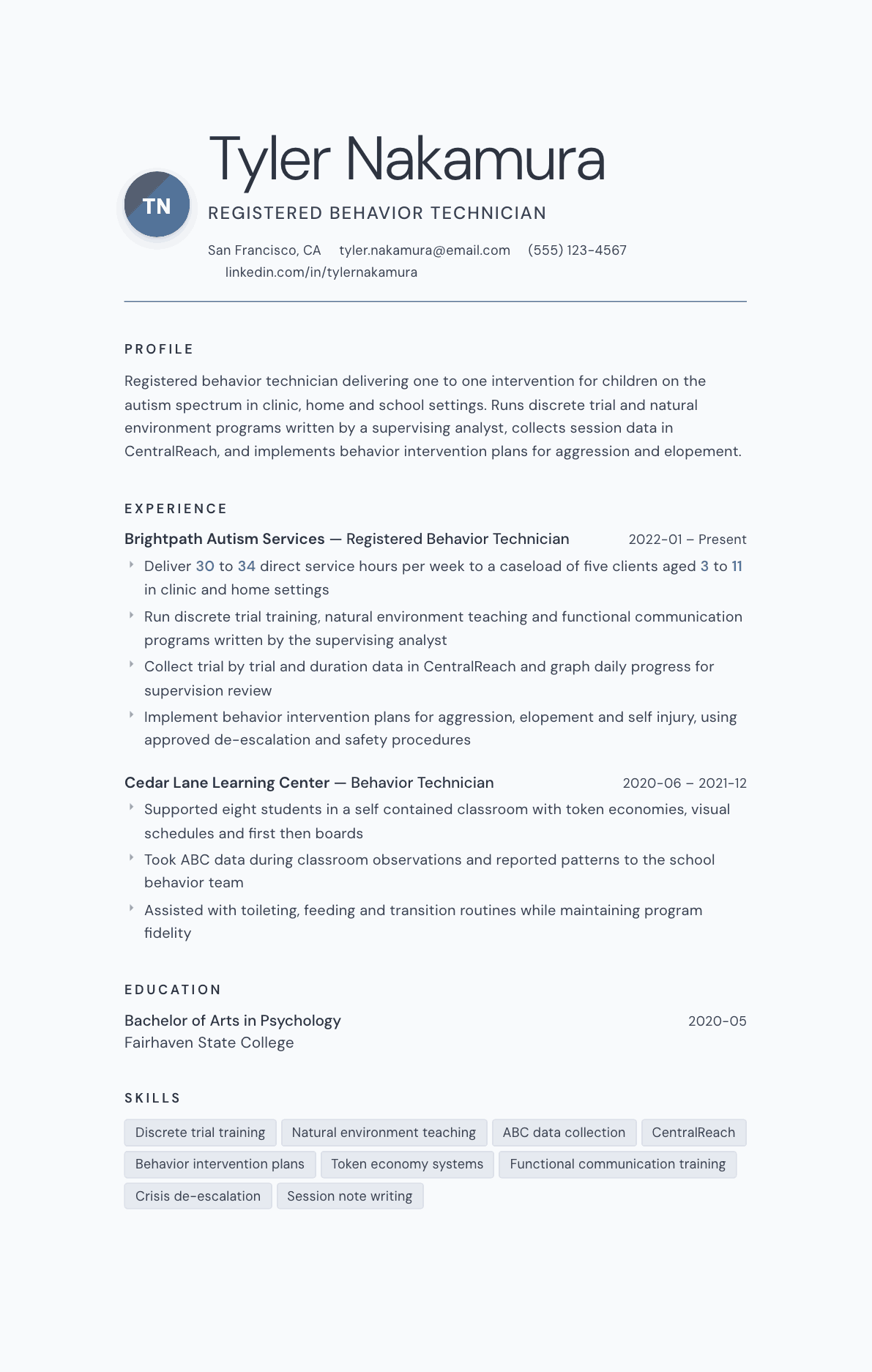
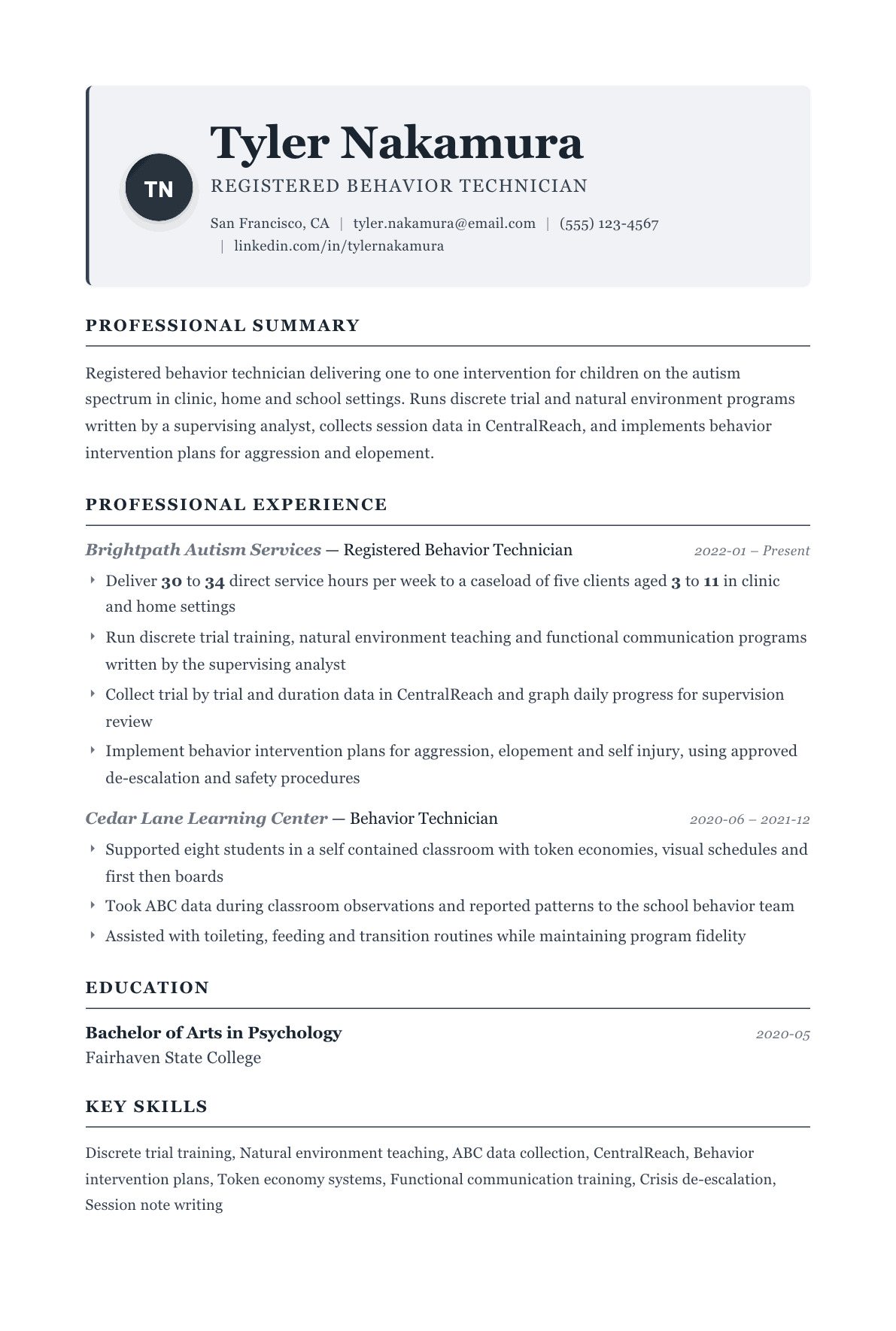
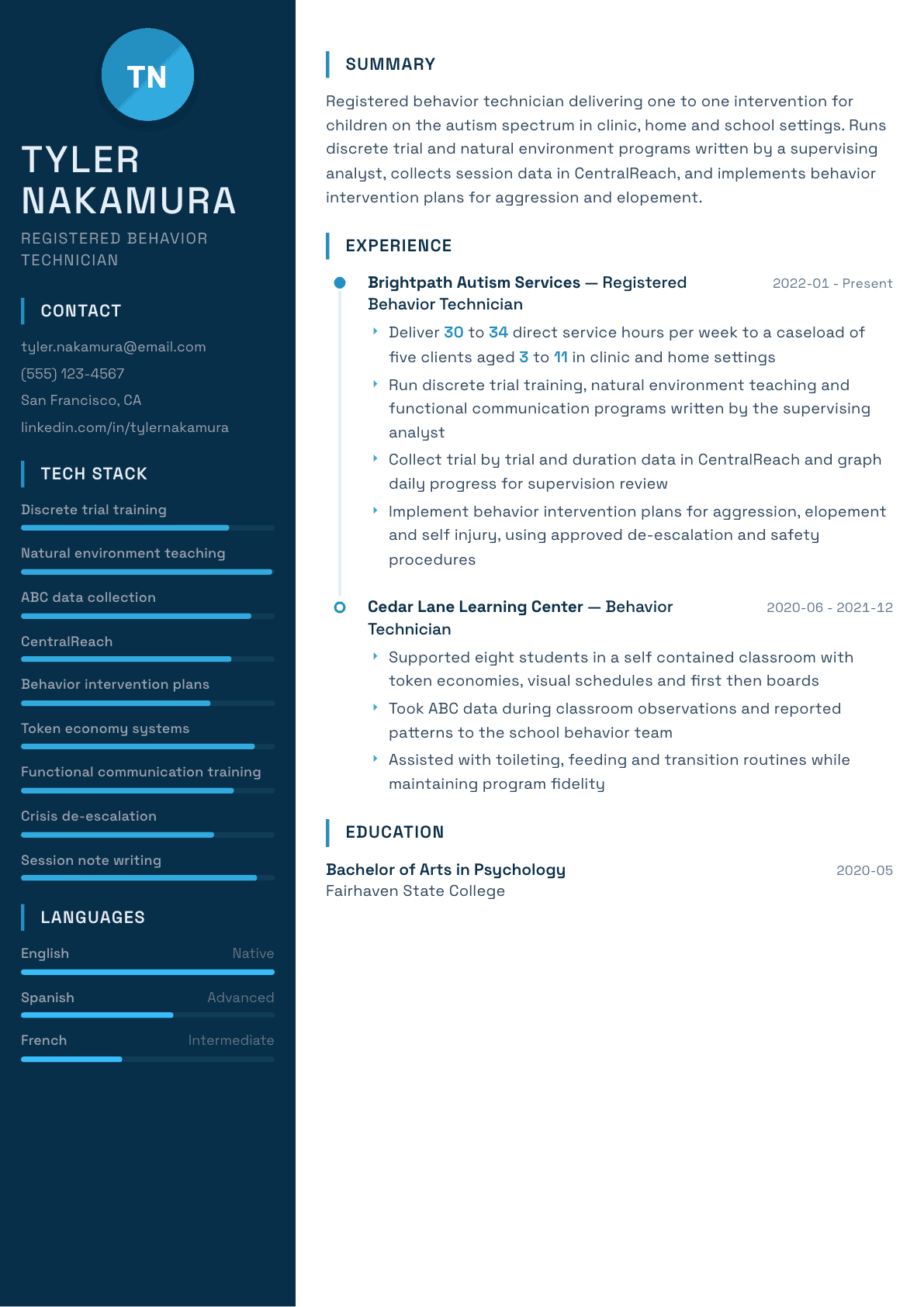
The same behavioral technician content laid out in three CVBooster templates, so you can see what the finished document looks like before you write a word.
Example Behavioral Technician summary
Registered behavior technician with three years delivering one to one intervention to children on the autism spectrum across clinic, home and school settings. Carries a caseload of five clients and about thirty direct service hours per week, running discrete trial and natural environment programs. Collects trial by trial data in CentralReach and implements behavior plans for aggression and elopement under analyst supervision.
Skills to list on a Behavioral Technician resume
- Applied behavior analysis
- Discrete trial training
- Natural environment teaching
- Functional communication training
- ABC data collection
- Behavior intervention plans
- Preference assessments
- Token economies
- Visual schedules
- Crisis de-escalation
- Session documentation
- Parent communication
- Program fidelity
- Prompting and fading
What actually gets this resume read
- Put your RBT credential and its issuing board in the header, because most agencies filter applications on that single line.
- State billable or direct service hours per week, since agencies staff by hours and need to know the load you can carry.
- Describe the client population by age range and diagnosis, and name the setting: clinic, in home, school or center based.
- Name the teaching procedures you have run rather than saying you followed a program, so the analyst reading it can picture your sessions.
- List the data platform you use, whether CentralReach, Rethink or Catalyst, because onboarding time drops when it matches.
- Show your supervision arrangement and any crisis training such as Safety-Care or CPI, since agencies must document both.
How to write a behavioral technician resume
Behavioral technician hiring moves fast and screens hard on two lines: the credential and the available hours. Agencies bill direct service, so a clinical director opening your resume is calculating how many billable hours you can cover and how soon you can run a program without a supervisor sitting beside you.
The rest of the read is about fidelity. A technician who follows the protocol exactly, takes clean data and reports a problem in the second session rather than the tenth is worth more than one who improvises warmly. Your bullets should show procedure names, data types and supervision communication, because those three things are what fidelity looks like on paper.
This guide covers the layout agencies expect, how to describe caseload and setting, two RBT resume examples written out, three summary examples from a brand new technician through a senior one, before-and-after bullets drawn from real session work, and the questions technicians ask when they apply for their first or second position.
Format: one page, credential and availability visible
One page, single column, no graphics. Agencies review high volumes of applications through simple systems and often on a phone screen. Put your city and the radius you can travel in the header, because in home and school cases are assigned geographically.
Add an availability line under the header if you are open to afternoons, evenings or weekends. Clinics that struggle to staff after school hours will move a candidate up the list purely for that.
- Header: name with credential abbreviation, city and state, phone, email.
- Availability: hours per week, days, willingness to travel.
- Sections: summary, credential, experience, skills and procedures, education.
Summary: credential, population, setting, hours
Three sentences. Name the credential and the certifying board, the client population by age range and diagnosis, the setting, and the direct service hours you carry each week. Directors read that block and immediately know whether to schedule you.
If you are new to the field, name what you do have: coursework in psychology or child development, the competency assessment you completed, classroom aide work, respite care or camp experience with children who have disabilities. Say clearly that you are credentialed or scheduled for the competency assessment.
Experience: caseload, procedures, data
Open each job with caseload size, client ages, diagnosis mix and setting. Five clients aged three to eleven across clinic and home is a picture. Providing services to children with autism is not.
Then name the teaching procedures rather than the philosophy: discrete trial training, natural environment teaching, functional communication training, mand training, task analysis and chaining, prompting hierarchies with fading, differential reinforcement. A supervising analyst reading those terms knows which programs you can pick up without retraining.
Give the data work its own bullet. Trial by trial, frequency, duration, latency, interval recording and ABC narrative are different systems, and saying which ones you collect, in which platform, and how quickly you close notes tells a director whether your billing will survive an audit.
Finish with behavior reduction. Name the topographies you have worked with, aggression, elopement, self injury or property destruction, the safety procedures you are trained in, and that you implement the written plan under supervision. Never imply independent clinical decisions.
Credential, training and supervision
Give your credential with the certifying board, the date of your competency assessment and your supervision arrangement. Agencies must document supervision hours, so a candidate who already understands that requirement looks easier to onboard.
List safety and crisis training by program name with the expiration, since a lapsed card can stop you being scheduled. Add anything else that matters in home and school settings: driving record, background clearance status, life support card and any language other than English you use with families.
- Credential with certifying board and current status.
- Crisis and safety training by program name, with expiration.
- Supervision structure: hours received, format, supervising analyst role.
- Practical clearances: background check, driving, languages spoken.
Keywords agency postings repeat
Look for behavior intervention plan, skill acquisition, data collection, discrete trial, natural environment teaching, functional communication, prompting, reinforcement, generalization, session notes, program fidelity, caregiver collaboration and de-escalation. Include the data platform by name, because agencies onboard faster when it matches.
RBT resume examples, written out
Most agency postings say Registered Behavior Technician or RBT, so put the credential in the header exactly that way. Here are two RBT resume examples as plain text, one for a newly certified technician and one for a technician in her third year. Both people and all employers are invented; the order is what to copy.
Example one, new RBT. Header: Tyler Brooks, RBT, city, phone, email, available weekday afternoons and Saturdays, reliable car. Summary: Newly credentialed Registered Behavior Technician with two summers as a camp counselor and a school year as an after school aide for children with autism. Completed the 40 hour RBT training and competency assessment under a BCBA, comfortable with discrete trial teaching, natural environment teaching and frequency and duration data on a tablet.
Example two, experienced RBT. Header: Maya Chen, RBT, city, phone, email, available up to 30 hours a week across home and clinic. Summary: Registered Behavior Technician with three years in home and clinic ABA for children aged three to ten, carrying a caseload of four clients, implementing skill acquisition and behavior reduction plans exactly as written and taking session data in an electronic data system. Trains new technicians on the clinic data routine.
- Example one, experience line: Camp counselor, two summers, groups of eight children including two with individual support plans, followed visual schedules and token systems set by the camp coordinator.
- Example two, bullet: Run daily discrete trial and natural environment teaching sessions for four clients and record trial by trial data in the session app before the end of each visit.
- Example two, bullet: Follow each behavior intervention plan as written, including the crisis steps, and flag a rise in target behavior to the supervising BCBA the same day.
- Example two, bullet: Support parent training by modeling prompting and reinforcement during home sessions, as directed by the BCBA.
Behavioral Technician resume summary examples
New technician
Newly credentialed behavior technician with a psychology degree and two years as a classroom aide supporting students with autism and developmental delays. Completed the competency assessment and initial training, comfortable with token systems, visual schedules and ABC recording, and available for thirty afternoon and evening hours weekly.
Three years in
Registered behavior technician carrying five clients aged three to eleven across clinic and home settings, at about thirty two direct service hours per week. Runs discrete trial, natural environment and functional communication programs, records trial by trial and duration data, and implements plans for aggression and elopement under analyst supervision.
Senior technician
Senior behavior technician and site trainer covering a clinic of twenty clients, taking the complex cases involving severe self injury and limited vocal communication. Onboards new technicians through paired observation and fidelity checks, and keeps same-day note completion above the agency standard across a full caseload.
Work experience bullets: before and after
Before: Worked one on one with children with autism.
After: Delivered 30 to 34 direct service hours per week to a caseload of five clients aged 3 to 11 across clinic and in home settings.
Weekly hours, caseload size, ages and settings answer every staffing question a director has.
Before: Followed treatment plans written by the BCBA.
After: Ran discrete trial training, natural environment teaching and functional communication programs written by the supervising analyst, holding to the prompting hierarchy and reinforcement schedule as written.
Named procedures plus explicit fidelity language show the reader exactly what your sessions look like.
Before: Took data during sessions.
After: Collected trial by trial, duration and ABC data in CentralReach, graphed daily progress before leaving the session and flagged flat trends to supervision within two sessions.
Data types, the platform and the escalation timing turn a routine task into evidence of clinical usefulness.
Before: Handled challenging behaviors.
After: Implemented behavior intervention plans for aggression, elopement and self injury using approved blocking and de-escalation procedures, with current safety training and immediate incident documentation.
Naming topographies, approved procedures and documentation shows safe practice within the technician scope.
Before: Communicated with parents about progress.
After: Gave a short structured handoff to caregivers at the end of every session covering targets run, prompting level reached and one skill to practice before the next visit.
A defined handoff format makes caregiver communication a repeatable practice rather than a friendly habit.
Hard skills
- Discrete trial training
- Natural environment teaching
- Functional communication training
- Prompting and fading procedures
- Reinforcement schedules
- Preference assessments
- Trial by trial data collection
- ABC narrative recording
- Behavior intervention plan implementation
- Token economy systems
- Visual schedules and first then boards
- Session note documentation
Soft skills
- Patience during long sessions
- Consistency across settings
- Caregiver communication
- Taking supervision feedback
- Composure during escalation
- Punctuality and reliability
Certifications worth listing
- Registered Behavior Technician (RBT) (Behavior Analyst Certification Board)
- Board Certified Autism Technician (BCAT) (Behavioral Intervention Certification Council)
- Safety-Care Behavioral Safety Training (QBS)
- Nonviolent Crisis Intervention (Crisis Prevention Institute)
- Basic Life Support (BLS) (American Heart Association)
Mistakes that cost behavioral technician candidates the interview
- Leaving out weekly direct service hours, which is the number an agency uses to decide whether to interview you at all.
- Describing sessions in general terms instead of naming the teaching procedures a supervising analyst would recognize.
- Implying independent clinical decisions, which reads as a scope problem to anyone who supervises technicians.
- Omitting the data platform and note timeliness, both of which determine whether your billing survives review.
- Letting crisis training lapse and listing it anyway without a date, since an expired card blocks scheduling.
- Sending the same file to a school district and a clinic when the settings need different first bullets.
Behavioral Technician resume questions
How do I get hired as a behavior technician with no experience?
Lead with related work: classroom aide, camp counselor, respite provider, tutoring or childcare for children with disabilities. Then state your credential status and availability. Many agencies train candidates through the competency assessment, so reliability and hours often outweigh a thin resume.
Should I list the number of clients on my caseload?
Yes. Caseload size with age range and setting is the fastest way to show what you can handle. Pair it with weekly direct service hours, because a director needs both the breadth of clients and the volume of time to plan their schedule.
Does school experience count toward a clinic role?
It counts, especially if you took data, ran token systems or supported behavior plans. Translate the classroom language into the terms a clinic uses, name the procedures you followed and say who supervised the plan you implemented.
How do I show I follow programs exactly?
Write bullets that name the procedure, the prompting hierarchy and the reinforcement schedule as written, mention fidelity checks you passed, and describe how quickly you raise a stalled program to supervision. That combination is what fidelity looks like to an analyst.
Should I put my career goal of becoming a BCBA on the resume?
A short line is fine and often helps, because agencies like technicians who intend to stay in the field and may offer supervision hours. Keep it to one sentence in the summary with your coursework status, and never let it overshadow current caseload evidence.