Clinical Psychologist Resume Examples: read this first
Advance Your Practice with a Clinical Psychologist Resume
By Mustafa Tarabya, founder of CVBooster · Published · Updated
Create a clinical psychologist resume highlighting your assessment expertise, evidence-based treatment modalities, and research contributions.
Sample resumes for a clinical psychologist
The same clinical psychologist content laid out in three CVBooster templates, so you can see what the finished document looks like before you write a word.
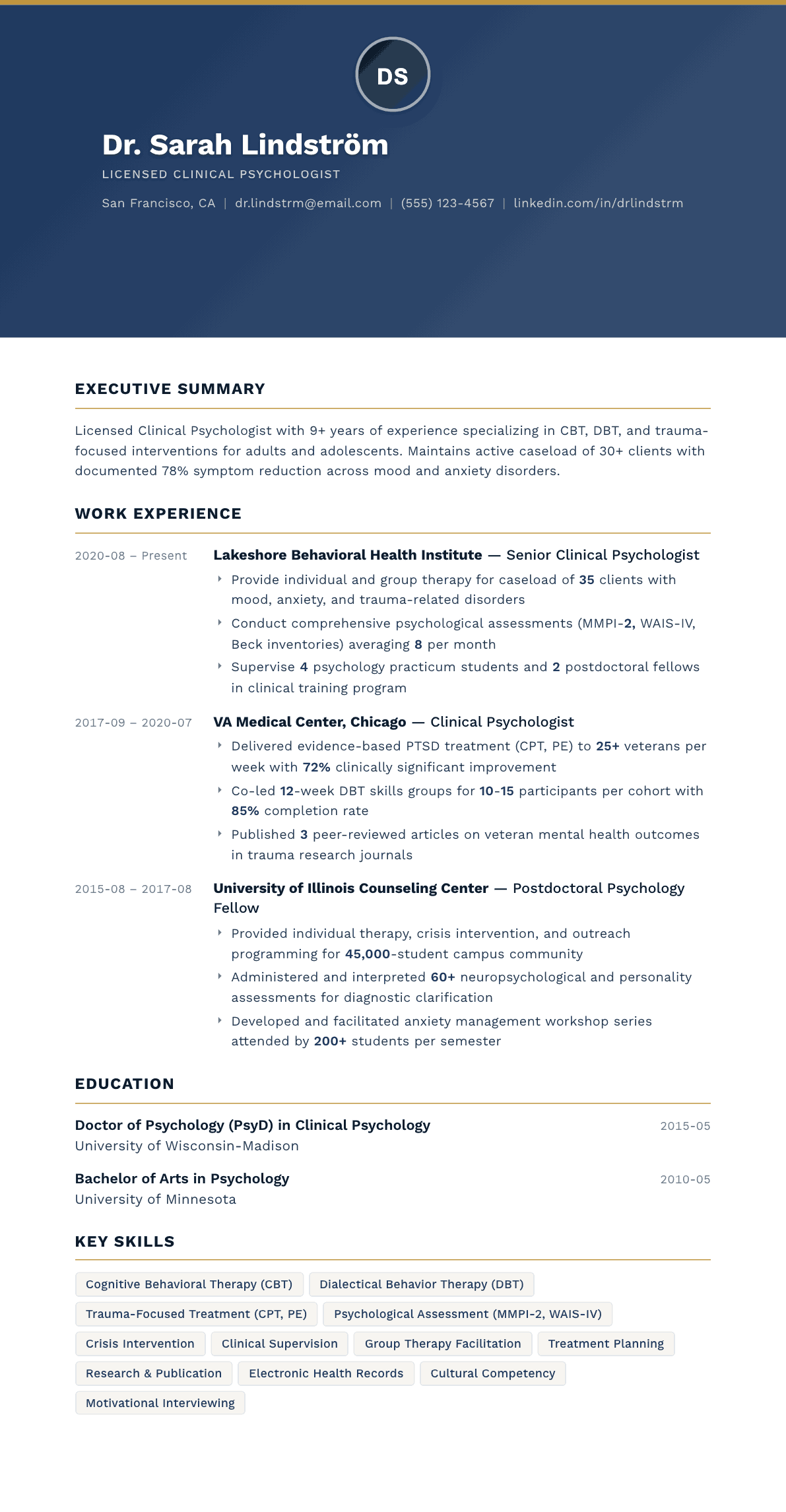
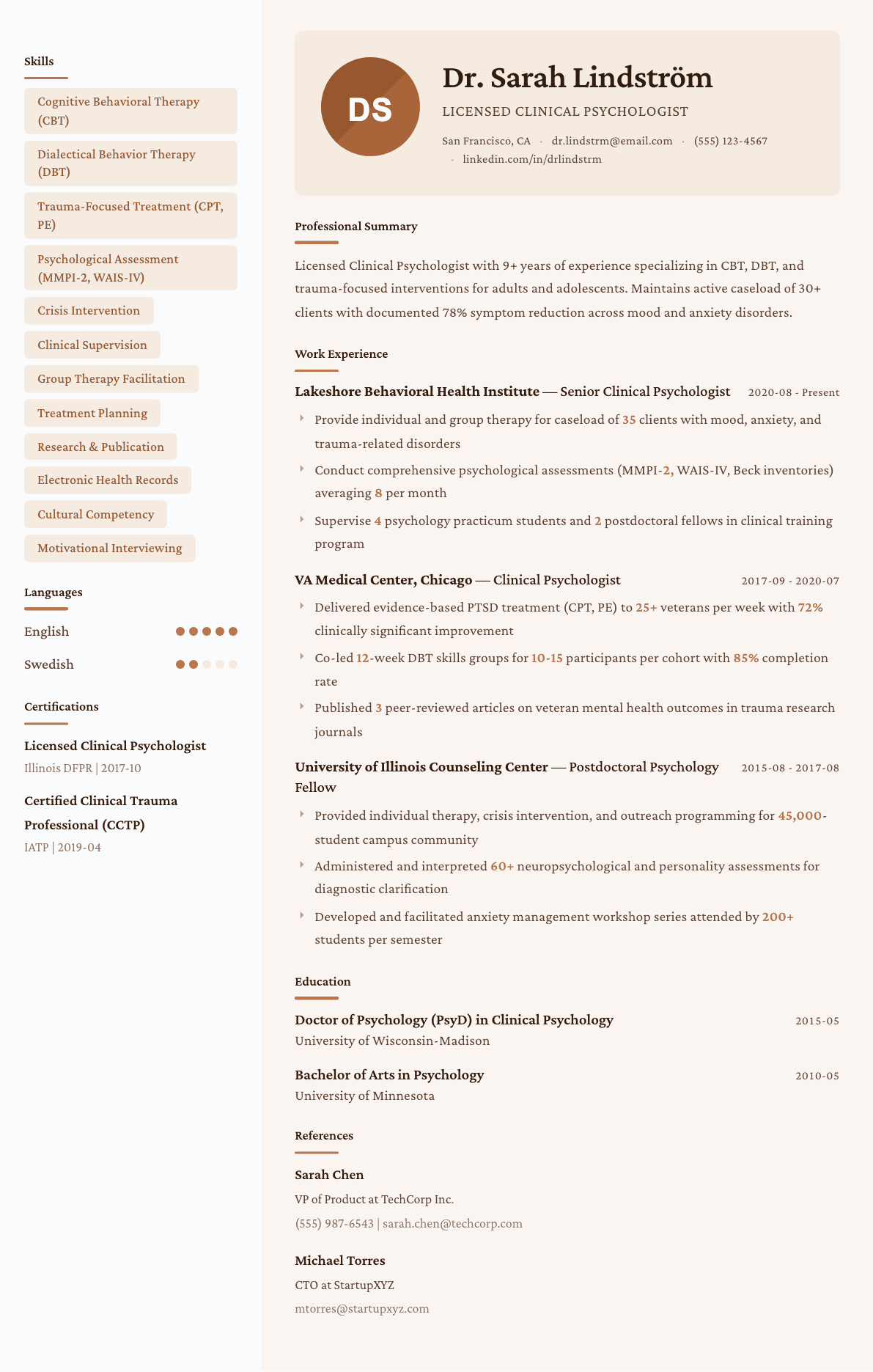
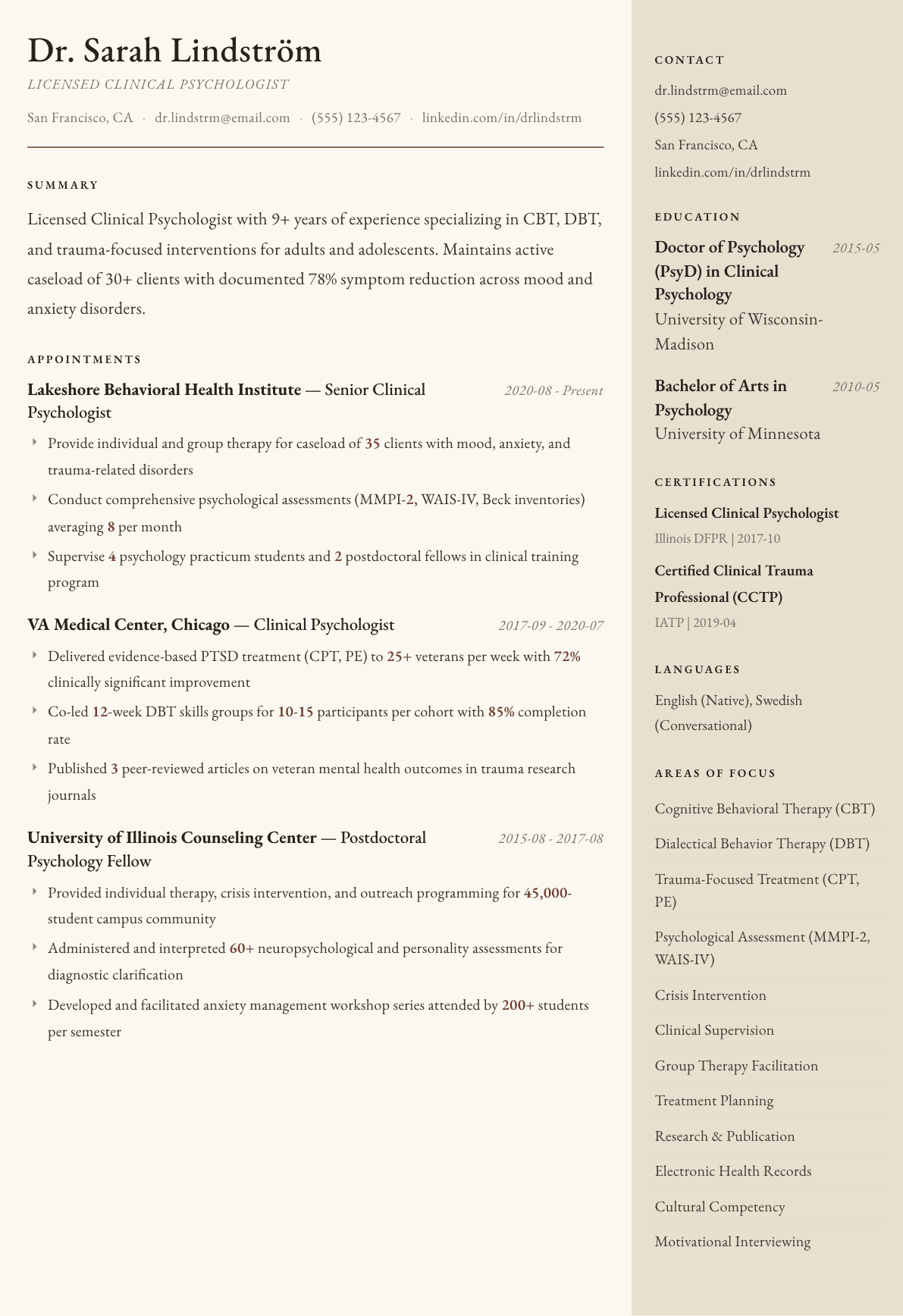
Example Clinical Psychologist summary
Licensed Clinical Psychologist with 9 years of experience in CBT, DBT, and trauma-focused treatment for adults and adolescents. Maintains 30+ client caseload with 78% symptom reduction and supervises practicum students and postdoctoral fellows.
Skills to list on a Clinical Psychologist resume
- CBT / DBT / ACT
- Trauma Treatment (CPT, PE, EMDR)
- Psychological Assessment
- Neuropsychological Testing
- Crisis Intervention
- Clinical Supervision
- Group Therapy
- Treatment Planning
- Motivational Interviewing
- Research & Publication
- Cultural Competency
- EHR Documentation
What actually gets this resume read
- List your license type and state prominently. Licensure is the most critical credential.
- Specify evidence-based modalities you practice: CBT, DBT, EMDR, ACT, psychodynamic, etc.
- Include assessment instruments you administer to show diagnostic capability.
- Highlight caseload size, treatment outcomes, and completion rates for measurable impact.
- Mention supervision, teaching, or research contributions that demonstrate clinical leadership.
How to write a clinical psychologist resume
A clinical psychologist resume is really a licensure document with clinical content attached. Whether the reader is a hospital behavioral health director, a community mental health clinical director, a group practice owner or a veterans health system panel, the first pass is always the same: doctoral degree, whether the program and internship were accredited, postdoctoral supervised hours, and current license with the state and status.
The second pass is population and modality. A psychologist who does trauma focused therapy with adults, one who does neuropsychological assessment with older adults and one who runs a pediatric consultation service share a license and almost nothing else. Hiring directors are filling a specific gap on a specific caseload, and a resume written in general clinical language forces them to guess.
This guide covers the section order this field expects, how to write about assessment and treatment without breaching confidentiality or overstating outcomes, three summaries by career stage, before and after bullets, and the questions psychologists ask when moving between hospital, community and private practice.
Format: curriculum vitae for academic and hospital roles, resume for practice
For academic medical centers, research positions and most hospital systems, use a curriculum vitae: complete training history, supervised hours, publications, presentations and grants, with no gaps in the timeline. For group practice, community agency and industry roles, a two page resume focused on clinical work is more appropriate and better received.
Whichever you use, put a licensure block immediately after the summary. State, license type, number status and expiry, plus any additional state licenses, participation in the interjurisdictional compact if you hold it, and national register listing if applicable. Everything downstream depends on this being findable in seconds.
- Header: name with degree, city and state, phone, email, license state.
- Order: summary, licensure, clinical experience, assessment and treatment competencies, supervision and teaching, education and training, research and presentations.
- Early career candidates put education, internship and postdoctoral fellowship above clinical experience.
Summary: population, setting, modalities, and the license
Three to four lines. Name the license and state, the years since licensure, the populations you treat, the settings you have worked in, and the evidence based modalities you actually deliver with fidelity. Adults, adolescents, children, couples, older adults, and the specific presentations you are strongest with: post traumatic stress, mood disorders, psychosis, personality disorders, substance use, chronic pain, or health psychology.
If you are assessment weighted rather than therapy weighted, say so in the first line. Assessment heavy positions in neuropsychology, forensic work, disability evaluation and school settings are a distinct job market, and directors filter for it immediately.
Clinical experience: caseload, setting, and how you treat
For each position give the setting and the model: inpatient psychiatric unit, partial hospitalization, community mental health center, integrated primary care, a veterans facility, university counseling center, correctional setting, or private group practice. Then the caseload size, the session model, and the presenting problems that dominated the schedule.
Name your modalities specifically and honestly, since they map directly to what agencies must offer. Cognitive behavioral therapy, dialectical behavior therapy with whether you ran skills groups and were on a consultation team, cognitive processing therapy, prolonged exposure, eye movement desensitization and reprocessing with training level, acceptance and commitment therapy, motivational interviewing, and psychodynamic or interpersonal approaches. Where a modality required formal training and consultation to reach fidelity, say that you completed it.
Treat assessment as its own paragraph or bullet cluster. The batteries you administer and interpret, the referral questions you answer, the report turnaround you maintain, and the settings that requested them. Naming specific instruments you are competent in is standard practice in this field and expected in an assessment focused application.
Include the systems work. Treatment planning to agency and payer standards, risk assessment and safety planning, crisis and involuntary hold procedures where you have used them, coordination with psychiatry and primary care, discharge planning, and documentation in the electronic health record within the required timeframe. Community and hospital directors screen hard on documentation timeliness because it drives their billing and their audits.
Outcomes: measurement based care, not cure rates
Report what measurement based care gives you: the symptom measures you administer routinely, the intervals, the completion rate of a course of treatment, no show and cancellation rate, and change on a standardized measure across an episode of care. Directors recognize these as the real operating numbers of a clinic.
Avoid framing outcomes as a personal success rate. A claim about a percentage of clients recovering invites a methodological argument you cannot win on paper and reads as clinically naive to a psychologist reading it. Describing routine outcome monitoring and what you did with the data is stronger and safer.
Supervision, teaching and scholarship
Supervision is a credential in this field, not a footnote. State the level of trainee you supervise, practicum students, interns or postdoctoral fellows, the number per year, whether you supervise toward licensure, and any supervision training you have completed. Agencies with training programs will hire on this alone.
Then teaching, program development and scholarship. Group curricula you wrote, a clinic pathway you built, courses you taught, and publications and presentations in a standard citation format. Keep this compressed on a practice resume and complete on an academic curriculum vitae.
Clinical Psychologist resume summary examples
Newly licensed
Licensed clinical psychologist, newly licensed after an accredited internship and a postdoctoral fellowship in an outpatient anxiety and trauma clinic. Deliver cognitive behavioral therapy, prolonged exposure and cognitive processing therapy with adults, carry a caseload of 22, and administer diagnostic and symptom measures at intake.
Seven years licensed
Licensed clinical psychologist with seven years in community mental health and integrated primary care, treating adults with mood, trauma and substance use presentations. Run two dialectical behavior therapy skills groups a week, sit on the consultation team, and supervise two practicum students each academic year.
Clinical director
Licensed clinical psychologist with 15 years across inpatient and outpatient settings, currently clinical director of a behavioral health program with 11 clinicians. Own clinical policy, risk protocols and the measurement based care system, supervise postdoctoral fellows toward licensure, and maintain a partial assessment caseload.
Work experience bullets: before and after
Before: Provided individual therapy to clients.
After: Carried an outpatient caseload of 24 adults with post traumatic stress, mood and substance use presentations, delivering cognitive processing therapy and prolonged exposure over 12 to 16 session protocols.
Caseload size, population and named protocols with a session count tell a director exactly what you can take on.
Before: Ran group therapy sessions.
After: Ran two dialectical behavior therapy skills groups a week across the full four module cycle, sat on the weekly consultation team and coached members between sessions per the model.
Describing the full model including consultation team and phone coaching shows adherence rather than a group by that name.
Before: Conducted psychological assessments.
After: Completed roughly 40 diagnostic and cognitive assessment batteries a year for treatment planning and disability referrals, delivering integrated reports within a two week turnaround.
Annual volume, referral question and report turnaround are the three facts an assessment focused employer needs.
Before: Supervised trainees.
After: Supervised two practicum students and one predoctoral intern each academic year, running weekly individual supervision with live and recorded session review and completing competency evaluations each term.
Trainee level, cadence and review method demonstrate real supervisory practice rather than nominal oversight.
Before: Improved client outcomes.
After: Introduced routine symptom measurement at every fourth session, reviewed the data in weekly team meetings, and used it to change treatment plans for clients who had not moved after eight sessions.
Describing the measurement system and what changed because of it is defensible, unlike a claimed recovery rate.
Hard skills
- Cognitive behavioral therapy
- Dialectical behavior therapy including skills groups
- Cognitive processing therapy
- Prolonged exposure therapy
- Acceptance and commitment therapy
- Motivational interviewing
- Diagnostic interviewing and differential diagnosis
- Cognitive and personality assessment
- Risk assessment and safety planning
- Measurement based care and outcome monitoring
- Treatment planning to payer standards
- Clinical supervision
- Group therapy facilitation
- Electronic health record documentation
Soft skills
- Therapeutic alliance under resistance
- Managing a high acuity caseload
- Coordination with psychiatry and primary care
- Clear written case formulation
- Ethical boundary management
Certifications worth listing
- Board Certification in Clinical Psychology (American Board of Professional Psychology)
- Board Certification in Clinical Neuropsychology (American Board of Professional Psychology)
- Health Service Psychologist Credential (National Register of Health Service Psychologists)
- Certified Clinical Trauma Professional (International Association of Trauma Professionals)
Mistakes that cost clinical psychologist candidates the interview
- Burying the license state, type and status instead of placing it directly under the summary.
- Listing modalities you have attended a workshop in beside those you deliver with fidelity and consultation.
- Writing in general clinical language so a director cannot tell which population and setting you fit.
- Claiming a personal recovery or success rate, which reads as clinically naive to another psychologist.
- Leaving out documentation timeliness and payer standard treatment planning, which agencies screen for hardest.
- Omitting supervision, which is a credential in this field and often the deciding factor at training sites.
- Using a two page resume for an academic medical center that expects a full curriculum vitae.
Clinical Psychologist resume questions
Should a clinical psychologist use a resume or a curriculum vitae?
Use a curriculum vitae for academic medical centers, research posts and most hospital systems, since they expect full training history and scholarship. A focused two page resume works better for group practice, community agencies and industry roles where clinical fit is the whole question.
How do I describe my caseload without breaching confidentiality?
Give the size, the setting, the age range and the categories of presenting problem, never anything identifying about individual clients. Directors need the shape of your caseload, not case detail, and offering case detail on a resume is itself a warning sign to them.
Which assessment instruments should I list?
The ones you administer, score and interpret independently, grouped by purpose such as cognitive, personality, and symptom measures. Leave out anything you have only observed, since assessment interviews commonly include questions about scoring, interpretation and integrated report writing.
Does board certification matter for clinical psychologists?
It is not required for most positions but it carries real weight in hospital systems, veterans health settings and forensic work, and in some systems it affects pay. If you hold it, put it in the licensure block with the issuing board and the specialty area.
How do I move from community mental health into private practice?
Lead with the presentations and modalities you want to fill your practice with, add any experience with intake screening, insurance paneling and billing, and show retention and attendance figures. Group practice owners are assessing whether you can hold a full and stable caseload.