Direct Support Professional Resume Examples: free score
Write a Direct Support Professional Resume That Shows Outcomes
By Mustafa Tarabya, founder of CVBooster · Published · Updated
Direct support professional resume example with goal tracking, behavior plan wording, community integration keywords and a full writing guide.
Sample resumes for a direct support professional
The same direct support professional content laid out in three CVBooster templates, so you can see what the finished document looks like before you write a word.
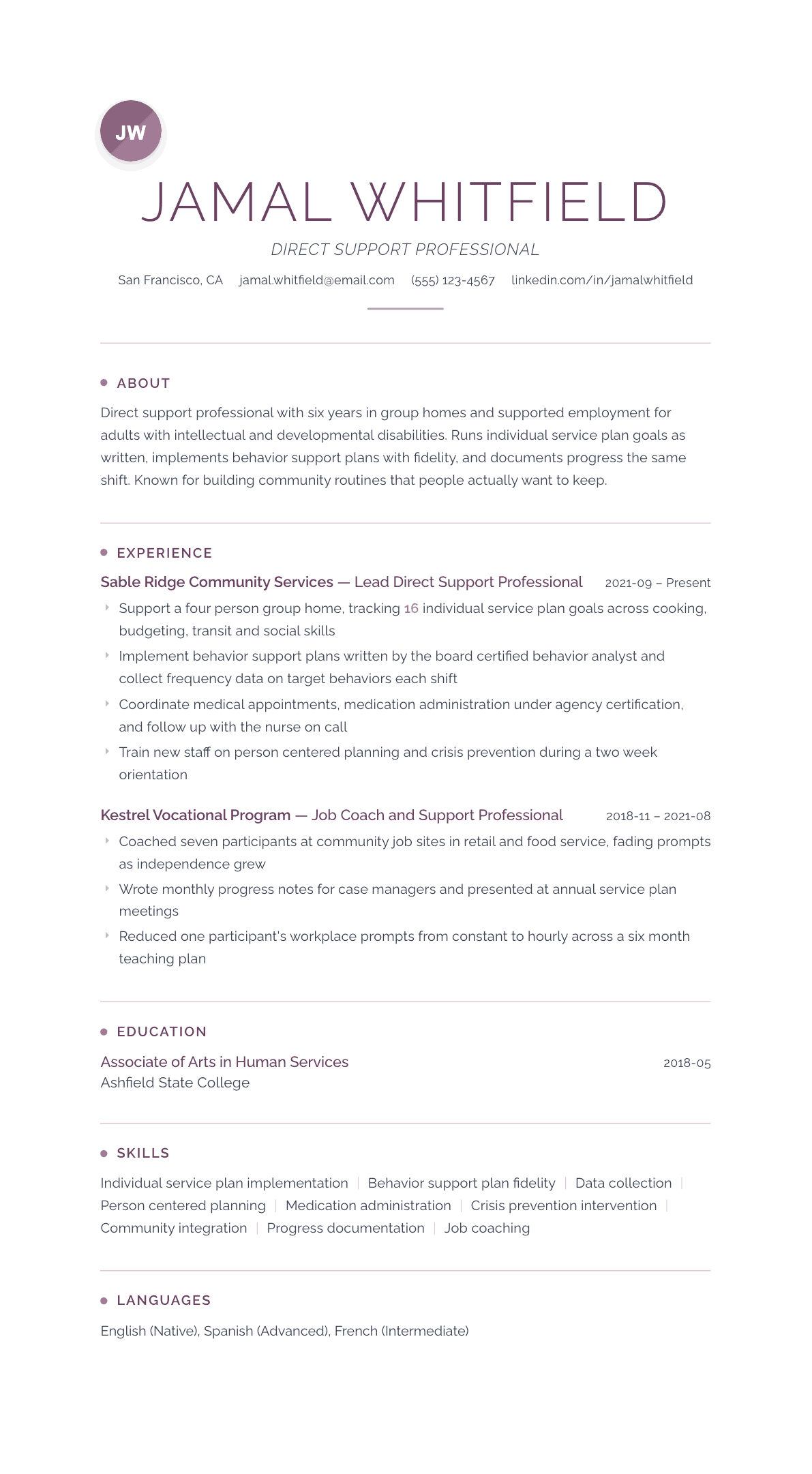
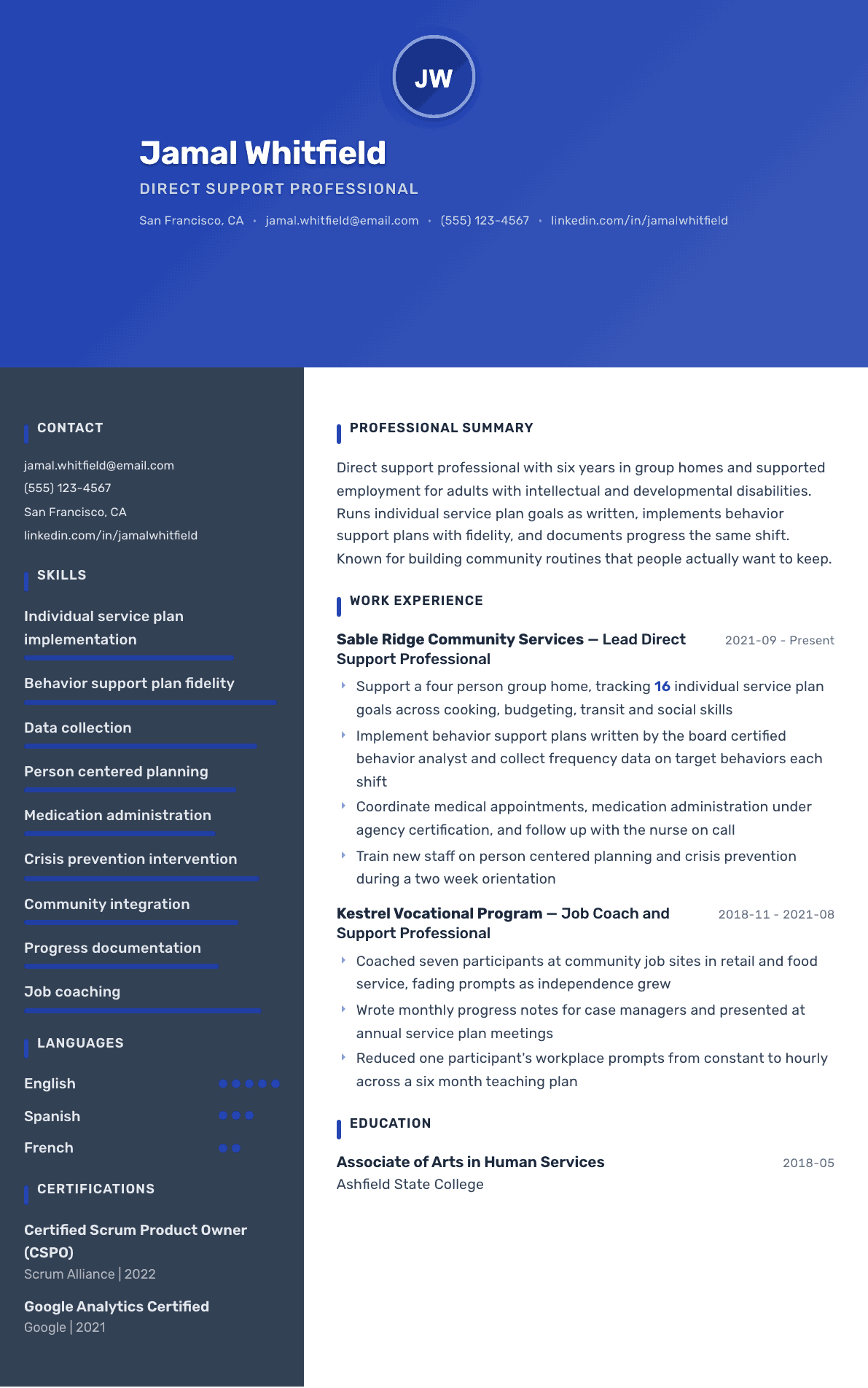
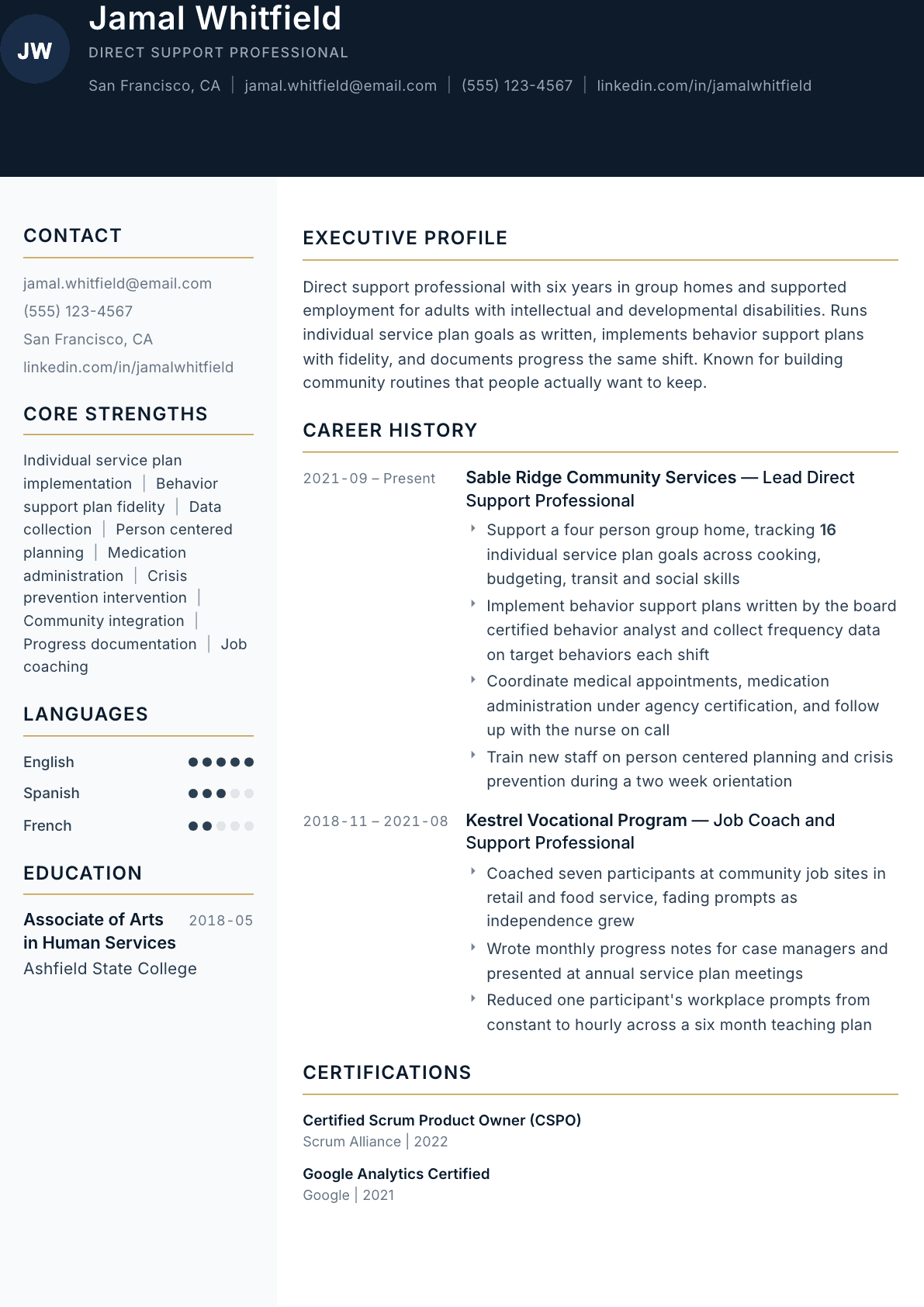
Example Direct Support Professional summary
Direct support professional with six years in group home and supported employment settings for adults with intellectual and developmental disabilities. Carries individual service plan goals through to measurable progress, collects behavior data every shift, and de-escalates without restraint wherever possible. Certified in medication administration and crisis prevention, and experienced in training new staff on person centered practice.
Skills to list on a Direct Support Professional resume
- Individual service plan support
- Behavior support plan implementation
- Applied behavior data collection
- Person centered planning
- Community integration
- Job coaching and prompt fading
- Medication administration
- Crisis prevention and de-escalation
- Adaptive daily living instruction
- Progress note documentation
- Incident reporting
- Transit and travel training
- Family and guardian communication
What actually gets this resume read
- Anchor every job to the setting: group home, day program, supported employment, or in home community based support.
- Name the plan documents you work from, since agencies hire on your ability to follow a written plan exactly.
- Report goal progress rather than duties, because state licensing reviews read outcomes and data, not task lists.
- List your crisis prevention training by its real name and keep the certification dates current on the resume.
- Show community integration work such as transit training, volunteering, banking and grocery routines with real people.
- Include medication administration certification and driving status, as both change which shifts you can be scheduled for.
How to write a direct support professional resume
Agencies serving people with intellectual and developmental disabilities are licensed, surveyed and funded on documentation. That fact shapes what a direct support professional resume has to prove. The program manager reading it wants to know whether you can carry service plan goals, run a behavior plan the way the analyst wrote it, collect data every shift, and write an incident report that will survive a state review.
Applicants usually write about caring deeply and building relationships. Those things are real and they belong in the interview answer about why you stay in the field. On paper they do not distinguish you, because every applicant writes them. Goal areas, data systems, plan fidelity and crisis training do distinguish you, and they are what a licensing surveyor would ask about.
This guide covers the section order agencies expect, summaries for three career stages, before and after bullets from group home and supported employment work, and the questions direct support professionals ask when they write the file for a lead or specialist role.
Format: one page, settings named, certifications visible
One page reverse chronological for most applicants, two only if you have supervisory history. Plain headings, no columns. Under your contact details put a short line naming the settings you have worked in: group home, day program, supported employment, in home community based support, or a crisis stabilization setting. Those settings require different skills and agencies staff them separately.
Put your certifications block high on the page. Medication administration certification, your crisis prevention training by its real name, CPR and first aid, and driving status all determine which shifts you can be scheduled for on day one.
- Header: name, city, phone, email, settings worked, driving status.
- Sections: summary, certifications, support experience, goal and data work, training, skills.
- New applicants lead with relevant coursework, volunteering, or work with any population needing structured support.
Summary: population, setting, plans carried, data habit
Three or four lines. Name your years, the population, the settings, the number of people you supported at once, and the plans you carried. A direct support professional who has run sixteen individual service plan goals across four residents is describing a workload. One who has been kind and patient is describing a temperament.
End the summary with your documentation habit. Same shift data entry, complete progress notes and clean incident reports are what a program manager is short of, and stating it up front is unusual enough to be noticed.
Experience: goals, behavior plans, data, community
For each role give the setting, the number of people supported, the shift pattern and whether you held any lead responsibility. Then write bullets in four areas that map onto how the agency is actually reviewed.
Goal implementation: name the domains you taught in, such as cooking, budgeting, hygiene, transit, social skills and self advocacy, and give the number of goals you carried. Behavior support: say that you implemented plans written by a board certified behavior analyst, name the antecedent strategies and replacement behaviors you used, and describe the data you collected. Health and safety: medication administration under agency certification, appointment coordination, seizure protocols, choking and aspiration precautions, and incident reporting. Community and employment: transit training, volunteering, banking, job site coaching and prompt fading.
Write outcomes rather than tasks wherever you can. A goal that moved from full physical prompting to independent completion within six months tells a manager more than any list of duties, and it is exactly the kind of progress a service plan meeting is built around.
Certifications, training and the plan documents you work from
List the crisis prevention curriculum you were trained in with its real name and the certifying organization, since agencies often refuse to accept an equivalent without retraining. Do the same with medication administration, first aid and any state mandated orientation you completed.
Add a short line naming the plan documents you have worked from: the individual service plan, the behavior support plan, the positive behavior support plan, the health care plan and the risk assessment. Naming them shows you know the paperwork architecture of the field, and it is a stronger signal than any adjective.
Skills and the vocabulary the tracking system matches
Postings repeat a specific vocabulary: person centered planning, self determination, least restrictive environment, natural supports, prompt hierarchy, antecedent intervention, replacement behavior, active treatment, activities of daily living, and community integration. Use those exact phrases once in your skills list and once inside a bullet that demonstrates them.
Name the electronic documentation system you have used for progress notes and data collection, and mention any experience entering into a state waiver reporting portal. Agencies weigh that experience heavily because it removes weeks from onboarding.
Direct support staff resume sample, written out
Agencies post the same job as direct support professional, direct support staff, direct care staff, residential support staff or habilitation technician. Use the exact title from the posting in your header and summary so the tracking system matches it, and keep the content the same: setting, population, plans, data and training.
Here is a direct support staff resume written out for a worker with two years in a group home. The person and agencies are invented.
- Header: Tasha Monroe, Direct Support Staff, city, phone, email.
- Summary: Direct support staff with two years in a four person group home for adults with intellectual and developmental disabilities. Carries service plan goals for daily living skills and community outings, runs behavior support plans as written, and records goal data in Therap every shift. Medication administration certified and CPI trained.
- Experience: Direct Support Staff, a community living agency. Supports four residents with personal care, meals, medications and community activities; documents goal data and shift notes before the end of each shift; writes incident reports that pass agency review; shows new staff the house routine.
- Earlier role: Home Health Aide, a home care agency, one year. Personal care and meal preparation for older adults, with daily visit notes.
- Certifications: medication administration, CPI Nonviolent Crisis Intervention, CPR and first aid, and a clean driving record for community outings.
Direct Support Professional resume summary examples
New to the field
Direct support professional candidate with an associate degree in human services, 120 hours of supervised practicum in a day program, and a year of volunteer coaching for adults with developmental disabilities. Trained in person centered planning and first aid, and available for evenings and weekend residential shifts.
Four years in group homes
Direct support professional with four years in a four resident group home, carrying sixteen individual service plan goals across cooking, transit and social skills. Implements behavior support plans with frequency data collected each shift, holds medication administration certification, and has completed a full crisis prevention curriculum with annual refreshers.
Lead or house manager track
Senior direct support professional with eight years across residential and supported employment settings, now leading a house team of six. Owns scheduling, goal review with case managers, incident reporting and new staff orientation, and represents the agency at annual service plan meetings with families and guardians.
Work experience bullets: before and after
Before: Helped residents with their goals.
After: Carried sixteen individual service plan goals across four residents covering meal preparation, money handling, public transit and social interaction, and recorded progress against each one every shift.
Goal count, domains and the recording habit turn a vague duty into the workload a manager is trying to staff.
Before: Dealt with challenging behavior.
After: Implemented a behavior support plan written by the board certified behavior analyst, using antecedent changes to the morning routine and a taught replacement request, and collected frequency data that showed the target behavior dropping over one quarter.
Plan fidelity plus data is the exact evidence a licensing review looks for, and it shows you did not improvise.
Before: Took residents into the community.
After: Taught two residents the bus route to their volunteer site over eight weeks, fading from riding with them to meeting them at the destination, and both now travel independently.
The teaching method and the fading sequence show instructional skill rather than transportation.
Before: Gave medications.
After: Administered medications under agency certification for four residents across evening and bedtime passes, tracked seizure activity against protocol, and reported two missed dose near misses through the incident system.
Naming the passes, the protocol and the honest reporting demonstrates the safety culture agencies need.
Before: Trained new staff.
After: Oriented six new direct support professionals through a two week schedule covering resident routines, plan reading, documentation standards and safe physical intervention practice.
A structured orientation with named content shows leadership readiness, unlike a claim of helping out.
Hard skills
- Individual service plan implementation
- Behavior support plan fidelity
- Frequency and interval data collection
- Person centered planning
- Prompt hierarchy and fading
- Medication administration under certification
- Crisis prevention and de-escalation
- Incident reporting and follow up
- Community integration and travel training
- Job coaching in competitive employment
- Adaptive daily living instruction
- Progress note documentation
Soft skills
- Consistency across a team of staff
- Respect for self determination
- Composure during escalation
- Clear handover between shifts
- Family and guardian communication
- Advocacy in service plan meetings
Certifications worth listing
- CPR and First Aid (American Red Cross)
- Registered Behavior Technician (RBT) (Behavior Analyst Certification Board)
- DSP Certification (National Alliance for Direct Support Professionals)
- Nonviolent Crisis Intervention (Crisis Prevention Institute)
- Medication Administration Certification (State approved training provider)
Mistakes that cost direct support professional candidates the interview
- Writing about compassion for a whole summary while never naming a goal domain, a plan document or a data method.
- Leaving out crisis prevention training by name, when agencies accept only specific curricula without retraining you.
- Describing behavior work as handling outbursts instead of implementing a written plan with recorded data.
- Omitting medication administration certification and driving status, both of which limit which shifts you can cover.
- Listing residents by name or describing incidents in identifying detail, which is a confidentiality problem on its face.
- Ignoring supported employment and community work, which is where much of the field is moving and where postings are growing.
Direct Support Professional resume questions
What is the difference between a direct support professional and a caregiver?
A caregiver focuses on personal care and daily assistance. A direct support professional does that too, but also teaches goals from a written service plan, implements behavior support plans, collects data and documents progress for a licensed agency.
Do I need a degree to become a direct support professional?
Usually not. Most agencies require a high school diploma, a background check, a driver license and completion of their own orientation. A human services degree helps for lead and coordinator roles, and some states have their own credential pathways.
How do I show behavior support experience without being a behavior analyst?
Describe implementation rather than design. Say which plan you followed, who wrote it, which antecedent strategies and replacement behaviors it contained, what data you collected and how you reported it back to the analyst or team.
Should I list every training my agency required?
List the transferable ones with the certifying body: crisis prevention, medication administration, first aid, human rights and abuse prevention. Skip internal courses whose names mean nothing outside your agency, unless the content is genuinely unusual.
Is a direct support staff resume different from a DSP resume?
No. Direct support staff, direct care staff and direct support professional are agency titles for the same work. Use the title from the posting in your header and summary, then write the same content: setting, population, the plans you carry, the data system you use and your certifications.