Senior Accountant Resume Examples: the lines they read
Write a Senior Accountant Resume Controllers Shortlist
By Mustafa Tarabya, founder of CVBooster · Published · Updated
A senior accountant resume built around the close calendar, reconciliations, systems and audit support, with a sample resume and a writing guide.
Sample resumes for a senior accountant
The same senior accountant content laid out in three CVBooster templates, so you can see what the finished document looks like before you write a word.
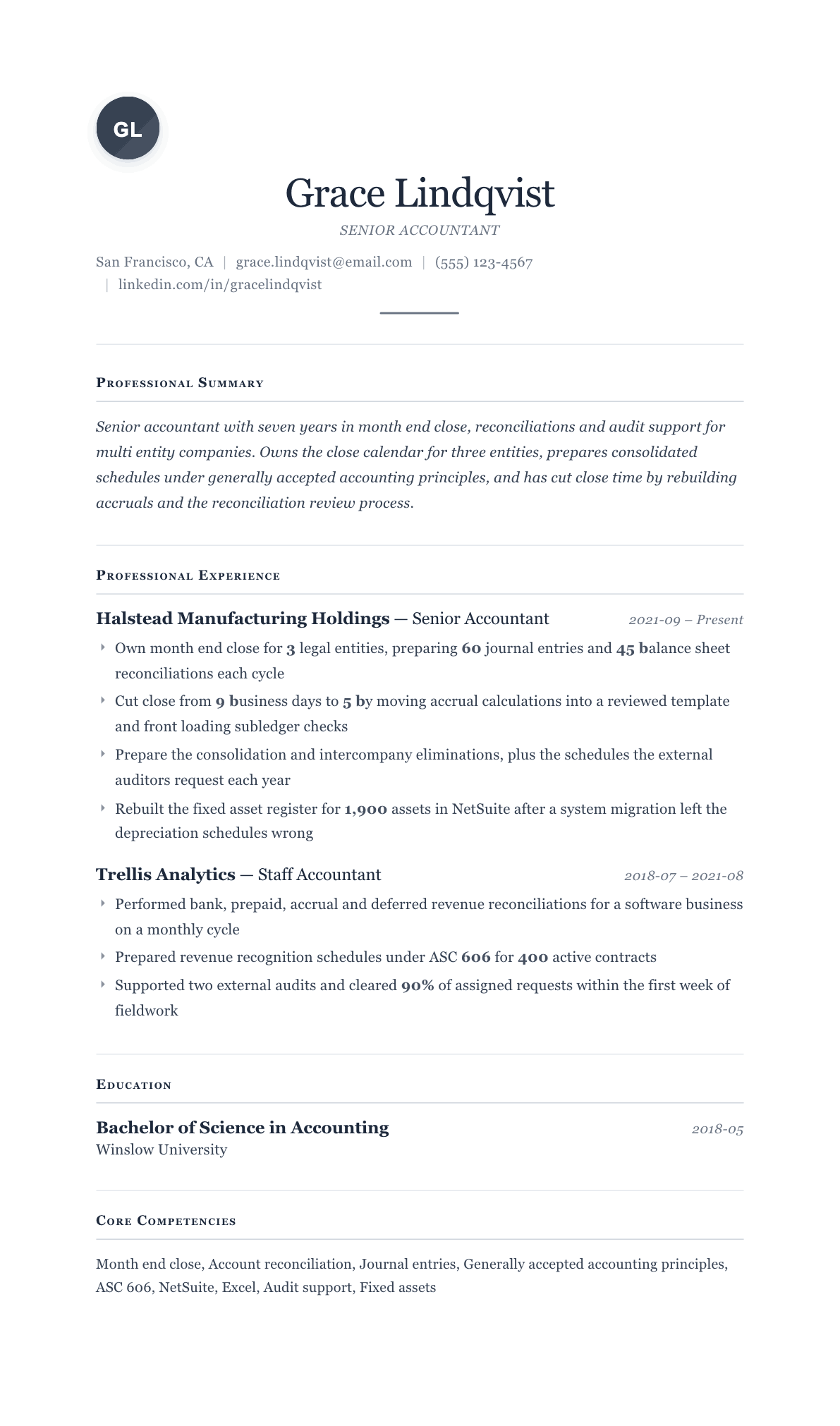
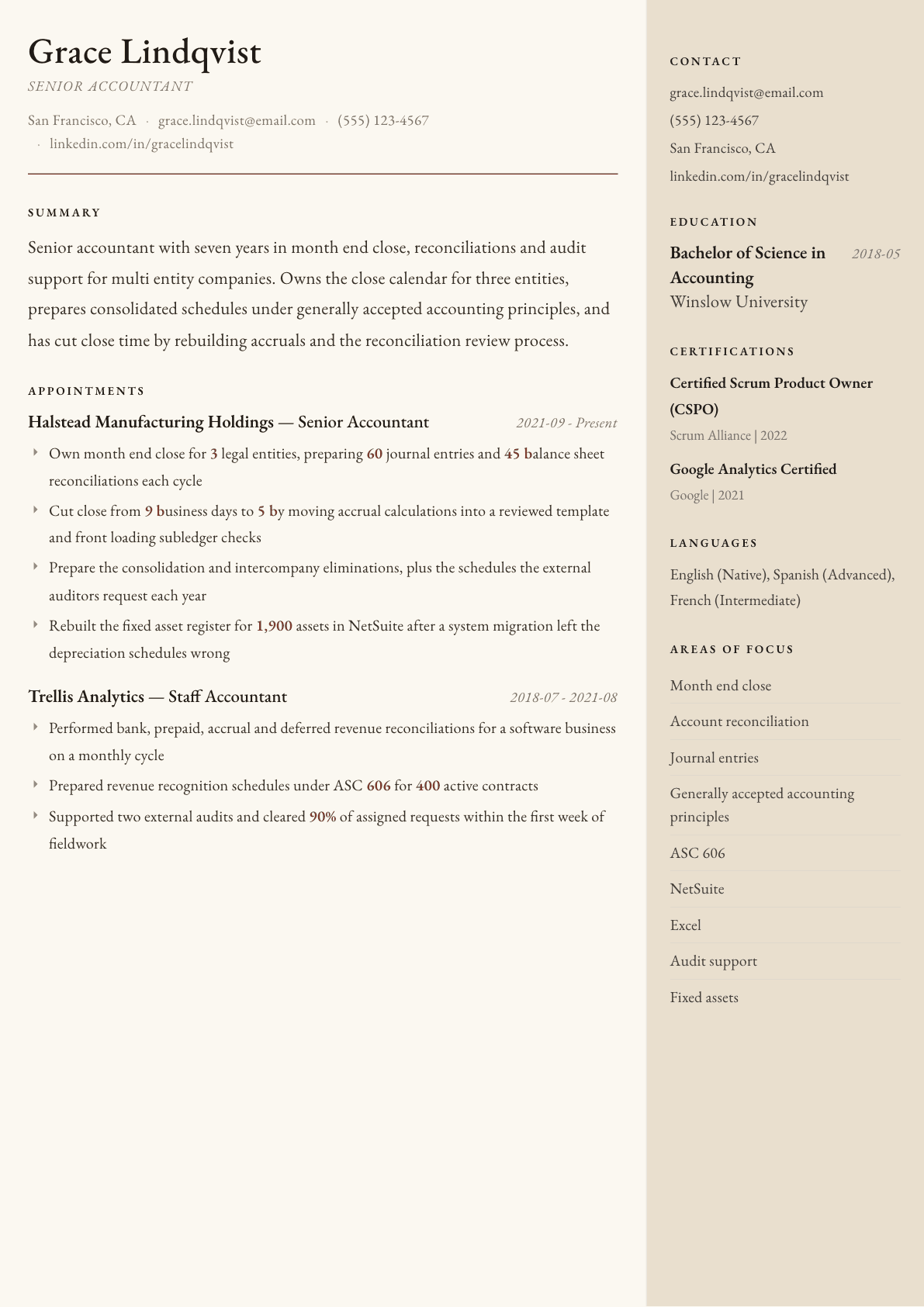
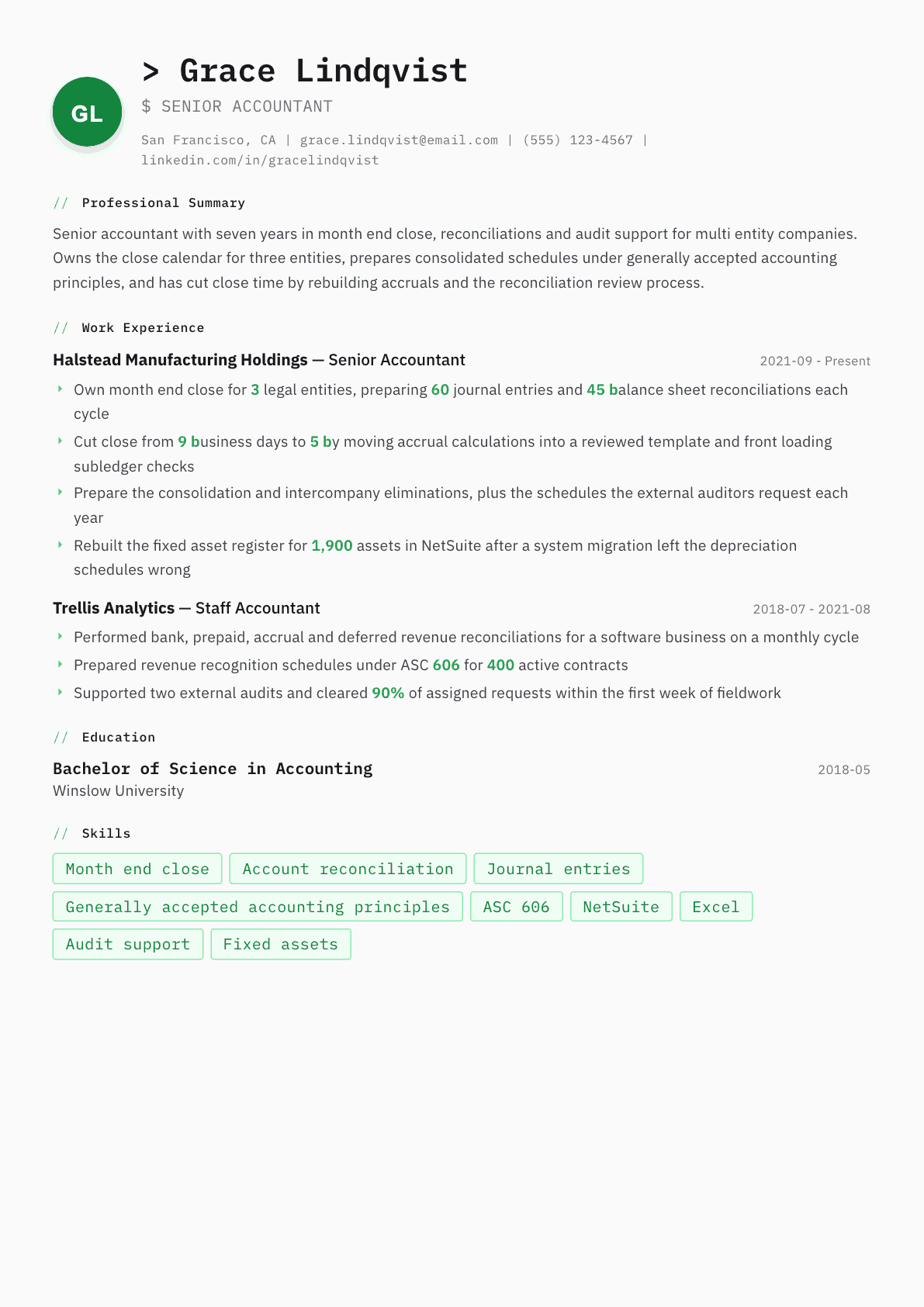
Example Senior Accountant summary
Senior accountant with seven years owning month end close, reconciliations and audit support across multiple legal entities. Cut a nine day close to five by rebuilding accrual templates and front loading subledger checks, prepares consolidations and intercompany eliminations, and rebuilt a fixed asset register after a migration left depreciation schedules wrong.
Skills to list on a Senior Accountant resume
- Month end close
- Account reconciliation
- Journal entries
- General ledger
- Consolidations and eliminations
- Generally accepted accounting principles
- ASC 606 revenue recognition
- ASC 842 lease accounting
- Fixed asset accounting
- Audit support
- Accruals and prepaids
- NetSuite
- SAP
- Advanced Excel
- Internal controls
What actually gets this resume read
- Quantify the close: how many entities, how many journal entries, how many reconciliations and how many business days.
- Name every accounting system and consolidation tool you have worked in, because those keywords drive most finance screens.
- Show the standards you applied by number, such as ASC 606 or ASC 842, rather than writing that you followed accounting rules.
- Describe audit support in terms of the requests you owned and how quickly you cleared them, not just that an audit happened.
- Say whether you review the work of staff accountants, since that is the line between a staff and a senior title.
- Include any process you rebuilt, because controllers hire senior accountants to fix a close, not only to carry one.
How to write a senior accountant resume
A senior accountant resume is screened by a controller who has a specific gap to fill and a close calendar that already hurts. She wants to know how many entities you close, how many reconciliations you own, how many business days the close takes, which system you work in, and whether you review other people's work. Those five facts decide the interview, and most applicants leave three of them off the page.
The word senior is the other thing being tested. Between a staff accountant and a senior accountant the difference is ownership: owning a close cycle rather than a set of entries, reviewing rather than only preparing, and fixing a process rather than executing it. A resume that lists the same duties a staff accountant performs invites the reader to offer the lower title.
This guide covers the layout, how to quantify the close, three example summaries across levels, before and after bullets taken from the phrases that appear on nearly every accounting resume, and the questions accountants ask when moving from public accounting into industry.
Format: one to two pages, systems visible early
One page is right until around seven years, then two. Reverse chronological, single column, plain formatting. Accounting departments run applicant tracking systems that mangle columns and tables, and a finance resume that loses its dates or its system names has failed at the only automated step it needed to pass.
Place a short systems line under the summary: the general ledger platform, the consolidation tool, the reconciliation software, the reporting tool and your spreadsheet level. Controllers search on those product names because a candidate who already knows the system starts producing weeks earlier.
- Header: name, city and state, phone, email, and the CPA credential if you hold it.
- Sections: summary, systems and standards, professional experience, certifications, education.
- Under each employer: entity count, reporting line, and whether you review staff work.
Quantify the close, because everyone else describes it
Give the close in numbers: how many legal entities, how many journal entries you prepare, how many balance sheet accounts you reconcile, how many business days the cycle takes, and where in the calendar your deliverables sit. Prepared journal entries and reconciliations as part of the month end close is the single most common sentence in this field and it distinguishes nobody.
Then show what you changed. Controllers hire senior accountants to fix a close, not merely to carry one. A close shortened from nine business days to five by moving accruals into a reviewed template and front loading subledger checks is exactly the story a hiring manager wants, because it is the problem she has.
Technical accounting: cite the standard by number
Name the standards you have applied. Revenue recognition under ASC 606, lease accounting under ASC 842, business combinations, stock compensation, impairment testing, or the international equivalents if you have worked under them. Applied generally accepted accounting principles tells a reader nothing, because every accountant claims it.
Add the memo and schedule work: technical memos you wrote, positions you researched, and the schedules you produce for external auditors. That work is what a controller needs when a new transaction lands and it is rarely visible on a resume that only lists routine tasks.
Consolidations deserve a mention of their own if you touch them. Intercompany eliminations, foreign currency translation and a multi entity consolidation are meaningfully harder than a single entity close and should not be buried inside a general bullet.
Audit support and controls
Describe audit work by the requests you owned and how fast you cleared them, not by the fact that an audit took place. Owning the fixed asset, accrual and revenue schedules for external auditors and closing most requests inside the first week of fieldwork is a specific, checkable claim.
If your company operates under internal control requirements, name the controls you perform or review, any walkthroughs you supported and any deficiency you helped remediate. Control experience is a common requirement for senior roles at larger employers and is frequently the reason one candidate is chosen over another.
Review responsibility and the keywords a screener matches
Say whether you review the work of staff accountants or clerks, how many, and what you review: entries, reconciliations, accounts payable batches, payroll postings. That sentence is what justifies the senior title and it is missing from most applications.
The phrases that repeat in postings are month end close, account reconciliation, general ledger, journal entries, accruals, prepaid expenses, fixed assets, consolidations, intercompany, variance analysis, audit support, internal controls and the standard numbers. Use the posting wording once inside a bullet where the work is shown.
Senior Accountant resume summary examples
Staff accountant moving up
Staff accountant with 3 years closing the books for a software business, owning bank, prepaid, accrual and deferred revenue reconciliations on a monthly cycle. Prepared revenue schedules under ASC 606 for 400 active contracts and cleared 90% of assigned audit requests in the first week of fieldwork.
Owning a multi entity close
Senior accountant with 7 years in multi entity manufacturing, owning close for 3 legal entities with 60 journal entries and 45 reconciliations each cycle. Cut close from 9 business days to 5, prepares the consolidation and intercompany eliminations, and reviews the work of two staff accountants.
Accounting supervisor level
Accounting supervisor and licensed CPA with 11 years across public accounting and industry, leading a team of 4 through a 5 day close for 8 entities. Owns technical memos, the lease accounting standard adoption and the audit relationship, and rebuilt the reconciliation review process after a system migration.
Work experience bullets: before and after
Before: Prepared journal entries and reconciliations for month end close.
After: Own month end close for 3 legal entities, preparing 60 journal entries and 45 balance sheet reconciliations each cycle and delivering the reporting package by day 5.
Entity count, entry and reconciliation volumes and a delivery day turn the most generic sentence in accounting into measurable ownership.
Before: Helped shorten the monthly close process.
After: Cut close from 9 business days to 5 by moving accrual calculations into a reviewed template and front loading subledger checks to the final week of the month.
The before and after day counts plus the two process changes show a fix a controller could apply to her own close.
Before: Worked on revenue recognition for customer contracts.
After: Prepared revenue recognition schedules under ASC 606 for 400 active contracts, including allocation across performance obligations and the deferred revenue rollforward.
Citing the standard, the contract volume and the specific work shows technical depth that a general reference to revenue cannot.
Before: Assisted with the annual audit.
After: Owned the fixed asset, accrual and revenue schedules requested by external auditors across two audits, clearing 90% of assigned items within the first week of fieldwork.
Naming the schedules owned and the clearance rate replaces a passive assist with evidence of how you perform under audit pressure.
Before: Fixed problems with fixed asset records after a system change.
After: Rebuilt the fixed asset register for 1900 assets in NetSuite after a migration left depreciation schedules incorrect, reconciling the subledger back to the general ledger within one cycle.
Asset count, system name and the reconciliation outcome make a cleanup project into a demonstration of technical control.
Hard skills
- Month end and year end close
- Balance sheet reconciliation
- Journal entries and accruals
- General ledger maintenance
- Consolidations and intercompany eliminations
- Revenue recognition under ASC 606
- Lease accounting under ASC 842
- Fixed asset accounting
- Variance and flux analysis
- External audit support
- Internal controls documentation
- NetSuite and SAP
- Advanced Excel modeling
Soft skills
- Reviewing others' work
- Meeting a hard calendar
- Written explanation of variances
- Working with auditors
- Process improvement mindset
Certifications worth listing
- Certified Public Accountant (CPA) (State Board of Accountancy)
- Certified Management Accountant (CMA) (Institute of Management Accountants)
- Chartered Global Management Accountant (CGMA) (Association of International Certified Professional Accountants)
- Certified Internal Auditor (CIA) (Institute of Internal Auditors)
Mistakes that cost senior accountant candidates the interview
- Writing that you prepared journal entries and reconciliations with no counts, entities or close timeline attached.
- Describing staff level duties on an application for a senior title, which invites an offer at the level below.
- Referring to accounting standards in general instead of naming the ones you have actually applied.
- Leaving the systems off the page, when controllers screen on the general ledger platform before anything else.
- Treating audit work as passive assistance rather than owned schedules with a clearance record.
- Never mentioning review responsibility, which is the clearest single signal that the senior title is earned.
- Listing every account touched instead of the process you rebuilt, which is what a hiring controller is buying.
Senior Accountant resume questions
What makes a resume read as senior rather than staff?
Ownership and review. Show that you own a close cycle for named entities, that you review the work of staff accountants or clerks, and that you have changed a process rather than only executing the one you inherited.
Do I need a CPA to be a senior accountant?
Many industry roles do not require it, though it helps and some postings list it as preferred. If you are a candidate in progress, state the parts passed and the expected completion so the reader can judge where you stand.
How do I move from public accounting into industry?
Translate audit work into close language. Describe the balance sheet areas you tested, the reconciliations and schedules you reviewed, the systems you saw at clients, and the technical standards you applied, then say plainly which industry you are targeting.
Which numbers should I put on an accounting resume?
Entity count, journal entry and reconciliation volumes, close duration in business days, contract or asset counts in the subledgers you own, and audit request clearance. Avoid quoting company revenue, since it measures the employer rather than you.
Should I list every accounting system I have used?
List the ones you worked in regularly and separate them from tools you only touched briefly. Controllers ask specific questions in a technical screen, so an inflated system list is one of the easiest claims to expose.
Related resume examples
- Accountant Resume example
- Controller Resume example
- Accounting Manager Resume example
- Financial Controller Resume example
- Staff Accountant Resume example
- CPA Resume example