Agency Recruiter Resume Examples: the lines they read
Build an Agency Recruiter Resume That Proves Billing Ability
By Mustafa Tarabya, founder of CVBooster · Published · Updated
Agency recruiter resume example with placement and billing evidence, keywords staffing firms scan for, and a writing guide.
Sample resumes for a agency recruiter
The same agency recruiter content laid out in three CVBooster templates, so you can see what the finished document looks like before you write a word.
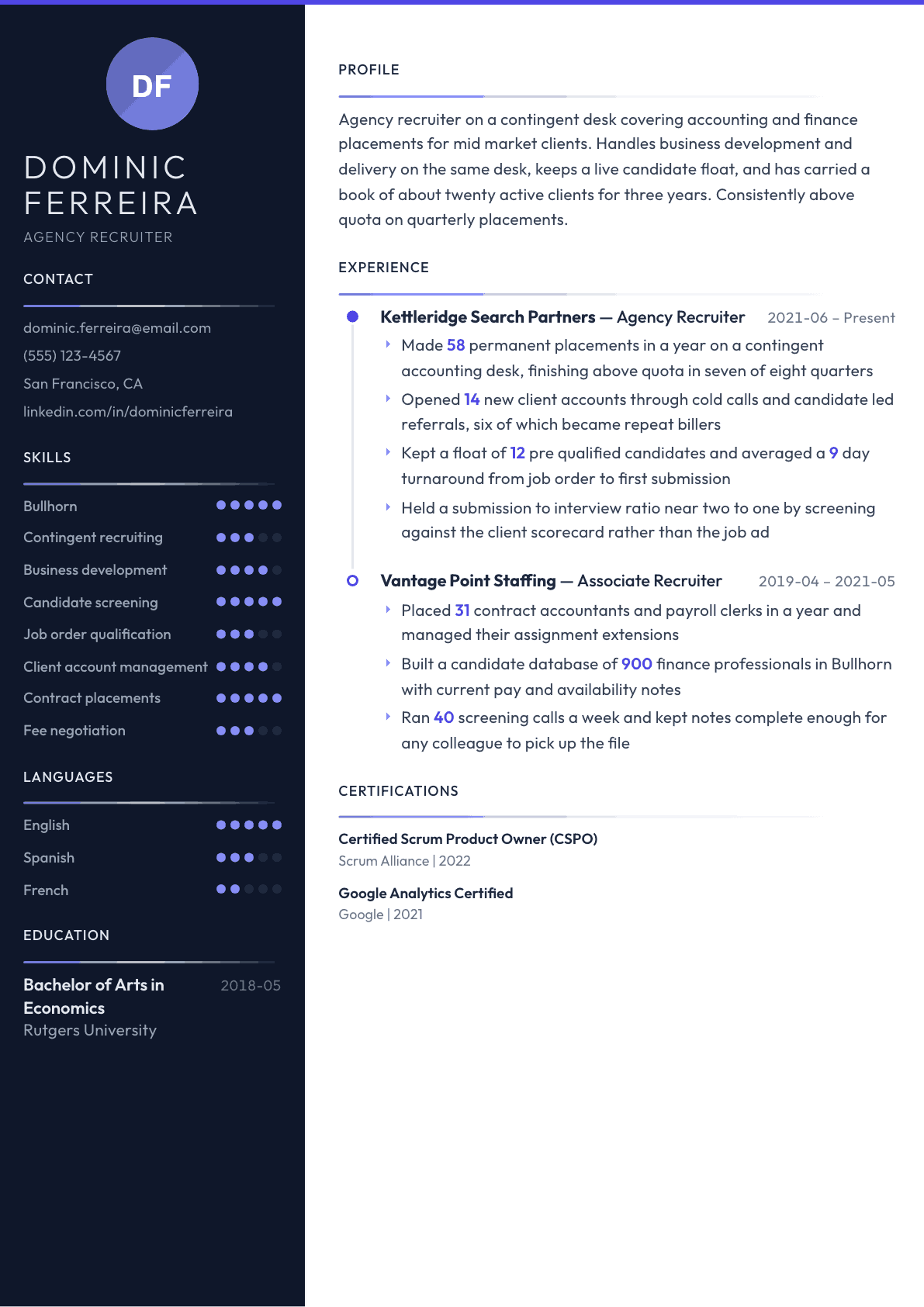
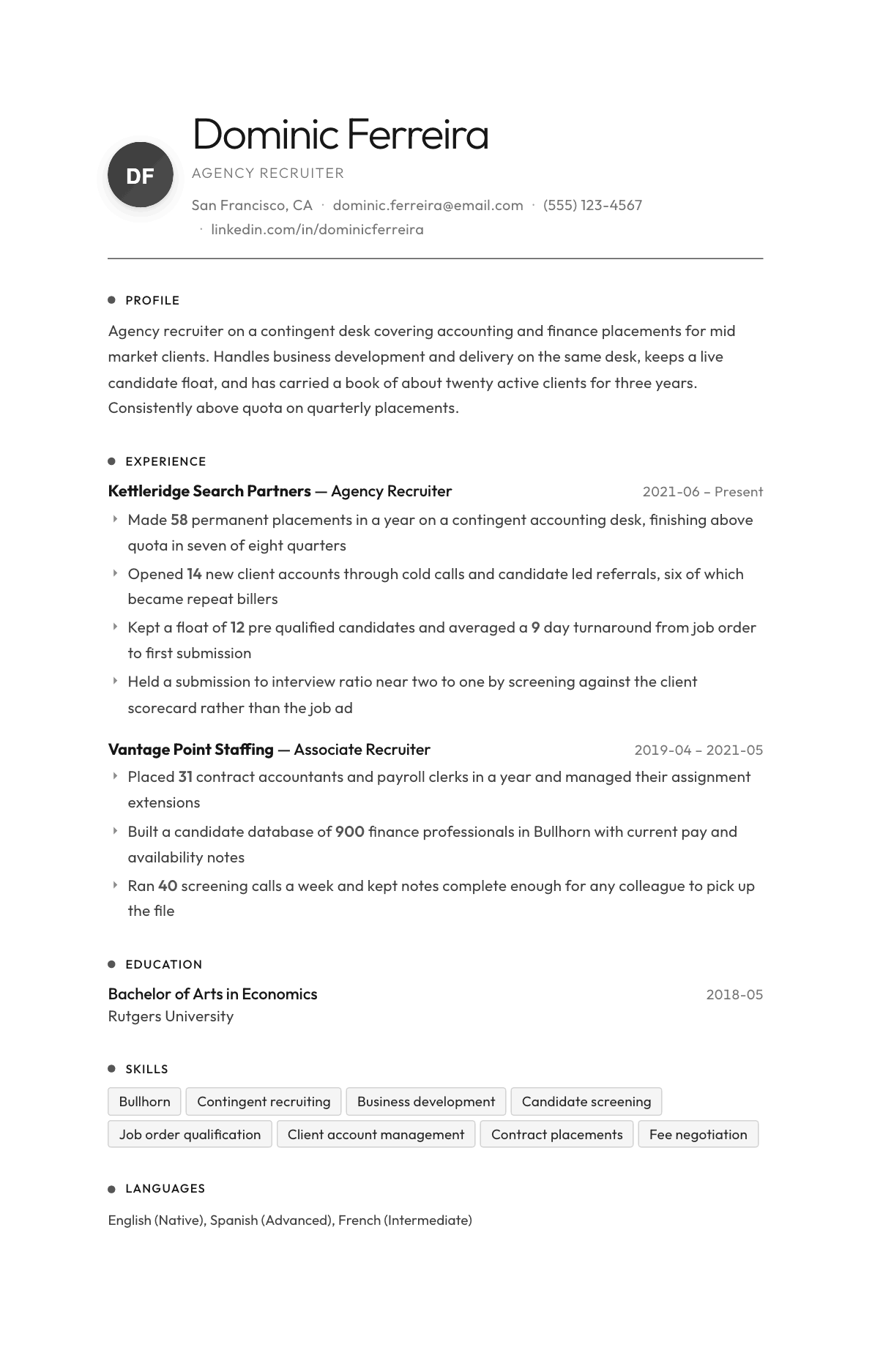
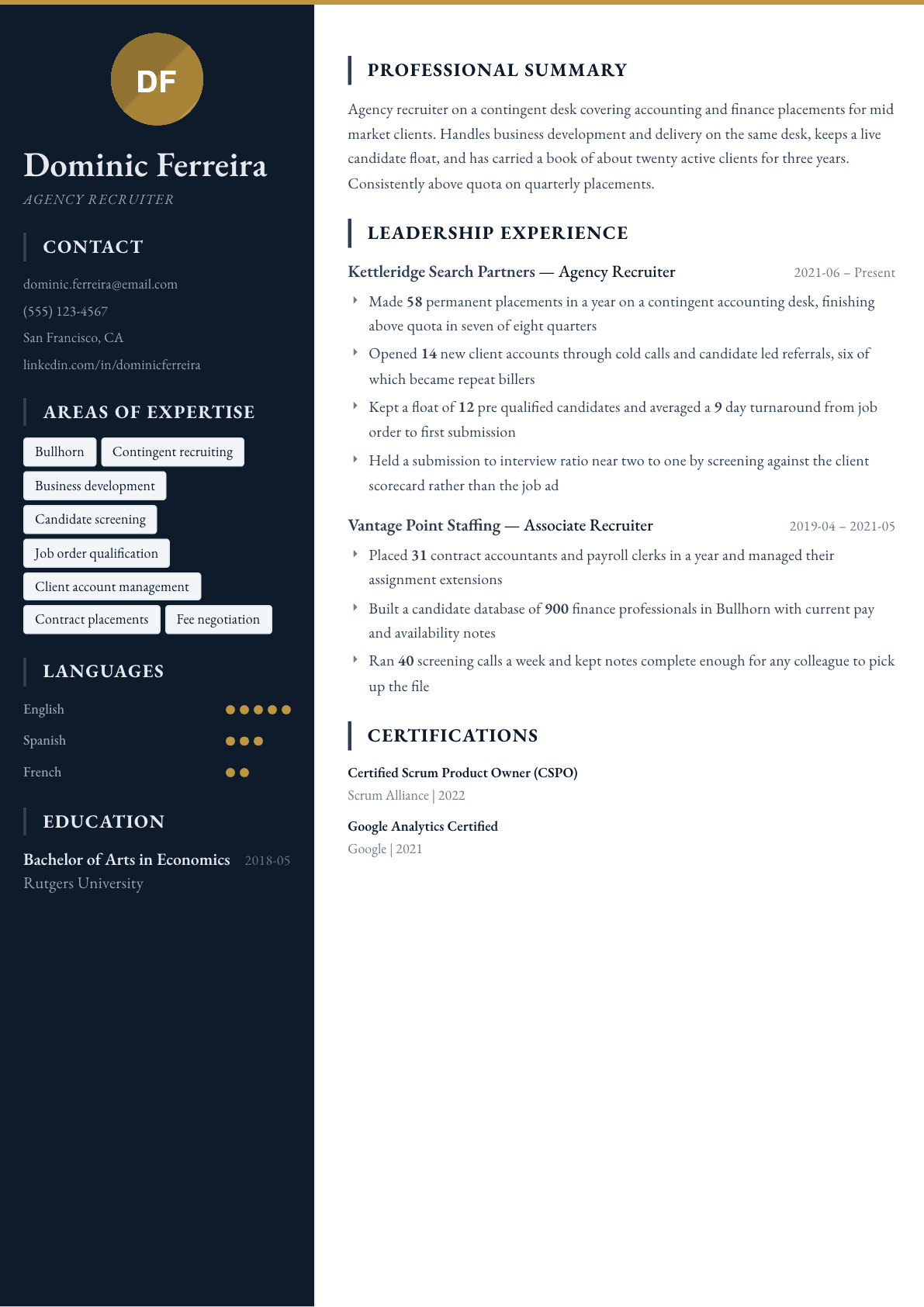
Example Agency Recruiter summary
Agency recruiter with six years on contingent accounting and finance desks, running business development and delivery side by side. Made fifty eight permanent placements last year, opened fourteen new client accounts, and keep a pre qualified candidate float that supports a nine day turnaround on new job orders. Looking for a firm where a strong biller is given room to build a specialist desk.
Skills to list on a Agency Recruiter resume
- Contingent recruiting
- Business development
- Job order qualification
- Candidate sourcing
- Bullhorn
- Applicant tracking systems
- Client account management
- Fee and rate negotiation
- Contract and temporary placement
- Candidate float management
- Reference checking
- Market mapping
- Cold calling
- Pipeline forecasting
What actually gets this resume read
- Lead with placements and quota performance, because an agency reader is trying to work out what you bill.
- Separate business development results from delivery results, since desks are structured very differently.
- Give submission to interview and interview to placement ratios, which show the quality of your screening.
- Name the vertical and the seniority you place, as an accounting desk and an engineering desk trade on different networks.
- Say whether the desk was contingent, retained or contract, because the sales motion behind each is not the same.
- Show client retention, such as accounts that gave you repeat job orders after the first placement.
How to write a agency recruiter resume
An agency recruiter resume is read by a billing manager who is doing arithmetic while reading. Placements, average fee, quota performance, and how much of your desk was inherited. Everything else on the page is secondary. This is one of the few recruiting jobs where the reader will forgive a plain document as long as the numbers are there and they hold up in conversation.
The mistake most drafts make is describing the process instead of the result. Screening calls made, candidates submitted and job orders worked all describe activity that a manager assumes. What they need to know is what you closed, how repeatable it was, and whether the clients came back.
This guide covers the structure that suits a billing desk, how to present placements and business development without exaggerating, three summaries for different stages, before and after bullets, and the questions agency recruiters ask when they move firm.
Format: one page, numbers close to the top
Reverse chronological, one page for most agency careers. Under each job title, put a desk line: the vertical, the seniority band, whether the desk was contingent, retained or contract, and whether it was a full desk covering both business development and delivery or a split role.
Do not bury results in paragraphs. A billing manager scans for numbers, so the first bullet of each role should carry placements and quota performance. Everything else supports it.
- Desk line format: contingent accounting and finance desk, mid market clients, full desk covering business development and delivery.
- Sections: summary, experience with desk lines, client and candidate highlights, education, systems.
- Systems line: the recruitment database, the sourcing seats and any client portal you worked through.
Summary: the desk you run and the market you own
Three lines that answer what you place, for whom, and how consistently. Naming the vertical and the seniority is essential, because a recruiter with a live network of accounting managers in one region is a specific asset, while a generalist with no market is a training cost.
Say whether you are a full desk biller or a delivery specialist. Firms structure this differently and hire against the structure they have. Being clear here saves you from interviews for a role you did not want.
Experience: placements, ratios and repeat clients
Give placements per year and quota performance across a period, such as above target in seven of eight quarters. Consistency is what separates a strong biller from someone with one lucky year. If your firm measured in fees rather than counts, describe performance against quota rather than publishing dollar figures.
Add the ratios that show quality: submissions to interview, interviews to placement, and turnaround from job order to first submission. A recruiter who submits three candidates and places one is worth more than one who floods a client with twenty resumes.
Then prove the client side. New accounts opened, how you opened them, and how many became repeat billers. Repeat business is the closest thing an agency has to proof that your placements stuck.
Candidate work: the float and the screen
Describe how you keep a live candidate float: how many pre qualified people you hold, how you refresh availability and pay expectations, and how quickly that lets you respond to a new job order. Speed to first submission is often what wins a contingent role against three other firms.
Explain your screen. Recruiters who screen against the client scorecard rather than the advertisement have far better interview conversion, and saying so in one sentence tells a manager you understand where fees are lost.
Systems, compliance and search keywords
Name the recruitment database and what you did in it, along with the sourcing seats and any job board contracts you managed. For contract desks, mention timesheet and assignment management, extensions, and the compliance checks your firm required, such as right to work and reference verification.
Firms search on familiar phrases: contingent recruitment, full desk, business development, job order, candidate submission, placement fee, contract and temporary staffing, client account management and billing quota. Mirror the ones that fit your desk, once in a skills area and once in a bullet.
Agency Recruiter resume summary examples
First year on the desk
Associate recruiter on a contract finance desk with 18 months of experience, placing 31 contract accountants and payroll clerks last year and managing their extensions. Run 40 screening calls a week and built a candidate database of 900 finance professionals. Ready for a full desk with business development.
Established biller
Agency recruiter running a full contingent accounting desk for mid market clients, with 58 permanent placements last year and above quota performance in seven of eight quarters. Opened 14 new accounts, six of which became repeat billers, and hold a submission to interview ratio near two to one.
Principal consultant
Principal consultant with nine years in agency recruitment, running a specialist finance desk and mentoring three associates. Consistently the top biller in a team of eight, retain a client base that gives repeat job orders without a competitive process, and negotiate terms directly with finance directors.
Work experience bullets: before and after
Before: Consistently exceeded placement targets.
After: Made 58 permanent placements on a contingent accounting desk last year and finished above quota in seven of eight quarters.
A count plus a consistency record turns a claim every applicant makes into a track a manager can trust.
Before: Developed new business through cold calling.
After: Opened 14 new client accounts through cold calls and candidate led referrals, six of which placed with me more than once in the same year.
Repeat billing is the proof that the new business was real rather than a single opportunistic fee.
Before: Submitted qualified candidates to clients quickly.
After: Averaged a nine day turnaround from job order to first submission by holding a float of 12 pre qualified candidates with current pay and notice details.
Speed is explained by a method, so the reader can see it was a system rather than luck.
Before: Screened candidates before sending them to clients.
After: Screened against the client scorecard rather than the job advertisement and held a submission to interview ratio near two to one across the year.
The ratio quantifies screening quality, which is where contingent desks quietly lose money.
Before: Kept the database updated with candidate information.
After: Built and maintained a database of 900 finance professionals in Bullhorn with current pay, notice period and availability notes so any colleague could pick up a file.
It shows the record keeping serving the desk rather than being an administrative chore.
Hard skills
- Contingent and permanent placement
- Business development and cold calling
- Job order qualification
- Candidate float management
- Recruitment database administration
- Fee and rate negotiation
- Contract and temporary staffing
- Reference and compliance checks
- Market mapping in a vertical
- Client terms of business
- Pipeline forecasting
- Assignment and extension management
Soft skills
- Resilience after a fall through
- Persuasion with hiring clients
- Negotiating between two parties
- Urgency without carelessness
- Relationship building over years
- Honesty about a weak shortlist
Certifications worth listing
- Certified Staffing Professional (CSP) (American Staffing Association)
- Certified Search Consultant (CSC) (American Staffing Association)
- Technical Services Certified (TSC) (American Staffing Association)
- Certified Internet Recruiter (CIR) (AIRS)
Mistakes that cost agency recruiter candidates the interview
- Describing activity such as calls made and resumes sent instead of placements closed.
- Publishing one exceptional year without the surrounding quarters, which reads as cherry picking.
- Hiding whether the desk was inherited or built, when a manager will ask in the first interview anyway.
- Leaving out the vertical and seniority, so no firm can tell whether your network transfers to their clients.
- Ignoring client retention entirely, which suggests placements were one time transactions.
- Overstating fees or quota performance that a reference call would contradict.
Agency Recruiter resume questions
Should I put my billings on an agency recruiter resume?
Publish placement counts and performance against quota rather than raw revenue. Numbers vary too much by fee structure and market to compare cleanly, and any figure you write will be tested in interview and in reference checks.
How do I show I built a desk rather than inherited one?
Say it directly and back it up: accounts opened by you, the first placement date on the desk, and how the job order flow grew. Managers ask this in every interview because an inherited book flatters an average biller.
What if my last year was poor because of the market?
Give the multi year picture and explain the context factually, such as a hiring freeze across your client base, then show what you did about it: new accounts opened, a vertical you added, or contract work you developed while permanent hiring slowed.
Is agency experience a disadvantage when applying in house?
Only if you leave the language untranslated. Placements become hires, job orders become requisitions, and clients become hiring managers. Keep the urgency and sourcing depth, and add any process work you did such as intake standards or scorecards.
How long should an agency recruiter resume be?
One page is standard and preferred. Billing managers read many of these and want the desk, the numbers and the vertical quickly. Use a second page only when you have several firms and a genuine leadership or team building record to show.
Related resume examples
- Recruiter Resume example
- Talent Acquisition Specialist Resume example
- Executive Recruiter Resume example
- Staffing Coordinator Resume example
- Sourcer Resume example
- Technical Recruiter Resume example