Executive Recruiter Resume Examples: what gets the call
Craft an Executive Recruiter Resume for Retained Search Firms
By Mustafa Tarabya, founder of CVBooster · Published · Updated
Executive recruiter resume sample covering retained search, mandates completed, keywords for search firms, and a writing guide.
Sample resumes for a executive recruiter
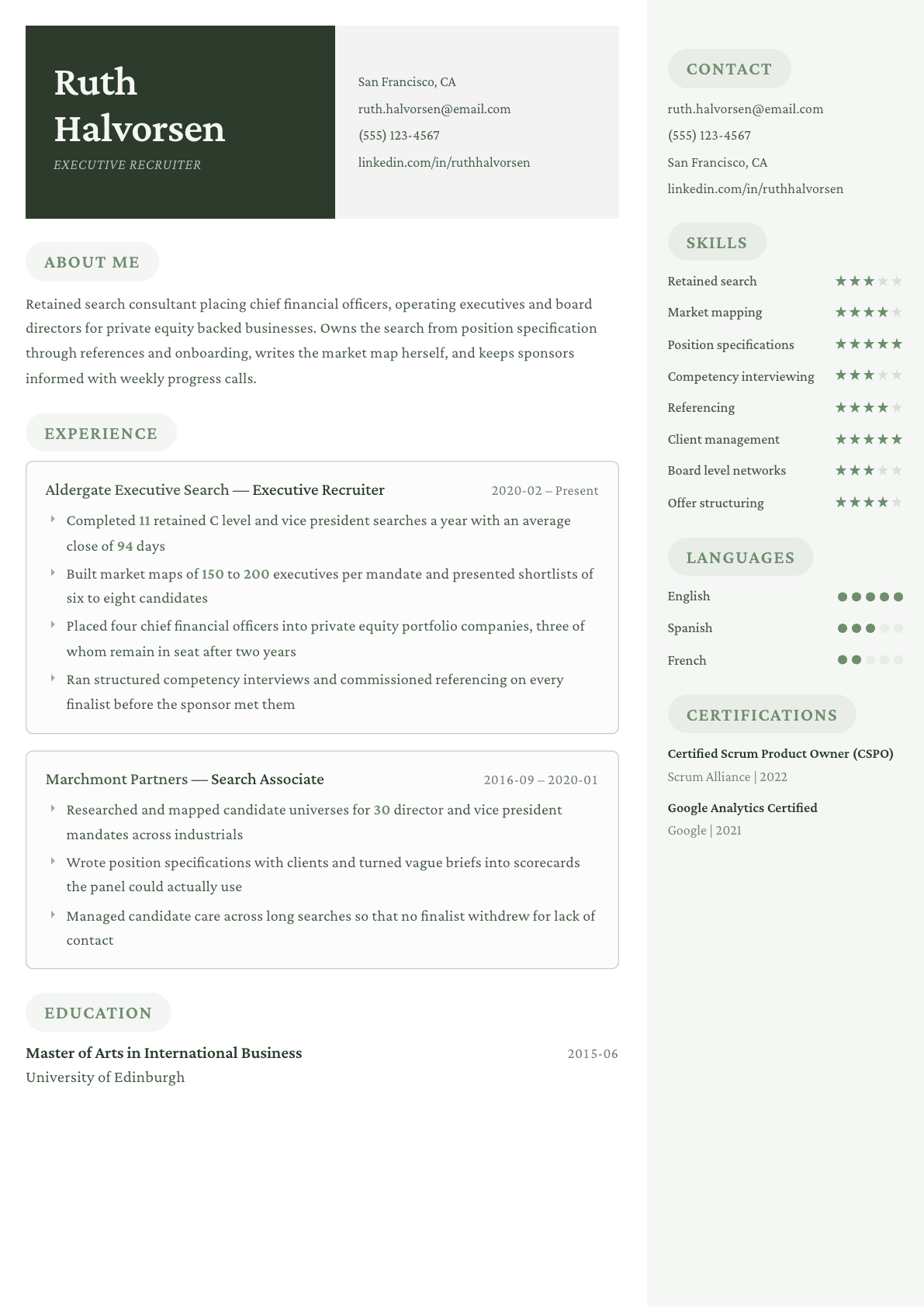
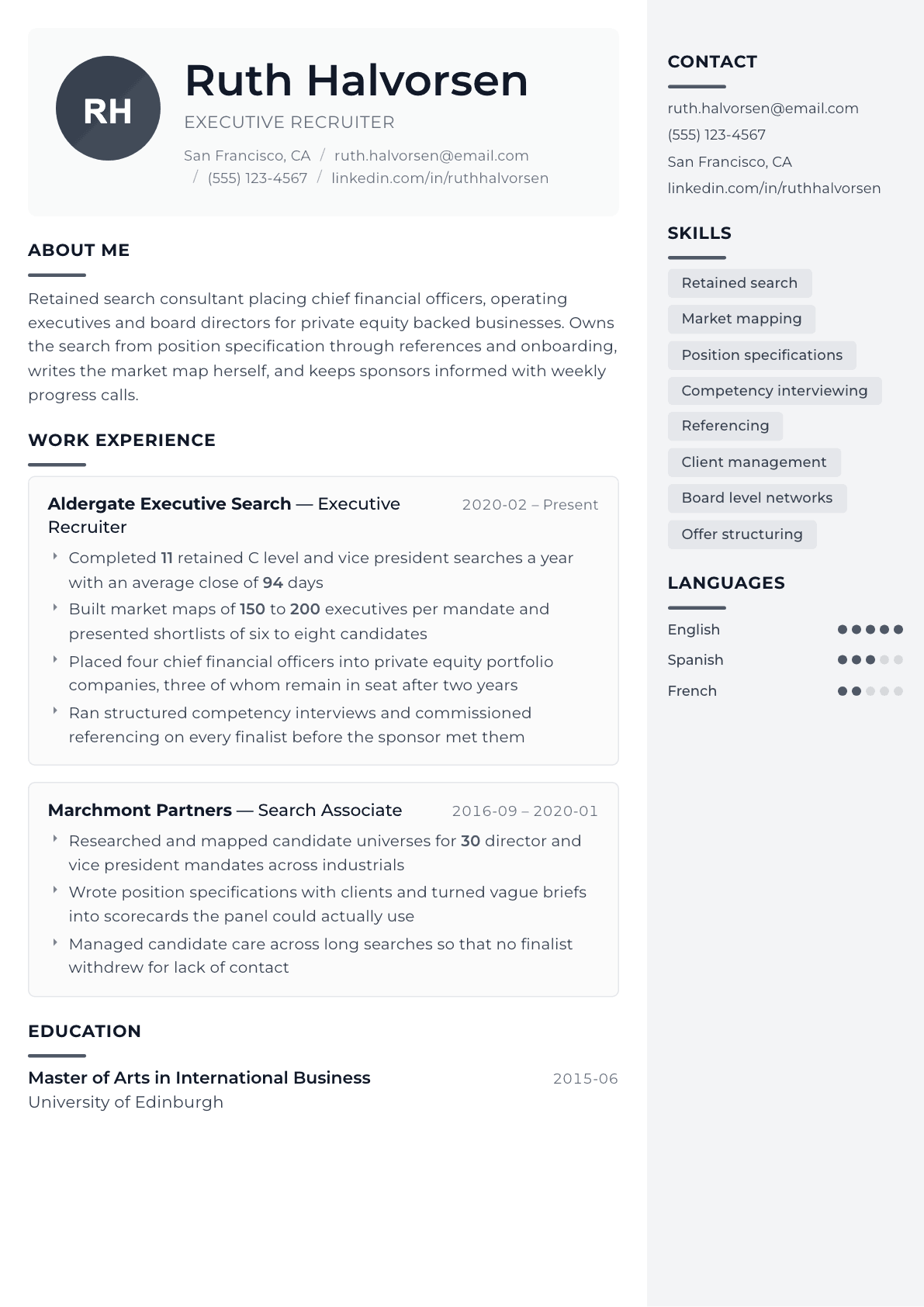
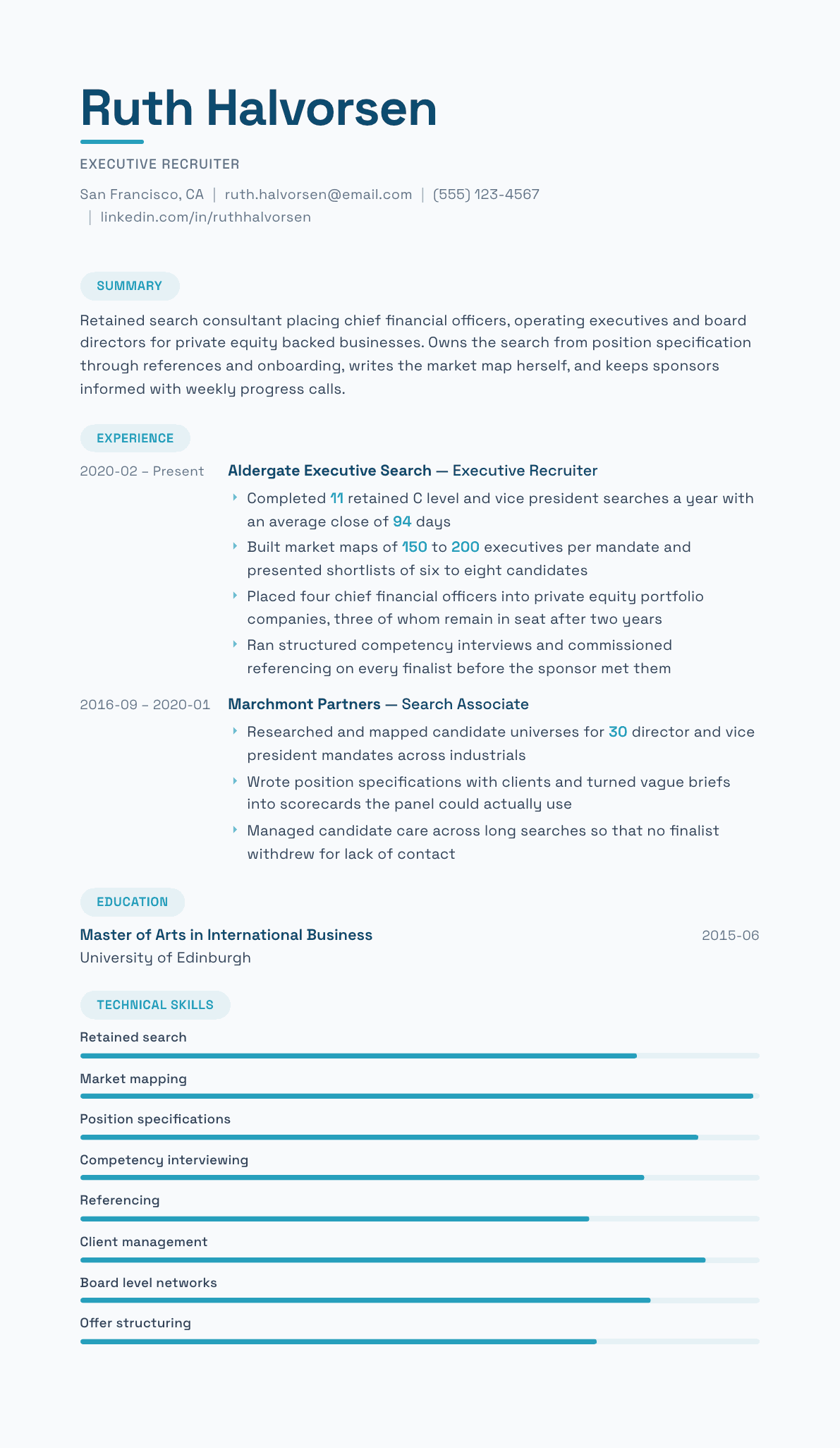
The same executive recruiter content laid out in three CVBooster templates, so you can see what the finished document looks like before you write a word.
Example Executive Recruiter summary
Executive recruiter running retained searches for chief financial officers, operating executives and board directors in private equity backed businesses. Complete around eleven mandates a year, build market maps of two hundred executives, and present shortlists that close in about three months. Seeking a partner track seat at a boutique firm where consultants own the client relationship end to end.
Skills to list on a Executive Recruiter resume
- Retained executive search
- Market mapping
- Position specification writing
- Competency based interviewing
- Candidate assessment
- Detailed referencing
- Client relationship management
- Compensation structuring
- Board and C level networks
- Succession advisory
- Search project management
- Confidential search handling
- Shortlist presentation
- Offer and onboarding support
What actually gets this resume read
- Count completed mandates rather than placements, because retained work is judged on searches finished.
- Name the levels and functions you place, since a chief financial officer search is not a director search.
- Show the depth of your research: candidates mapped, shortlists presented, and how the long list narrowed.
- Include stayed in seat outcomes where you have them, as clients pay for placements that hold.
- Describe how you write position specifications with a client, since that is where a search is won or lost.
- Mention the sectors and ownership types you serve, such as private equity backed or family owned businesses.
How to write a executive recruiter resume
An executive recruiter resume is judged by partners at a search firm or by a talent leader building an internal executive search team. Both are asking a narrow question: can this person carry a mandate in front of a client who pays in advance? Retained work is sold on process and judgment, not on speed, so the resume has to read like the work of someone comfortable in a boardroom.
The document itself is part of the assessment. A search consultant who writes vaguely about a mandate will write vaguely in a position specification. Precision here, in the language and in the structure, is treated as a sample of your professional writing.
This guide sets out the sections a search firm expects, what to publish about mandates without breaching client confidence, three summaries across research associate to partner track, before and after bullets, and the questions consultants raise when they move between firms.
Format: mandates, sectors and levels, written soberly
Reverse chronological, restrained typography, two pages once you have several years of completed searches. Under each title, place a practice line: the functions and levels you search, the sectors and ownership types you serve, and whether the work is retained, engaged or internal executive search.
Avoid graphics, color blocks and anything that would look out of place in a client document. A search resume should read the way a good candidate report reads: clear structure, controlled language, no decoration.
- Practice line format: retained chief financial officer and operating executive searches, private equity backed industrials, national scope.
- Sections: summary, experience with practice lines, selected mandates described generically, education, professional memberships.
- Keep a line for research capability: mapping depth, database work, and the market studies you have produced.
Summary: level, function, sector, and how you run a search
Four lines. State the levels you place, the functions, the sectors, and the type of client. Then say something about your method, because retained clients buy method: how you build the specification, how deep you map, how you assess and how you reference.
Do not claim relationships you cannot demonstrate. A consultant who says they have a live network of operating executives in one industry and names how that network was built is believable. One who claims global reach at every level is not.
Experience: completed mandates and the shape of each search
Count completed mandates per year, not placements, and add the average time from launch to signed offer. Give the shape of the funnel: candidates mapped, long list, shortlist presented, finalists interviewed by the client. Those numbers describe rigor in a way that a placement count cannot.
Describe representative searches without naming clients unless they are public. The level, the sector, the ownership structure, the constraint that made it hard, and the outcome are enough. A search for a first professional chief financial officer in a founder led business is instantly recognizable to another consultant.
Include the parts that clients pay for and juniors often skip: writing the position specification, running structured competency interviews, commissioning or conducting detailed references, advising on compensation structure, and supporting onboarding after the signature.
Client development and repeat work
For partner track roles, show origination. Retainers won, how the relationship started, and how much of your work came from repeat clients or referrals. Firms distinguish sharply between consultants who deliver searches sold by others and those who bring in mandates.
Stayed in seat outcomes are the strongest evidence you can offer. If placements you made remain in role after two years, or if a client returned to you for the next executive hire, say so plainly. It answers the quality question that time to fill never touches.
Research, assessment and the language firms search on
Name your research approach: how you build a candidate universe, the sources you use, and how you keep a mapped market current between mandates. Search firms hire consultants who can still do the research when there is no associate available.
The vocabulary that appears in these postings is consistent: retained search, position specification, market mapping, long list, shortlist, competency based interviewing, referencing, board level appointments, succession advisory and client development. Use the terms that describe your real practice.
Executive Recruiter resume summary examples
Search associate
Search associate with three years supporting retained mandates in industrials, mapping candidate universes of up to 200 executives and drafting position specifications with lead consultants. Managed candidate care across long searches with no finalist withdrawing for lack of contact. Seeking a consultant seat carrying my own mandates.
Search consultant
Executive recruiter completing 11 retained vice president and C level mandates a year for private equity backed businesses. Build market maps of 150 to 200 executives per search, present shortlists of six to eight, and close in about 94 days. Four placed chief financial officers, three still in seat after two years.
Partner track
Senior search consultant with 12 years in retained executive search, running a finance and general management practice with a personal origination record. Won 9 retainers last year, half from repeat clients, and advise boards on succession as well as individual appointments. Mentor two associates and lead firm wide assessment standards.
Work experience bullets: before and after
Before: Recruited senior executives for a range of clients.
After: Completed 11 retained mandates a year at chief financial officer and vice president level for private equity backed businesses, closing at an average of 94 days from launch to signed offer.
Mandate count, level, client type and cycle time describe a retained practice rather than a job title.
Before: Built long lists of potential candidates.
After: Mapped 150 to 200 executives per mandate through original research, narrowing to a long list of 25 and a client shortlist of six to eight.
The funnel from map to shortlist is what clients pay a retainer for, and it shows the research was yours.
Before: Wrote job specifications with clients.
After: Turned vague briefs into position specifications with agreed success measures for the first year, then used them as the scorecard for every panel interview.
It shows the specification being used as an assessment instrument rather than a marketing document.
Before: Conducted interviews and reference checks.
After: Ran structured competency interviews against the specification and commissioned detailed referencing on every finalist before the client met them, including two off list references per candidate.
The sequencing and the off list references demonstrate a standard of diligence a client can rely on.
Before: Maintained good client relationships.
After: Won nine retainers last year with half coming from clients who had used me before, including one board that returned for its third executive appointment.
Repeat retainers are the clearest available proof that earlier searches were judged successful.
Hard skills
- Retained executive search
- Position specification writing
- Original market mapping
- Long list and shortlist construction
- Competency based interviewing
- Detailed and off list referencing
- Executive compensation structuring
- Board and succession advisory
- Search project management
- Client origination and retainer negotiation
- Confidential search handling
- Onboarding and integration support
Soft skills
- Boardroom presence
- Discretion with sensitive appointments
- Persuasive written assessment
- Patience across long searches
- Challenging a client brief respectfully
- Reading interpersonal dynamics
Certifications worth listing
- Certified Search Consultant (CSC) (American Staffing Association)
- Senior Professional in Human Resources (SPHR) (HR Certification Institute)
- Hogan Assessment Certification (Hogan Assessment Systems)
Mistakes that cost executive recruiter candidates the interview
- Counting placements like a contingent desk when retained work is measured in completed mandates.
- Naming client companies that never announced the appointment, which reads as a breach waiting to happen.
- Describing searches so generically that no reader can tell a board appointment from a manager hire.
- Leaving out referencing and assessment, the parts of the process a retained client is actually buying.
- Claiming origination when you delivered mandates that partners sold, a claim that unravels in interview.
- Using promotional language and decorative formatting that would embarrass you in front of a client.
Executive Recruiter resume questions
How do I describe searches without breaching client confidentiality?
Describe the role, the level, the sector and the ownership structure, and leave the client anonymous unless the appointment was publicly announced. Consultants read these descriptions fluently, and discretion on the page is itself a qualification for the work.
Should an executive recruiter resume include placement numbers?
Include completed mandates per year, average time to close and repeat client share. Avoid revenue figures. Search firms compare consultants on mandate load, level of appointment and whether the clients came back, not on a headline number.
How do I move from contingent agency work into retained search?
Emphasize the elements that overlap: original research, market mapping, senior level conversations and client development. Then show any work resembling retained process, such as written specifications, structured assessment or referencing beyond a standard employment check.
Does an executive recruiter resume need to be one page?
No. Two pages is normal, because the practice line, the mandate detail and the client development record all need room. Keep the writing tight, since the document is read as a sample of how you would write about a candidate.
What matters more, sector expertise or functional expertise?
Functional depth usually travels better, since a finance leadership search follows similar logic across industries. Sector knowledge wins mandates where the client base is tight knit. State both, and be honest about which one your network really sits in.
Related resume examples
- Recruiter Resume example
- Chief People Officer Resume example
- Agency Recruiter Resume example
- Recruiting Manager Resume example
- Sourcer Resume example
- Technical Recruiter Resume example