Technical Recruiter Resume Examples: what gets the call
Create a Technical Recruiter Resume Engineering Teams Respect
By Mustafa Tarabya, founder of CVBooster · Published · Updated
Technical recruiter resume example with real funnel numbers, the stacks worth naming, ATS keywords and a full writing guide.
Sample resumes for a technical recruiter
The same technical recruiter content laid out in three CVBooster templates, so you can see what the finished document looks like before you write a word.
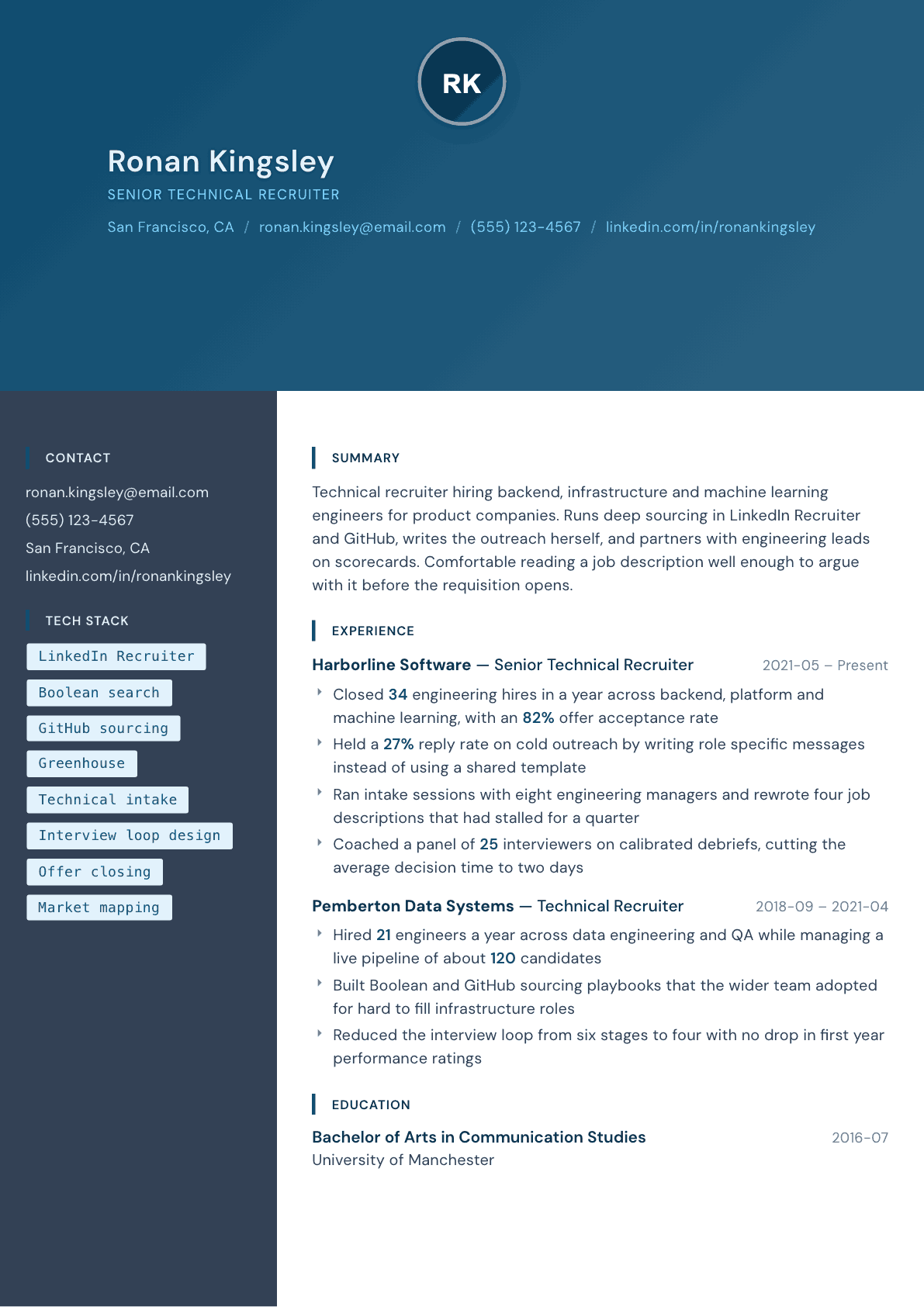
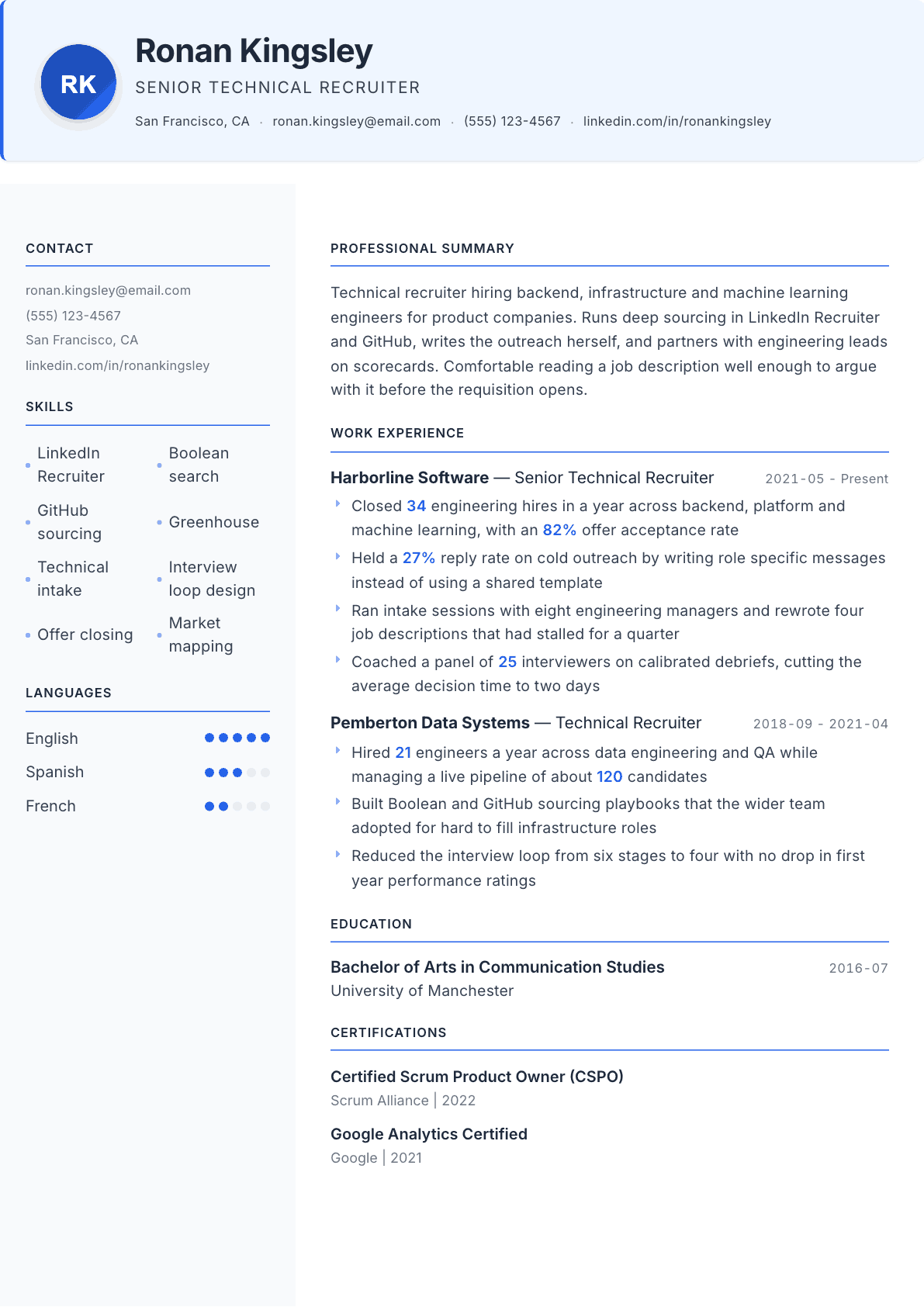
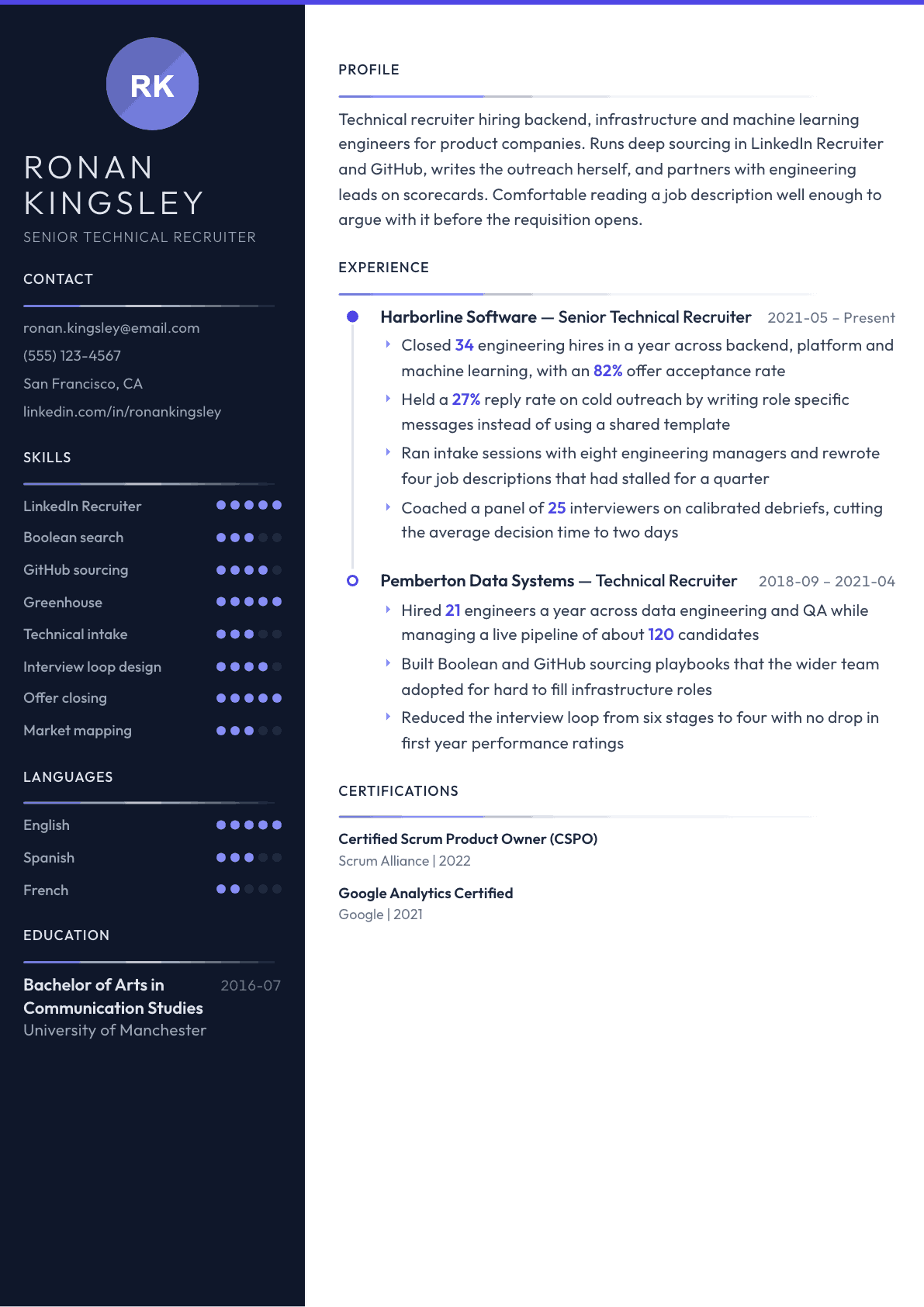
Example Technical Recruiter summary
Technical recruiter with seven years hiring engineers for product companies, currently closing more than thirty backend, platform and machine learning roles a year. Source and write outreach personally, run intake with engineering managers, and hold offer acceptance above eighty percent. Looking for a team where recruiters are trusted to shape the interview loop, not only to fill the top of it.
Skills to list on a Technical Recruiter resume
- Technical sourcing
- Boolean search
- LinkedIn Recruiter
- GitHub and Stack Overflow sourcing
- Applicant tracking systems
- Greenhouse
- Intake meetings
- Interview loop design
- Scorecard writing
- Offer negotiation
- Market mapping
- Compensation benchmarking
- Candidate experience
- Pipeline reporting
What actually gets this resume read
- Name the engineering areas you hire for, because backend, security and data hiring pull from different markets.
- Show that you understand the stack by referencing the tools in context rather than listing acronyms.
- Report reply rate and offer acceptance together, since one shows sourcing and the other shows closing.
- Describe an intake conversation you changed, as engineering leaders hire recruiters who push back well.
- Include the loop you designed or trimmed, because interview process work separates senior from junior recruiters.
- Mention how you keep a live pipeline organized when you carry many open requisitions at once.
How to write a technical recruiter resume
A technical recruiter resume gets read by a recruiting lead first and, in many companies, by an engineering manager second. The recruiting lead checks your funnel: how many engineers you closed, from what pipeline, at what acceptance rate. The engineering manager is checking something harder to fake, which is whether you understand the work well enough to hold a credible conversation with a staff engineer who is not looking for a job.
Most drafts fail the second test. They list technologies as keywords, claim to hire for full stack roles, and never show one moment of technical judgment. The fix is not to pretend to be an engineer. It is to write about the market the way someone who has actually mapped it does: which skills are scarce, which job descriptions were unhireable as written, and what you changed.
This guide walks through the sections in the order a recruiting lead reads them, with summaries for a first technical desk, a mid career recruiter and a lead, five before and after bullets, and the questions that come up when technical recruiters rewrite this document.
Format: one page until you have five years, no rating bars
Reverse chronological, plain layout, no columns. Under each job title add a scope line: the engineering areas you covered, the number of live requisitions you carried, and the applicant tracking system in use. Technical recruiting is a specialist market, so the areas matter more than the company logo above them.
Skip skill rating graphics. A bar chart claiming eight out of ten on Kubernetes from a recruiter is the fastest way to lose an engineering reader. Show technical fluency through the way you describe roles instead.
- Scope line format: backend, platform and machine learning hiring, 10 to 14 live requisitions, Greenhouse.
- Sections: summary, experience with scope lines, sourcing and process work, education, tools.
- Tools line: sourcing platforms, applicant tracking system, outreach and analytics tools you use daily.
Summary: the stacks you hire for and how you close
Name the engineering areas, the seniority band, and the company type. Hiring backend engineers for a payments company and hiring embedded engineers for a hardware manufacturer draw from unrelated candidate pools, and a recruiting lead is screening for the one they need.
Then say how you win. Personally written outreach, referrals through engineering networks, conference and community sourcing, or a reputation in a niche market. One concrete sentence about your closing approach beats a paragraph about passion for talent.
Experience: sourcing evidence, loop work and closes
Give hires closed and the areas they were in, then the two numbers that reveal how you got there: outreach response rate and offer acceptance. Response rate proves your messages are worth opening. Acceptance proves you managed expectations on level and pay before the offer went out.
Show at least one hard search in detail. The market you mapped, the Boolean or community angle that opened it, how long the role had been stuck, and what closed it. Engineering leaders remember the recruiter who filled the role everyone else gave up on.
Include process ownership. Intake sessions you ran, job descriptions you rewrote, loops you shortened, debrief standards you introduced, interviewers you trained and calibrated. A technical recruiter who improves the loop is far more valuable than one who only feeds it.
Showing technical fluency without overclaiming
Write about technology the way a good recruiter speaks: in terms of what the team builds and what the engineer would do. Saying you hired engineers for a team moving batch data pipelines to streaming tells an engineering manager more than a list of five frameworks.
Name the areas you know cold and be honest about the edges. A recruiter who says they know backend and data hiring well and are new to security hiring reads as trustworthy. One who claims every discipline reads as someone who will waste a hiring manager time.
Tools and the keywords the search will hit
List the sourcing stack by name: the recruiter seat you work from, the code hosting and community sources you search, your outreach and candidate relationship tool, and the applicant tracking system. Add any assessment platform you have administered.
Recruiting postings repeat these phrases: full cycle recruiting, technical sourcing, Boolean search, intake meetings, scorecards, structured interviews, offer negotiation, pipeline management and candidate experience. Use the ones that are true of you, once in a tools or skills area and once inside a bullet.
Technical Recruiter resume summary examples
First technical desk
Recruiter with two years of corporate hiring moving onto a technical desk, currently supporting QA and data engineering requisitions alongside a senior recruiter. Built the Boolean library the team uses for data roles and ran 200 screening calls last year. Looking to own an engineering desk end to end.
Five years on engineering roles
Technical recruiter closing 30 to 35 engineering hires a year across backend, platform and machine learning at product companies. Write outreach personally and hold a reply rate above 25%, with offer acceptance at 82%. Run intake with engineering managers and rewrite job descriptions that stall.
Lead technical recruiter
Lead technical recruiter with nine years hiring engineers, currently owning the infrastructure and security desks while mentoring three recruiters. Redesigned the engineering loop from six stages to four, trained 40 interviewers on calibrated debriefs, and closed two principal engineers last year.
Work experience bullets: before and after
Before: Recruited software engineers for multiple teams.
After: Closed 34 engineering hires in a year across backend, platform and machine learning teams, carrying 12 live requisitions at a time in Greenhouse.
Volume, areas and live load tell an engineering reader what kind of desk you actually ran.
Before: Sent outreach to passive candidates on LinkedIn.
After: Held a 27% reply rate on cold outreach by writing two role specific lines into every message and rotating subject lines weekly against response data.
A response rate and the method behind it separate real sourcing from a mail merge.
Before: Worked closely with hiring managers.
After: Ran intake sessions with eight engineering managers and rewrote four job descriptions that had produced no hires in a quarter, two of which closed within six weeks after the rewrite.
It shows the recruiter changing the requirement rather than accepting an unhireable brief.
Before: Helped improve the interview process.
After: Cut the engineering loop from six stages to four, introduced a written debrief template, and brought average decision time down to two days with no drop in first year performance ratings.
The before and after, plus the quality check, prove the process change did not simply lower the bar.
Before: Filled a difficult senior role.
After: Filled a staff infrastructure role open for five months by mapping 140 engineers in three metro areas and sourcing through open source contributor lists rather than job boards.
Naming the market, the size of the map and the unusual channel shows technique instead of luck.
Hard skills
- Technical sourcing
- Boolean and X ray search
- Open source and community sourcing
- Intake and requirement definition
- Interview loop design
- Scorecard writing
- Applicant tracking system workflows
- Compensation benchmarking
- Offer negotiation and closing
- Market and talent mapping
- Pipeline and funnel reporting
- Candidate experience management
Soft skills
- Credible technical conversation
- Pushing back on unrealistic briefs
- Candidate advocacy
- Persistence in long searches
- Written clarity in outreach
- Calm handling of counteroffers
Certifications worth listing
- Certified Internet Recruiter (CIR) (AIRS)
- Certified Diversity and Inclusion Recruiter (CDR) (AIRS)
- SHRM Certified Professional (SHRM-CP) (Society for Human Resource Management)
Mistakes that cost technical recruiter candidates the interview
- Listing frameworks and languages as a skills block, which reads to engineers as keyword collecting.
- Claiming to recruit for every discipline from embedded firmware to data science with no depth shown anywhere.
- Reporting hires without a response rate or an acceptance rate, so nobody can tell how the pipeline was built.
- Describing the requisition as given instead of showing where you challenged an unhireable job description.
- Filling the resume with candidate care language while leaving out the loop and debrief work that leads value.
- Using rating graphics for technologies you do not practice, which undermines the rest of the document.
Technical Recruiter resume questions
How technical does a technical recruiter really need to be?
Deep enough to describe what a team builds, to tell adjacent skills apart, and to ask a follow up question that is not on the scorecard. You do not need to code. You do need to be able to explain why two backend candidates are not interchangeable.
What numbers should I put on a technical recruiter resume?
Hires closed by area, live requisition load, outreach response rate, and offer acceptance rate. Add time to fill only if it was measured consistently. Avoid profile view counts and message volume, which say nothing about quality of pipeline.
How do I move from corporate recruiting to technical recruiting?
Lead with any engineering adjacent roles you filled, such as data, QA or product, then show sourcing technique: Boolean libraries you built, communities you searched, and screening questions you developed with an engineer. Depth on one area beats broad claims.
Should I list the companies whose engineers I sourced from?
No. Naming target companies reads as market intelligence you are giving away and can be seen as indiscreet. Describe the market instead, such as engineers from payments infrastructure teams or from open source contributors in a given ecosystem.
Is agency technical recruiting experience valued in house?
Yes, especially the sourcing muscle and the urgency. Translate the language: placements become hires, job orders become requisitions, clients become hiring managers. Then add evidence of in house work such as intake, loop design or interviewer training.
Related resume examples
- Recruiter Resume example
- Talent Acquisition Specialist Resume example
- Sourcer Resume example
- Corporate Recruiter Resume example
- Executive Recruiter Resume example
- Agency Recruiter Resume example