Sourcer Resume Examples: free score, then the gap list
Write a Sourcer Resume That Proves Real Pipeline Building
By Mustafa Tarabya, founder of CVBooster · Published · Updated
Sourcer resume sample with outreach and pipeline metrics, sourcing tool keywords, and a guide to writing every section well.
Sample resumes for a sourcer
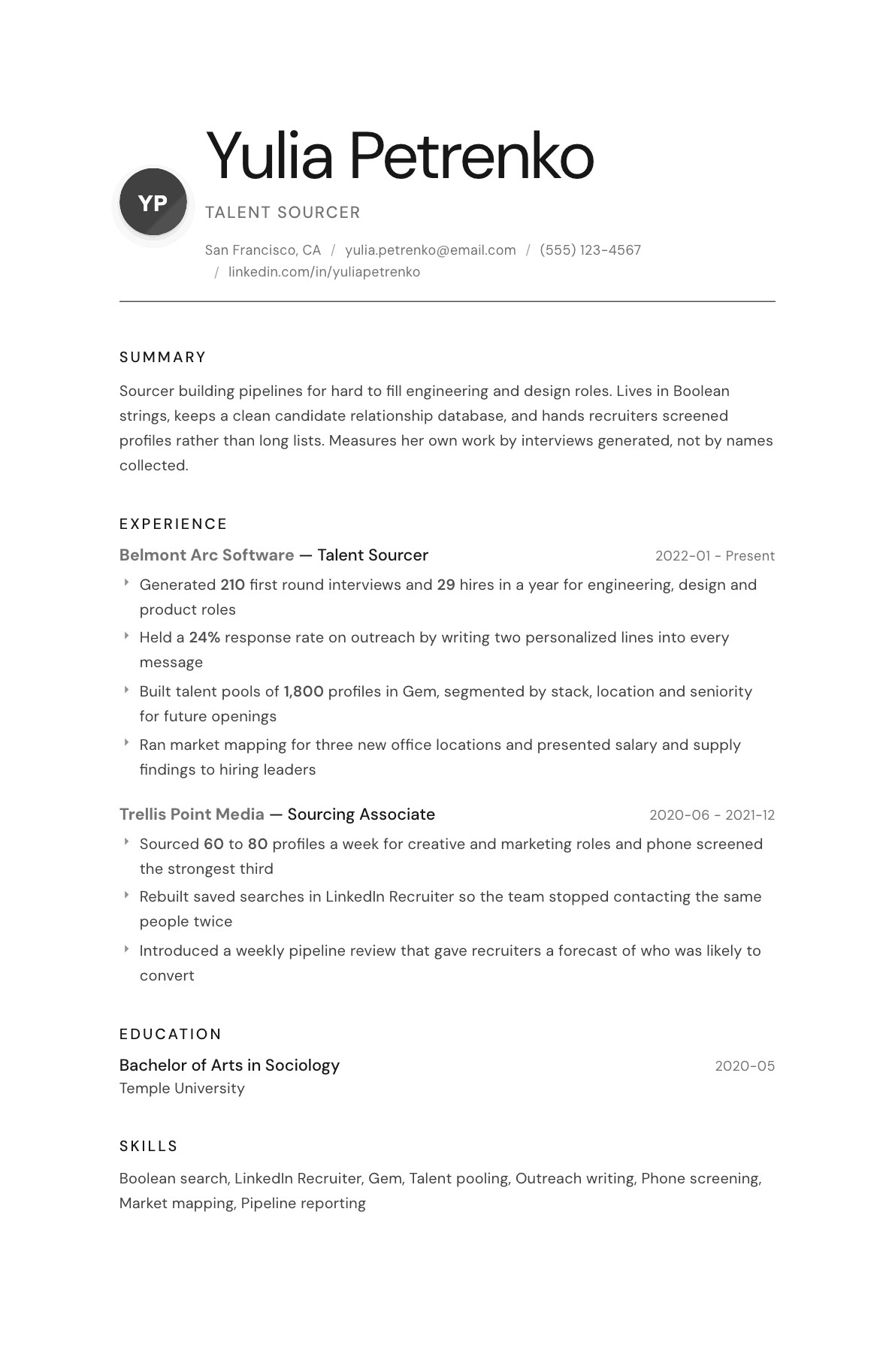
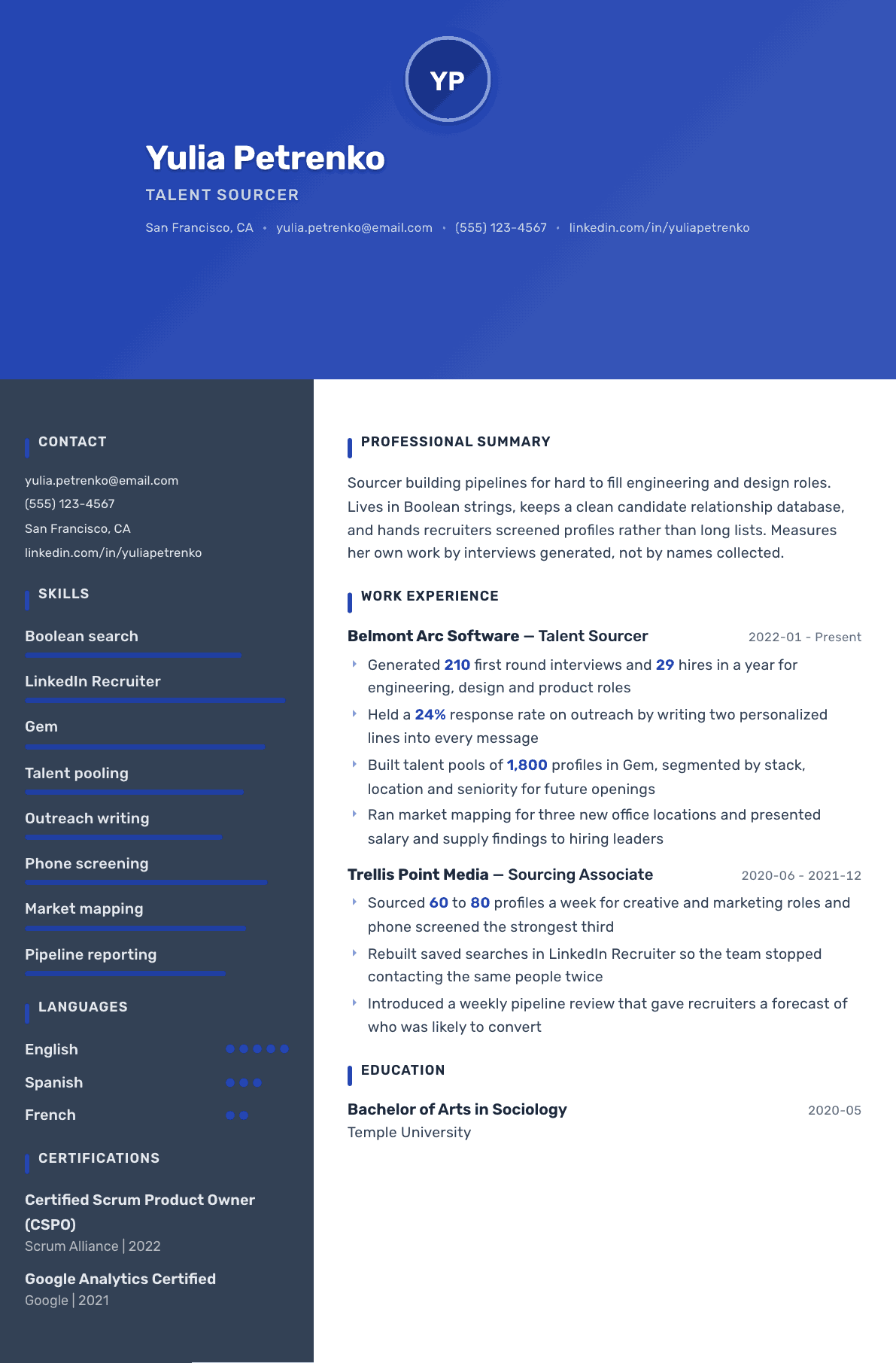
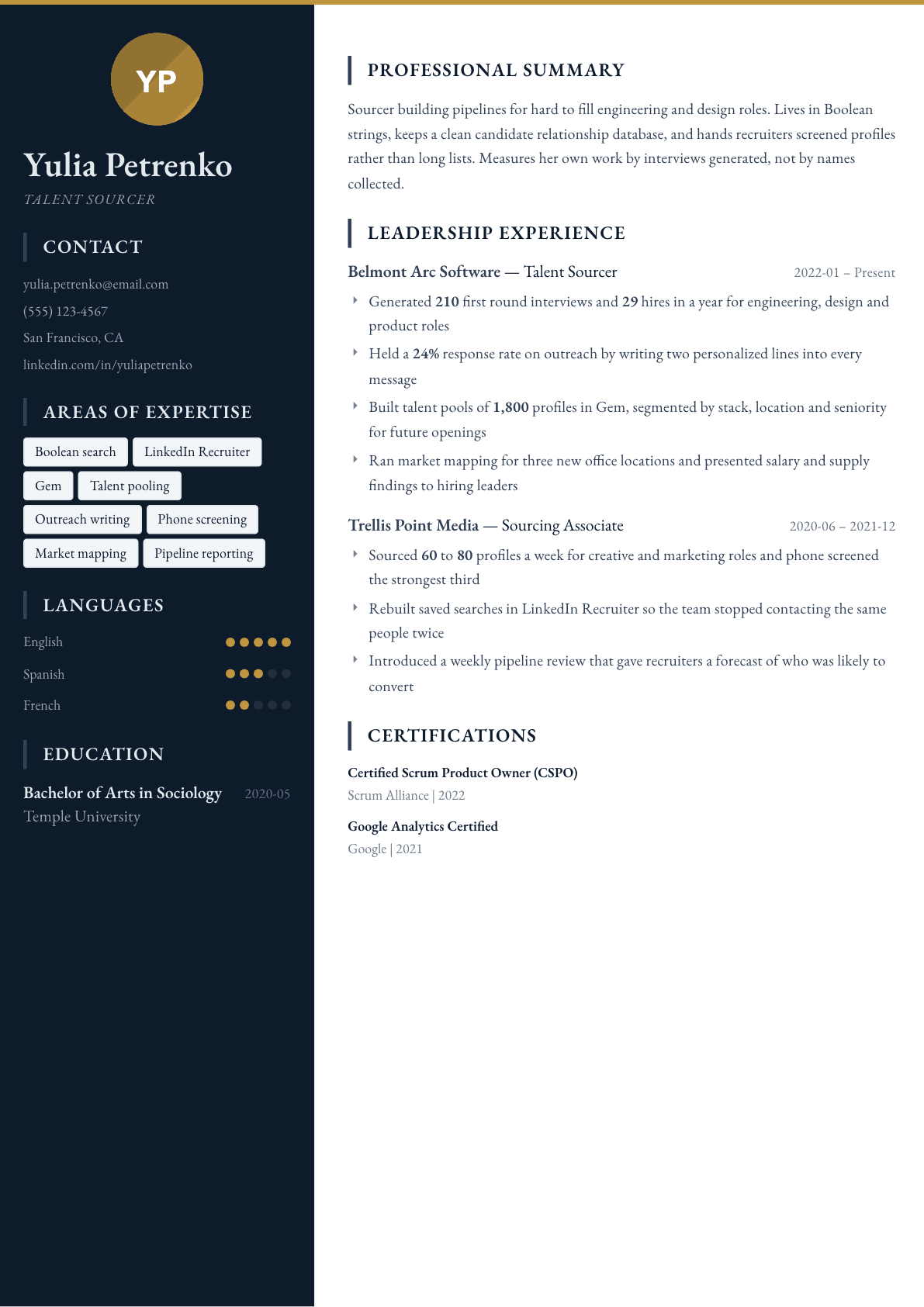
The same sourcer content laid out in three CVBooster templates, so you can see what the finished document looks like before you write a word.
Example Sourcer summary
Talent sourcer with four years building pipelines for engineering, design and product roles at software companies. Generated more than two hundred first round interviews last year at a response rate above twenty percent, and maintain segmented talent pools that recruiters reopen for new requisitions. Seeking a sourcing seat on a team that measures interviews created rather than profiles added.
Skills to list on a Sourcer resume
- Boolean search
- LinkedIn Recruiter
- X ray search
- GitHub sourcing
- Gem
- Candidate relationship management
- Talent pooling
- Cold outreach writing
- Phone screening
- Market mapping
- Compensation research
- Pipeline reporting
- Diversity sourcing
- Applicant tracking systems
What actually gets this resume read
- Measure yourself in interviews generated and hires influenced, not in the number of profiles you added.
- Give your outreach response rate and say what you did to earn it, since templates alone do not.
- Name the sourcing tools and the extensions you actually use, because sourcing teams hire on tool fluency.
- Show one hard search you cracked: the market, the Boolean approach, and how the pipeline finally moved.
- Explain how you keep talent pools usable months later, with segmentation and refreshed contact notes.
- Include any market or compensation research you produced, as that is the step up from sourcer to recruiter.
How to write a sourcer resume
A sourcer resume is read by a recruiting lead who has been disappointed before. Almost every applicant claims Boolean skill, a talent pipeline and a candidate first mindset. What the reader wants to know is narrower: how many interviews your work produced, what share of your outreach got answered, and whether the pipelines you built were still useful three months later.
The job is misunderstood inside companies as well as on resumes. Sourcing is not sending messages. It is defining the market for a role, finding the people in it who are reachable, writing something worth answering, and handing a recruiter candidates who are already interested. Your resume should make that distinction visible in the first five lines.
This guide covers how to structure the document around output rather than activity, three summaries from associate to lead sourcer, before and after bullets, and the questions sourcers ask when their applications keep getting screened out.
Format: output first, one page, no tool logo grids
Reverse chronological and one page. Under each job title, put a coverage line: the role families you sourced for, the number of requisitions you supported at once, and the recruiters or teams you fed. A sourcer supporting three recruiters across engineering is doing a different job from one supporting a single high volume desk.
Skip the grid of tool logos and proficiency bars. List the tools plainly in one line and use the space you save on the numbers a lead is looking for.
- Coverage line format: engineering, design and product sourcing, supporting four recruiters and 15 open roles.
- Sections: summary, experience with coverage lines, sourcing projects and market work, education, tools.
- Tools line: recruiter seat, candidate relationship platform, applicant tracking system, extensions and enrichment tools.
Summary: what you produce, not what you use
Three lines. Name the role families you source for, the volume of interviews or hires your work generated last year, and your response rate. Those three facts answer the screening question immediately and set you apart from applicants who lead with tool names.
Add the thing you are known for: cracking scarce markets, diversity sourcing, building talent pools that recruiters reopen, or turning market research into hiring decisions. Sourcing teams hire for a specific gap, and being narrow is an advantage here.
Experience: interviews generated, response rate, pipeline health
Lead with interviews generated and hires influenced. Profiles added to a system is an activity count that any tool can inflate, and experienced leads discount it entirely. Interviews are the point where your judgment was tested by someone else.
Give your response rate and explain the method behind it. Personalization on two specific lines, subject line testing, follow up cadence, or switching channel for a market that ignores email. The number without the method reads as luck; the method without the number reads as theory.
Then show pipeline durability. Talent pools built, how you segmented them, how you refreshed availability and interest, and how often a recruiter reopened one for a new requisition. A pool that dies within a quarter was a list, not a pipeline.
Technique: show one hard search in full
Devote one bullet to a search that was genuinely difficult. Name the constraint, whether that was a small candidate universe, an unusual skill combination, a location requirement or a compensation ceiling. Then name the approach that opened it: a different search surface, a community, a conference list, a set of adjacent titles nobody had tried.
This is the bullet a sourcing lead reads twice. It shows how you think when the obvious search returns nothing, which is the only part of the job that cannot be taught in a week.
Market work and the keywords a lead will search
If you have produced market maps, supply and demand studies for a new location, or compensation research that changed a range, put it in its own bullet. This is the work that moves a sourcer toward a recruiter or a talent intelligence role, and it is often left out.
Postings for these roles reuse a set of phrases: talent sourcing, Boolean search, candidate outreach, talent pipeline, candidate relationship management, market mapping, diversity sourcing, response rate and pipeline reporting. Use the ones that are true, once in your tools or skills area and once inside a bullet.
Sourcer resume summary examples
Sourcing associate
Sourcing associate with 18 months supporting creative and marketing hiring, delivering 60 to 80 profiles a week and phone screening the strongest third. Rebuilt saved searches so the team stopped contacting the same people twice. Looking to move onto a technical desk and own pipeline for a group of requisitions.
Sourcer with a full desk
Talent sourcer supporting four recruiters across engineering, design and product, generating 210 first round interviews and 29 hires last year. Hold a 24% response rate by writing two personalized lines into every message, and maintain segmented talent pools of 1,800 profiles in Gem.
Lead sourcer
Lead sourcer with seven years building pipelines for hard to fill engineering and executive roles, now setting sourcing standards for a team of five. Run market mapping for new office locations, present supply and pay findings to hiring leaders, and coach sourcers on outreach that earns a reply.
Work experience bullets: before and after
Before: Sourced candidates and added them to the talent pipeline.
After: Generated 210 first round interviews and 29 hires in a year across engineering, design and product by sourcing and pre screening candidates before handing them to recruiters.
Interviews and hires measure output that someone else validated, unlike a count of profiles added.
Before: Sent personalized outreach messages to passive candidates.
After: Held a 24% response rate by writing two role specific lines into every message and testing subject lines weekly against reply data.
A rate plus the method behind it turns a claim everyone makes into something the reader can evaluate.
Before: Built talent pools for future hiring needs.
After: Built pools of 1,800 profiles segmented by stack, location and seniority, refreshed contact notes quarterly, and had recruiters reopen four of them for new requisitions.
Segmentation, refresh discipline and reuse prove the pool stayed alive instead of decaying into a list.
Before: Used Boolean strings to find hard to reach candidates.
After: Cracked a stalled infrastructure search by mapping open source contributors and conference speakers rather than job titles, producing five interviews in the first two weeks.
It names the constraint, the unusual surface and the result, which is what sourcing skill actually looks like.
Before: Provided market information to hiring managers.
After: Ran market mapping for three new office locations and presented candidate supply and pay findings that changed the target level for two of the roles.
Research only counts when the reader learns which hiring decision it moved.
Hard skills
- Boolean and X ray search
- Recruiter platform sourcing
- Open source and community sourcing
- Candidate relationship management
- Talent pool segmentation
- Cold outreach writing and testing
- Phone screening
- Market and talent mapping
- Compensation research
- Diversity sourcing programs
- Applicant tracking system hygiene
- Pipeline and funnel reporting
Soft skills
- Curiosity about unfamiliar markets
- Written persuasion in short messages
- Discipline in follow up
- Partnership with recruiters
- Comfort with repetition
- Judgment on candidate fit
Certifications worth listing
- Certified Internet Recruiter (CIR) (AIRS)
- Certified Diversity and Inclusion Recruiter (CDR) (AIRS)
- Certified Social Sourcing Recruiter (CSSR) (AIRS)
Mistakes that cost sourcer candidates the interview
- Reporting profiles added or messages sent, which measures activity that tools can inflate.
- Leading with a list of sourcing tools instead of the interviews and hires those tools produced.
- Claiming a strong response rate without saying what you did to earn it.
- Describing talent pools with no segmentation or refresh method, so the reader assumes they went stale.
- Skipping the one hard search, which is the only place technique becomes visible.
- Ignoring the recruiter relationship, when a sourcer whose handoffs are messy creates work rather than saving it.
Sourcer resume questions
What metrics should a sourcer put on a resume?
Interviews generated, hires influenced, response rate and screen to interview conversion. Add pipeline reuse if you can show recruiters reopening pools you built. Leave out profile counts and message volume, which experienced leads discount immediately.
How do I write a sourcer resume with no recruiting background?
Lead with research and written outreach from wherever you did it: sales development, market research, journalism or academic work. Then show sourcing specifics you have practiced, such as a Boolean library you built or a market you mapped for a real opening.
Is sourcing a step toward becoming a recruiter?
It commonly is, and your resume can make that path obvious by including screening, intake input and market research alongside pipeline work. Some people stay in sourcing and specialize in scarce markets or talent intelligence, which is a full career on its own.
How do I show diversity sourcing work without overstating it?
Describe what you actually ran: the communities and partner organizations you sourced through, the search practices you changed, and the change in the shape of the pipeline. Avoid claiming outcomes that were decided by hiring panels rather than by your sourcing.
Should I list every sourcing tool I know?
List the ones you use weekly and can be tested on, grouped in a single line. A long inventory of tools invites a screening question about one you barely touched, and it crowds out the numbers that get you the interview.
Related resume examples
- Recruiter Resume example
- Talent Acquisition Specialist Resume example
- Technical Recruiter Resume example
- Agency Recruiter Resume example
- Executive Recruiter Resume example
- Corporate Recruiter Resume example