Airline Pilot Resume Examples: free ATS score and gap list
Build an Airline Pilot Resume the Hiring Board Can Score Quickly
By Mustafa Tarabya, founder of CVBooster · Published · Updated
Airline pilot resume example with ATP details, type ratings, a clean flight time table, keywords and a guide to the one page format boards expect.
Sample resumes for a airline pilot
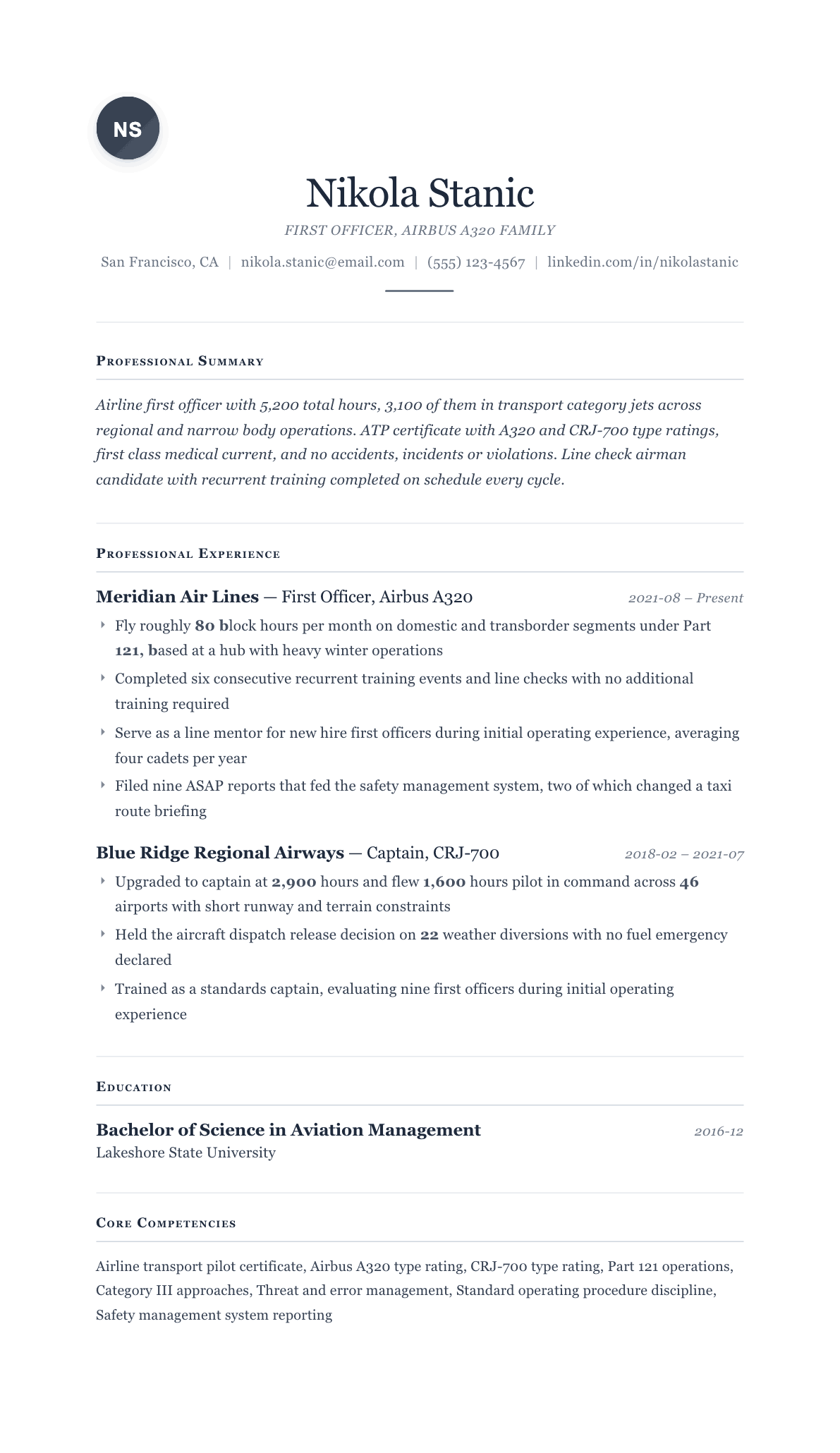
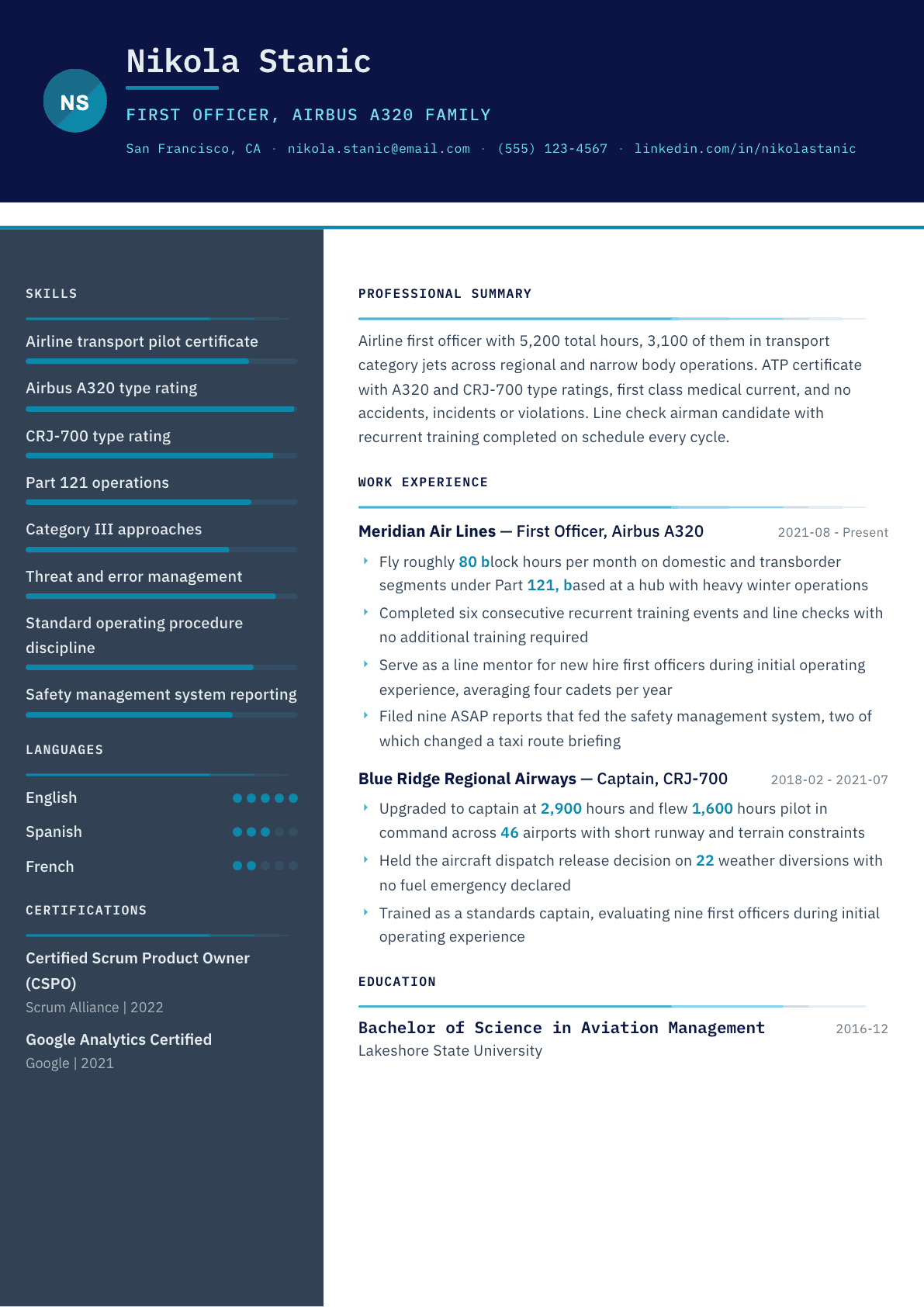
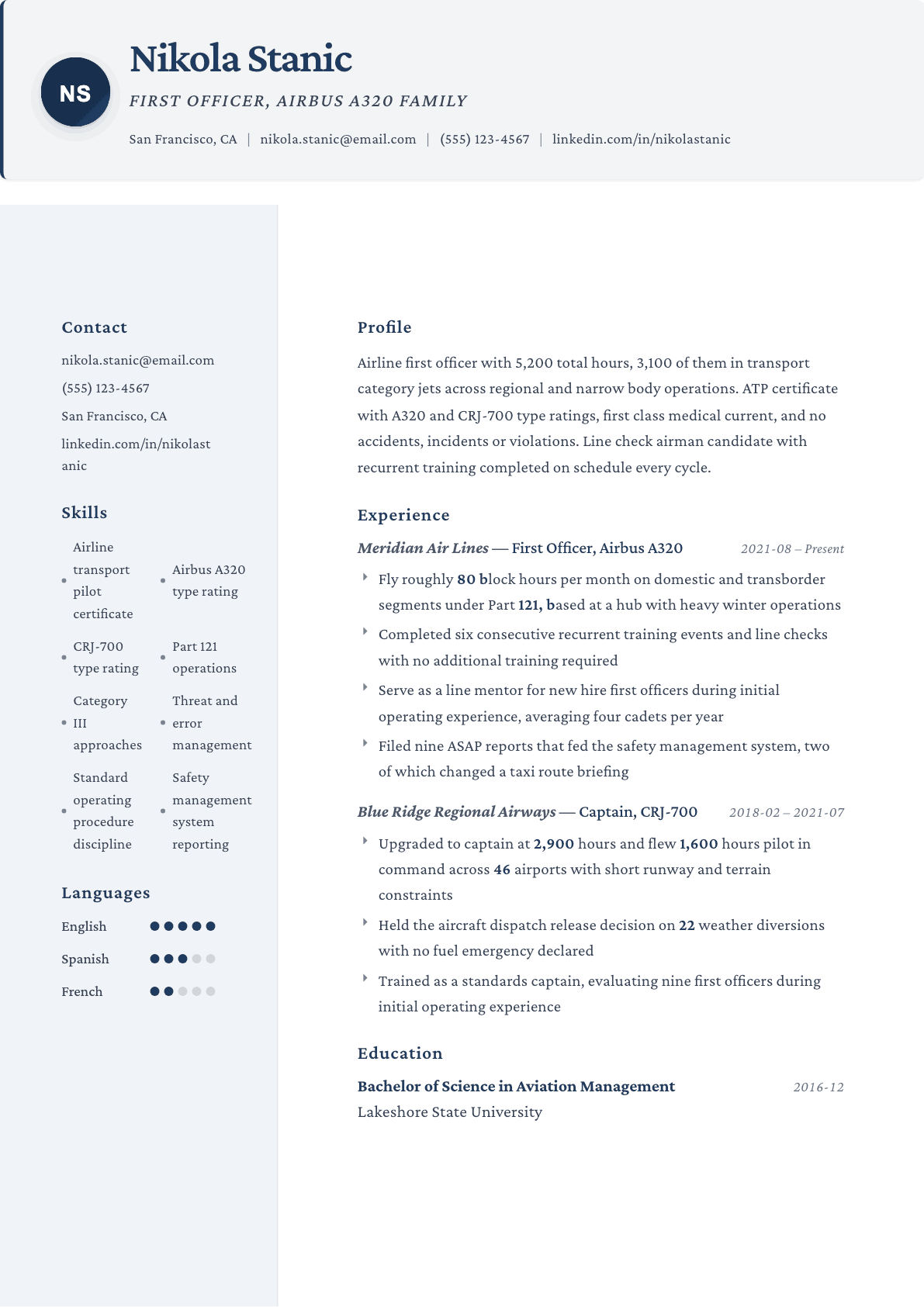
The same airline pilot content laid out in three CVBooster templates, so you can see what the finished document looks like before you write a word.
Example Airline Pilot summary
Airline pilot with 5,200 total hours and 3,100 hours in transport category jets, currently flying the A320 under Part 121 with a hub winter operation. ATP with A320 and CRJ-700 type ratings, first class medical current, and no accidents, incidents or violations. Former regional captain with 1,600 hours pilot in command and standards captain experience training new first officers.
Skills to list on a Airline Pilot resume
- Airline transport pilot certificate
- Type rating currency
- Part 121 operations
- Jet transport handling
- Category II and III approaches
- Threat and error management
- Crew resource management
- Standard operating procedures
- Dispatch release coordination
- Fuel and alternate planning
- Deicing and winter operations
- Safety report writing
- Line mentoring
- Fatigue risk management
What actually gets this resume read
- Put total time, pilot in command, turbine, jet, instrument and night hours in a table the board can read in seconds.
- Name the ATP certificate, every type rating, and the medical class with the month it was issued at the top.
- Say plainly that you have no accidents, incidents or violations, because the board will look for that line anyway.
- Give the operating rule and the equipment for each job, along with the base and the kind of route structure flown.
- Include failed checkrides honestly if you have them, since the records check will surface them regardless.
- Keep the resume to a single page and let the application form carry the detailed logbook breakdown.
How to write a airline pilot resume
Airline hiring runs on a scoring sheet. A recruiter opens the file, checks the certificate, the medical, the total time, the turbine pilot in command time and the record of accidents, incidents and violations, then assigns points. Everything else on the page is there to keep you in the room once the numbers clear the bar.
That is why the airline resume is the shortest document a professional pilot ever writes. One page. No colors, no logos, no photographs of an airplane. The detailed logbook breakdown belongs in the online application, and the interview panel will have that in front of them anyway. The resume exists so a human can confirm in twenty seconds that you are the person the application described.
This guide covers the header block, the flight time table, how to write experience for regional, cargo and corporate flying, what a pilot records check will surface, and the five questions that come up every time a first officer sits down to rewrite the file.
Format: one page, no exceptions
Single column, one clean serif or sans face, standard margins, black on white. A pilot with twenty years of flying still fits on one page because the resume carries positions and totals, not narrative. Every line you spend on formatting is a line you did not spend on hours.
Order the page: header with certificates and medical, flight times, employment history, education, training and awards. Put dates on the right in a fixed column so a reader can scan continuity without reading the entries.
- Header: name, city and state, phone, email, certificate held, type ratings, medical class and issue month, passport status.
- One explicit line stating no accidents, incidents or violations, or an honest note if you have one.
- Employment gaps of more than a few months get a one line explanation on the page, not a question in the interview.
The flight time block a recruiter scores
Airline minimums are written as specific categories, so mirror them exactly: total time, pilot in command, second in command, turbine, turbine pilot in command, multi-engine, instrument, actual instrument, night, and cross country. Add a line for time in the last twelve months, because recency is a separate scoring item at most carriers.
Give the date the totals were computed. Hours move every month and a table with no date makes a recruiter guess whether the file is stale. Update the figure and the date each time you send the resume out.
Experience: equipment, seat, rule, route structure
Each employment entry needs the carrier, the seat, the equipment and the operating rule, then two to four bullets. A line reading captain on the CRJ-700 under Part 121 tells a panel more than three sentences of description, because they already know the training footprint and the checking cycle behind it.
Bullets should show scale and judgment. Block hours a month, the base and the kind of weather it produces, the number of airports in the route structure, the runway or terrain constraints, and the decisions you actually owned: diversions, fuel calls, deicing holdover, maintenance dispatch under a minimum equipment list.
Add the roles beyond the line if you have them. Line check airman, standards captain, instructor, safety committee member and cadet mentor are all evidence that your own carrier trusted you with other pilots. Panels weight that heavily.
- Show upgrade timing: the hour count at which you upgraded and how long you held the left seat.
- Name the checking record: consecutive recurrent events and line checks completed with no additional training.
- Name the safety system: the report program you used and one change that came out of a report you filed.
Records, honesty and the background check
A carrier will pull your pilot records, your medical file and your driving record before an offer becomes real. Anything you leave off the resume will appear anyway, and the gap between the two documents is what ends applications, not the underlying event.
Write failures plainly and briefly: the event, the retraining, the successful recheck. One line. Do the same for a driving offense, an employment separation or a period out of flying. A panel is far more comfortable with a pilot who volunteers a fact than with one who waits to be asked.
Skills, keywords and what to leave out
Carrier postings reuse a narrow vocabulary: airline transport pilot certificate, type rating, restricted privileges, threat and error management, crew resource management, standard operating procedures, safety management system, first class medical. Place each of those once where it is true, in the header or inside a bullet that proves it.
Leave out the objective statement, the hobbies, the references line and every soft skill claim. Panels test communication and teamwork in the interview room, and a resume that asserts them instead of demonstrating them looks like a resume from outside the industry.
Airline Pilot resume summary examples
New first officer
Airline transport pilot with restricted privileges, 1,600 total hours and 240 multi-engine, hired into a regional first officer seat in 2024. CRJ-700 typed, first class medical current, no accidents, incidents or violations, and a clean training record through initial and initial operating experience.
Five thousand hours
Airline pilot with 5,200 total hours and 3,100 in transport category jets, currently a first officer on the A320 under Part 121 at a winter operations hub. Former regional captain with 1,600 hours pilot in command, six consecutive clean line checks, and no accidents, incidents or violations.
Captain and check airman
Airline captain with more than eleven thousand total hours and 6,900 as pilot in command on the A320 and Boeing 737, including five years as a line check airman conducting initial operating experience. Experienced in the safety management system as a report reviewer and in fatigue risk policy work with the flight operations group.
Work experience bullets: before and after
Before: Operated as first officer on the Airbus A320.
After: Fly about 80 block hours a month as first officer on the A320 across domestic and transborder segments, based at a hub with a full deicing season.
Block hours, route type and the winter environment give the panel a picture of your monthly exposure.
Before: Maintained training currency with the company.
After: Completed six consecutive recurrent training events and line checks with no additional training required and no unsatisfactory items recorded.
A checking record stated in the carrier vocabulary is the strongest quality signal a line pilot can offer.
Before: Helped train new pilots.
After: Mentored roughly four new hire first officers a year through initial operating experience, covering flow discipline, briefing standards and station specific arrival procedures.
Naming the phase of training and the content proves the mentoring was structured rather than informal.
Before: Made decisions about diversions and fuel.
After: Held the dispatch release decision on 22 weather diversions as regional captain with no fuel emergency declared and no missed customer connection bank.
A count of real diversions plus the outcome converts a judgment claim into a track record.
Before: Involved in the company safety program.
After: Filed nine safety reports into the safety management system, two of which changed a taxi route briefing at a construction affected airport.
A report volume and a resulting procedure change show the pilot used the system rather than merely knowing about it.
Hard skills
- Airline transport pilot certificate
- Airbus A320 type rating
- Part 121 flight operations
- Category II and III approach procedures
- Threat and error management
- Standard operating procedure discipline
- Dispatch release and minimum equipment list use
- Fuel, alternate and holdover planning
- Deicing and contaminated runway operations
- Safety management system reporting
- Initial operating experience instruction
- Fatigue risk and duty rule compliance
Soft skills
- Crew resource management
- Briefing clarity
- Assertive first officer communication
- Command decision making
- Mentoring new hires
- Composure under abnormal conditions
Certifications worth listing
- Airline Transport Pilot Certificate (Federal Aviation Administration)
- Aircraft Type Rating (Federal Aviation Administration)
- First Class Medical Certificate (Federal Aviation Administration)
- Certified Flight Instructor Instrument (Federal Aviation Administration)
- Radiotelephone Operator Permit (Federal Communications Commission)
Mistakes that cost airline pilot candidates the interview
- Running to two pages. Panels read the application for detail and treat a long resume as a sign the applicant cannot prioritize.
- Leaving out turbine pilot in command time, the single figure most competitive applications are ranked on.
- Omitting a training failure or a separation that the pilot records request will produce a week later.
- Failing to date the flight time table, which makes a recruiter assume the totals are months out of date.
- Adding graphics, a photograph or a colored header that pushes real content off the page.
- Describing the aircraft instead of the flying, when the panel already knows what the airplane does.
- Skipping the line about accidents, incidents and violations, which every scoring sheet has a box for.
Airline Pilot resume questions
How long should an airline pilot resume be?
One page for every level, including captains with two decades of flying. The online application carries the detailed logbook breakdown, employment addresses and training history, so the resume only needs certificates, totals, positions and dates.
Where do I put my type ratings?
In the header directly under your certificate line, listed by aircraft designation. Add hours in type beside each one if the time is significant, since a panel reads a type rating with real hours behind it very differently from one earned and never flown.
Do I include military flying on a civilian airline resume?
Yes, translated into civilian terms. Give the airframe, the seat, the mission and the hours, then convert your qualifications into their nearest civilian equivalents so a recruiter who never served can score the file without guessing.
Should I list a failed checkride on the resume?
Put it in one honest line with the retraining and the successful recheck. Carriers pull pilot records under federal rules, so the event will surface, and volunteering it removes the credibility problem that discovering it would create.
What if I have a gap in my flying history?
Explain it on the page in a single line: furlough, medical recovery, family leave, education or a period in another industry. A dated explanation closes the question before the interview, while an unexplained gap invites the panel to imagine something worse.
Related resume examples
- Pilot Resume example
- Commercial Pilot Resume example
- Flight Attendant Resume example
- Flight Instructor Resume example
- Aircraft Mechanic Resume example
- Helicopter Pilot Resume example