Aircraft Mechanic Resume Examples: the lines they read
Aviation Mechanic Resume Examples for A&P Line and Hangar Work
By Mustafa Tarabya, founder of CVBooster · Published · Updated
Aviation mechanic resume examples and a written sample for A&P mechanics, with certificate placement, aircraft type lists and logbook bullets.
Sample resumes for a aircraft mechanic
The same aircraft mechanic content laid out in three CVBooster templates, so you can see what the finished document looks like before you write a word.
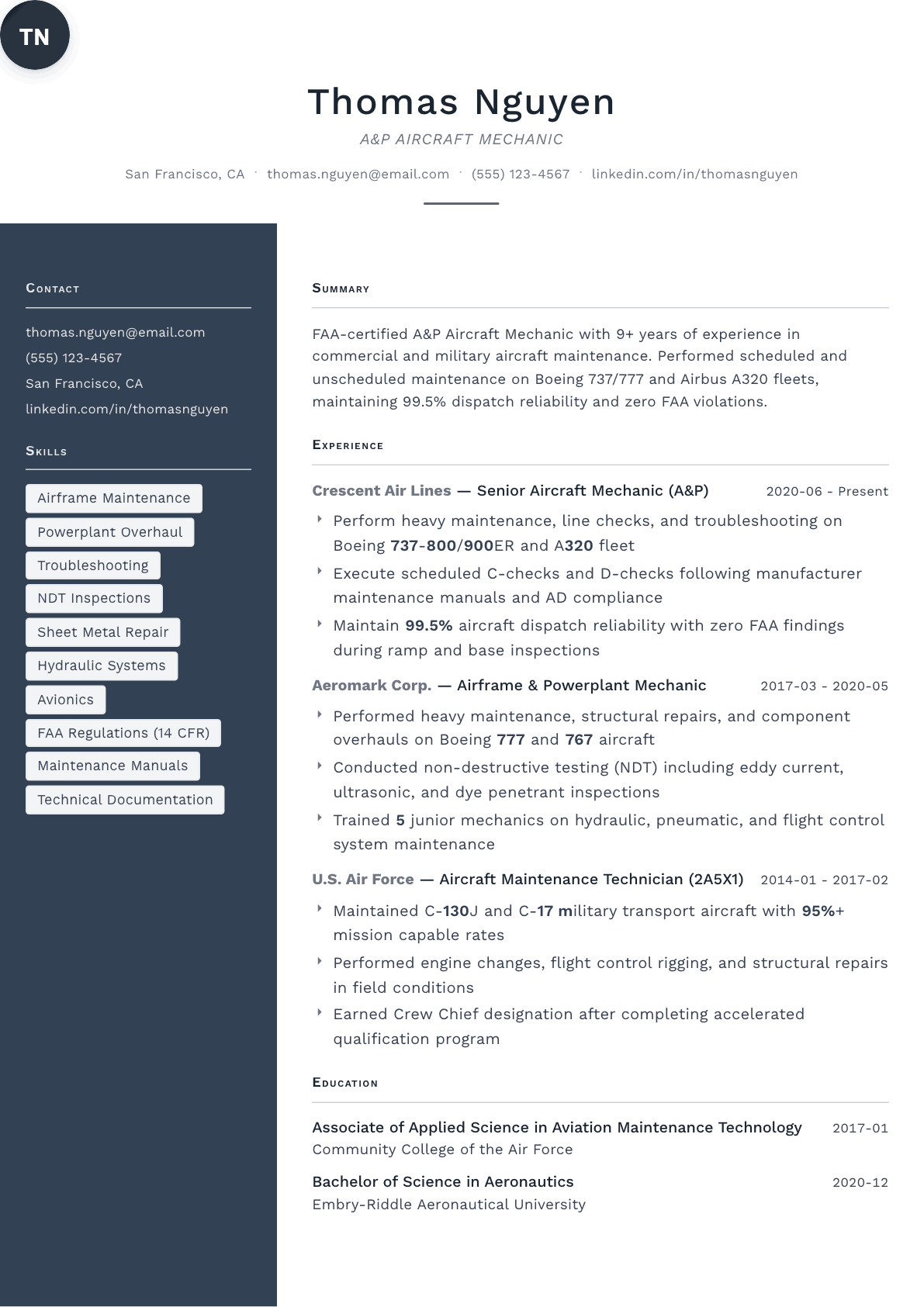
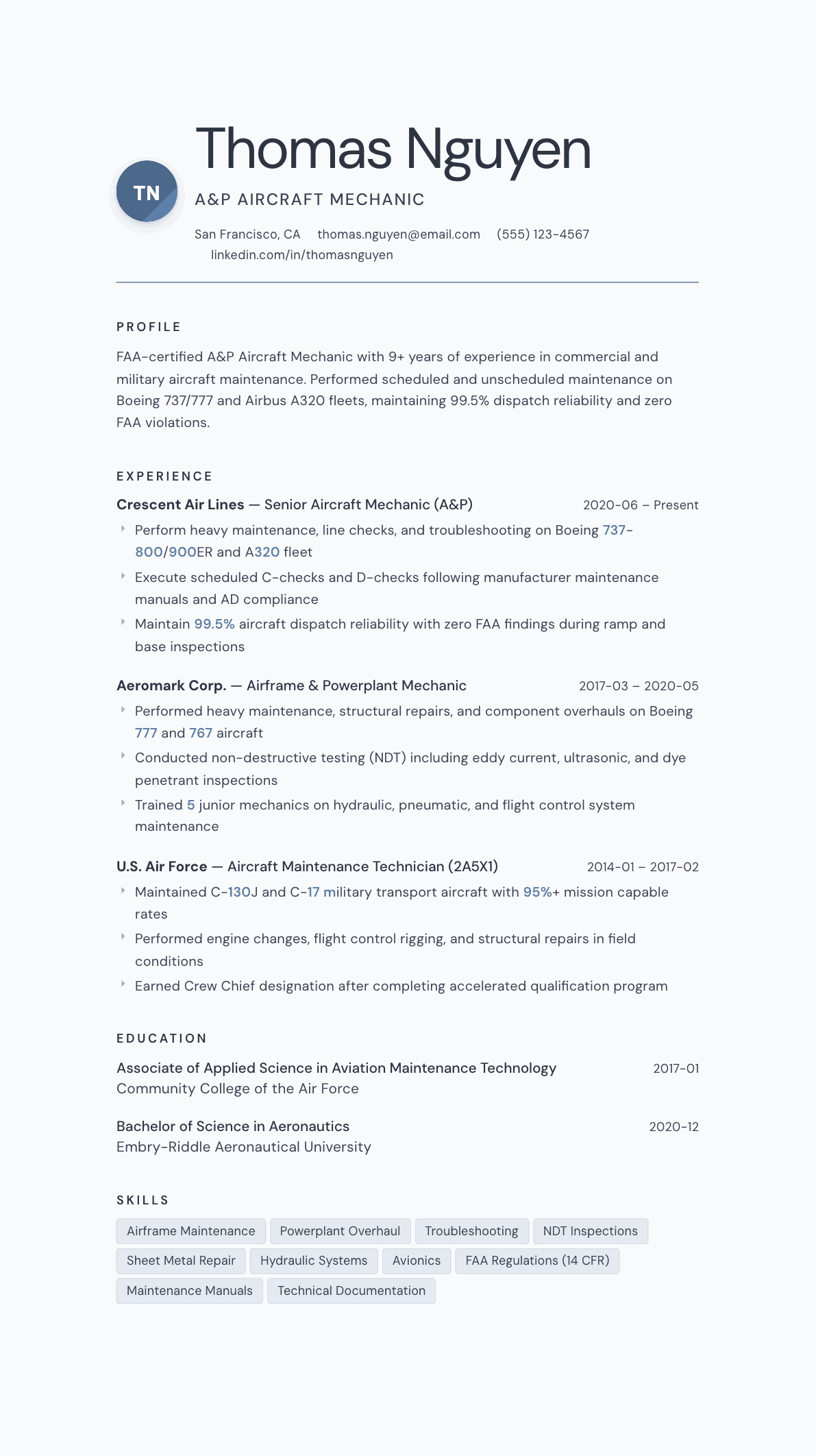
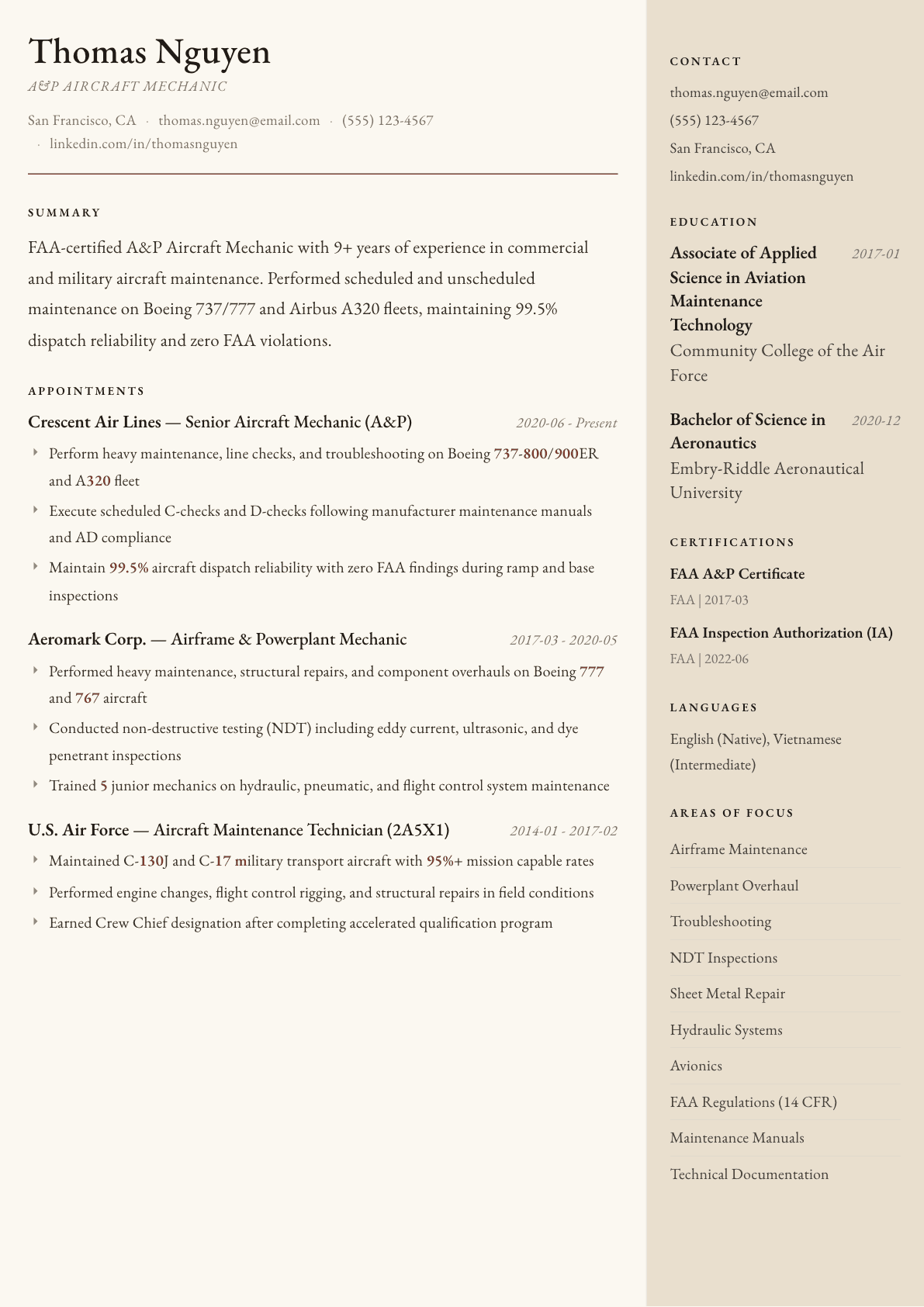
Example Aircraft Mechanic summary
FAA-certified A&P Aircraft Mechanic with 9 years of experience on Boeing and Airbus commercial fleets. Maintained 99.5% dispatch reliability with zero FAA violations. Seeking a lead mechanic or quality inspector role with a major airline or MRO.
Skills to list on a Aircraft Mechanic resume
- Airframe Maintenance
- Powerplant Systems
- Troubleshooting & Diagnostics
- NDT Inspection
- Sheet Metal Repair
- Hydraulic Systems
- Pneumatic Systems
- Avionics
- FAA Regulations (14 CFR)
- Maintenance Manual Compliance
- Engine Changes
- Composite Repair
- Technical Documentation
- Safety Management Systems
What actually gets this resume read
- List your FAA A&P certificate and any additional authorizations (IA, Repairman) at the top.
- Specify aircraft types you are experienced on: Boeing 737, 777, Airbus A320, regional jets, military.
- Highlight dispatch reliability rates and safety record with zero FAA violations.
- Include NDT qualifications: eddy current, ultrasonic, magnetic particle, dye penetrant.
- Mention military aviation experience as it transfers directly to commercial aviation roles.
- Show compliance with AD (Airworthiness Directives), service bulletins, and maintenance manuals.
How to write a aircraft mechanic resume
Aviation maintenance hiring is a compliance process wearing the clothes of a job application. Before anyone asks what you can fix, a human resources team verifies your Federal Aviation Administration certificate, and a maintenance manager checks whether your experience maps to the airframes on his line and whether your documentation habits will survive an audit. Both parts have to be visible on one page.
The reason documentation matters so much is that the mechanic signature is the legal record. A repair station or airline is buying your judgment and your logbook discipline together, and a resume that lists tasks without naming the manuals, the airworthiness directives and the sign-off authority you held is describing only half of the job.
This guide covers the certificate-first header aviation employers expect, how to present aircraft types and maintenance environments, three career-stage summaries, and the rewrites that show a hiring manager you can return an aircraft to service without creating a finding. Aviation mechanic, aircraft mechanic and A&P mechanic name the same job on a resume, so the examples here work under any of those titles; use the exact wording of the posting in your target line.
Format: certificates first, aircraft types second
The first block under your name is certificates. Airframe and Powerplant certificate with the number, any Inspection Authorization, repairman certificates tied to a specific repair station, and any airline transport or other pilot certificate if you hold one. Add relevant qualifications such as nondestructive testing levels, borescope, composite repair and run-up or taxi authorization.
Second block is aircraft and engine experience. List the specific types you have worked on and the engines that hang on them, because a narrow-body line station and a business jet completion center need different people. Vague phrasing like commercial and general aviation aircraft loses to a list of types with hours or years on each.
One page for most mechanics, two once you have a long type list, leadership or several maintenance environments. Plain single-column layout, since airline applicant systems often parse resumes into a profile before a human sees them.
Aviation mechanic resume sample, the top third written out for a line maintenance job: Daniel Ortiz, A&P Mechanic, Dallas, Texas. Certificates: FAA Airframe and Powerplant certificate, engine run and taxi qualified, borescope trained. Aircraft and engines: Boeing 737NG with CFM56, Embraer 175 with CF34. Summary: Line mechanic with five years on a night shift station, clearing deferred items, changing components between departures and making return to service entries under own certificate. The experience section then opens with the operator, the fleet, the shift and the crew size, as described below.
- Header: name, A&P certificate number, Inspection Authorization if held, city and state, phone, email.
- Section order: certificates, aircraft and engine types, experience, technical qualifications, training, education, security and background items.
- Recent graduates lead with the maintenance school, the program approval, project work and any internship or apprenticeship hours.
Summary: environment, aircraft, and the level you sign at
Name the maintenance environment first, because the work is completely different in each: line maintenance turning aircraft between flights, heavy checks in a hangar, component overhaul at a repair station, corporate and business aviation, rotorcraft, or a military maintenance unit. Then the aircraft types and the systems you specialize in.
Close with your authority. Whether you sign off your own work, hold an Inspection Authorization for annual inspections, act as a lead or crew chief, or perform required inspection item checks tells a manager exactly where you fit in his structure without an interview.
Experience: the tasks, the manuals, and the paperwork
Frame each job with the operator or repair station type, the fleet, the shift and the crew size. Then write bullets around actual maintenance: troubleshooting to a fault isolation manual, engine changes, landing gear removal and installation, flight control rigging, hydraulic and pneumatic system repair, avionics removal and installation, sheet metal and composite structural repair, borescope inspection and life-limited part tracking.
Attach the documentation to the work. Completing work cards, making logbook entries, complying with airworthiness directives and service bulletins, raising and closing nonroutine items, deferring items under the minimum equipment list, and returning aircraft to service. These sentences are the ones a maintenance manager reads twice, because they predict whether you generate findings during an audit.
If you have worked heavy checks, say which checks and what you owned inside them. If you have worked line, say the turn times, the number of departures your station handled and how often you cleared a defect before pushback rather than deferring it.
Safety and reliability: claim only what you can support
Say plainly if you have a clean record with no certificate action and no incidents attributable to your maintenance. That is a real and checkable statement. Avoid invented reliability figures; instead describe the outcomes you contributed to, such as reducing repeat defects on a system by rewriting a troubleshooting procedure, or clearing a recurring write-up that had been deferred repeatedly.
Participation in safety programs matters. Mention involvement in a safety management system, human factors training, tool control and foreign object debris programs, and any voluntary safety reporting program your employer runs, since those show a professional culture rather than only a skill set.
Training, security and the words the screener matches
List manufacturer and operator type training with the course and the provider, plus recurrent training, human factors, engine run and taxi qualification, and any nondestructive testing methods with the level held. Military maintenance experience translates directly, so give the airframes, the maintenance specialty and the level of authority rather than only the unit and rank.
Aviation employers screen for practical eligibility items too, so state your ability to obtain airport identification with a criminal history records check, a valid driver license, passport for international travel if relevant, and willingness to work rotating shifts. Mirror the posting vocabulary: airworthiness, return to service, work cards, nonroutine, minimum equipment list, service bulletin, life-limited parts and troubleshooting.
Aircraft Mechanic resume summary examples
Recent A&P graduate
Airframe and Powerplant certificate holder from a Part 147 school, with 1,900 program hours across sheet metal, powerplant and avionics labs and a piston engine overhaul project completed to manual specification. Seeking a line maintenance apprentice position on a narrow-body fleet.
Six years in
Aircraft mechanic with six years of line maintenance on Boeing 737 and Airbus A320 fleets, handling turn checks, deferred defect clearance, engine borescope inspections and component changes on a night shift. Signs off own work, qualified for engine run, and holds a clean certificate record.
Lead mechanic with Inspection Authorization
Lead mechanic and Inspection Authorization holder with fifteen years across heavy check and business aviation, supervising a crew of eight through C checks and completions. Performs required inspection items, manages airworthiness directive compliance and life-limited part tracking, and mentors new mechanics toward sign-off authority.
Work experience bullets: before and after
Before: Performed maintenance and repairs on aircraft.
After: Performed line maintenance on Boeing 737 and Airbus A320 aircraft, completing transit and daily checks, clearing deferred defects and changing components between departures on a station handling 40 turns a night.
Naming the fleet, the check types and the station volume shows a manager the tempo you already work at.
Before: Troubleshot aircraft systems and fixed problems.
After: Troubleshot hydraulic, pneumatic and electrical faults to the fault isolation manual, using built-in test equipment and wiring diagrams to isolate defects before removing components rather than swapping parts.
The method and the reference documents show diagnostic discipline, which is what separates a mechanic from a parts changer.
Before: Completed paperwork after maintenance tasks.
After: Documented all work on task cards and in the aircraft logbook, raised and closed nonroutine items, recorded airworthiness directive and service bulletin compliance and made return to service entries under my certificate.
Documentation stated in its real vocabulary tells an auditor-conscious manager you will not create findings.
Before: Worked on engines and did inspections.
After: Completed 12 engine changes and routine borescope inspections on CFM56 powerplants, tracking life-limited parts and coordinating with the powerplant shop on findings requiring removal.
Specific engine family, task counts and the coordination step demonstrate powerplant depth rather than exposure.
Before: Trained newer mechanics on the team.
After: Mentored four apprentice mechanics through their first year, walking each through work card discipline, tool control and manual research until they qualified to sign off their own tasks.
A mentee count and the specific habits taught turn a training claim into evidence of technical leadership.
Hard skills
- Airframe maintenance and structural repair
- Powerplant maintenance and engine changes
- Troubleshooting to fault isolation manuals
- Sheet metal and composite repair
- Hydraulic and pneumatic systems
- Avionics removal and installation
- Borescope inspection
- Nondestructive testing methods
- Airworthiness directive and service bulletin compliance
- Logbook entries and return to service
- Minimum equipment list deferrals
- Life-limited part tracking
Soft skills
- Documentation discipline
- Working to a departure deadline
- Shift handover communication
- Safety reporting culture
- Crew coordination
- Composure during aircraft on ground events
Certifications worth listing
- Airframe and Powerplant (A&P) Mechanic Certificate (Federal Aviation Administration)
- Inspection Authorization (IA) (Federal Aviation Administration)
- Repairman Certificate (Federal Aviation Administration)
- Nondestructive Testing Level I and II certification (American Society for Nondestructive Testing)
- Aircraft Electronics Technician (AET) (Aircraft Electronics Association)
Mistakes that cost aircraft mechanic candidates the interview
- Leaving the A&P certificate number off the resume, which stalls the file at the human resources verification step before a manager ever sees it.
- Writing worked on various aircraft instead of listing types and engines, which is the match criterion for every line and hangar posting.
- Omitting documentation work entirely, when logbook entries and airworthiness compliance are the legal core of the job.
- Claiming a dispatch reliability figure that belonged to the whole fleet rather than to anything you personally influenced.
- Presenting military maintenance only as unit and rank, so a civilian manager cannot see the airframes, specialty or sign-off level.
- Using a design template with columns and icons, which airline applicant systems frequently parse into an unreadable profile.
Aircraft Mechanic resume questions
Do I need an A&P certificate to apply for aircraft mechanic jobs?
For most positions that return aircraft to service, yes. Some repair stations hire uncertificated technicians to work under supervision, and manufacturers hire assembly technicians without one, so read the posting and apply where your status actually fits.
How do I list aircraft types on my resume?
Give a dedicated block with the airframes and the engines you have worked on, and add rough years or hours on each. A maintenance manager staffing a specific fleet reads that block before anything else on the page.
How should military aircraft maintenance experience be translated?
Convert unit language into civilian terms: name the airframes, the maintenance specialty, the systems you owned, your inspection authority and crew size supervised. Add any Joint Service certificate documentation that supports your civilian certificate eligibility.
Is an aviation mechanic resume different from an aircraft mechanic resume?
No. Employers use aviation mechanic, aircraft mechanic, aircraft maintenance technician and A&P mechanic for the same work, and the examples on this page fit all four. Copy the title the posting uses into your target line, keep the certificate number, any Inspection Authorization and your aircraft types near the top, and the screener will match you either way.
What do employers check besides the certificate?
Certificate action history, the ability to obtain airport identification with a background check, drug and alcohol program eligibility, a valid driver license and shift availability. Stating these plainly removes screening friction and moves your file forward faster.
Related resume examples
- Mechanic Resume example
- Diesel Mechanic Resume example
- Maintenance Technician Resume example
- Aircraft Maintenance Technician Resume example
- Elevator Technician Resume example
- Fleet Mechanic Resume example