Helicopter Pilot Resume Examples: the lines they read
Write a Helicopter Pilot Resume Built Around Mission and Turbine Time
By Mustafa Tarabya, founder of CVBooster · Published · Updated
Helicopter pilot resume example covering rotorcraft hours, turbine time, mission types, external load work, keywords and a full writing guide.
Sample resumes for a helicopter pilot
The same helicopter pilot content laid out in three CVBooster templates, so you can see what the finished document looks like before you write a word.
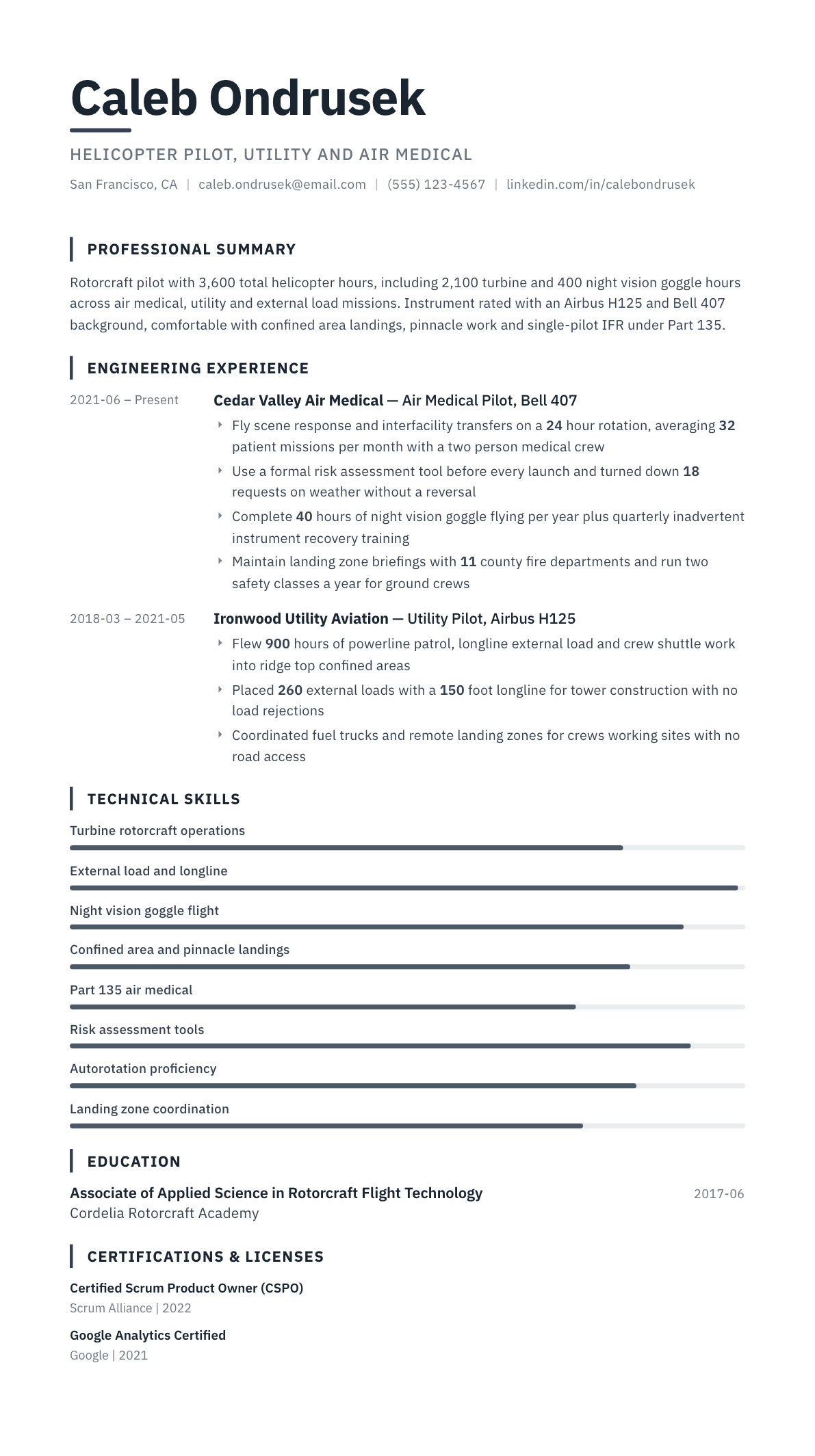
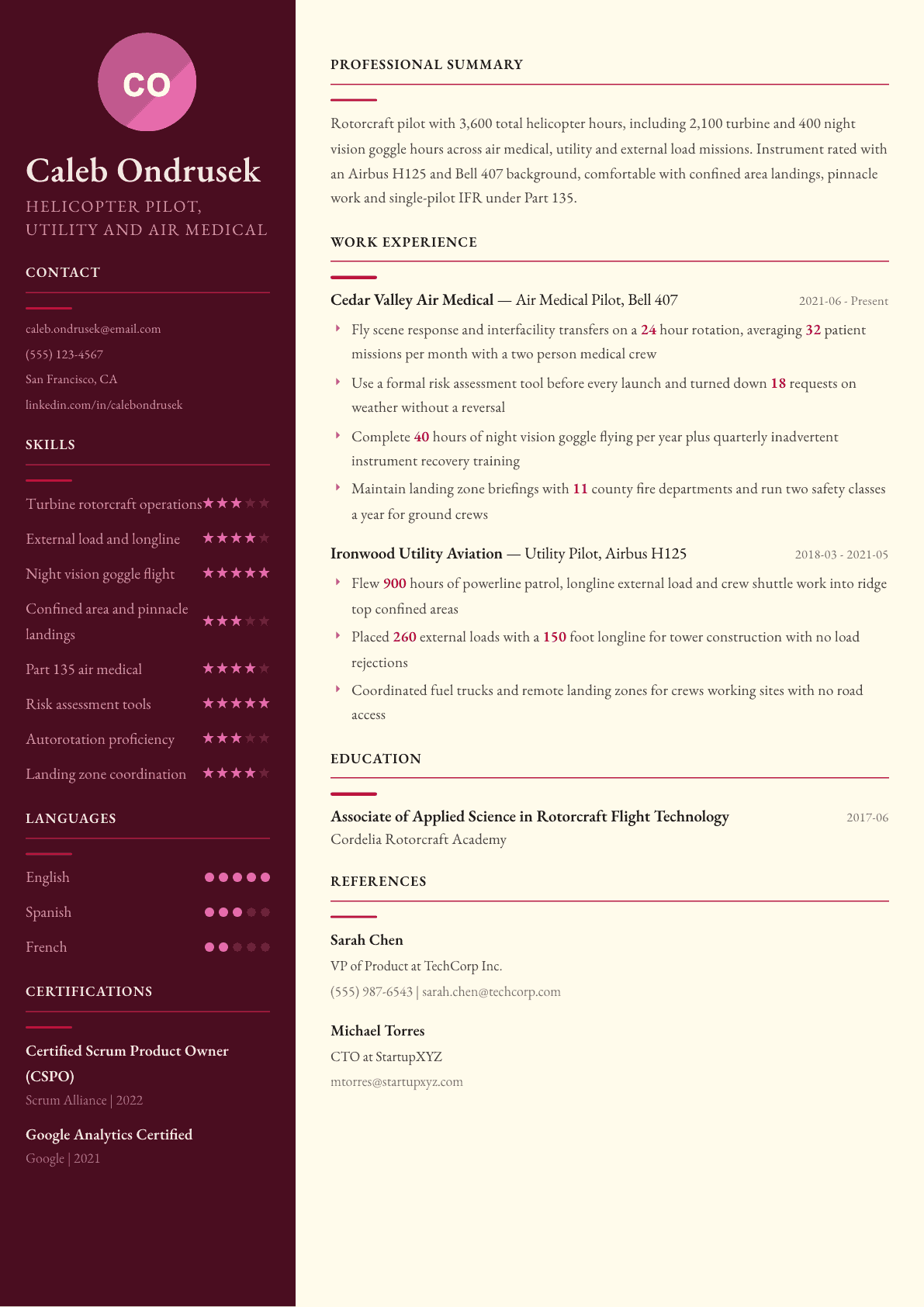
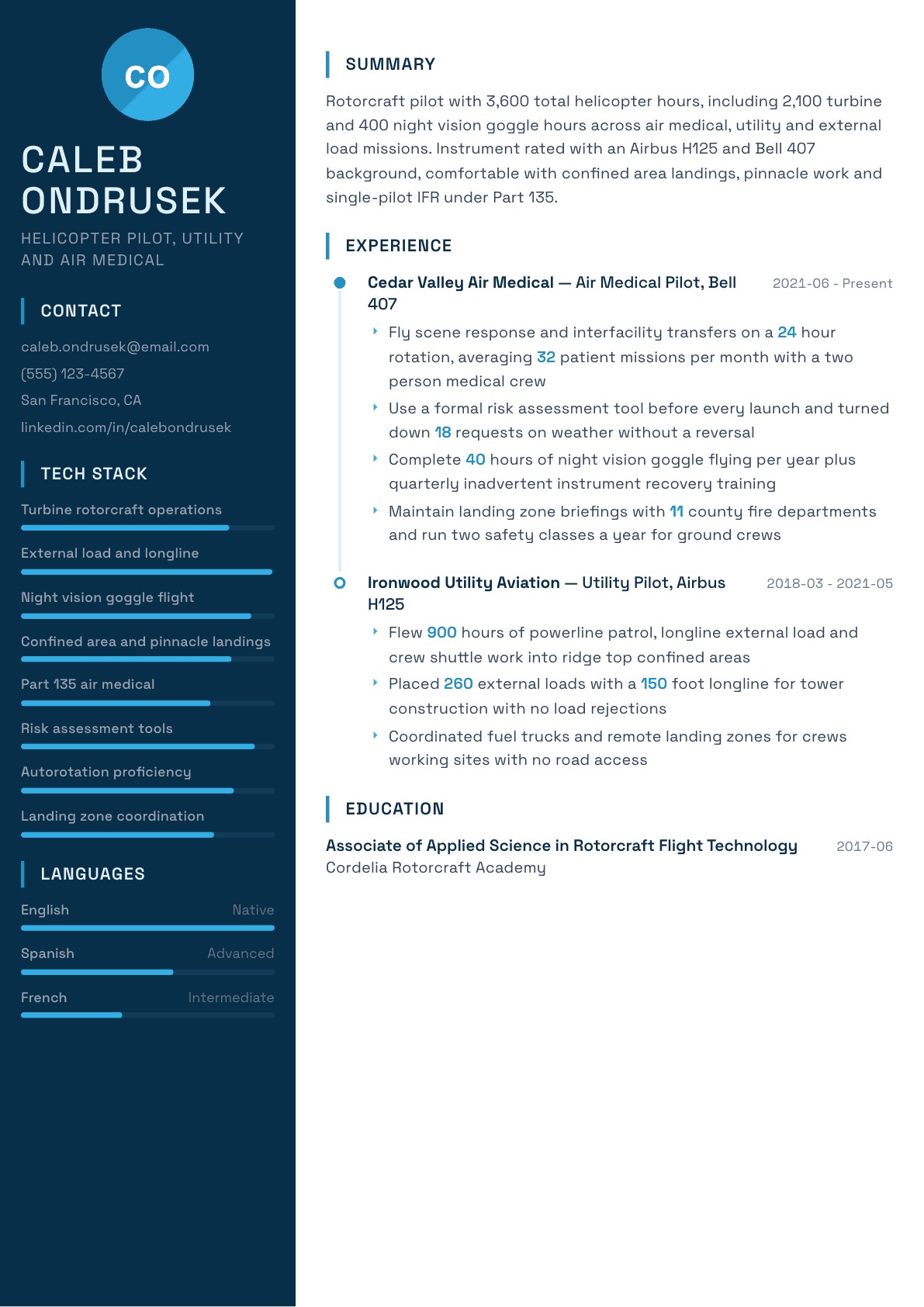
Example Helicopter Pilot summary
Helicopter pilot with 3,600 rotorcraft hours, 2,100 of them turbine, flying air medical and utility missions in mountainous terrain. Instrument rated on the Bell 407 and Airbus H125, current on night vision goggles, and experienced with longline external loads into confined ridge top sites. Turns down flights on a documented risk tool and runs landing zone safety training for county fire crews.
Skills to list on a Helicopter Pilot resume
- Turbine helicopter operations
- Longline external load
- Night vision goggle flight
- Confined area landings
- Pinnacle and ridge operations
- Air medical missions
- Inadvertent instrument recovery
- Autorotation proficiency
- Landing zone briefing
- Weight and balance for sling loads
- Risk assessment and go or no go decisions
- Powerline patrol
- Bell 407 systems
- Airbus H125 systems
What actually gets this resume read
- Break rotorcraft hours out by total, turbine, pilot in command, night, night vision goggle and instrument time.
- List every helicopter you have flown by model, because operators hire against a specific airframe and hour minimum.
- Name the mission type for each job: air medical, utility, tour, firefighting, law enforcement or offshore.
- Quantify external load work with the line length, the load count and the kind of site you were placing into.
- Include your last recurrent, your instrument proficiency check and the risk assessment tool your operator uses.
- Keep unrelated fixed wing time in a single line so it does not crowd out the rotorcraft hours a chief pilot needs.
How to write a helicopter pilot resume
Rotorcraft hiring is airframe specific and mission specific in a way that fixed wing hiring is not. An air medical program advertises a turbine minimum, a night vision goggle minimum and an instrument requirement. A utility operator wants longline hours and confined area work. A tour company wants hours in the model it flies and a customer facing manner. The same helicopter pilot resume will clear one of those and fail the others unless the hours are broken out so a chief pilot can find his own minimums.
The second thing a chief pilot reads is how you decide. Rotorcraft flying is full of moments where the safe answer is to shut down on a ridge and wait, and operators have learned to look for pilots who can point at flights they turned down. A resume that shows only completed missions reads as a pilot who has never said no.
This guide covers the rotorcraft hour breakdown, how to write experience for air medical, utility, tour and law enforcement work, what to do with fixed wing time, which credentials to list, and the questions that come up when a pilot moves between mission types.
Format: hours block first, mission history second
Use a plain one column layout. Header, rotorcraft flight time block, aircraft flown with hours in type, experience, training and checks, education. One page up to roughly three thousand hours, two after that if type and training detail justifies it.
Aircraft flown deserves its own short block rather than being scattered through the experience section. A chief pilot filling a Bell 407 seat wants to see the model and the hours in it without reading three jobs to add them up.
- Header: name, location, phone, email, certificate level with rotorcraft category, instrument rating, medical class and issue month.
- Hours block: total rotorcraft, turbine, pilot in command, turbine pilot in command, night, night unaided, night vision goggle, instrument, actual instrument, external load.
- Fixed wing time gets one summary line so it does not dilute the rotorcraft figures.
Experience: name the mission, the terrain and the landing area
Lead each job with the operator, the position, the model and the mission: air medical, utility and external load, powerline patrol, firefighting, tour, offshore, law enforcement or corporate. Then say where the flying happened, because a helicopter pilot who works ridge tops and unimproved landing zones is a different candidate from one who works between prepared helipads.
The bullets should be about landing areas and decisions. How many scene responses a month, into what kind of zones, with what obstruction environment. Whether you were flying single pilot with a medical crew, or with a second pilot and a crew chief. Whether you were placing loads on a longline and how long the line was. Whether you were flying at night on goggles and how many hours a year of that you hold.
Include the flights you declined. Turn down counts, weather aborts and the risk assessment tool your operator uses are among the strongest bullets a rotorcraft resume can carry, because every program has lost aircraft to pressure and every chief pilot knows it.
- Give external load work a line length, a load count and the type of site: tower construction, ski lift, fire rebuild, seismic.
- Give air medical work a mission count, a crew composition and the number of receiving facilities you land at.
- Give tour and offshore work a passenger count, a route length and the weather envelope you operate in.
Training, currency and the checks that matter
List your last recurrent training, the provider, and whether it was in aircraft or simulator. Add the date of your instrument proficiency check, your night vision goggle currency, and your last inadvertent instrument recovery training. Programs that fly at night in poor visibility treat these as the difference between a candidate and a hire.
Autorotation proficiency, hoist qualification, water ditching training and human external cargo authorization are worth a line each if you hold them. Say where the training was done, because the provider name tells a reader what standard was applied.
Skills, keywords and moving between mission types
Job postings for rotorcraft repeat a tight vocabulary: turbine pilot in command, night vision goggle, external load, confined area, pinnacle, single pilot instrument flight rules, inadvertent instrument conditions, risk assessment, landing zone coordination. Use the terms that are honestly yours, once in the skills block and once in a bullet where the flying proves them.
When you change mission types, name the transfer explicitly. A utility pilot moving to air medical should point at the confined area work, the mountain weather judgment and the ground crew coordination, then be honest that patient transport protocols will be new. A chief pilot respects a candidate who maps his own gap better than one who hopes it goes unnoticed.
Helicopter Pilot resume summary examples
Low time instructor
Helicopter pilot with 620 total rotorcraft hours, 480 of them dual given as a flight instructor in the Robinson R22 and R44. Commercial certificate with rotorcraft and instrument ratings, second class medical current, and seeking a turbine transition seat in tour or utility operations.
Turbine and mission qualified
Helicopter pilot with 3,600 rotorcraft hours, 2,100 turbine and 400 on night vision goggles, flying air medical and utility work in mountain terrain. Instrument rated on the Bell 407 and Airbus H125, current on inadvertent instrument recovery, and experienced with longline external loads into confined ridge sites.
Lead pilot
Lead helicopter pilot with 7,800 rotorcraft hours across air medical, utility and firefighting, including six years running base operations for a twin engine instrument program. Holds hoist and human external cargo authorization, writes the base risk assessment policy, and trains new pilots through area orientation.
Work experience bullets: before and after
Before: Flew air medical missions for a hospital program.
After: Flew scene response and interfacility transfers on a 24 hour rotation in the Bell 407, averaging 32 patient missions a month with a two person medical crew.
The rotation, the airframe, the mission count and the crew size describe the actual working day.
Before: Used good judgment about weather.
After: Applied the program risk assessment tool before every launch and declined 18 requests on weather over the year with no request reversal after a decline.
A turn down count with no reversals is verifiable evidence of authority and self discipline.
Before: Performed external load operations.
After: Placed 260 external loads on a 150 foot longline for tower construction into ridge top sites with no load rejection and no line strike.
Line length, load count and site type let a utility chief pilot judge precision work directly.
Before: Worked with ground crews and fire departments.
After: Ran landing zone briefings with 11 county fire departments and taught two ground safety classes a year covering rotor clearance and approach lanes.
The department count and the training content prove ongoing outreach rather than incidental contact.
Before: Kept night flying currency.
After: Completed 40 hours of night vision goggle flying a year plus quarterly inadvertent instrument recovery training in the simulator with the program instructor.
Naming the annual hours and the recurring recovery training shows currency that a program can verify.
Hard skills
- Turbine rotorcraft operations
- Longline external load placement
- Night vision goggle flight
- Confined area and pinnacle landings
- Inadvertent instrument condition recovery
- Single pilot instrument flight rules
- Autorotation proficiency
- Sling load weight and balance
- Landing zone selection and briefing
- Powerline and pipeline patrol technique
- High density altitude power management
- Bell 407 and Airbus H125 systems
Soft skills
- Go or no go decision discipline
- Crew coordination with medical teams
- Calm handling of scene pressure
- Ground crew communication
- Mentoring low time pilots
- Clear post flight debriefing
Certifications worth listing
- Commercial Pilot Certificate, Rotorcraft Helicopter (Federal Aviation Administration)
- Instrument Rating, Helicopter (Federal Aviation Administration)
- Certified Flight Instructor, Rotorcraft Helicopter (Federal Aviation Administration)
- Airline Transport Pilot Certificate, Rotorcraft Helicopter (Federal Aviation Administration)
- Second Class Medical Certificate (Federal Aviation Administration)
Mistakes that cost helicopter pilot candidates the interview
- Reporting one total time figure with no turbine, night or external load split, which forces a chief pilot to guess whether you meet his minimums.
- Burying the aircraft models inside job descriptions when the whole hiring decision starts with hours in type.
- Letting fixed wing hours dominate the page on a rotorcraft application.
- Writing only completed missions and never a decline, which reads as a pilot who has not exercised authority.
- Skipping night vision goggle currency and inadvertent instrument recovery dates on an application to a night program.
- Describing the helicopter rather than the landing environment, when confined area and pinnacle work is the real skill being bought.
- Leaving out the risk assessment tool and the safety reporting system, both of which every serious operator asks about in the interview.
Helicopter Pilot resume questions
How do I break out helicopter flight hours on a resume?
Give total rotorcraft, turbine, pilot in command, turbine pilot in command, night, night vision goggle, instrument, actual instrument and external load as separate lines. Operators publish minimums against those exact categories, so a merged total makes you unscoreable.
How much does time in type matter for a helicopter job?
It matters enormously, because insurance underwriters set the minimums an operator must meet. List every model you have flown with the hours beside it, and note any factory or training provider course you completed on that airframe even if the hours are modest.
I am a flight instructor in piston helicopters. How do I get considered for turbine work?
Lead with dual given, the ratings your students earned, and any mountain, confined area or external load instruction you delivered. Then state clearly that you are seeking a turbine transition and list any factory ground school or simulator time you have paid for yourself.
Should I list flights I turned down?
Yes. Give a turn down count for the year and name the risk assessment tool your program uses. Air medical and utility operators treat documented weather declines as evidence that a pilot will hold the line when a mission is urgent.
Do military rotorcraft hours transfer to a civilian resume?
They do, once translated. Give the airframe, the seat, the mission and the hours in civilian categories, convert instructor pilot and standardization roles into their nearest civilian equivalents, and state which civilian certificates and ratings you hold today.
Related resume examples
- Pilot Resume example
- Commercial Pilot Resume example
- Aircraft Mechanic Resume example
- Flight Instructor Resume example
- Harbor Pilot Resume example
- Airline Pilot Resume example