Commercial Pilot Resume Examples: the lines they read
Write a Commercial Pilot Resume That Gets You to the Interview Board
By Mustafa Tarabya, founder of CVBooster · Published · Updated
Commercial pilot resume examples with a flight time table, ratings, type experience, keywords and a full writing guide for charter and corporate roles.
Sample resumes for a commercial pilot
The same commercial pilot content laid out in three CVBooster templates, so you can see what the finished document looks like before you write a word.
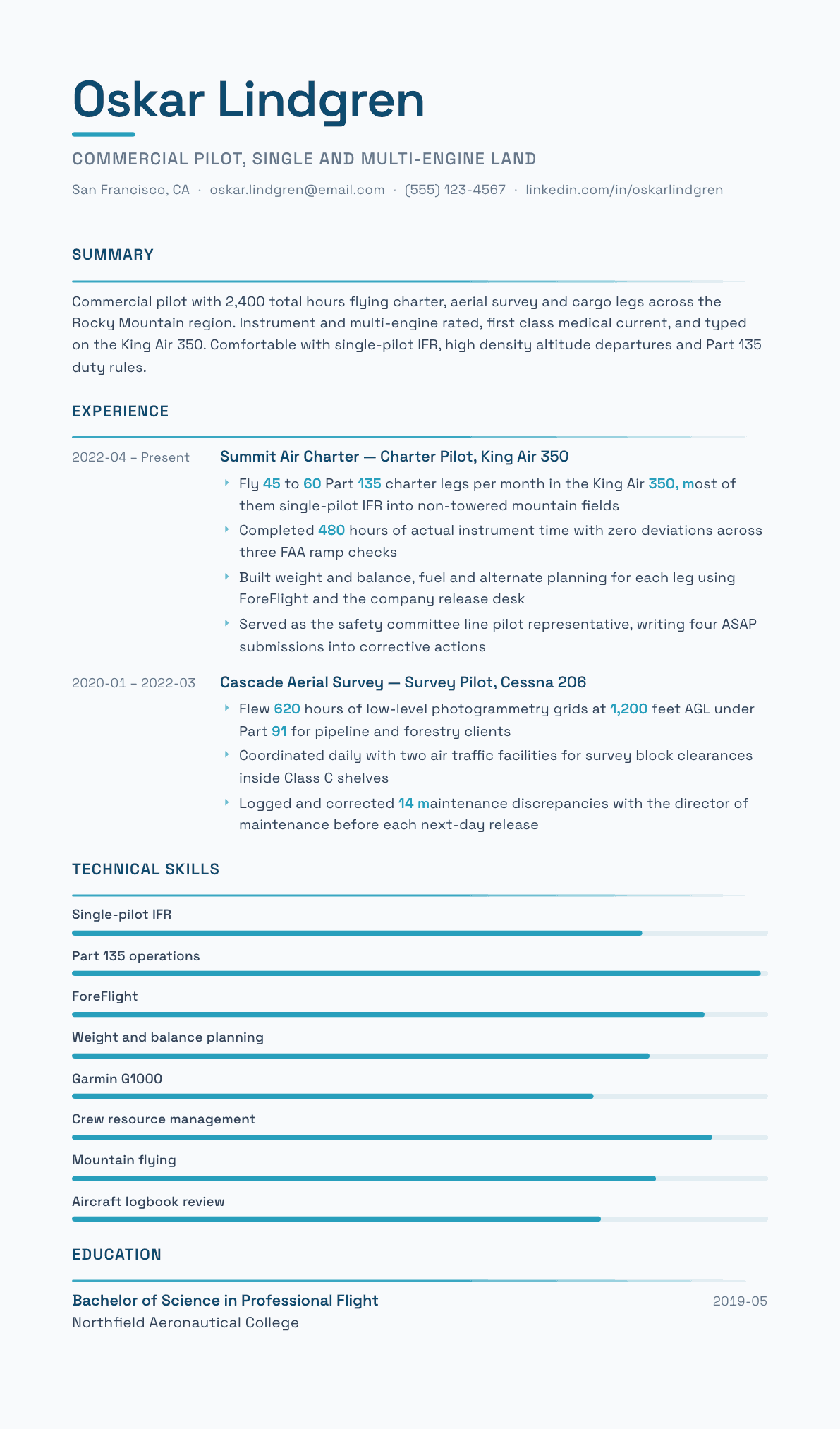
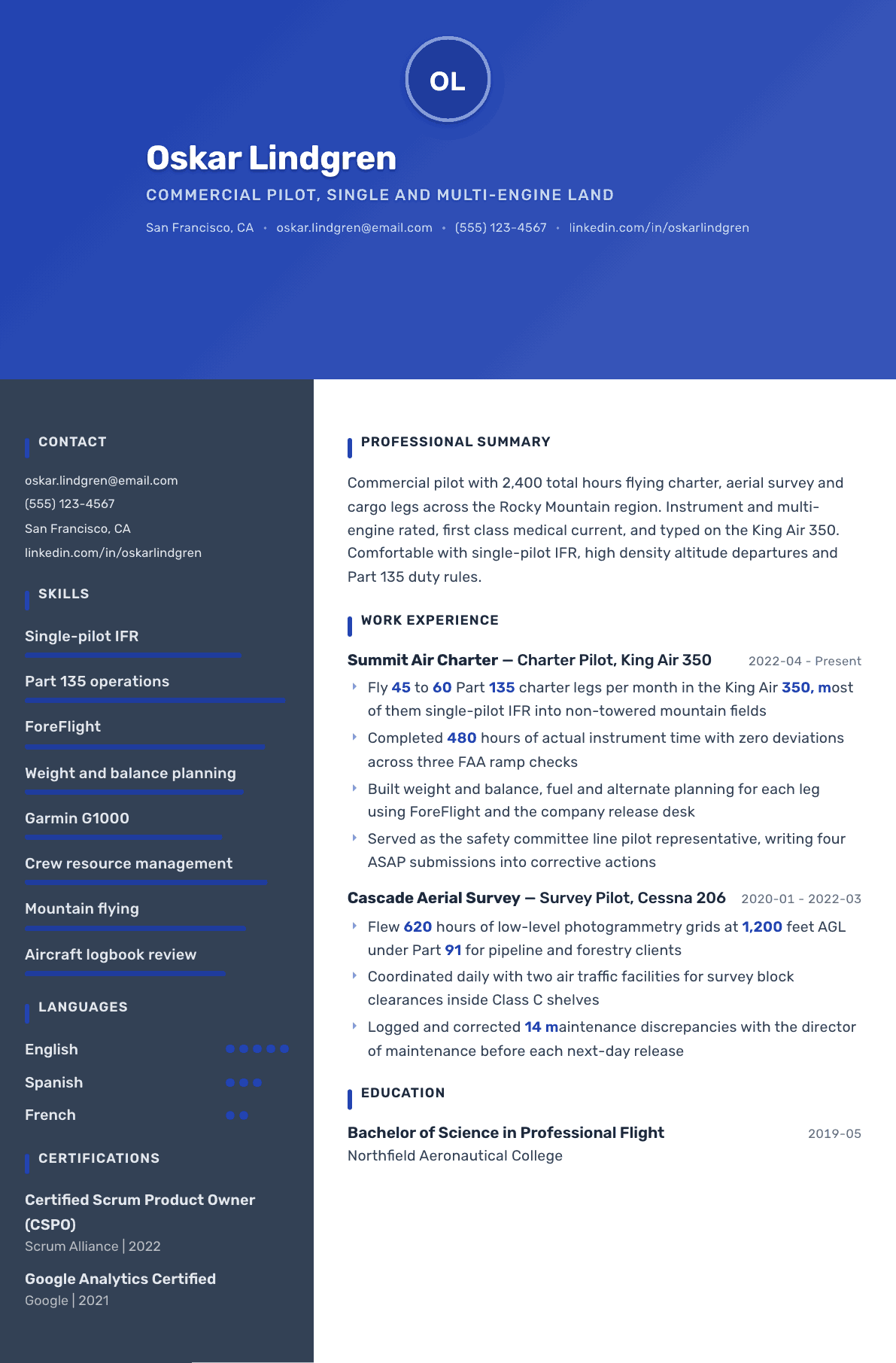
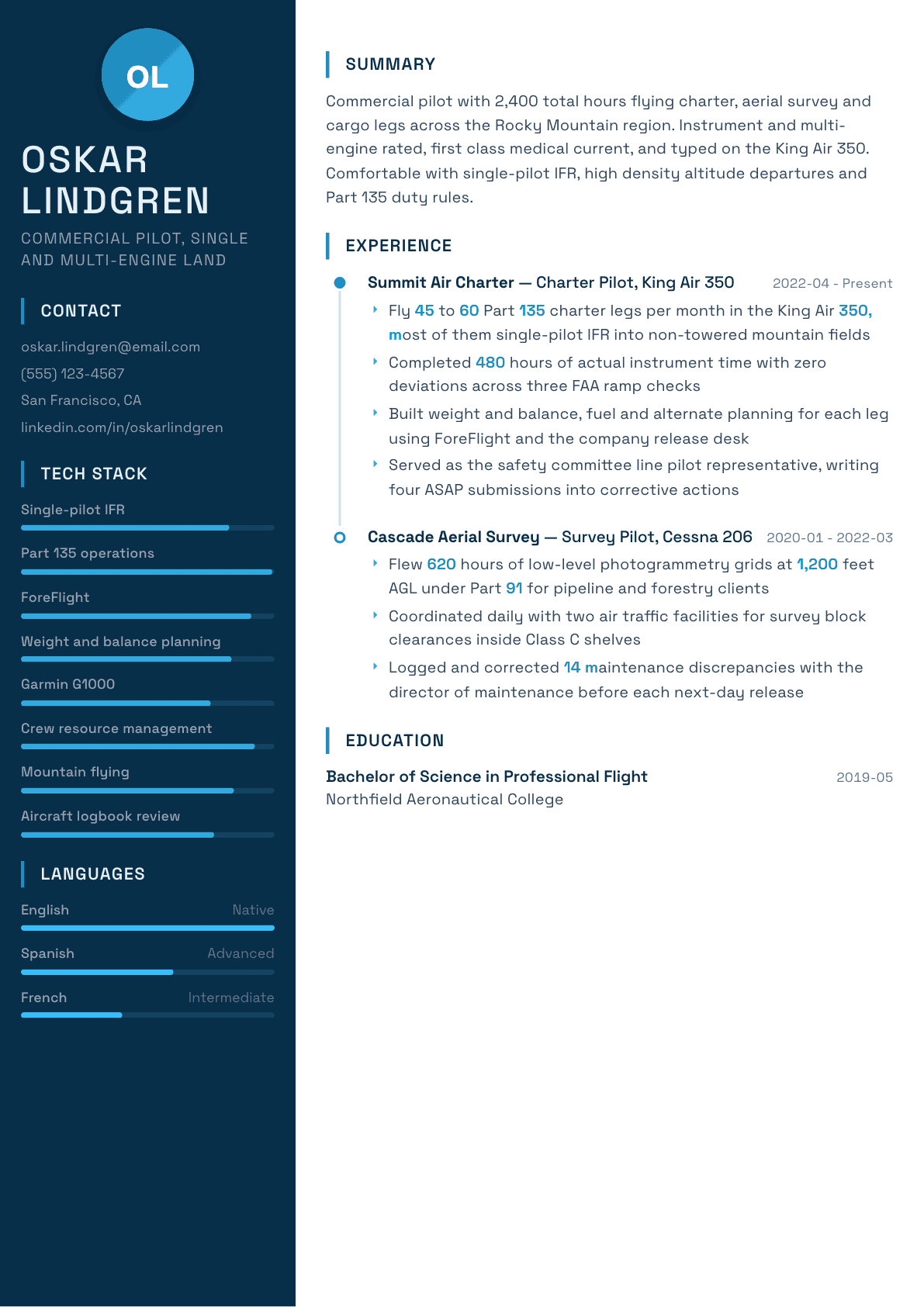
Example Commercial Pilot summary
Commercial pilot with 2,400 total hours and 900 hours pilot in command of turbine equipment, flying charter and aerial survey work in high terrain. Instrument, multi-engine and King Air 350 typed, with a current first class medical and a clean checkride record. Known for disciplined single-pilot IFR technique and for writing safety reports that turned into procedure changes.
Skills to list on a Commercial Pilot resume
- Instrument flight rules
- Multi-engine operations
- Part 135 charter
- Turbine aircraft handling
- Flight planning and dispatch release
- Weight and balance
- ForeFlight
- Garmin G1000 avionics
- Crew resource management
- Aeronautical decision making
- Duty and rest compliance
- Weather interpretation
- Radio communication
- Aircraft logbook review
What actually gets this resume read
- Open with a flight time table: total, pilot in command, multi-engine, turbine, instrument, night and cross country hours.
- List every certificate and rating in FAA wording, then the medical class and the date it was issued.
- Name each aircraft you have flown by make and model, with the hours you hold in type beside it.
- State the operating rule for every job, because Part 91, Part 135 and Part 121 experience are read very differently.
- Show checkride and training history: initial, recurrent, and any type rating, with the training provider named.
- Keep the resume to one page until you pass about 3,000 hours, then a second page for type and training detail.
How to write a commercial pilot resume
A commercial pilot resume is scored, not read. Whoever opens it is looking for four things in the first ten seconds: total time, pilot in command time, turbine or multi-engine time, and whether your certificates and medical are current. If those numbers are buried inside paragraphs, the file goes to the bottom of the pile even when the hours behind it are excellent.
The second reader is a chief pilot. He wants to know what kind of flying you have actually done. Single-pilot IFR into an unlit strip at night is a different job from right seat time in a two crew turboprop on a scheduled route, and both are called commercial flying. Name the operating rule, the mission and the terrain in every entry, because that is the part a chief pilot uses to guess how you will handle his airplanes.
This guide covers the flight time table, the certificates block, how to write experience for charter, survey, cargo and corporate work, which credentials belong on the page, and the questions pilots ask most when they sit down to build the file.
Format: one page, flight times near the top
Use a single column, reverse chronological layout with no icons and no graphics. Many operators run resumes through an applicant tracking system before a human sees them, and a two column layout scrambles the hour figures that matter most.
The order that works: header with certificates and medical, flight time table, experience, education, training and certifications, then additional qualifications. Keep it to one page until roughly three thousand hours, then allow a second page for type ratings and training history.
- Header: name, city and state, phone, email, certificate level, ratings, medical class and issue month.
- Flight time table: total, pilot in command, second in command, multi-engine, turbine, turbine PIC, instrument, actual instrument, night, cross country.
- Round times down to the logbook figure. An operator will ask for logbook pages and the numbers must match.
The flight time table is the resume
Build the table as plain labeled rows or a simple grid, not a chart. Every hiring minimum an operator publishes maps to one of these rows, so the reader is checking your figures against a list. If a row is zero, leave it out rather than writing a zero that draws the eye.
Put a currency line under the table: date of last flight review or proficiency check, date of last instrument proficiency check, and whether you are current for night and instrument approaches. A pilot who is current is available next month, and that is worth stating.
Experience: operating rule, equipment, mission, terrain
Give every job a header line that reads like an operations specification: employer, position, aircraft make and model, and the rule you flew under. A reader who sees charter pilot on a King Air under Part 135 already knows your duty limits, your training footprint and your dispatch environment before reading a single bullet.
Then three to five bullets that only a person in that job could write. Say how many legs a month, into what kind of fields, with what weather. Say whether you flew single pilot or with a crew. Say what you owned besides the controls: fuel and alternate planning, weight and balance, the release decision, customer handling, maintenance write ups with the director of maintenance.
Avoid bullets that describe piloting in general. Safely operated aircraft in accordance with regulations is true of everyone who still holds a certificate, and it eats the line a real detail needed.
- Name the airspace and terrain: mountain fields, coastal fog, Class B transitions, unimproved strips, high density altitude departures.
- Name the tools: ForeFlight, Garmin G1000 or Pro Line avionics, the release desk, the risk assessment matrix.
- Name the outcomes: ramp checks passed, on time completion rate, safety reports that became procedure changes.
Certificates, ratings and training history
List certificates in the order the FAA writes them: commercial pilot with airplane single engine land, airplane multi-engine land and instrument airplane, then any type ratings, then the flight instructor certificates if you hold them. Add the medical class and the month it was issued, since a first class medical that has aged into second class privileges is a detail an operator checks.
Training history matters more than most applicants realize. Name where you did initial and recurrent training, the simulator or aircraft used, and the date. If you failed a checkride, state it plainly with what you did afterward. The records request will surface it, and an unexplained gap reads worse than an honest line.
Keywords a screener filters on
Operator postings reuse the same phrases: pilot in command, turbine, multi-engine land, instrument rated, first class medical, single pilot IFR, Part 135, crew resource management, type rating, and the specific airframe. Use the exact wording once in the header or the skills line and once inside a bullet where it is proven by context.
Do not build a keyword block. A chief pilot reads the file immediately after the software does, and a wall of terms with no flying behind it reads as padding.
Commercial Pilot resume summary examples
Freshly commercial
Commercial pilot with 320 total hours, 45 multi-engine and 60 instrument, holding single engine land, multi-engine land and instrument airplane ratings with a current first class medical. Built time as a flight instructor through 2024 and seeking a right seat position in turboprop cargo or charter.
Two thousand hours in
Commercial pilot with 2,400 total and 900 turbine pilot in command hours flying Part 135 charter and aerial survey in mountain terrain. King Air 350 typed, single pilot IFR current, and clean across three FAA ramp checks. Looking for a corporate flight department seat with a structured training footprint.
Chief pilot track
Commercial pilot with 5,800 total hours, 3,400 as pilot in command of turbine equipment, plus four years as a Part 135 check airman running initial and recurrent training. Experienced with operations specifications, training records and FAA principal inspector relationships across two certificate renewals.
Work experience bullets: before and after
Before: Flew charter flights for a Part 135 operator.
After: Flew 45 to 60 Part 135 charter legs a month in the King Air 350, most of them single pilot IFR into non towered mountain fields with published circling minimums.
The leg count, the airframe and the single pilot IFR detail tell a chief pilot exactly what workload you carry.
Before: Responsible for preflight planning and fuel calculations.
After: Built weight and balance, fuel and alternate planning for every leg in ForeFlight, then reconciled the numbers with the release desk before each departure.
Naming the tool and the reconciliation step shows a repeatable process rather than a task on a checklist.
Before: Maintained a good safety record.
After: Completed 480 hours of actual instrument time with no altitude or course deviations across three FAA ramp checks during the same period.
A safety record only counts when it is attached to a measurable exposure and an outside check.
Before: Participated in company safety program.
After: Served as the line pilot representative on the safety committee and wrote four aviation safety action reports that became changes to the icing and runway contamination procedure.
The specific role and the outcome show judgment beyond the cockpit, which is what separates a captain candidate.
Before: Flew survey missions in a Cessna 206.
After: Flew 620 hours of low level photogrammetry grids at 1,200 feet above ground for pipeline and forestry clients, coordinating block clearances with two air traffic facilities.
Altitude, hours and the coordination detail turn a generic mission line into evidence of precision flying.
Hard skills
- Single pilot instrument flight rules
- Multi-engine land operations
- Turbine aircraft handling
- Part 135 and Part 91 operations
- Weight and balance computation
- Fuel and alternate planning
- ForeFlight flight planning
- Garmin G1000 avionics
- High density altitude departures
- Aircraft logbook and discrepancy review
- Weather and icing interpretation
- Duty and rest rule compliance
Soft skills
- Aeronautical decision making
- Crew resource management
- Customer handling on charter
- Calm workload prioritization
- Clear radio phraseology
- Written safety reporting
Certifications worth listing
- Commercial Pilot Certificate (Federal Aviation Administration)
- Instrument Rating, Airplane (Federal Aviation Administration)
- Multi-Engine Land Rating (Federal Aviation Administration)
- Certified Flight Instructor (Federal Aviation Administration)
- First Class Medical Certificate (Federal Aviation Administration)
- Airline Transport Pilot Certificate (Federal Aviation Administration)
Mistakes that cost commercial pilot candidates the interview
- Hiding the flight time table below the experience section, so a screener has to hunt for the only numbers that gate the application.
- Rounding hours up to hit an advertised minimum. Logbook pages get audited and the correction ends the process.
- Writing the same three bullets for every flying job when the missions were completely different.
- Leaving out the operating rule, so a reader cannot tell whether the time is instructional, private carriage or common carriage.
- Omitting a failed checkride that the pilot records request will show anyway.
- Using a designed two column template with aviation clip art, which scrambles the hour figures in most parsers.
- Listing every airport visited instead of the terrain, weather and equipment that made the flying demanding.
Commercial Pilot resume questions
How many hours do I need before a commercial resume is worth sending?
Send it as soon as you hold the certificate. Operators hire at wildly different minimums, and instructors, banner tow pilots and survey pilots all build time somewhere. Apply with the honest table and a clear statement of the flying you want next.
Should the flight time table go on the resume or only in the application?
Both. The online application asks for a detailed breakdown, but the resume needs its own table because that is the document a chief pilot forwards to a hiring committee, often without the application attached.
How do I present flight instructing time on a commercial pilot resume?
Treat it as real flying employment with a position line and bullets. Give the student count, the certificates and ratings your students earned, the pass rate on practical tests, and any complex, tailwheel or multi-engine instruction you gave.
Do I list type ratings if I have no recent time in the aircraft?
Yes, list the type rating and be honest about currency by adding the hours in type and the date of your last flight in it. A dormant type rating is still evidence you passed a checkride to airline transport pilot standards.
What should a commercial pilot put in the education section?
A degree if you hold one, with the major and the school, plus any collegiate flight program and the restricted airline transport pilot privileges it granted. If you trained at a Part 141 or Part 61 school instead, name the school and the certificates completed there.
Related resume examples
- Pilot Resume example
- Airline Pilot Resume example
- Flight Attendant Resume example
- Aircraft Mechanic Resume example
- Flight Instructor Resume example
- Helicopter Pilot Resume example