Video Editor Resume Examples: free ATS score and gap list
Video Editor Resume: Video Editing Resume Examples That Make the Cut
By Mustafa Tarabya, founder of CVBooster · Published · Updated
Video editing resume examples for assistant, staff and series editors: credit-led format, freelance and in-house versions, and bullets that show judgment.
Sample resumes for a video editor
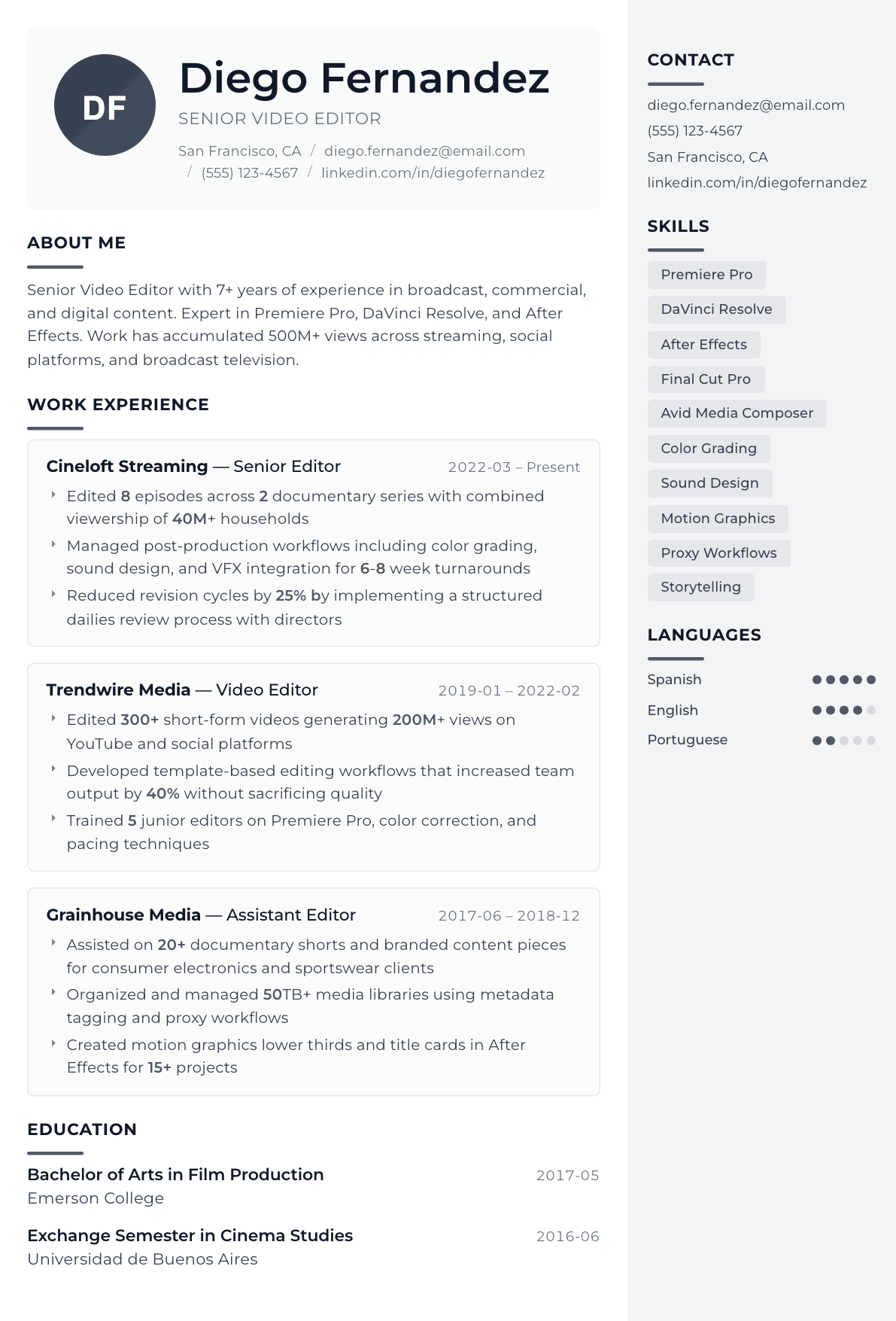
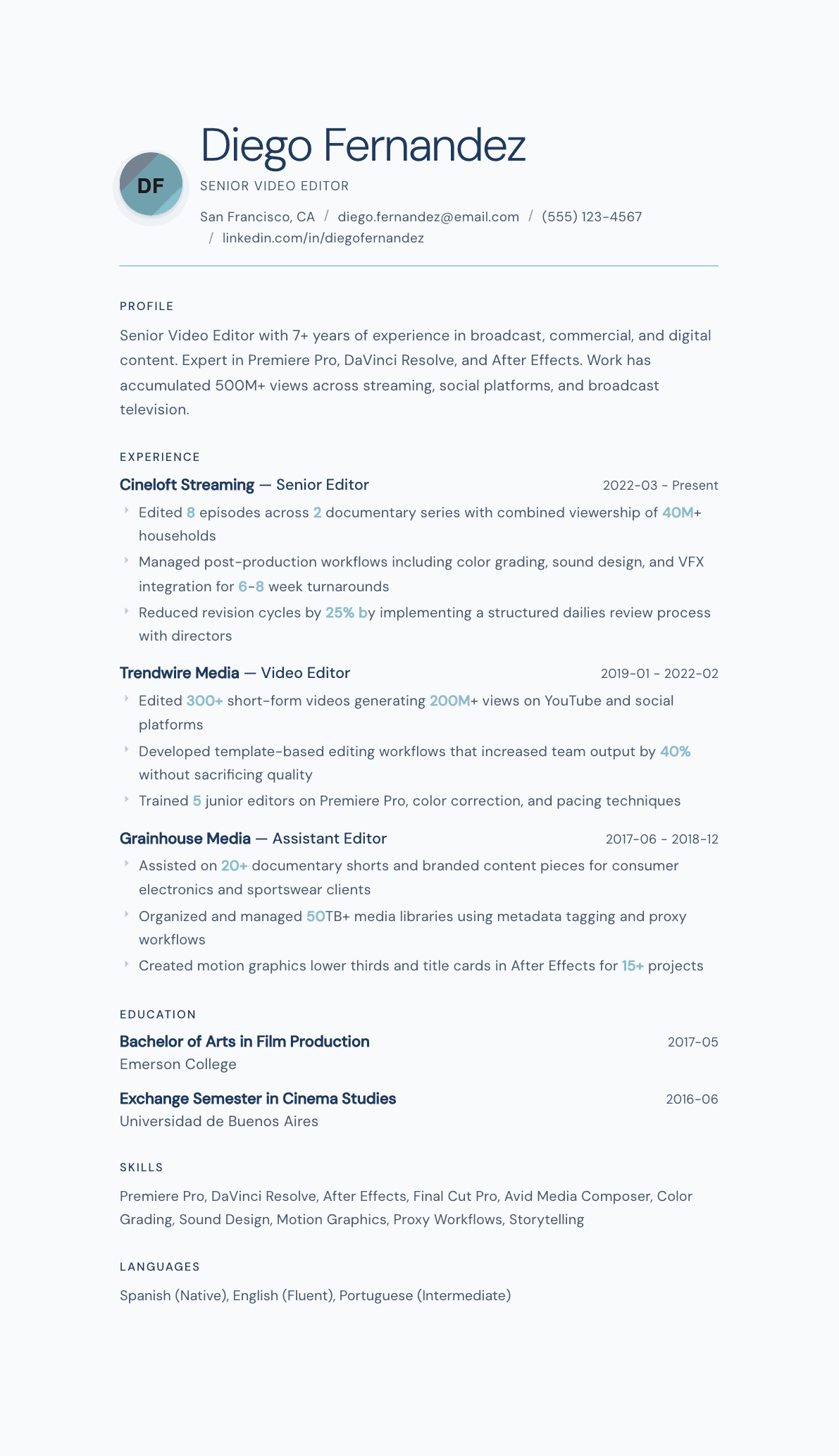
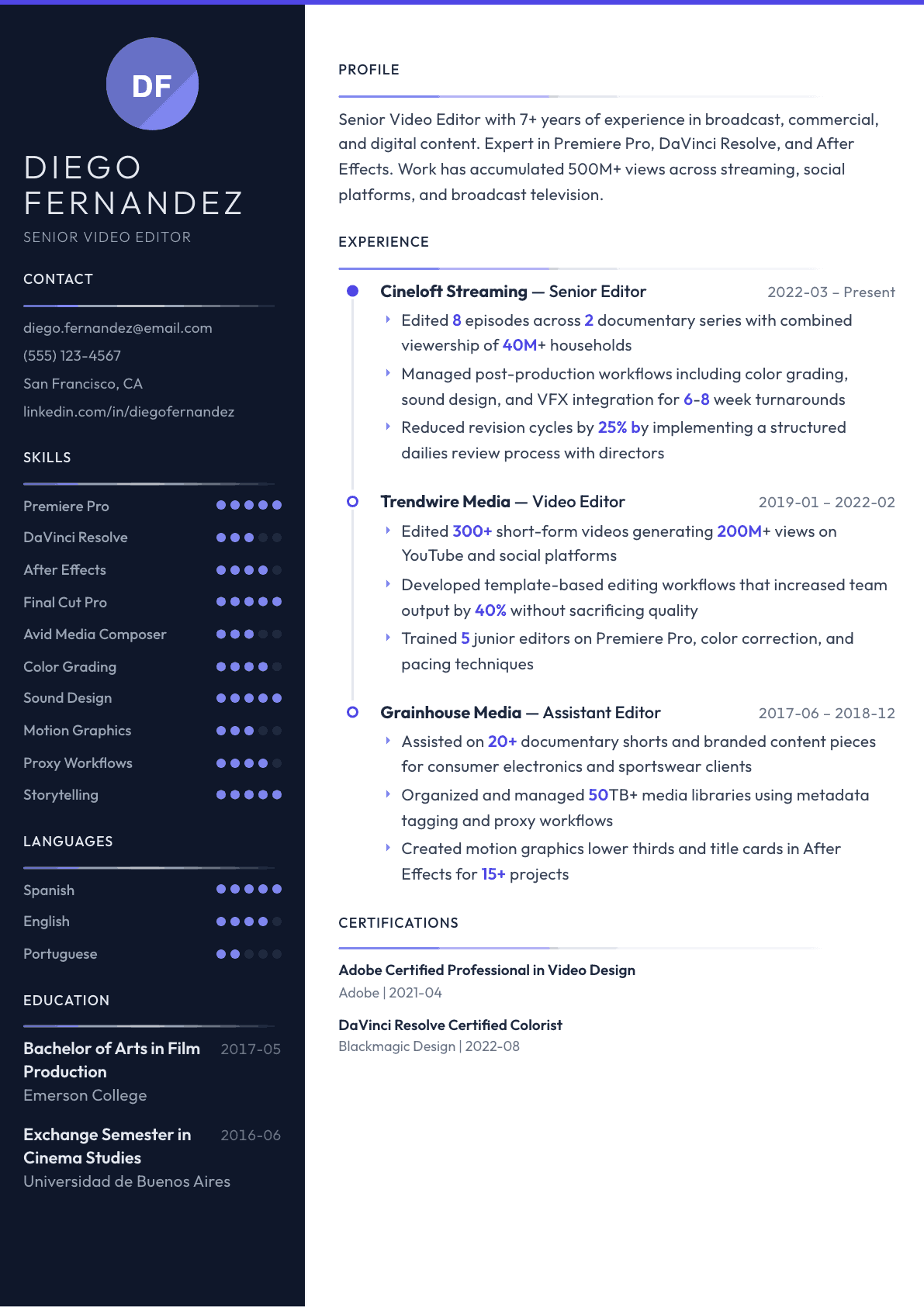
The same video editor content laid out in three CVBooster templates, so you can see what the finished document looks like before you write a word.
Example Video Editor summary
Video Editor with 7 years across broadcast, documentary, and digital content. Cut 300+ videos with 500M+ cumulative views, including 8 episodes of streaming documentary series, and owns color, sound, and VFX handoff end to end in Premiere Pro and DaVinci Resolve.
Skills to list on a Video Editor resume
- Premiere Pro
- DaVinci Resolve
- After Effects
- Final Cut Pro
- Avid Media Composer
- Color Grading
- Sound Design
- Motion Graphics
- Media Management
- Proxy Workflows
- Storytelling
- Documentary Editing
- Commercial Editing
- Multicam Editing
What actually gets this resume read
- Link to your reel or a curated playlist of your best edits -- hiring managers will watch before reading.
- Quantify your impact: view counts, episode counts, production turnaround times, or cost savings.
- List all NLEs and post-production tools you are proficient in: Premiere, DaVinci, Avid, Final Cut.
- Mention genres and formats: documentary, commercial, branded content, social media, long-form, short-form.
- Show technical range: editing, color grading, sound design, motion graphics, VFX compositing.
How to write a video editor resume
A video editor is hired on the reel and kept on the workflow. The post supervisor or creative director reading your resume watches ninety seconds of your work first, then comes back to the page to find out whether you can be dropped into their pipeline: which editing platform, what kind of media, how much footage, what turnaround, and whether you can hand off to color and sound without breaking anything.
The word covers several distinct jobs and mixing them up is the most common resume mistake in post. A scripted assistant editor lives in media management and conform. A documentary editor writes the film in the timeline over months. A social and short form editor cuts dozens of pieces a week to a format. A commercial editor works to a board with an agency in the room. Each has different metrics and different tools, so the resume has to declare which one you are.
A video editing resume for freelance work and one for a staff seat list the same skills in a different order, and the section below shows both. After that comes the credit-led structure post houses expect, three summaries at different levels, before and after bullets that show editorial judgment rather than software use, and the questions editors ask when the reel is strong but the page is not getting calls.
Format: one page, reel link in the header, platform stated up front
One page, with a credit list on a second page only if your filmography is long. The header carries name, city, phone, email and a reel link that plays without a download. Put your primary editing platform in the top third: an Avid house and a Premiere house filter on that line before they read anything else, and a Resolve finishing role is a different job again.
Section order: summary, selected credits, experience, technical and workflow, equipment if you work remotely, education, awards. Say plainly whether you cut, assisted, finished, or all three on each project, because assistant editor work and editor work are priced and staffed differently.
- Header: name, city, phone, email, reel link, and primary platform.
- For each credit: title, format, length, client or network, your role, and the year.
- Give the reel a note saying what you cut on each piece, since reels get read suspiciously otherwise.
- Remote editors should state their setup: storage, calibrated monitoring, review platform and bandwidth.
Video editing resume: freelance, in-house and social versions
A freelance editor groups work by client and project, with the format and length of each piece, because a production company booking a freelancer is buying a specific kind of cut for a fixed run. An in-house editor writes a normal reverse chronological resume, and the volume and turnaround figures carry the weight that client names carry for a freelancer.
Short form and social editors should name the platforms they deliver to and the aspect ratios they cut, since vertical delivery with burned in captions is its own skill. If your work spans film and branded content, lead with the kind the posting asks for and move the rest to a secondary credits list. A video resume, where you record yourself talking to camera, is a different document; send one only when the posting asks for it.
- Freelance: client, project, format, length, your role and the year, grouped by kind of work.
- In-house: employer, title, dates, pieces delivered a year and the turnaround you held.
- Social: platforms, aspect ratios, captioning and the weekly volume you cut.
- Film editor or video editor: use the title the posting uses, as long as it matches what you did.
Summary: format, length, volume and turnaround
Say what you cut and how long it is: feature documentary, episodic television, thirty second commercial, branded short form, corporate and event, or vertical social. Length is a real distinction, because holding an audience through ninety minutes and holding them through fifteen seconds are opposite skills.
Then volume and turnaround, which is what a hiring manager needs to model his week. An editor delivering four social pieces a day is a different resource from one delivering an episode every three weeks. Finish with the platform you cut on and the parts of finishing you can carry yourself, such as color, graphics or mix prep.
Experience: footage, structure, revisions, delivery
Build bullets around the four pressures of an edit. Footage: how much raw material you worked from, in hours or terabytes, and how it was organized. Structure: what you did editorially, which is the actual craft. Revisions: how many rounds, with whom, and how notes were managed. Delivery: what you output, to what spec, and whether it passed QC the first time.
Editorial judgment is the hardest thing to put on a page and the most valuable. Describe decisions rather than actions: restructuring an act because the emotional turn was landing too late, cutting a scene that everyone loved because it repeated information, building a cold open from material shot for a different sequence, finding a through line in an interview that had no script. That is what a supervisor is trying to detect.
Do not skip the technical spine of the job. Media ingest and organization, proxy workflows, multicam grouping and sync, transcript based assembly for interview work, conform and relink, AAF and XML export to sound and color, and archive at the end. Editors who leave a clean project behind get rehired more than editors who do not.
- Quantify footage handled and the ratio you were cutting at where it was extreme.
- Name the review and notes platform you have worked in, since it shapes the revision cycle.
- Say who you took notes from: a director, a showrunner, an agency, a client with no post experience.
- Include graphics and sound work you did yourself, and be clear about what was handed to a specialist.
Technical and workflow: the section that decides fit
Split this so it scans. Editing platforms with an honest level for each: Avid Media Composer, Adobe Premiere Pro, DaVinci Resolve, Final Cut Pro. Finishing and graphics: After Effects, Resolve color, motion templates, titling and lower thirds. Audio: dialogue cleanup, temp mix, and what you hand to a sound editor.
Then workflow, which is where post supervisors actually judge candidates. Camera formats and codecs you have handled, proxy and transcode pipelines, media management and naming conventions, shared storage and project locking on team edits, timecode and sync, LUTs and dailies, and delivery specs including frame rate, color space, captioning and loudness for the platform.
If you work remotely, describe the setup honestly: local storage, a calibrated monitoring path, how you access shared media, and how review sessions run. Remote editing is normal now, and the ones who get hired are the ones who have already solved the review and media problems rather than assuming the client will.
Reels, credits and the honesty rule
The reel is the application. Keep it short, lead with the strongest piece, and choose work that matches the job: a documentary house does not need a montage of social cutdowns. Provide the full pieces separately for anyone who wants to see whether you can hold a story past a highlight, because editing is judged over duration and reels hide that.
Attribution matters. Say exactly what you did on each piece: cut the whole thing, cut one sequence, assisted, or finished someone else's cut. Post is a small industry and everybody knows the other houses. An overstated credit costs more than the job it might have won.
Video Editor resume summary examples
Assistant editor
Assistant editor with two years in a post house, handling ingest, proxy transcodes, multicam sync and project organization across documentary and branded work. Cuts short form pieces independently in Premiere Pro and prepares AAF handoffs for sound on every delivery.
Staff editor, short and mid form
Video editor with six years cutting branded and social content, delivering around 300 pieces a year from 30 second spots to 10 minute features. Works in Premiere Pro and After Effects, handles color and temp mix in house, and manages client notes across two revision rounds per piece.
Documentary and series editor
Editor with twelve years in documentary features and episodic series, credited on 6 features and 30 episodes. Cuts in Avid Media Composer from footage ratios above 100 to 1, structures acts with directors and showrunners, and supervises two assistant editors through conform and delivery.
Work experience bullets: before and after
Before: Edited videos for the marketing team.
After: Cut around 300 pieces a year for paid and organic channels, from 15 second vertical spots to 10 minute case study films, working to a two round notes cycle with brand and legal review.
Volume, length range and the approval process tell a hiring manager exactly what production rhythm you can sustain.
Before: Used Premiere Pro and After Effects on projects.
After: Cut in Premiere Pro with a proxy workflow off shared storage, built lower thirds and animated titles in After Effects, and delivered graded masters plus platform specific versions from a single timeline.
It describes a pipeline instead of naming two applications everyone lists.
Before: Edited a documentary from a lot of footage.
After: Assembled a feature documentary from 400 hours of verite and interview footage, building a transcript based selects structure and restructuring the second act after test screenings moved the reveal earlier.
The ratio, the method and a structural decision show editorial judgment rather than button pressing.
Before: Organized media and helped the editor.
After: Ingested and transcoded 50TB of camera media a season, grouped multicam, synced audio to timecode, maintained naming conventions across the project and prepared conform and AAF handoffs for color and sound.
Assistant editing is a technical discipline, and this describes it as one rather than as helping.
Before: Made revisions based on client feedback.
After: Ran notes through a review platform with timestamped comments, consolidated conflicting feedback from three stakeholders into a single change list, and turned each round within 24 hours.
Managing conflicting notes and a stated turnaround is the part of client work that actually causes projects to fail.
Hard skills
- Avid Media Composer
- Adobe Premiere Pro
- DaVinci Resolve
- Final Cut Pro
- After Effects and motion graphics
- Color correction and grading
- Dialogue editing and temp mix
- Multicam sync and grouping
- Proxy and transcode workflows
- Media management and naming conventions
- Conform, AAF and XML handoff
- Codecs, frame rates and color space
- Captioning and delivery specifications
- Transcript based assembly
Soft skills
- Story structure instinct
- Taking notes without defensiveness
- Pacing judgment
- Working alongside a director in the room
- Managing conflicting stakeholder feedback
- Endurance across long cutting schedules
Certifications worth listing
- Avid Certified User, Media Composer (Avid)
- Avid Certified Professional, Media Composer (Avid)
- Adobe Certified Professional, Premiere Pro (Adobe)
- DaVinci Resolve Certified Editor (Blackmagic Design)
Mistakes that cost video editor candidates the interview
- Hiding the primary editing platform, when an Avid house and a Premiere house filter on that line before anything else.
- Linking a reel that requires a download or a login, which most supervisors will skip entirely.
- Leaving attribution vague on reel pieces in an industry small enough that someone will check.
- Listing software names instead of describing the workflow, the media and the delivery you handled.
- Mixing short form social work and long form documentary credits into one list with no signal about which you want.
- Skipping media management, conform and delivery, the work that decides whether a post house rehires you.
Video Editor resume questions
How do I write a freelance video editing resume?
Group the work by client and project rather than by year, and give each credit its format, length, your role and the year. Put the reel link and your primary editing platform in the header, and add a line on your remote setup and turnaround, because a production company booking a freelancer is booking a schedule as much as a cut.
Which editing software should I put on a video editor resume?
Lead with the one you would be trusted to work in on day one, and give an honest level for the others. Broadcast and scripted work still runs largely on Avid, agency and branded work on Premiere, and finishing increasingly on Resolve, so match the house you are applying to.
How do I move from assistant editor to editor?
Show cutting you have already done: sequences you were handed, short form pieces you owned, or work outside the day job. Keep the technical assistant skills on the page, because a supervisor will value an editor who can also solve a conform problem without calling anyone.
What numbers actually belong on an editor resume?
Footage handled in hours or terabytes, pieces or episodes delivered, length range, turnaround per piece and revision rounds. Audience figures help for content work but they belong to the whole production, so keep them modest and attributed correctly.
Do I need to know color and sound as a video editor?
Enough to deliver a presentable cut and a clean handoff. Short form and branded roles usually expect you to grade and temp mix yourself, while long form work expects a correct AAF or XML export to specialists. Say which version you can do rather than implying both.