Wind Turbine Technician Resume Examples: free ATS score
Power Your Career with a Wind Turbine Technician Resume
By Mustafa Tarabya, founder of CVBooster · Published · Updated
Build a wind turbine technician resume highlighting your renewable energy expertise, safety record, and maintenance capabilities.
Sample resumes for a wind turbine technician
The same wind turbine technician content laid out in three CVBooster templates, so you can see what the finished document looks like before you write a word.
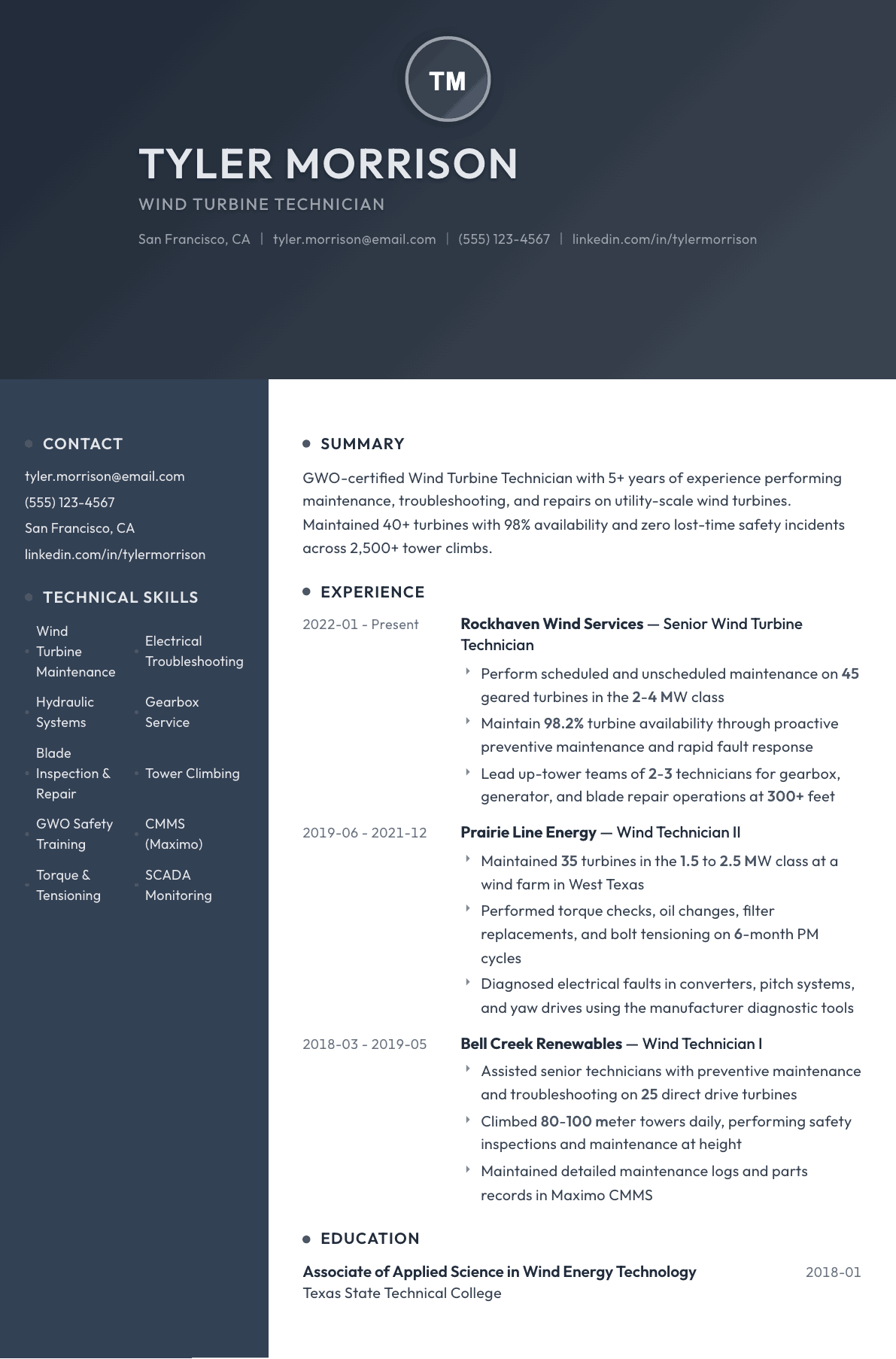
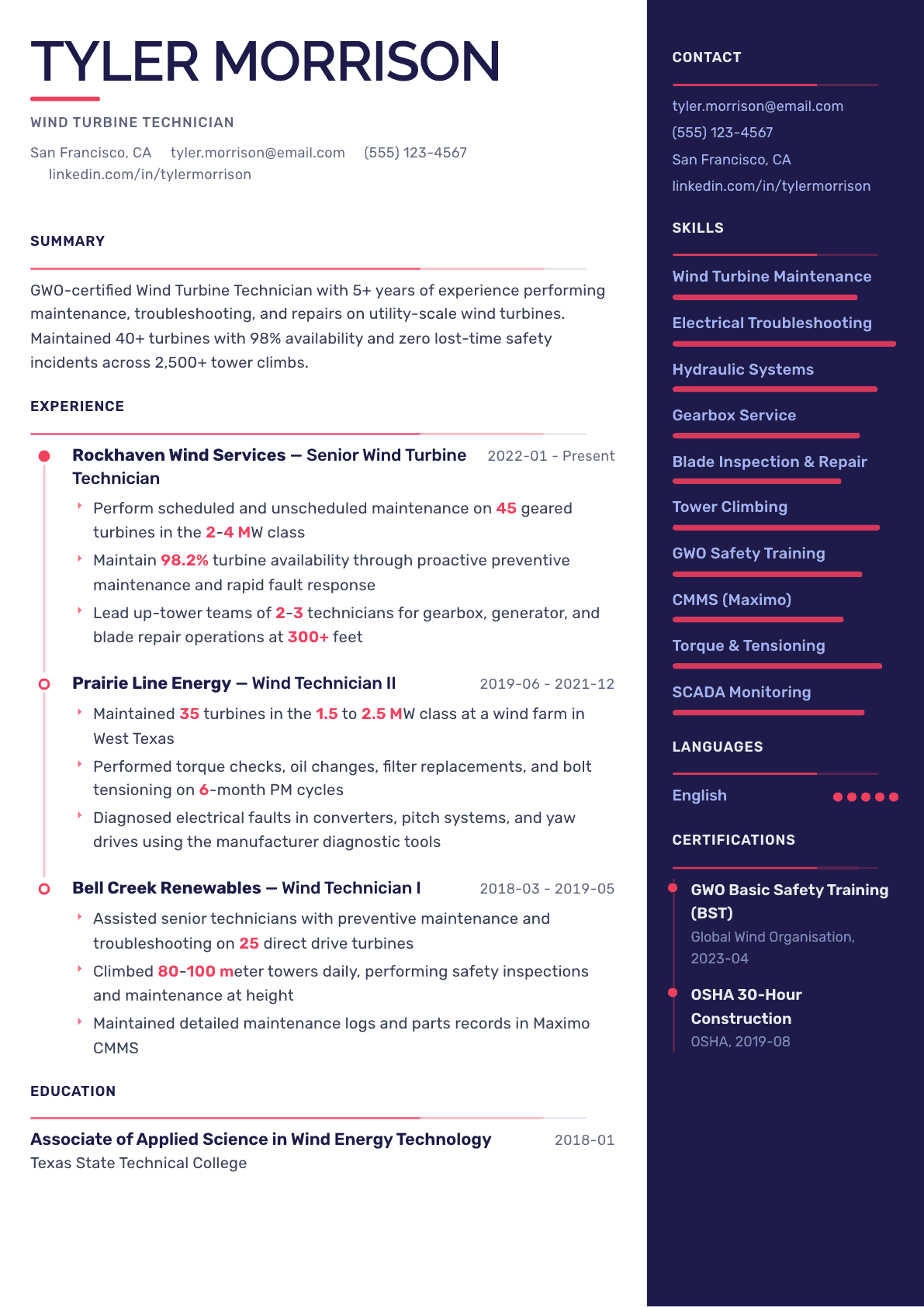
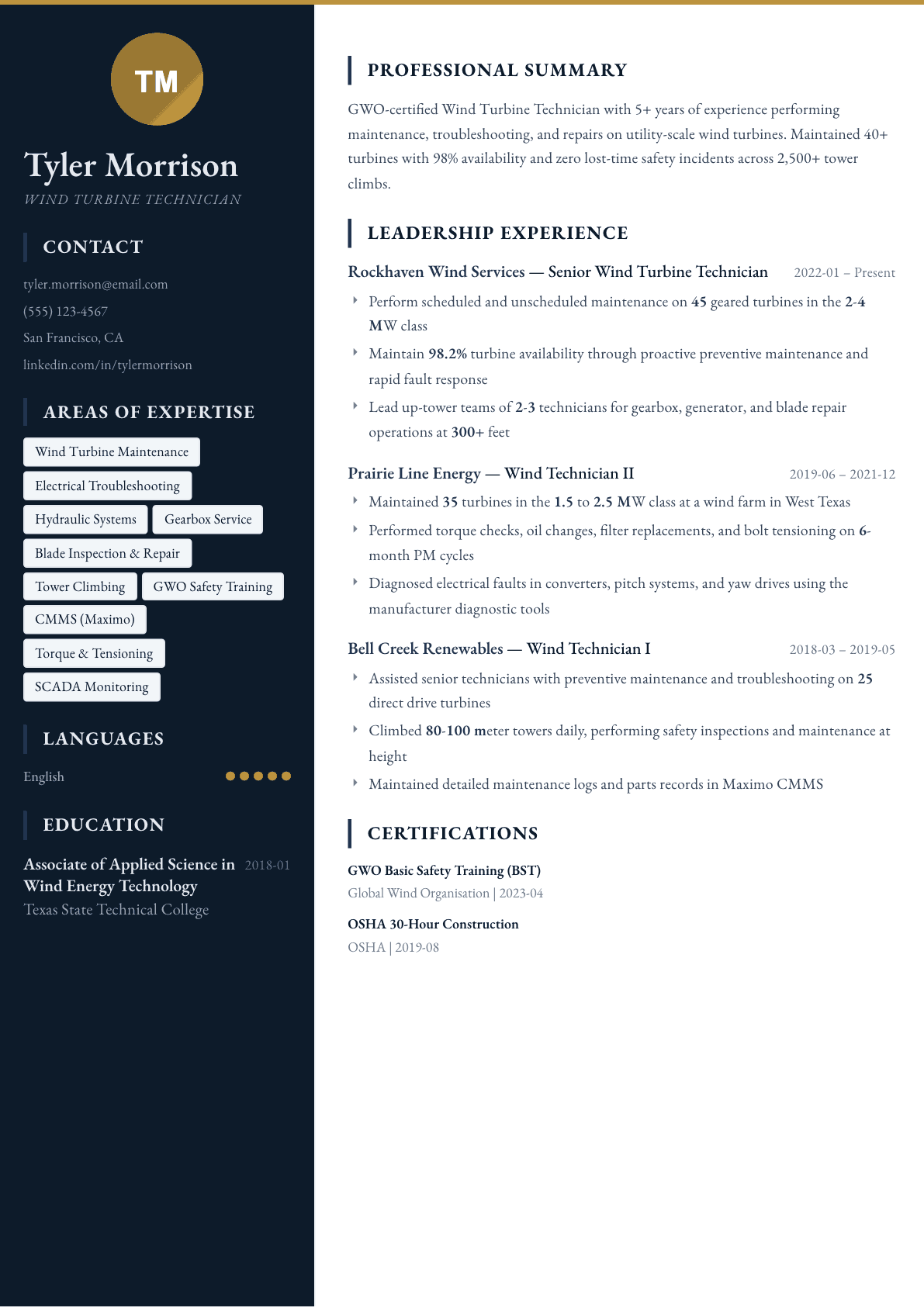
Example Wind Turbine Technician summary
GWO-certified Wind Turbine Technician with 5 years of experience maintaining 40+ utility-scale turbines with 98% availability. Zero lost-time incidents across 2,500+ tower climbs. Seeking a lead technician or site supervisor role in renewable energy.
Skills to list on a Wind Turbine Technician resume
- Wind Turbine Maintenance
- Electrical Systems
- Hydraulic Systems
- Gearbox & Drivetrain
- Blade Inspection & Repair
- Tower Climbing (300+ ft)
- GWO Safety Training
- SCADA Monitoring
- CMMS (Maximo, SAP)
- Torque & Bolt Tensioning
- Converter / Inverter Service
- Pitch System Maintenance
- Yaw System Service
- Fall Protection
What actually gets this resume read
- Include GWO certifications (BST, ART, BTT) as they are required by most wind energy employers.
- Specify turbine platforms you have experience on: Vestas V110/V150, GE 1.5/2.5 MW, Siemens Gamesa.
- Quantify your turbine portfolio: number of turbines maintained and availability percentages.
- Highlight your safety record: tower climbs completed, lost-time incident rate, rescue training.
- Mention SCADA monitoring and diagnostic software experience.
- Include willingness to travel as many wind tech roles require 50-100% travel.
How to write a wind turbine technician resume
A site manager hiring a wind turbine technician screens for safety before skill, because the job is performed alone or in pairs at height inside a machine that stores enormous energy. The first things read are the safety training package, the climb and rescue qualification, and whether you have worked a full season on a utility scale site without an incident.
The second read is technical. Turbines are electromechanical machines with an electrical side that most technicians never fully master. Converters, pitch and yaw systems, generator connections, slip rings and control cabinets are where the difficult faults live, while gearboxes, hydraulics, bolt tensioning and blade work carry the physical load. The resume needs to show which end you are strong at.
This guide covers the layout wind operators expect, how to write about turbine platforms and availability, three summaries from technician one to lead, before and after bullets, and the safety credentials that decide whether you get on a tower at all.
Format: safety credentials at the top, platforms next
One page, reverse chronological. Immediately under your contact details, list the safety training with current expiry dates, because these credentials lapse and an expired card means you cannot be dispatched. Include the climbing and rescue module, first aid, fire awareness, manual handling and any confined space or advanced rescue training.
Then a platform block. Name the turbine manufacturers and models you have worked, the rated capacity range, and whether they were geared or direct drive. Operators run specific fleets, and platform familiarity shortens your ramp-up by months.
- Header: name, city and state, phone, email, willingness to travel, and current safety training status.
- Order: summary, safety and technical certifications, turbine platforms, experience, education.
- Say whether each role was site-based operations, traveling construction and commissioning, or a blade or gearbox specialty crew.
Summary: platforms, discipline, and your safety record
Three lines. Years in the trade, the platforms, whether you lead on electrical or mechanical work, and the safety record stated plainly as recordable or lost time incidents. In wind, the safety line is not a formality, it is the qualification.
Mention travel appetite. Construction, commissioning and major component exchange work is nearly all traveling, while site operations is local. Recruiters filter on this constantly and a candidate who states it clearly saves everyone a call.
Experience: fleet size, availability, and fault work
Open each entry with the site: how many turbines, which platform, the rated capacity, and the terrain or offshore context. Then bullets that show both maintenance types. Scheduled service means torque and tension checks, filter and oil changes, greasing, brake and coupling inspection, and electrical connection checks on a defined interval.
Unscheduled work is where the reader learns your ceiling. Converter and pitch faults, yaw drive failures, generator issues, slip ring and brush service, hydraulic leaks and accumulator work, sensor and anemometry faults, and control cabinet troubleshooting from wiring diagrams. Name the faults, not the categories.
Quantify with the numbers a site manager reports: fleet availability, mean time to repair, number of turbines in your assigned group, scheduled service completed inside the window, and the season you worked without a safety event. Availability is the site scorecard, and a technician who speaks in it sounds like an operator.
Safety and rescue: the section that must be exact
Describe the practice, not just the cards. Pre-climb inspection of the fall arrest system, correct use of the climb assist and the service lift, staying attached to the ladder at every point of the climb, lockout of the turbine and confirmation of rotor lock before entering the nacelle or the hub, and the pre-job hazard assessment your team completed before each task.
Rescue matters most. State that you are trained and current on tower rescue including nacelle, hub and down-tower retrieval, and mention any drills you led. A partner who could actually get you down is what makes a two-person team viable, and site managers know it.
Skills and the terms wind postings repeat
The vocabulary is narrow and technical: preventive maintenance, torque and tensioning, hydraulics, electrical troubleshooting, converter, pitch and yaw systems, gearbox, generator, blade inspection and repair, SCADA, and up-tower and down-tower work. Mirror the phrases the posting uses once in the skills block and once in a bullet.
List the tools and systems that show level: hydraulic torque and tensioning equipment, meters and insulation testers, thermal imaging, borescopes for gearbox inspection, the maintenance management platform you closed work orders in, and the SCADA front end you used to interrogate alarms before climbing. Reading the alarm history first is a habit experienced technicians have and beginners do not.
Wind Turbine Technician resume summary examples
Technician one, first season
Wind energy technology graduate with one full season on a utility scale site, supporting scheduled maintenance on 2 megawatt geared turbines. Holds current basic safety training including working at height and rescue, climbed daily to 80 meters, and logged work orders in the site maintenance system.
Technician three
Wind turbine technician with 5 years across two manufacturers and 3 to 4 megawatt platforms, leading up-tower teams on gearbox, generator and pitch system work. Holds fleet availability above 97% across an assigned group of 40 turbines with no lost time incidents in 2,500 climbs.
Lead technician
Lead wind turbine technician with 9 years spanning commissioning, operations and major component exchange. Runs the site scheduled maintenance plan, troubleshoots converter and control faults from wiring diagrams, leads rescue drills, and trains new technicians through their first climb season.
Work experience bullets: before and after
Before: Performed maintenance on wind turbines.
After: Completed six-month and annual scheduled service on 45 turbines in the 3 megawatt class, covering bolt tensioning, gearbox and hydraulic oil changes, filter replacement, greasing and electrical connection checks.
The service intervals, fleet size and task list show exactly what scheduled work you can be assigned alone.
Before: Fixed electrical faults in the turbine.
After: Diagnosed converter and pitch system faults from wiring diagrams and the alarm history, replacing failed IGBT modules, pitch batteries and encoder feedback devices to return units to production the same day.
Naming the components and the diagnostic source proves electrical depth, which is the scarcer half of this trade.
Before: Climbed towers and worked at height safely.
After: Completed roughly 2,500 tower climbs to 100 meters using climb assist and fall arrest, inspecting personal equipment before every ascent and working under rotor lock and turbine lockout in the nacelle and hub.
Specific procedures replace a safety adjective with practice a site manager can recognize as correct.
Before: Helped improve turbine performance numbers.
After: Reviewed SCADA alarm trends each week to catch pitch and yaw faults before they tripped a turbine offline, lifting availability across a 40-unit group above 97% for the season.
A method tied to the site scorecard turns a vague improvement into a repeatable practice.
Before: Did blade inspections.
After: Performed ground and up-tower blade inspections for leading edge erosion, lightning receptor continuity and bond line cracking, documenting findings with photographs for the engineering team to schedule repair.
Inspection criteria and the reporting path show technical judgment rather than a walk-around.
Hard skills
- Scheduled turbine maintenance
- Hydraulic torque and tensioning
- Electrical troubleshooting and insulation testing
- Converter and drive systems
- Pitch and yaw system service
- Gearbox inspection and oil analysis
- Generator and slip ring service
- Blade inspection and minor repair
- SCADA alarm interpretation
- Hydraulic system repair
- Tower rescue procedures
- CMMS work order documentation
Soft skills
- Two-person team dependability
- Situational awareness at height
- Clear radio communication
- Comfort with remote rotating schedules
- Physical stamina and self-monitoring
- Stopping work when conditions change
Certifications worth listing
- GWO Basic Safety Training (Global Wind Organisation)
- GWO Basic Technical Training (Global Wind Organisation)
- GWO Advanced Rescue Training (Global Wind Organisation)
- OSHA 30-Hour Construction Safety (OSHA Outreach Training Program)
- NFPA 70E Electrical Safety Training (National Fire Protection Association)
Mistakes that cost wind turbine technician candidates the interview
- Listing safety training without expiry dates, when the whole point is whether the card is current enough to dispatch you.
- Never naming the turbine platforms, which is the fastest signal an operator has about your ramp-up time.
- Describing only scheduled service, leaving a manager unsure whether you can troubleshoot an unscheduled fault alone.
- Leaving out availability or turbines assigned, the two numbers a site is measured on.
- Being silent about travel and rotation, when construction and major component work is almost entirely traveling.
- Treating rescue training as a footnote rather than proof that you can be half of a safe two-person team.
Wind Turbine Technician resume questions
What safety training do I need before applying?
The recognized basic safety package covering working at height, rescue, first aid, fire awareness and manual handling is effectively mandatory on utility scale sites. List each module with its expiry, and add advanced rescue if you have it because it widens the roles you can fill.
How do I get into wind with no turbine experience?
Lead with transferable trades: industrial electrical work, hydraulics, heavy equipment or military maintenance all convert well. Then add a wind energy technology program or the basic safety training package, and state clearly that you are comfortable working at height and traveling.
Should I list the number of climbs I have completed?
It is a useful figure if you can estimate it honestly, because it tells a site manager you are conditioned for the work and not likely to quit in the first month. Pair it with the tower heights and your incident record rather than quoting it alone.
Does offshore experience belong on the same resume?
Yes, and highlight it, since offshore adds sea survival training, transfer procedures and longer rotations. Keep it in its own entry so a reader can see the offshore work and the onshore work as separate operating environments.
What separates a technician one from a technician three on paper?
Autonomy and electrical depth. Technician one supports scheduled service, technician three leads up-tower work, troubleshoots faults from diagrams and signs off on the job. Write your bullets to show which of those you were actually trusted to do.
Related resume examples
- Maintenance Technician Resume example
- Electrician Resume example
- Mechanic Resume example
- Diesel Mechanic Resume example
- Elevator Technician Resume example
- Medical Equipment Technician Resume example