Junior Architect Resume Examples: the lines they read
A Junior Architect Resume That Gets Past the First Screen
By Mustafa Tarabya, founder of CVBooster · Published · Updated
Junior architect resume examples, licensure and AXP guidance, software keywords and a writing guide for early career architecture roles.
Sample resumes for a junior architect
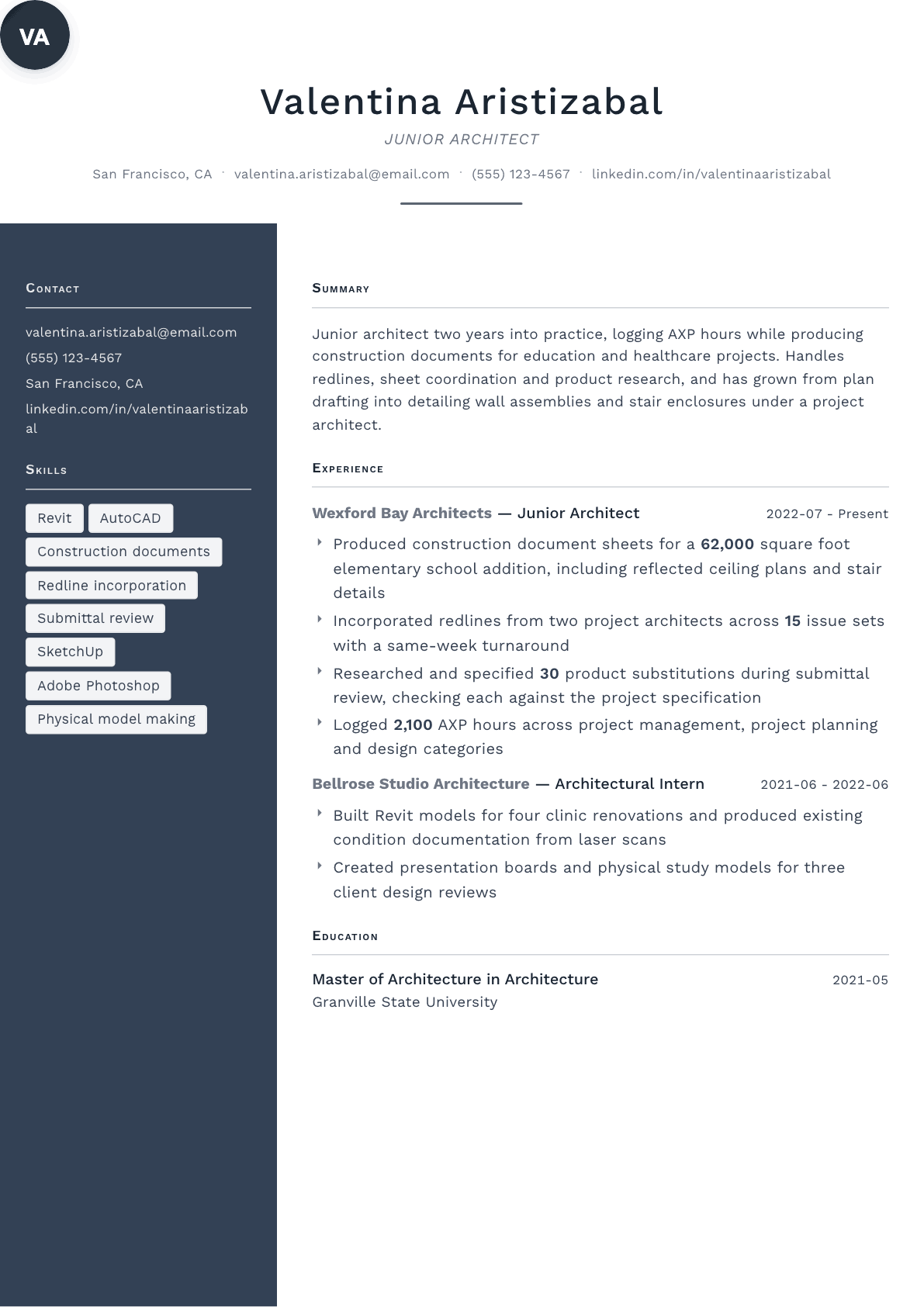
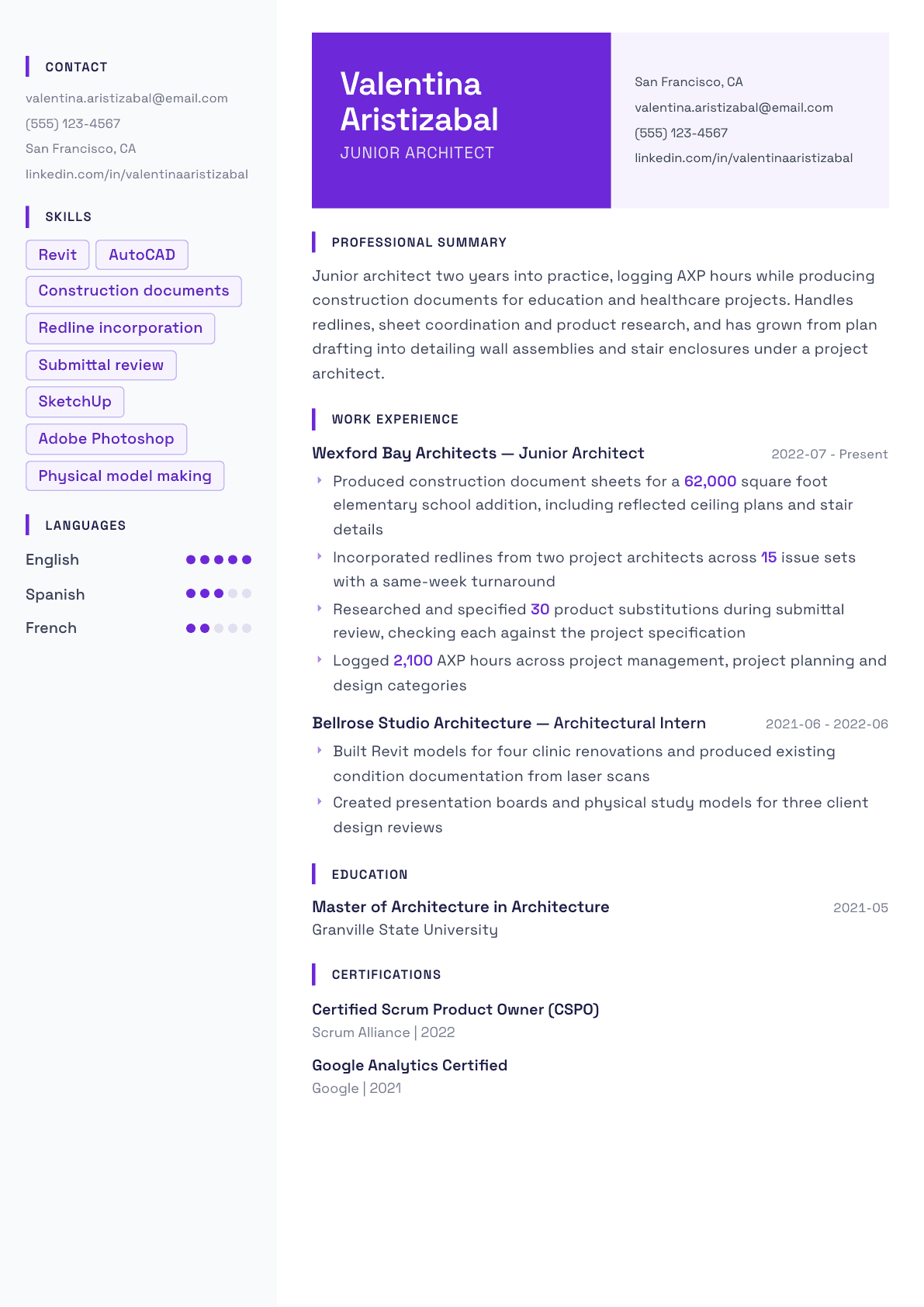
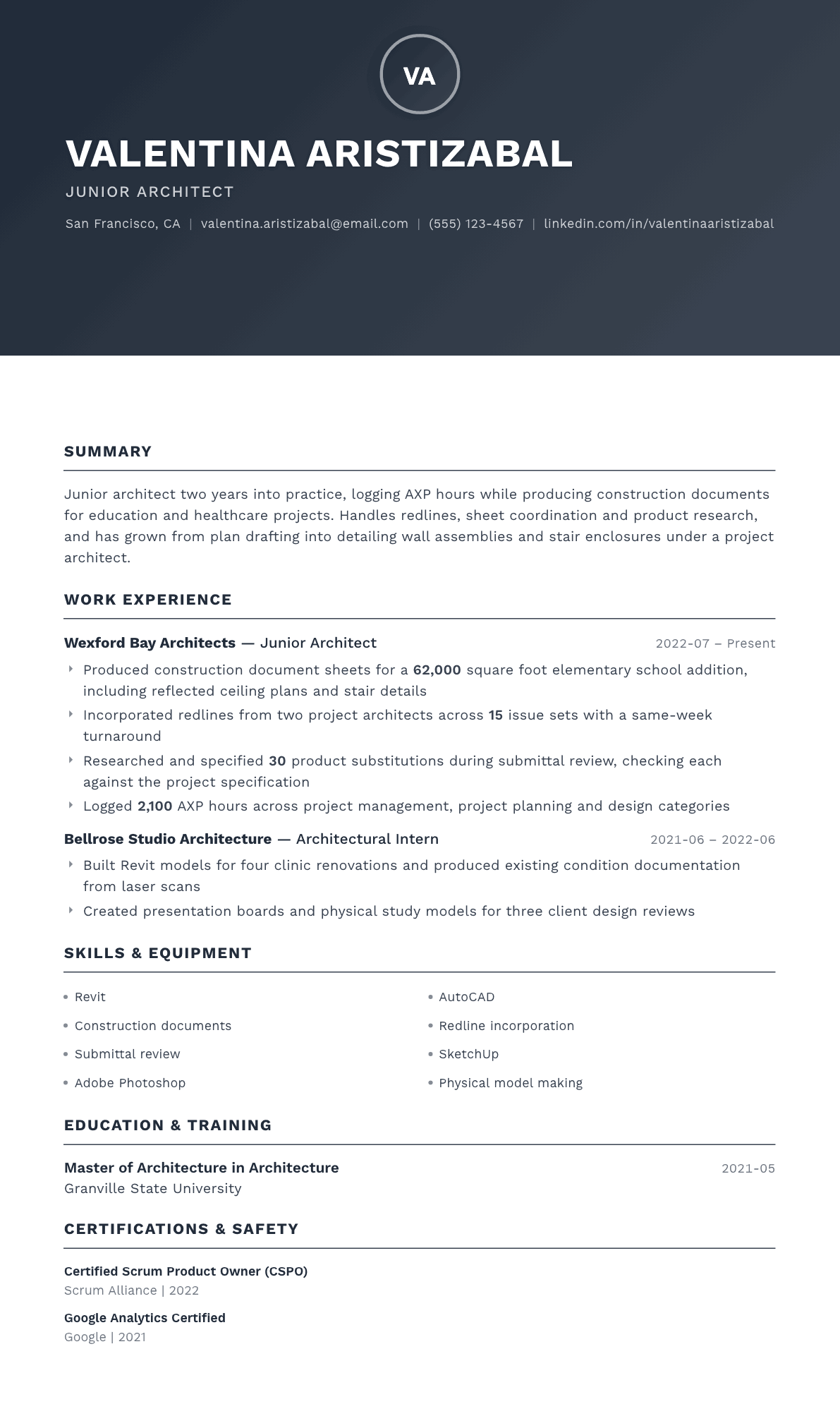
The same junior architect content laid out in three CVBooster templates, so you can see what the finished document looks like before you write a word.
Example Junior Architect summary
Junior architect with two years in practice producing construction documents for education and healthcare projects. Draws stair, wall assembly and ceiling details, turns redlines from two project architects around within the same week, and reviews product submittals against the specification. Holds an accredited Master of Architecture, has logged more than two thousand AXP hours, and is working through the registration exam.
Skills to list on a Junior Architect resume
- Revit
- AutoCAD
- SketchUp
- Enscape
- Construction documents
- Detail drafting
- Redline incorporation
- Submittal and shop drawing review
- Existing conditions documentation
- Building code research
- Adobe Photoshop
- Adobe InDesign
- Physical model making
- Sheet and drawing coordination
What actually gets this resume read
- Say where you are in licensure: the accredited degree, the AXP hours logged, and any exam divisions already passed.
- Describe the sheets and details you personally drew, because a hiring architect wants to know what work he can hand you.
- Show you can take a redline: turnaround time, number of issue sets, and how you tracked comments to closure.
- List the building types you have touched, since education, healthcare and multifamily each carry their own detailing habits.
- Keep the resume to one page and put your portfolio link in the header rather than burying it at the bottom.
- Include model making, rendering and graphic skills, because small studios still value them for client presentations.
How to write a junior architect resume
A junior architect is hired to absorb production work: sheets, details, redlines, submittals and the research nobody senior has time for. The resume that wins the interview is the one that proves you can take that load off a project architect immediately, without a second person checking every line you draw.
That is a narrower claim than it sounds, and most junior resumes miss it. They describe projects the office worked on rather than the drawings the candidate produced. A hiring architect wants the opposite: name the sheets, name the details, name the turnaround on redlines, and say how you tracked comments to closure.
What follows is the structure that works, three example summaries for different points in early practice, before and after bullets drawn from real production work, the credentials worth listing this early, and the questions that come up when you are writing the page during your first years in a studio.
Format: one page, production evidence in the middle of it
One page, single column, portfolio link in the header. At this stage the resume has a single job: convince a project architect that handing you a package is faster than drawing it himself. Anything that does not support that claim is taking space from something that does.
Education stays near the top because the accredited degree and the licensure track are screening facts, but keep it to three lines. The middle of the page belongs to what you drew and how it was checked.
- Header: name, city, phone, email, portfolio link, AXP hours and exam divisions passed.
- Sections: summary, experience, licensure progress, software, education, awards or competition results.
- Keep any attached work sample short and lead it with a construction detail rather than a concept image.
Summary: building types, sheet types, and where you are in licensure
Three lines. Name the building types you have documented, the sheets and details you produce without supervision, and your licensure position. A junior architect who states that she draws stair enclosures and wall assemblies for education projects while logging AXP hours has said everything a staffing decision needs.
Resist the urge to write about design ambition here. It is fine to have it, and the portfolio can carry it, but the summary of a junior resume is a competence statement. Ambition in the summary reads as a candidate who will be unhappy doing the work the role actually contains.
Experience: name the drawings you personally produced
For each job, open with the project type and size, then write bullets about your own output. Reflected ceiling plans, enlarged toilet room plans, stair and elevator details, wall types, door and window schedules, and existing condition sets are all specific enough to prove real production experience.
Add the checking loop. How many issue sets you worked through, how quickly you incorporated redlines, and how you tracked comments so nothing was lost between rounds. A junior who can be trusted with a redline set is worth more than one who draws faster and misses two comments.
If you have done submittal review, product research or code lookups, give them a bullet each. Those tasks eat senior time, and volunteering that you can carry them is a direct argument for hiring you.
Licensure: be precise, because firms plan around it
State the accredited degree, the AXP hours logged and the exam divisions completed. Being exact matters here. A candidate with two thousand hours and three divisions passed is a different staffing proposition from one who has done neither, and firms reimburse exam fees and adjust review workload accordingly.
If you are on an alternative path to registration, or working under a different jurisdiction requirement, say so in one line rather than leaving the reader to guess. Ambiguity in this section is usually read as no progress at all.
Software and technical skills at the production level
Revit first, and say what you do inside it: sheet setup, view templates, detail components, schedules and keynoting. Then AutoCAD for legacy backgrounds and consultant files, SketchUp or Rhino if you use them, Bluebeam for markup, and the Adobe applications for presentation work.
Add the non software production skills that still matter in a small studio: hand sketching to explain a detail, physical model making, and photographing models for the office website. Those are real deliverables in many offices and few junior candidates list them.
- Revit production: sheets, schedules, detail components, keynotes, view templates.
- Documentation support: redline incorporation, submittal review, product substitution research.
- Communication: hand sketching, model making, presentation board layout.
Junior Architect resume summary examples
First year in a studio
Junior architect in the first year of practice, producing plan and section sheets for clinic renovations under a project architect. Builds Revit models from measured surveys and laser scans, incorporates redlines within the same week, and holds an accredited Master of Architecture.
Two years in, testing
Junior architect with two years documenting education and healthcare projects. Draws stair, wall assembly and reflected ceiling details, turns redlines from two project architects around inside a week, and reviews product submittals against the specification. Has logged 2,100 AXP hours and passed three exam divisions.
Ready for project architect
Junior architect with four years and a complete construction document set of her own on a small civic project. Runs code research and accessibility checks, coordinates consultant backgrounds, mentors an intern on Revit standards, and has one exam division remaining before registration.
Work experience bullets: before and after
Before: Worked on construction documents for a school project.
After: Produced construction document sheets for a 62K square foot elementary school addition, including reflected ceiling plans, stair sections and door schedules.
Listing the actual sheet types shows what a project architect can hand you on day one.
Before: Made changes based on markups.
After: Incorporated redlines from two project architects across 15 issue sets with same week turnaround, tracking each comment to closure in a shared markup log.
The tracking method is the part that earns trust, so it belongs in the bullet.
Before: Reviewed submittals.
After: Researched and reviewed 30 product substitution requests during submittal review, checking each against the specification and flagging four that failed the fire rating.
A specific rejection reason proves the review was substantive rather than a stamp and file.
Before: Modeled existing buildings.
After: Built Revit models of four clinic buildings from laser scan point clouds and produced existing condition sets used for permit submission.
The source data and the downstream use show the model served a real deliverable.
Before: Made models and boards for client meetings.
After: Built physical study models at quarter inch scale and laid out presentation boards for three client design reviews, two of which approved the preferred scheme.
Scale and outcome turn craft work into evidence that it supported a decision.
Hard skills
- Revit sheet and schedule production
- Detail drafting
- AutoCAD
- Redline incorporation
- Submittal and shop drawing review
- Building code research
- Accessibility clearance checks
- Existing conditions documentation
- Point cloud to model workflows
- Bluebeam markup
- Adobe InDesign and Photoshop
- Physical model making
- SketchUp
- Drawing set coordination
Soft skills
- Taking and closing redlines
- Asking questions early
- Attention to drawing standards
- Time management across issue sets
- Note taking in coordination meetings
- Working alongside consultants
Certifications worth listing
- LEED Green Associate (Green Business Certification Institute)
- Autodesk Certified Professional: Revit for Architectural Design (Autodesk)
Mistakes that cost junior architect candidates the interview
- Describing what the office built instead of what you drew, which leaves a hiring architect unable to judge your output.
- Listing AXP as a single word with no hours, so the firm assumes you have logged almost nothing.
- Using the protected title architect without registration, which some firms treat as an immediate disqualification.
- Filling the page with student studio work after two years of practice instead of real production experience.
- Leaving out redline, submittal and code research work because it feels routine, when that is the job being hired for.
- Sending a heavy portfolio attachment with the resume and having the whole email blocked before anyone reads it.
Junior Architect resume questions
Can I call myself a junior architect before registration?
It depends on the jurisdiction, and several boards restrict any use of the title. The safe route is architectural designer or design staff on the resume, with your licensure progress stated. Use the exact posted title when you apply to a firm that advertised it.
How long should student work stay on the resume?
Keep one or two studio projects through your first year of practice, then remove them. After that, professional production work carries far more weight, and studio projects are better placed in the portfolio where they can be shown properly.
What if I have not passed any exam divisions yet?
Say the degree is accredited and give your AXP hours, then note the division you are scheduled for. Firms understand that early practice is busy. What they dislike is a blank where the licensure information should be.
Should I include the software versions I have used?
No. Versions date the resume and nobody screens on them. What matters is the depth of use: whether you can set up sheets, build detail components, manage view templates and work in a shared model without breaking someone else work.
How do I stand out among junior applicants with similar experience?
Volunteer for the work seniors dislike and then put it on the page. Submittal logs, code research, existing condition surveys and redline tracking are unloved and always needed. A candidate who names those tasks reads as immediately useful.
Related resume examples
- Architect Resume example
- Architectural Designer Resume example
- Architecture Intern Resume example
- Architectural Drafter Resume example
- Interior Architect Resume example
- Landscape Architect Resume example