Logo Designer Resume Examples: free ATS score and gap list
Build a Logo Designer Resume Around Marks, Not Mood Boards
By Mustafa Tarabya, founder of CVBooster · Published · Updated
Logo designer resume example with identity process, vector craft, client work, portfolio advice, keywords and a writing guide.
Sample resumes for a logo designer
The same logo designer content laid out in three CVBooster templates, so you can see what the finished document looks like before you write a word.
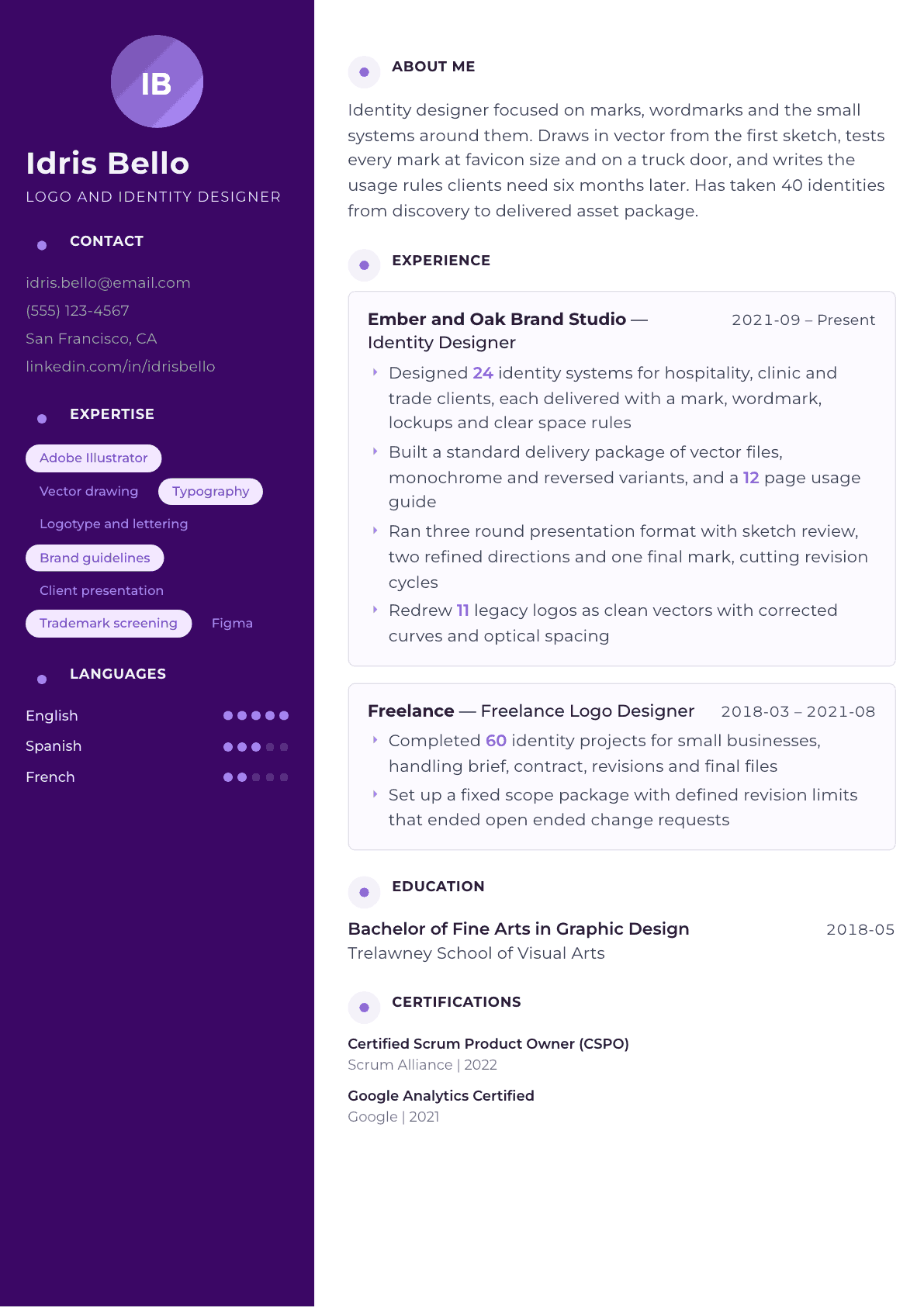
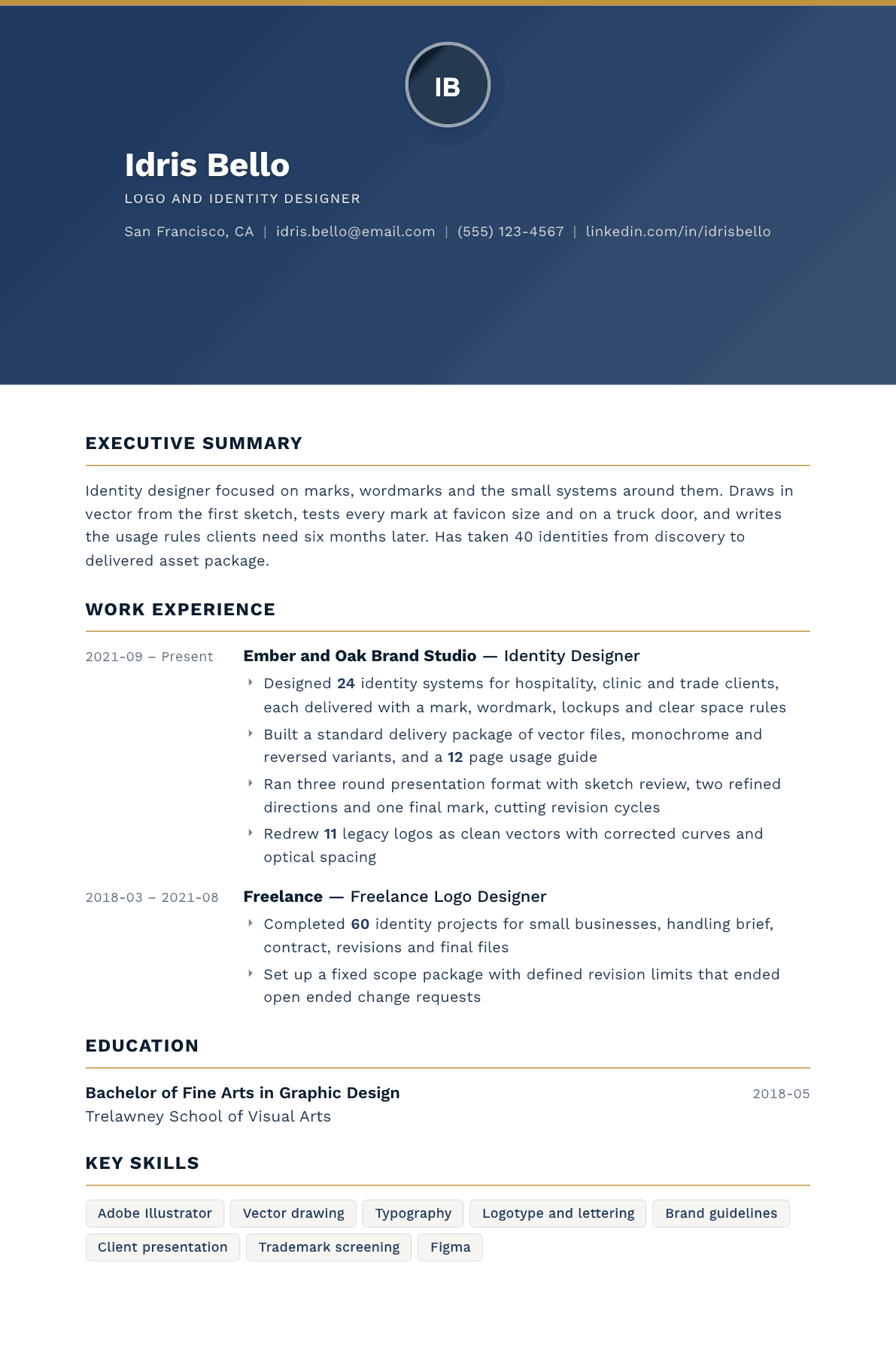
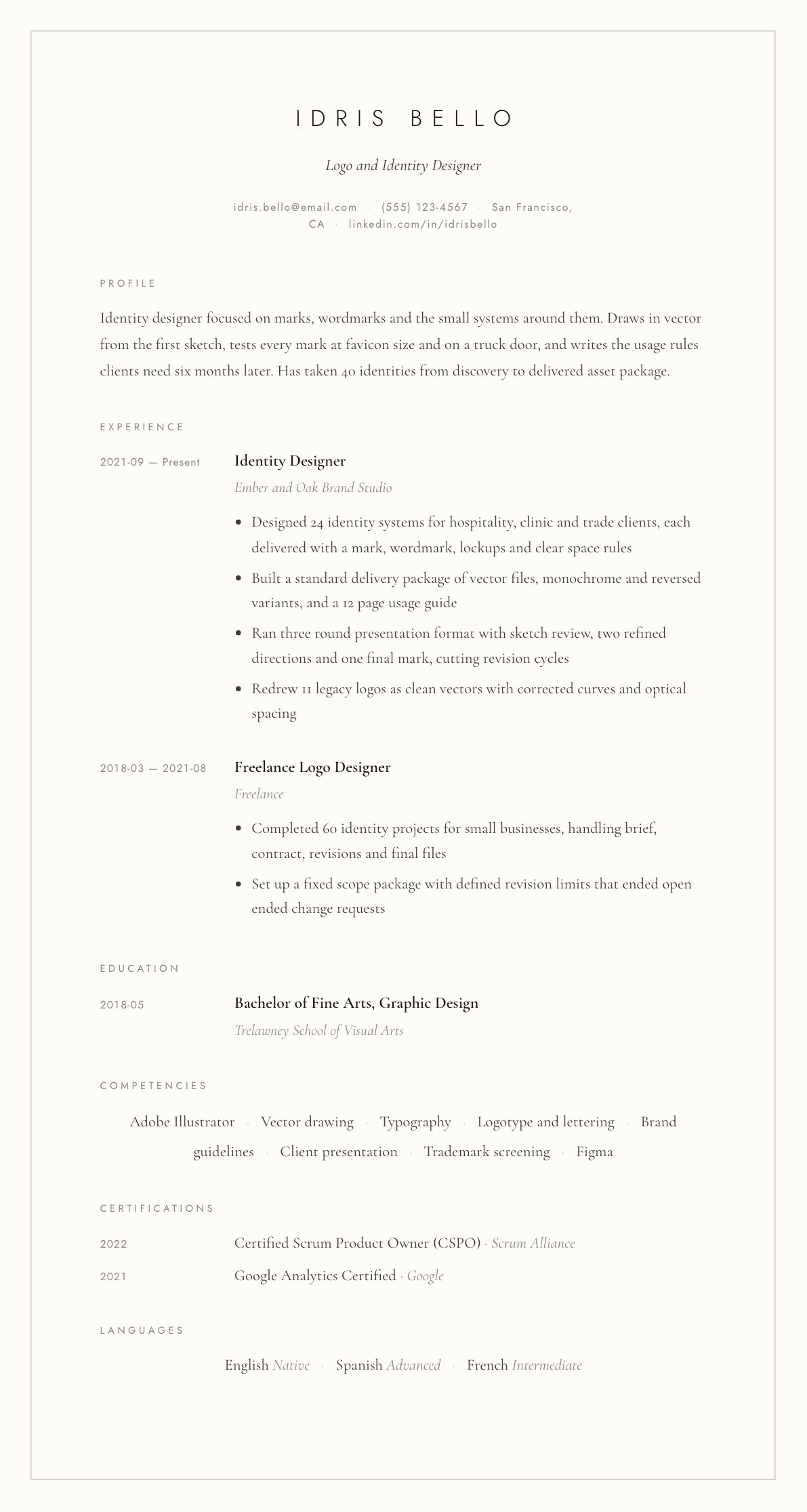
Example Logo Designer summary
Identity designer with six years of marks, wordmarks and the systems that keep them consistent. Draws in vector, tests every mark at small sizes and in single color, and delivers a package with lockups, clear space rules and usage guidance. Has taken dozens of identities from discovery through client presentation to final files. Seeking studio work on brand identity projects with real research time.
Skills to list on a Logo Designer resume
- Adobe Illustrator
- Vector drawing
- Logotype design
- Custom lettering
- Typography
- Brand identity systems
- Brand guidelines
- Color systems
- Grid and optical spacing
- Client presentation
- Concept development
- Trademark screening
- Figma
- Mockup and application design
What actually gets this resume read
- Describe your identity process in the resume itself: discovery, sketching, direction, refinement, delivery package.
- Say what a client receives, including vector formats, monochrome variants, clear space rules and a usage document.
- Prove scale legibility work, such as testing marks at small sizes, single color and on physical applications.
- Name the industries you have designed identities for, because studios hire for category familiarity.
- Mention trademark screening habits and how you flag risk to clients before a mark goes into production.
- Keep the portfolio to your strongest twelve marks with the reasoning shown, not every logo you have ever drawn.
How to write a logo designer resume
Anyone can post a grid of marks. What a brand studio actually screens for when hiring a logo designer is process, because a mark that arrived by luck cannot be repeated on the next client. The resume has to show that you have a repeatable route from discovery to delivered asset package, and that the clients you took through it signed off without a fourth round of unpaid redraws.
The second screen is craft under stress. A mark that looks confident at portfolio size may fall apart at favicon scale, in a single color, embroidered on a shirt or vinyl cut on a truck door. Studios ask about small size legibility, optical spacing and curve quality in the first interview, so the resume should already answer some of it.
This guide covers how to write your identity process into the document itself, what to say about deliverables and usage guidance, how to describe freelance identity work so it reads as professional rather than casual, and how to handle trademark risk without claiming legal expertise you do not have.
Format: one page, process visible, portfolio curated hard
One page, reverse chronological, with a portfolio link that lands on marks rather than a home page slider. The portfolio should hold your strongest dozen identities with the reasoning shown, not every logo you have ever drawn. A studio reads a bloated portfolio as an inability to edit, which is the same skill as choosing between three good directions.
Put the process itself on the resume in a short section or a line inside the summary. Discovery, sketching, direction development, refinement, delivery. Naming the stages tells a studio you have a method that survives a difficult client, and it gives an interviewer something concrete to ask about.
- Header: name, title, city, email, portfolio address.
- Sections: summary, identity process, experience, skills, education, selected client categories.
- List client categories rather than every client name if some work is under agreement.
Summary: marks, systems and the volume behind them
Lead with what you make: marks, wordmarks, lockups and the small systems around them. Then the volume, because identity work is a numbers game in the best sense. A designer who has taken dozens of identities from discovery to a delivered asset package has seen enough client behavior to be trusted with a new one.
Add one line of craft evidence. Drawing in vector from the first refined sketch, testing every mark at small size and in a single color, and writing the usage rules clients need months later are all specific habits that separate an identity designer from a general graphic designer who occasionally draws a logo.
Experience: what the client actually received
Describe the delivery package precisely. Vector source files, export formats, monochrome and reversed variants, horizontal and stacked lockups, clear space and minimum size rules, color values across print and screen, and a usage document with a real page count. A studio hiring for identity work knows how much labor sits in that list and reads it as evidence you finish jobs.
Write the presentation structure too. A three round format with sketch review, two refined directions and one final mark keeps clients out of a design by committee spiral, and describing it shows you manage the relationship rather than absorb its chaos.
Redraw and refinement work counts. Rebuilding legacy marks as clean vectors with corrected curves and optical spacing is a real service, and it demonstrates the technical drawing standard you hold yourself to better than a new concept does.
Freelance work: write it like a business, not a hobby
Freelance identity projects belong on the resume as a role with a date range, a project count and bullets. Include the commercial parts: fixed scope packages, defined revision limits, contracts and deposits. Studios read that as maturity, because the most common failure of a freelance hire is an inability to say no to unlimited changes.
Name the industries. Hospitality, clinics, trades, food, professional services. Category familiarity is a real hiring criterion, since a studio pitching a restaurant group wants a designer who has already learned what menus, signage and vehicle graphics do to a mark.
Trademark awareness: flag risk, do not give legal advice
Say that you screen for obvious conflicts early and raise them with the client before a direction goes into refinement, and that you advise clients to run a formal clearance with an attorney. That is the accurate description of a designer role, and it reassures a studio that you will not walk a client into an expensive rebrand.
Add anything you do to support the process: naming similar marks in a category audit, checking existing usage in the client sector, and documenting where a direction sits relative to competitors. This is judgment work, and it is one of the reasons identity design costs what it does.
Logo Designer resume summary examples
First identity role
Graphic designer moving into identity work, with 2 years producing marks, wordmarks and brand collateral for small business clients. Draws in vector from refined sketch through final curve correction, tests each mark in a single color at small size, and delivers a file package with lockups and clear space rules.
Six years in
Identity designer with 6 years and around 80 completed identity projects across hospitality, clinic and trade clients. Runs a three round presentation format with sketch review, two refined directions and one final mark. Delivers vector files, monochrome and reversed variants, and a 12 page usage guide with every project.
Studio lead
Senior identity designer leading brand programs from discovery through launch, with 12 years across studio and freelance practice. Sets the direction strategy, presents to founder level clients, writes the usage guidance, and mentors two designers through sketching and vector craft. Screens for trademark conflict before refinement begins.
Work experience bullets: before and after
Before: Created logos for a range of clients.
After: Designed 24 identity systems for hospitality, clinic and trade clients, each delivered with a primary mark, a wordmark, horizontal and stacked lockups, and clear space rules.
Naming the client categories and the components of each system replaces a vague count with a description of the actual work.
Before: Delivered final logo files to clients.
After: Built a standard delivery package of vector source files, monochrome and reversed variants, print and screen color values, and a 12 page usage guide clients could hand to a printer.
The package contents show you finish an identity rather than emailing an image file and disappearing.
Before: Presented concepts and made revisions.
After: Ran a three round presentation format of sketch review, two refined directions and one final mark, which ended open ended revision requests on client projects.
A named process explains how you control the relationship, which is what a studio worries about most.
Before: Cleaned up old logos.
After: Redrew 11 legacy marks as clean vectors, correcting uneven curves, inconsistent stroke weights and optical spacing so each held at favicon size and in a single color.
The specific defects fixed prove the drawing standard rather than asserting attention to detail.
Before: Set up my freelance business.
After: Established a fixed scope identity package with a defined revision limit, a deposit schedule and a written brief stage, which removed unbilled change requests from every later project.
Commercial structure shows a studio you will not be a liability on client facing work.
Hard skills
- Adobe Illustrator
- Vector drawing and curve correction
- Logotype and custom lettering
- Typography and type selection
- Brand identity systems
- Lockup and clear space rules
- Brand guideline writing
- Color systems for print and screen
- Grid and optical spacing
- Concept development and sketching
- Trademark conflict screening
- Figma
- Mockup and application design
- Client presentation decks
Soft skills
- Client discovery interviewing
- Explaining design decisions
- Scope discipline
- Editing your own work
- Handling critical feedback
Certifications worth listing
- Adobe Certified Professional: Graphic Design & Illustration (Illustrator) (Adobe)
Mistakes that cost logo designer candidates the interview
- Posting every mark you have ever drawn instead of curating the strongest dozen with reasoning.
- Describing the outcome without the process, which makes a good mark look accidental.
- Leaving out what the client receives, so a studio cannot tell whether you finish an identity.
- Showing marks only on premium mockups and never in a single color at small size.
- Writing freelance work without dates, counts or commercial structure, which reads as casual.
- Claiming legal clearance ability instead of describing conflict screening and attorney referral.
- Using a decorated resume template that distracts from the typographic judgment you are selling.
Logo Designer resume questions
How many logos should a logo designer portfolio contain?
Around twelve strong identities, each with a short explanation of the brief and the reasoning. A curated set reads as editorial judgment. A grid of eighty marks reads as volume without discrimination, and studios treat that as a warning sign.
Should I show sketches and process work?
Yes, for two or three projects. Sketch pages, direction boards and the refinement steps prove the mark was reasoned rather than found. Keep the process sections short so the finished identity still carries the page.
How do I present unused concepts?
Only if you own the rights and the client relationship is not harmed. Label them clearly as unselected directions, and never present a rejected concept as delivered work, because studios do check and the credibility cost is severe.
Do I need a design degree for identity work?
Studios weigh the portfolio and process far above the degree, but formal training in typography and drawing shows in the work. If you are self taught, name the courses, workshops and mentors that built the craft rather than leaving education blank.
What should I say about trademark checks?
Describe what a designer legitimately does: screening for obvious conflicts in the client category, raising risk before refinement begins, and advising a formal clearance with an attorney. Never imply you can provide legal clearance yourself.