Brand Designer Resume Examples: the lines they read
Create a Brand Designer Resume That Tells Your Story
By Mustafa Tarabya, founder of CVBooster · Published · Updated
Build a brand designer resume that demonstrates your ability to craft cohesive visual identities, design systems, and brand strategies with creative templates.
Sample resumes for a brand designer
The same brand designer content laid out in three CVBooster templates, so you can see what the finished document looks like before you write a word.
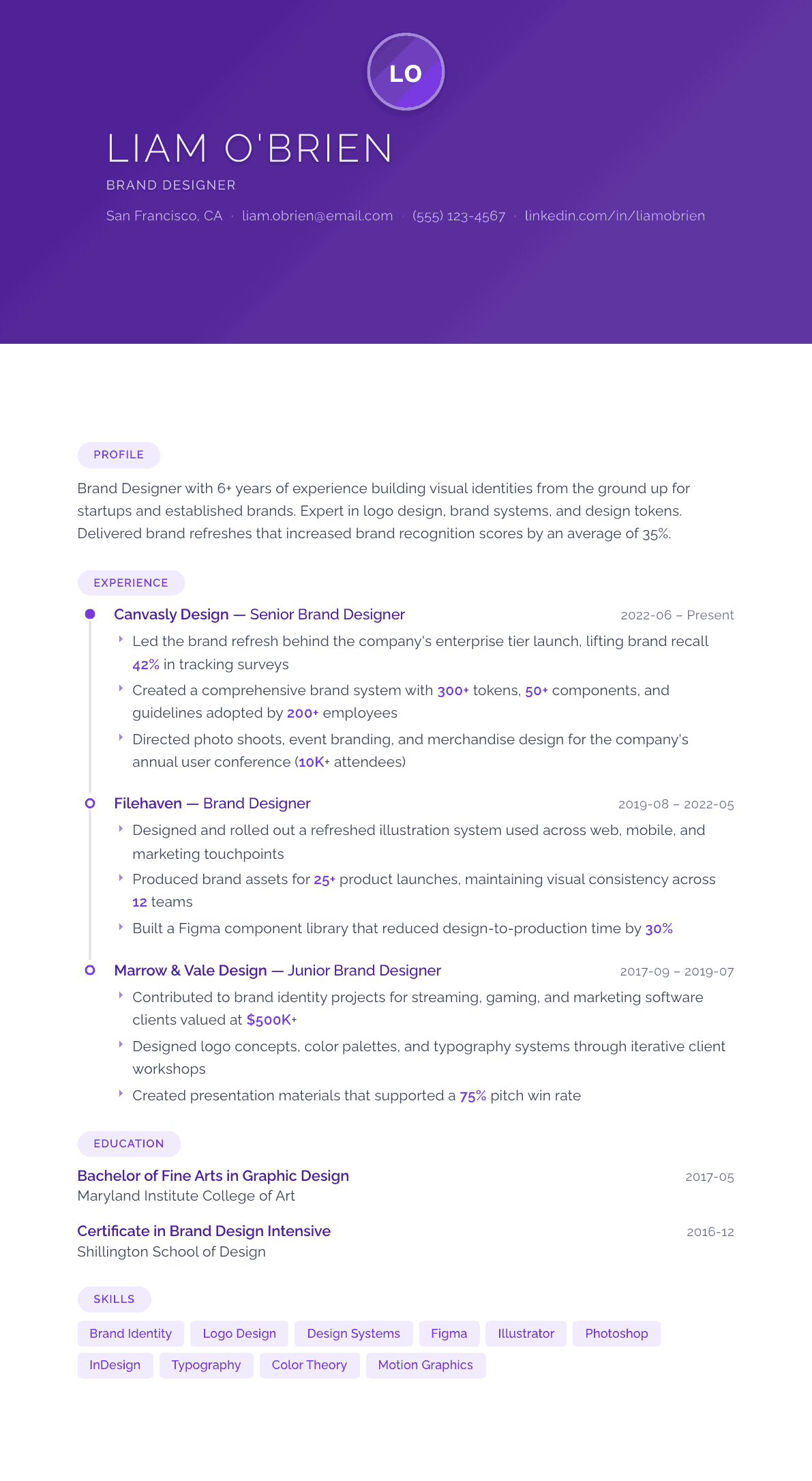
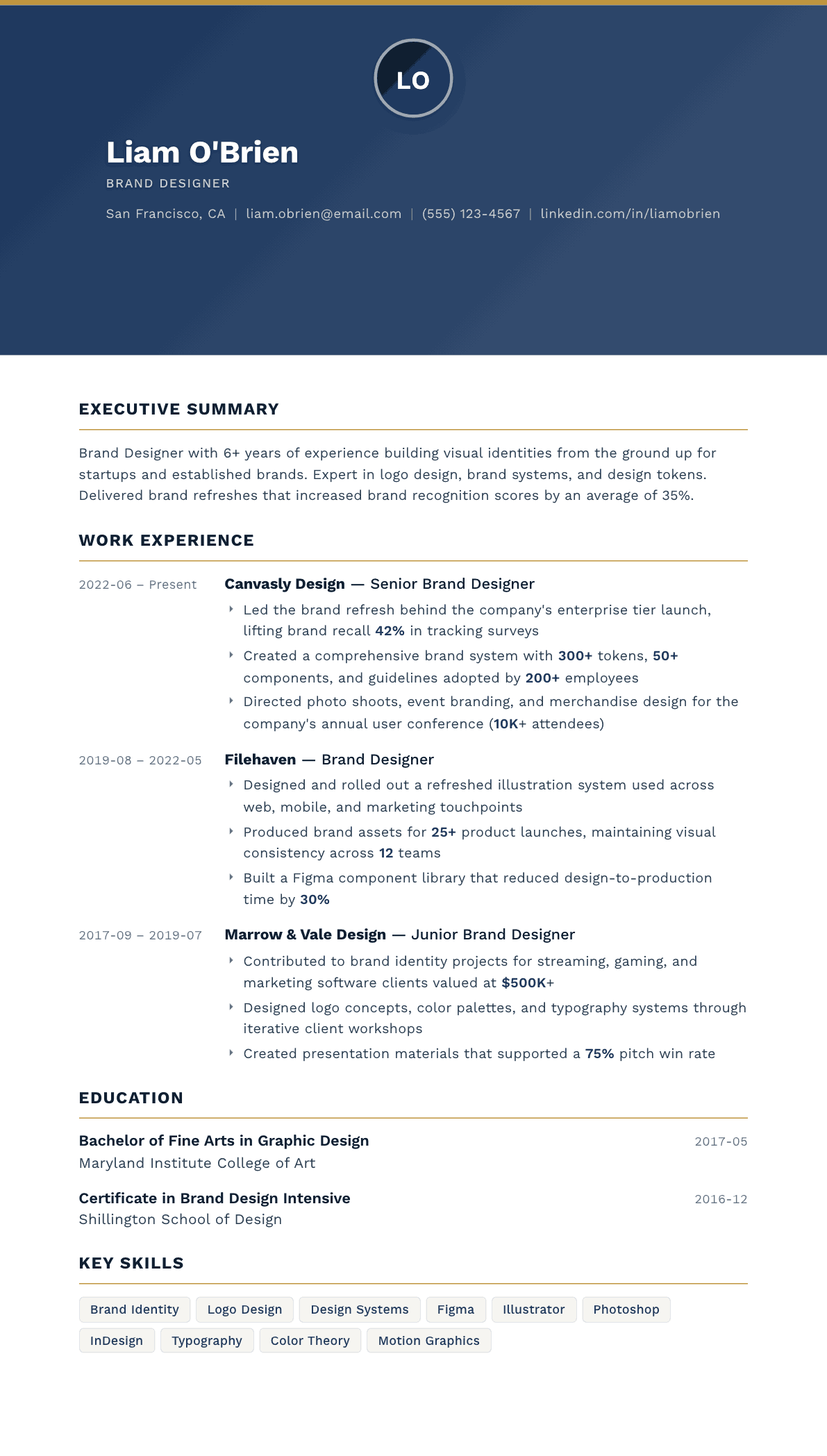
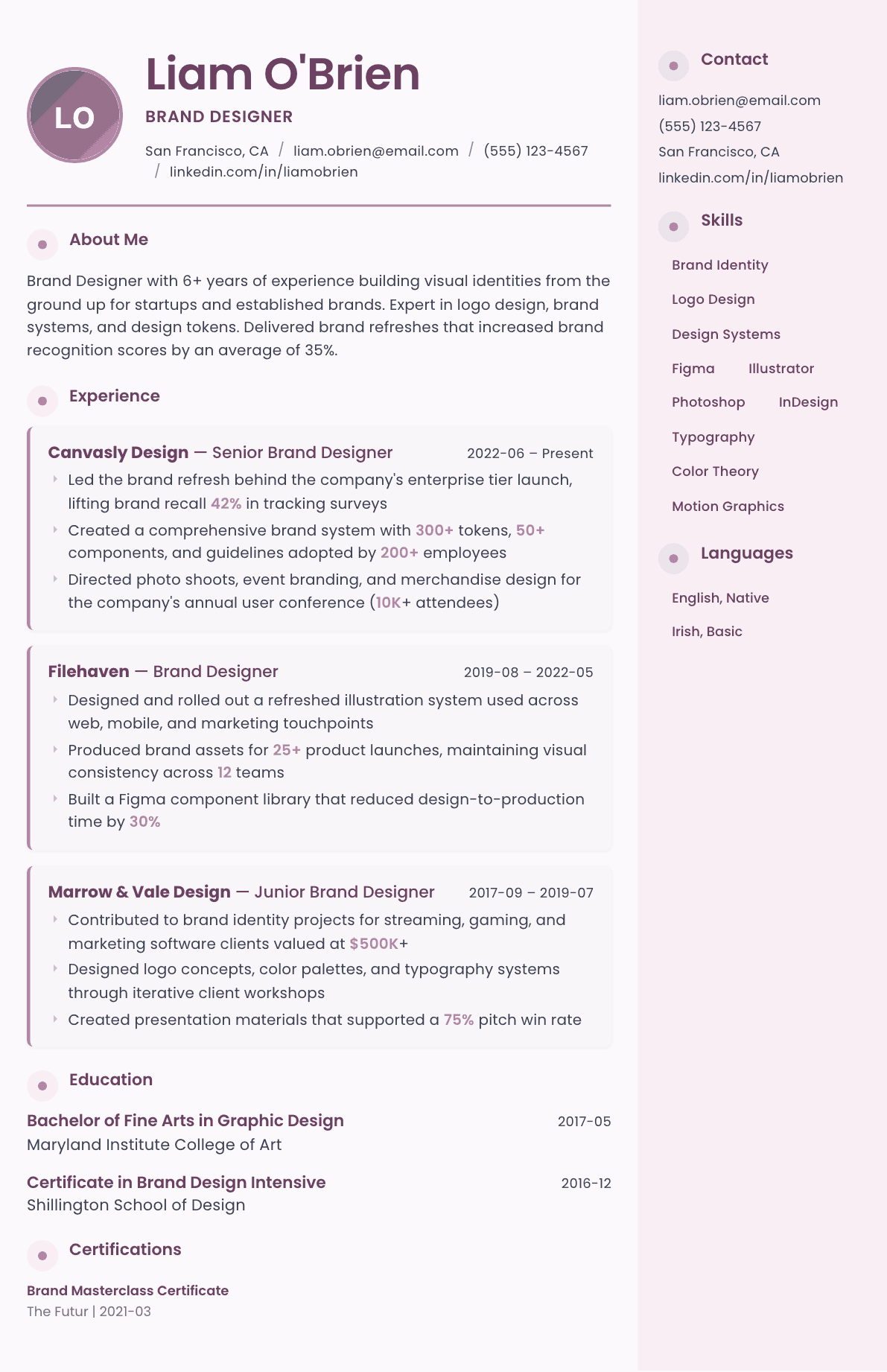
Example Brand Designer summary
Brand Designer with 6 years building visual identities for software and consumer brands from first mark to full system. Built a 300-token, 50-component brand system used by 200+ employees and lifted brand recall 42% on an enterprise launch. Works in Figma, Illustrator, and InDesign.
Skills to list on a Brand Designer resume
- Brand Identity
- Logo Design
- Design Systems
- Visual Identity
- Typography
- Color Theory
- Illustration
- Figma
- Illustrator
- Photoshop
- InDesign
- Presentation Design
- Brand Guidelines
- Print Production
What actually gets this resume read
- Show before-and-after case studies in your portfolio to demonstrate transformative impact.
- Quantify brand impact: recognition scores, engagement lifts, consistency improvements, or revenue effects.
- List the full scope of brand deliverables you can produce: logos, guidelines, templates, environmental, digital.
- Highlight collaboration with marketing, product, and executive stakeholders.
- Mention the scale of systems you have built: number of tokens, components, or teams served.
How to write a brand designer resume
Brand design sits between strategy and craft, and the resume has to prove both halves. A hiring design lead wants evidence that you can hold an idea about what a company means and turn it into marks, type, color, motion and voice that stay coherent when forty other people start using them without you in the room. Craft alone gets you a designer role; the system thinking is what makes it brand design.
The reader is trying to size the scope you have worked at. Designing a logo for a small client is a real project and so is rebuilding the identity of a company with ten product lines and a global partner network, and the two demand different skills. Say plainly which one you have done. Brand designers who inflate scope get found out in the portfolio walkthrough, when the follow up question is who else used this and how did you keep it consistent.
This guide covers the layout brand hiring leads expect, how to describe identity work as a system rather than a set of files, how to write case study lines that make a portfolio worth opening, three summaries from junior through lead, before and after bullets, and the questions brand designers ask most when they rewrite the page.
Format: one page, portfolio link at the top, typeset with care
One page and a portfolio link in the header, written in full. Brand hiring leads open the portfolio first and the resume second, so the page exists to place your work in context: where you did it, at what scope, with whom, and what changed afterward.
Set the page like you would set a piece of work. A single type family used with real hierarchy, generous margins, consistent alignment. Do not brand your resume with a personal logo lockup and a color system unless you are prepared to defend every decision in it, since a brand lead will read the page as a self identity project and judge it accordingly.
- Header: name, title, city, email, portfolio link, and any personal site or writing you want read.
- Sections: summary, experience, selected identity projects, skills and tools, education, recognition if you have any.
- Under each role, give the company or client type, the industry, the team you sat in, and whether you worked in house, at a studio, or independently.
Identity work: describe the system, not the deliverables
The deliverable list is the least interesting part of an identity project. Logo, palette, typography and guidelines appear on every brand designer resume. What distinguishes yours is the thinking: the strategic problem the identity was solving, the decisions you made about how flexible the system needed to be, and how the pieces hold together when applied by people who have never met you.
Say what the system had to survive. A brand used by a sales team in slide decks, by an engineering team in a product interface, by a partner network on printed material, and by a social team every day has different demands than one used on packaging alone. Naming those pressures shows a lead that you design for reality rather than for a case study image.
Include the governance half. Guidelines documents, component and template libraries, asset delivery, onboarding sessions for the teams who use the brand, and the review process for work coming back. Brand design that is not adopted is just artwork, and adoption is a design problem you either solved or did not.
Range: the pieces that prove you can take a brand anywhere
A wordmark is the smallest part of an identity and the part everyone shows. Prove range with the applications that are harder to fake: type systems and the reasoning behind the family choice, color built for accessibility as well as for mood, photography and illustration direction, motion behavior for the mark and for transitions, packaging with real structural constraints, environmental and signage work, and the digital surfaces where the brand meets a product.
Say where you worked with specialists rather than doing everything yourself. Commissioning a custom typeface, briefing an illustrator, working with a motion designer or a fabricator is senior work and is not weakened by naming the collaborator. Leads read it as evidence you can run a project rather than only produce files.
Working with the rest of the company
Brand designers fail on stakeholders far more often than on craft. Name the people you worked with and how: marketing leaders setting the calendar, product design teams who need brand and interface to agree, sales teams who want a logo bigger, founders and executives with strong opinions and no framework. Describe how you presented, how you got a decision, and how you handled the round where somebody senior wanted a different direction.
If you have run a rebrand rollout, that is the single most valuable paragraph on the page. Sequencing the launch, migrating existing material, briefing every internal team, and holding consistency in the first six months are the parts that go wrong. Anyone who has done it once is worth interviewing on that alone.
Skills, tools and search terms
List the tools you actually work in for vector drawing, layout, interface design and prototyping, plus whatever you use for motion and for building presentation material. Add production knowledge such as print specification, color management across screen and press, packaging dielines, and how you hand off to a web or product team.
Recruiters search for brand identity, visual identity, logo design, brand systems, brand guidelines, typography, art direction, packaging, and increasingly for design system and token language where brand and product overlap. Use the terms honestly. If your work is identity only and not product, do not claim a system role you have not held.
Brand Designer resume summary examples
Junior brand designer
Junior brand designer with 2 years at a small studio, working on identity projects for local hospitality and nonprofit clients. Draws marks and type systems, builds guideline documents and templates, and has taken 4 identities from research through client presentation and rollout.
Mid level, in house
Brand designer with 6 years, currently the second designer on an in house brand team at a consumer software company. Owns the type and color system, illustration direction and campaign toolkits, and runs quarterly reviews of work coming from regional marketing teams.
Lead brand designer
Lead brand designer with 11 years across studio and in house work, including two full rebrands taken from strategy to launch. Directs a team of 3 designers plus commissioned illustrators and motion partners, and owns brand governance across product, marketing and partner channels.
Work experience bullets: before and after
Before: Designed a new logo and brand guidelines.
After: Rebuilt the identity for a consumer subscription business, drawing the mark and a two family type system, then writing guidelines that covered flexible lockups, minimum sizes and the cases where the mark should not appear at all.
Naming the constraints and the negative rules shows a designer who thought about how the system fails, not only how it looks.
Before: Created brand assets for the marketing team.
After: Built a campaign toolkit of layout templates, type styles and photography rules that the marketing team used to produce their own assets, cutting the number of one off design requests each month.
Enabling other people to make on brand work is the leverage that separates brand design from a request queue.
Before: Worked on the rebrand rollout.
After: Sequenced a rebrand launch across the website, product interface, sales material and two office spaces, running briefing sessions for each internal team and reviewing their first output before it went out.
Rollout sequencing and internal briefing are where rebrands actually succeed or fail, and few resumes mention either.
Before: Chose colors and fonts for the brand.
After: Selected a type family with a full weight range for interface use and built a palette tested for contrast on both light and dark backgrounds, documenting the accessible pairings for product and marketing.
Grounding the choice in real usage and accessibility replaces taste with reasoning a lead can evaluate.
Before: Presented design work to stakeholders.
After: Presented identity routes to the founders and the marketing lead, framing each around the positioning it supported, and used a stress test on the weakest applications to bring the room to one direction.
Showing the method used to reach a decision proves you can move a stakeholder group rather than only show work to it.
Hard skills
- Logo and mark design
- Typography and type system selection
- Color systems and accessible contrast
- Brand guidelines authoring
- Template and toolkit design
- Illustration direction
- Motion direction for identity
- Packaging and print production
- Environmental and signage design
- Layout and editorial design
- Vector drawing and prototyping software
- Brand governance and review process
Soft skills
- Explaining a decision without jargon
- Handling a strong opinion from a founder
- Editing your own work down
- Briefing specialists clearly
- Patience through a long rollout
Mistakes that cost brand designer candidates the interview
- Listing deliverables instead of the system, which reads as a file inventory rather than as brand thinking.
- Overstating the scope of an identity project, a claim that unravels in the portfolio walkthrough.
- Showing only the mark and never the applications, so a lead cannot tell whether the system holds up in use.
- Skipping adoption and governance, when unused brand work is the most common failure in this job.
- Branding the resume itself with a personal logo and palette you are not ready to defend in an interview.
- Claiming design system experience when the work was identity only, since the two hire from different teams.
Brand Designer resume questions
What is the difference between a brand designer and a graphic designer resume?
A graphic designer resume can lead with execution across many kinds of work. A brand designer resume has to show systems: how a set of decisions holds together across applications, who used them, and how consistency was maintained after the launch.
How many projects should the portfolio show?
Three to five identity projects with real depth beats a gallery. Show each one from the problem through the system to the applications in use. Hiring leads read depth as evidence of thinking and volume as evidence of a freelance queue.
Should I include client work from a studio where I was not the lead?
Yes, with your role stated plainly. Say whether you led the project, drew a particular part, or produced applications from someone else direction. Being honest about a supporting role on strong work is far safer than implying ownership.
How do I show brand work that never launched?
Include it and label it as unlaunched or as a concept, with the reason if you can share it. Projects die for budget and leadership reasons that say nothing about the design. What you cannot do is present unlaunched work as if it shipped to market.
Do brand designers need to know product or interface design?
Not always, but the overlap is growing and it widens the roles you can apply for. If you have worked on interface type scales, component styling or design tokens, say so specifically. If you have not, keep the resume focused on identity rather than claiming both.