Visual Designer Resume Examples: the lines they read
Build a Visual Designer Resume That Proves Craft and Systems Thinking
By Mustafa Tarabya, founder of CVBooster · Published · Updated
Visual designer resume example with design system work, Figma craft, portfolio guidance, ATS keywords and a full writing guide.
Sample resumes for a visual designer
The same visual designer content laid out in three CVBooster templates, so you can see what the finished document looks like before you write a word.
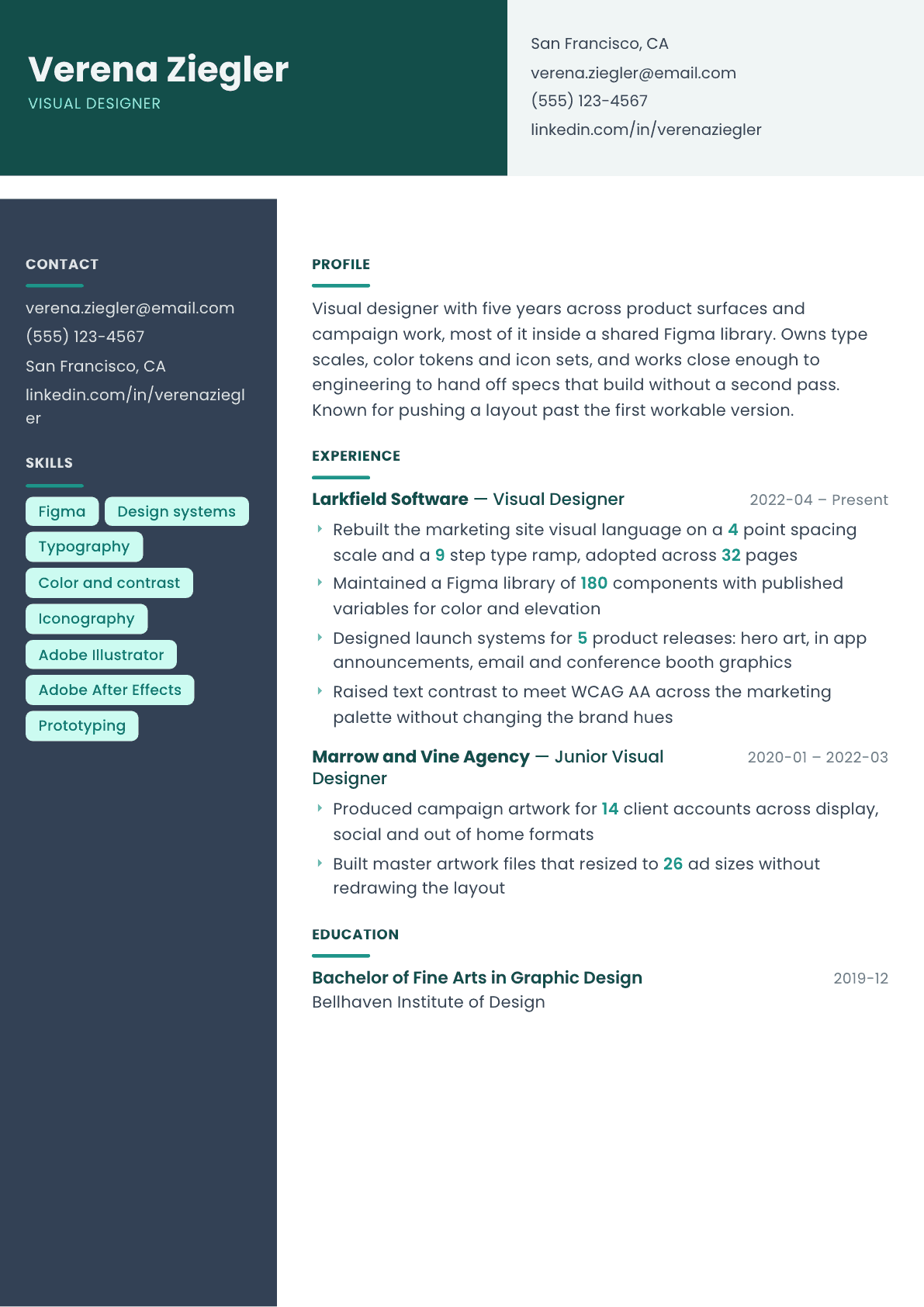
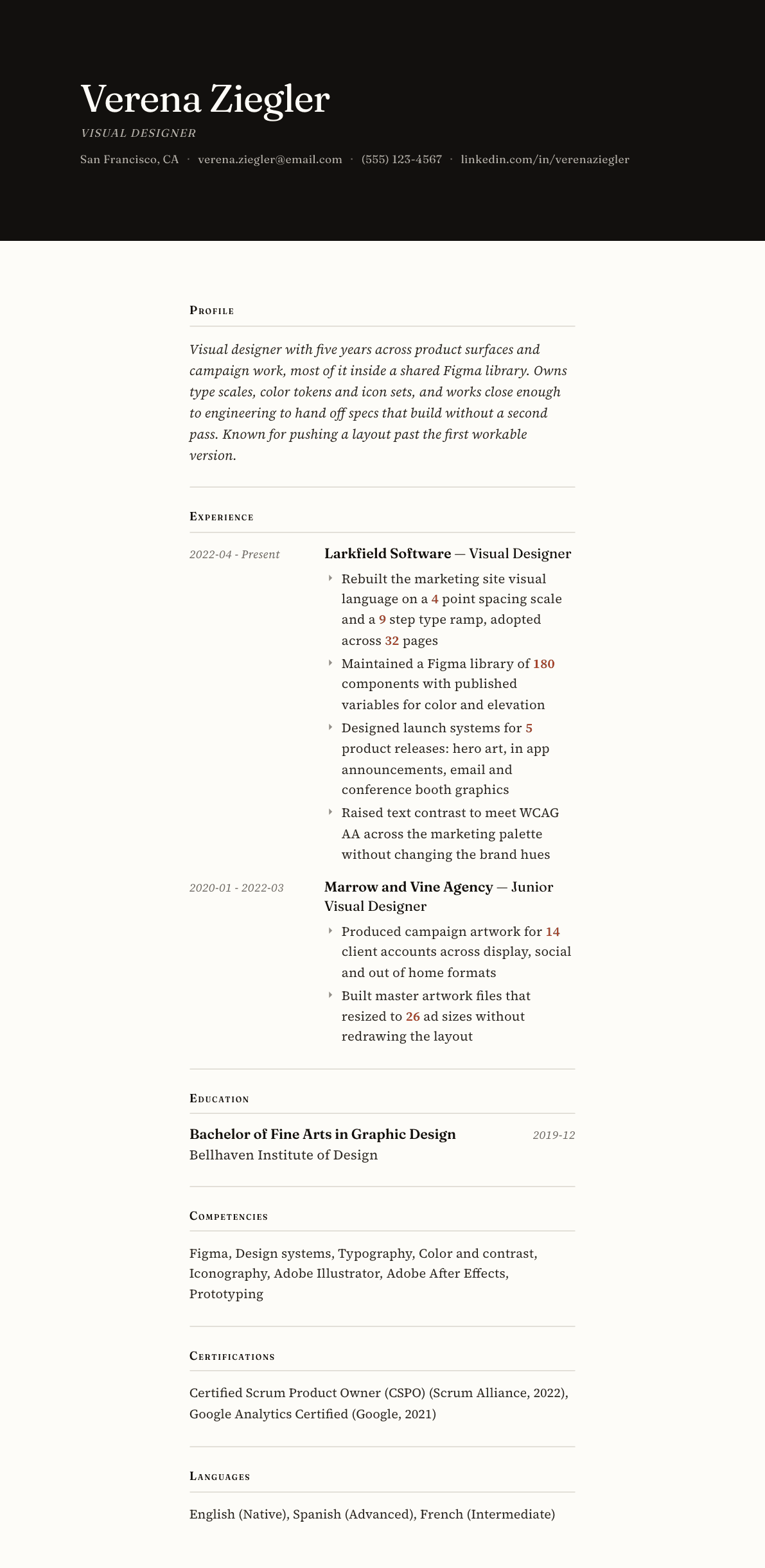
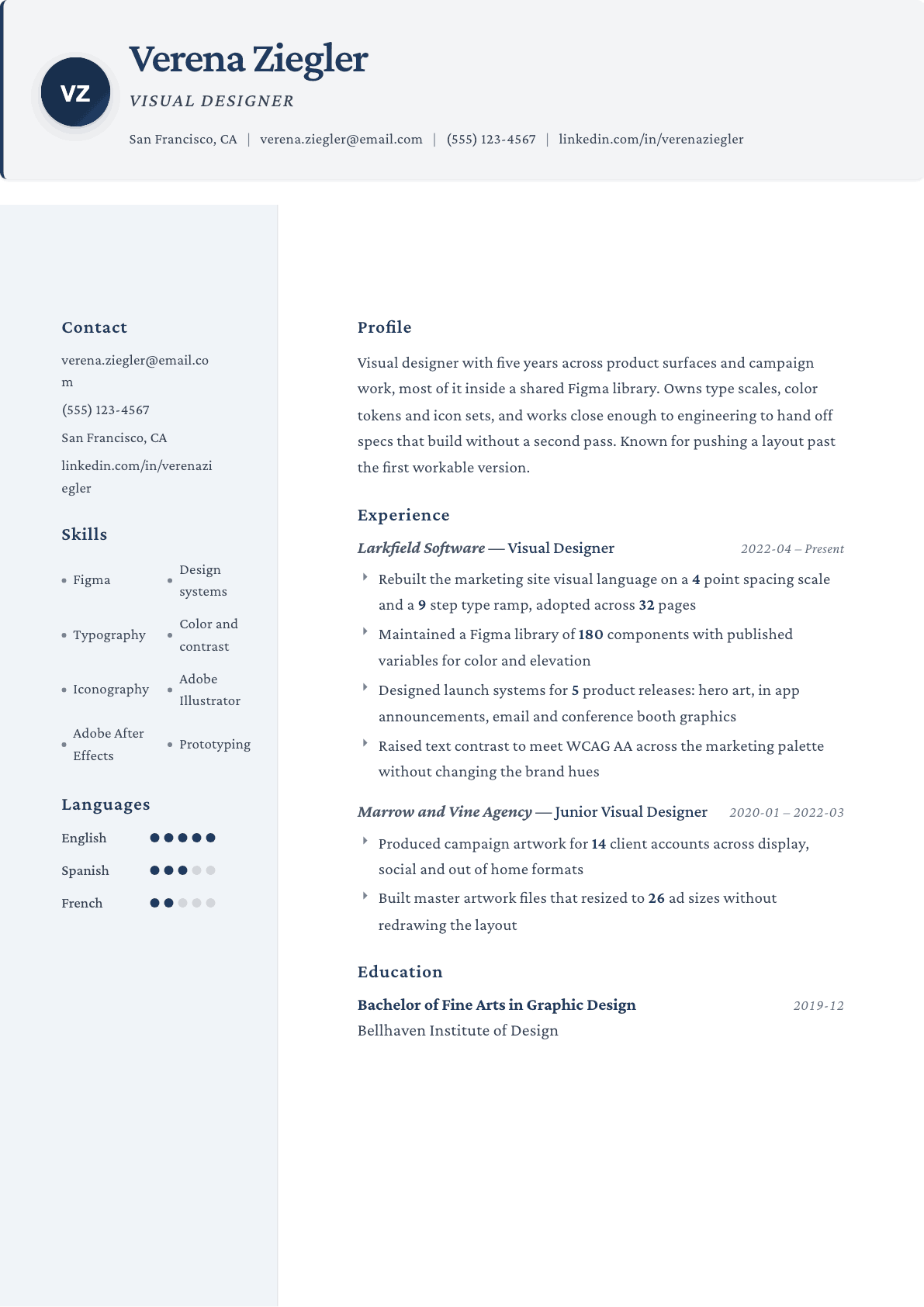
Example Visual Designer summary
Visual designer with five years spanning product interface work and campaign art direction. Owns a Figma library of components, type ramps and color tokens, and hands off specs engineers build from without rework. Rebuilt a marketing site on a single spacing system across dozens of pages and raised palette contrast to meet accessibility guidance. Looking for a team where the design system is treated as a product.
Skills to list on a Visual Designer resume
- Figma
- Design systems
- Typography
- Color theory
- Layout and composition
- Iconography
- Adobe Illustrator
- Adobe Photoshop
- Adobe After Effects
- Prototyping
- Design tokens
- Accessibility and contrast
- Art direction
- Motion basics
- Brand identity
What actually gets this resume read
- Open with the surfaces you design for: product UI, marketing, brand, or all three, because those hire differently.
- Quantify the system, not the taste: components maintained, pages migrated, ad sizes derived from one master file.
- Name the handoff practice, including specs, tokens and how engineers picked up your files.
- Show accessibility work such as contrast ratios and type minimums, since hiring managers now screen for it.
- Put two or three case study links inline next to the jobs they belong to rather than only in the header.
- Avoid listing every Adobe application; name the four you actually work in daily and go deeper on those.
How to write a visual designer resume
Visual designer is one of the least standardized titles in the industry. At one company it means product interface surfaces inside a shared component library. At another it means campaign art direction, hero illustration and conference booth graphics. At a third it means both, with a marketing site attached. The person screening your resume already knows which of those three jobs is open, and the first thing they look for is whether you have done that one.
The second thing they look for is systems evidence. Craft is assumed at this level, and the portfolio proves it anyway. What the resume has to prove is that your files are structured, your type ramp and color tokens are deliberate, and an engineer can build from your handoff without a second round of questions. That is the difference between a designer who makes beautiful screens and one who keeps a product visually consistent as it grows.
This guide covers how to signal surface and seniority in the first three lines, how to write experience bullets that quantify a system rather than taste, which accessibility work to include, and where case study links belong.
Format: one page under six years, links placed next to the work
Reverse chronological, one page for most visual designers and two only when the credit list genuinely needs it. Skip the sidebar template with skill rating dots. A design team reads the layout as a work sample, and a five dot rating on Figma tells a hiring manager nothing they cannot learn in the first ten minutes of an interview.
Put the main portfolio link in the header, then place two or three case study links inline beside the jobs they belong to. A reviewer looking at your last role should be able to jump straight to that work rather than hunting through a site index for the project you just described.
- Header: name, title, city, email, portfolio address, and a case study index if the site is large.
- Sections: summary, experience with inline project links, skills grouped by purpose, education, selected recognition.
- One clean typeface, real hierarchy, and left aligned dates in a fixed column.
Summary: the surfaces you design, the years, the system you own
Open by naming the surfaces: product interface, marketing, brand, motion, or the combination. Then the years, then the thing you are known for. A visual designer who owns type scales, color tokens and an icon set is a different hire from one who art directs campaign photography, and the summary is where a screener sorts you into the right pile.
End with the environment you want. A designer who says they want a team that treats the design system as a product filters out three postings and lands harder on the fourth. Vague ambition reads as no preference at all.
Experience: quantify the system, not the taste
Craft claims cannot be checked on a resume, so write the countable parts. Components maintained in a published library, pages migrated to a new spacing scale, ad sizes derived from one master artwork file, releases you designed the full launch system for, teams that adopted the ramp you set. These numbers describe scope, and scope is how seniority is judged.
Name the structural decisions underneath the work. A 4 point spacing scale, a nine step type ramp, published variables for color and elevation, a naming convention that survived a library migration. A hiring manager who has maintained a library recognizes those details instantly and reads them as proof you have done the unglamorous half of the job.
Include the handoff practice explicitly. Say what engineers received, whether the tokens matched the code, and how many rounds a typical build took. Designers who cut rework are rare enough that saying it plainly stands out.
Accessibility and quality: include the checks you run
Contrast ratios, minimum type sizes, focus states, target sizes and color independent status indicators are now screened for in interviews, and most portfolios say nothing about them. One line describing how you raised text contrast to meet an accessibility standard without changing brand hues shows judgment, restraint and technical understanding at once.
Add your visual quality pass if you have one: cross browser checks, dark mode, rendering on low density screens, and what you catch before release. Visual designers who own that pass are the reason a release looks finished.
Skills: group them so a scanner finds the one it wants
Split the list into design tools, system work, and adjacent craft. Do not list ten Adobe applications. Name the four you work in weekly and go deeper: what you do in After Effects, whether Illustrator work is icon drawing or illustration, whether prototyping means click through flows or motion specs.
Mirror the exact vocabulary of the posting once in the skills section and once inside a bullet. Postings for this role recur around design systems, design tokens, typography, iconography, art direction, prototyping and brand identity, and those phrases are what a keyword filter is set to find.
Visual Designer resume summary examples
First design job
Visual designer with 2 years of agency campaign work across display, social and out of home formats. Built master artwork files that resized to 26 ad sizes without redrawing a layout, and maintained brand consistency across 14 client accounts. Moving toward product and design system work on an in house team.
Five years in
Visual designer with 5 years across product surfaces and campaign work, most of it inside a shared Figma library of 180 components with published color and elevation variables. Rebuilt a marketing site on a 4 point spacing scale and a 9 step type ramp across 32 pages. Wants deeper ownership of a growing design system.
Lead visual designer
Lead visual designer with 9 years setting the visual language for product and marketing surfaces at two software companies. Owns type scales, color tokens, iconography and launch systems, partners closely with engineering on handoff, and raised palette contrast to meet accessibility guidance. Mentors three designers and reviews all outgoing work.
Work experience bullets: before and after
Before: Maintained the company design system in Figma.
After: Maintained a Figma library of 180 components with published variables for color and elevation, and ran a quarterly audit that retired 30 detached one off styles.
Component counts and an audit habit show ownership of the library rather than occasional contribution to it.
Before: Redesigned the marketing website.
After: Rebuilt the marketing site visual language on a 4 point spacing scale and a 9 step type ramp, then migrated 32 pages onto it with the content team over two release cycles.
Naming the underlying scales and the migration scope turns a redesign claim into system work.
Before: Worked closely with engineers on handoff.
After: Delivered annotated specs with token names matching the code base, which brought most launch pages through visual review in a single build pass.
The mechanism of the collaboration is what a hiring manager wants, not the fact that it happened.
Before: Improved accessibility across the brand palette.
After: Raised text contrast to meet WCAG AA across the marketing palette by adjusting tints and text weights, keeping the original brand hues intact.
Naming the standard and the constraint proves real accessibility work instead of a general intention.
Before: Designed assets for product launches.
After: Designed complete launch systems for 5 product releases: hero art, in app announcement screens, lifecycle email, and conference booth graphics from one visual idea.
Listing the surfaces shows range and the discipline of carrying one concept across all of them.
Hard skills
- Figma
- Design systems and component libraries
- Design tokens and variables
- Typography and type scales
- Color and contrast
- Iconography
- Layout and composition
- Adobe Illustrator
- Adobe Photoshop
- Adobe After Effects
- Prototyping
- Art direction
- Accessibility standards
- Design handoff and specs
Soft skills
- Critique and feedback
- Cross functional partnership
- Design rationale writing
- Mentoring
- Prioritizing under release pressure
Certifications worth listing
- Certified Professional in Accessibility Core Competencies (CPACC) (International Association of Accessibility Professionals)
- Adobe Certified Professional in Visual Design Using Adobe Photoshop (Adobe)
Mistakes that cost visual designer candidates the interview
- Not saying which surfaces you design for, so a screener cannot tell product work from campaign work.
- Listing the entire Adobe suite instead of the four applications you actually work in weekly.
- Describing craft with adjectives when the countable parts of the system are what prove seniority.
- Hiding every project behind a single portfolio link with no inline case study next to the relevant job.
- Skipping accessibility entirely, which is now a standard interview topic for this role.
- Using skill rating bars, which a design team reads as a substitute for evidence.
Visual Designer resume questions
What is the difference between a visual designer and a product designer resume?
A product designer resume leads with problems, research and outcomes. A visual designer resume leads with craft and systems: type ramps, color tokens, iconography, art direction and the visual consistency of a growing product. Show interaction work if you do it, but do not bury the visual evidence.
How many case studies should the portfolio hold?
Four to six deep ones beat twelve shallow ones. Each should show the constraint, the visual decisions and the final result across the surfaces it shipped on. Put a short process section in each so a reviewer sees judgment as well as the finished screens.
Should I include motion work?
Yes if you produce it. Name what you actually do: interface micro interactions, launch animation, or full After Effects sequences. Link a short reel rather than embedding video, and keep motion claims proportionate to what a reviewer will find in the portfolio.
How do I show design system work if I was not the owner?
Describe your contribution precisely: components you authored, tokens you defined, documentation you wrote, or audits you ran. Contributor level system work is respected as long as you do not claim ownership a reference call would contradict.
Does the resume matter when the portfolio is strong?
It matters for the screening pass before anyone opens the portfolio. Recruiters filter on title, tools, years and keywords, and hiring managers use the resume to decide which case studies to read first. Treat it as the map to the work.