Sound Designer Resume Examples: the lines they read
Craft a Sound Designer Resume That Resonates
By Mustafa Tarabya, founder of CVBooster · Published · Updated
Create a sound designer resume that showcases your audio production, Foley, and spatial audio skills with templates tailored for creative audio professionals.
Sample resumes for a sound designer
The same sound designer content laid out in three CVBooster templates, so you can see what the finished document looks like before you write a word.
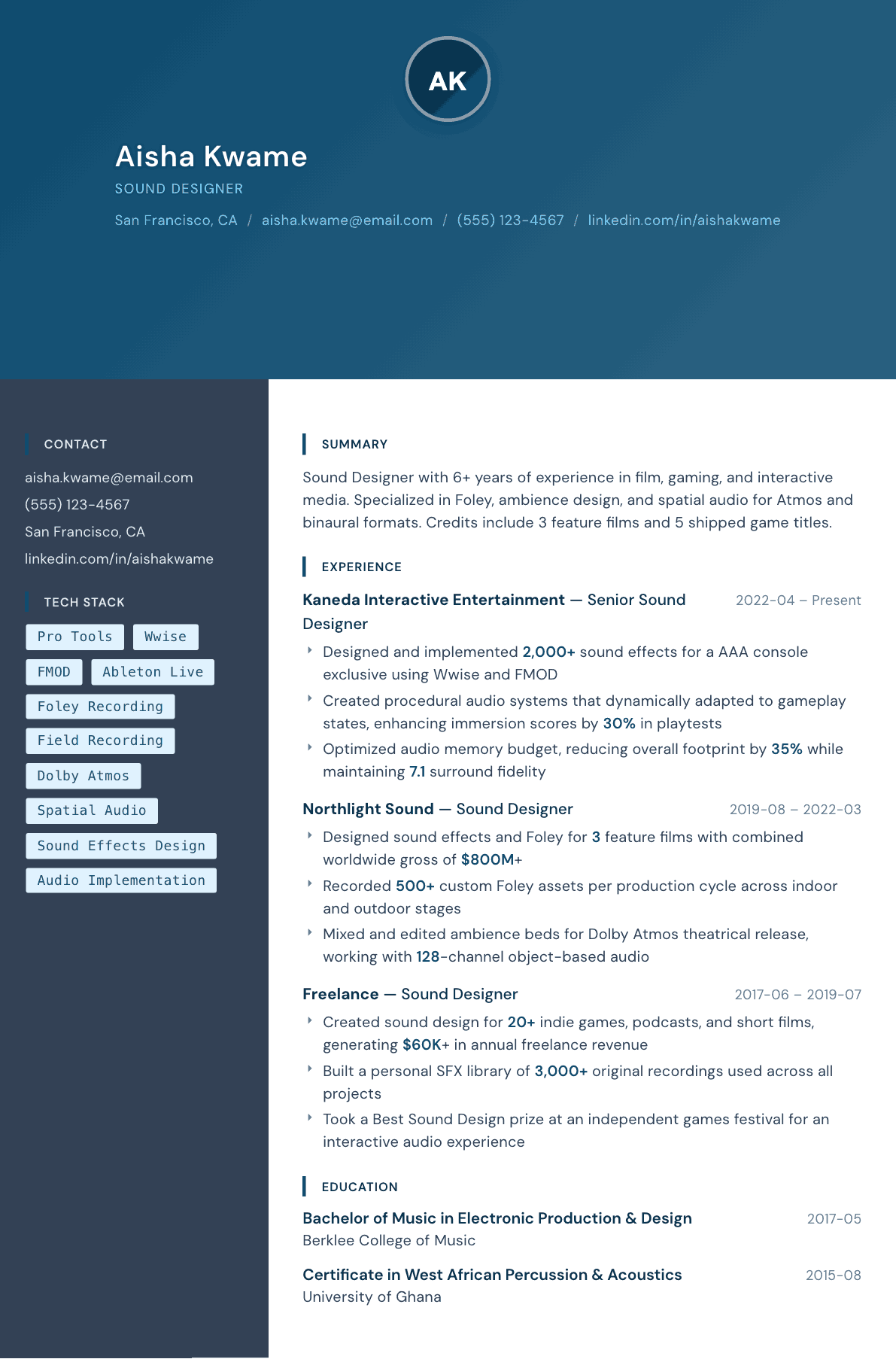
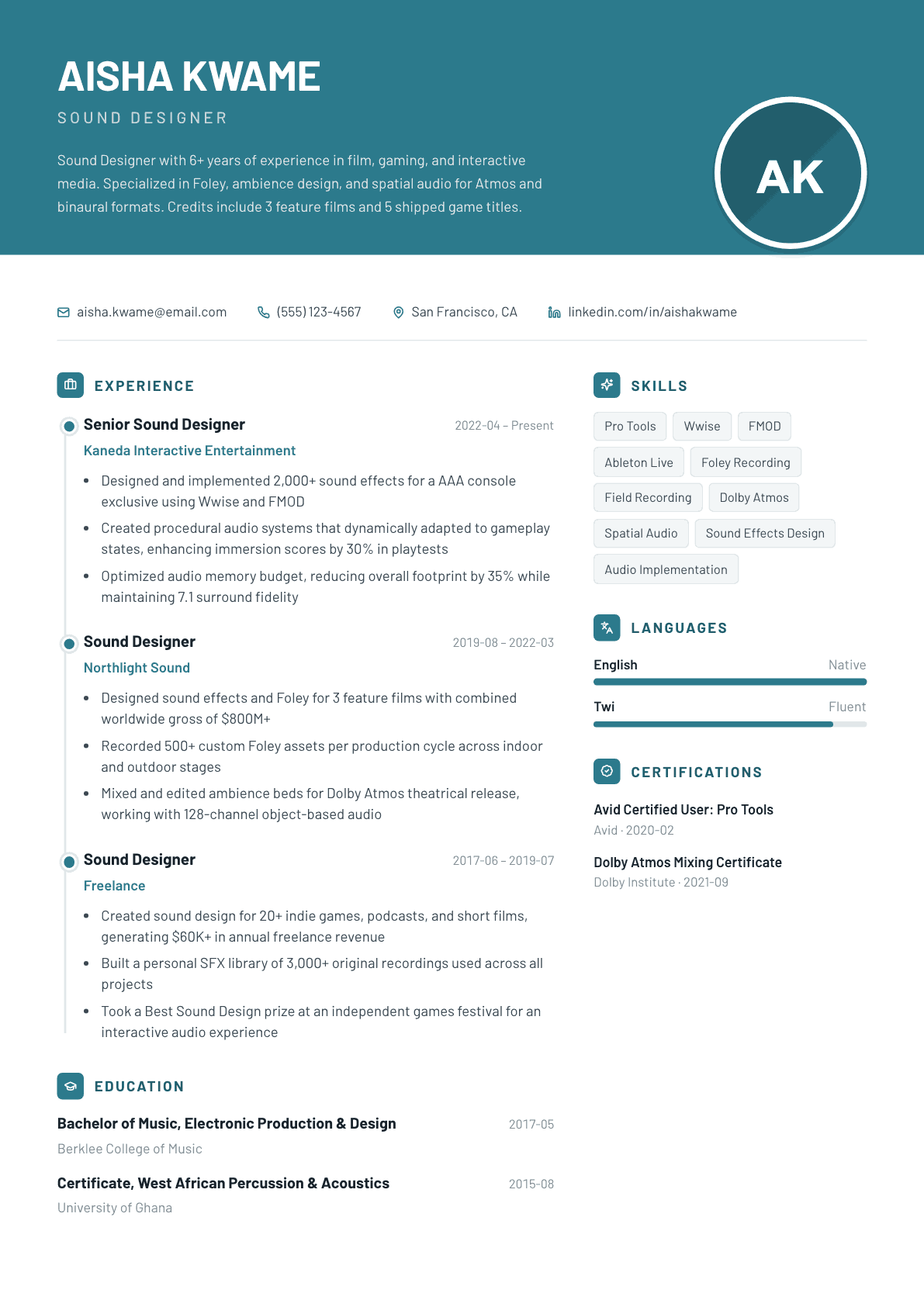
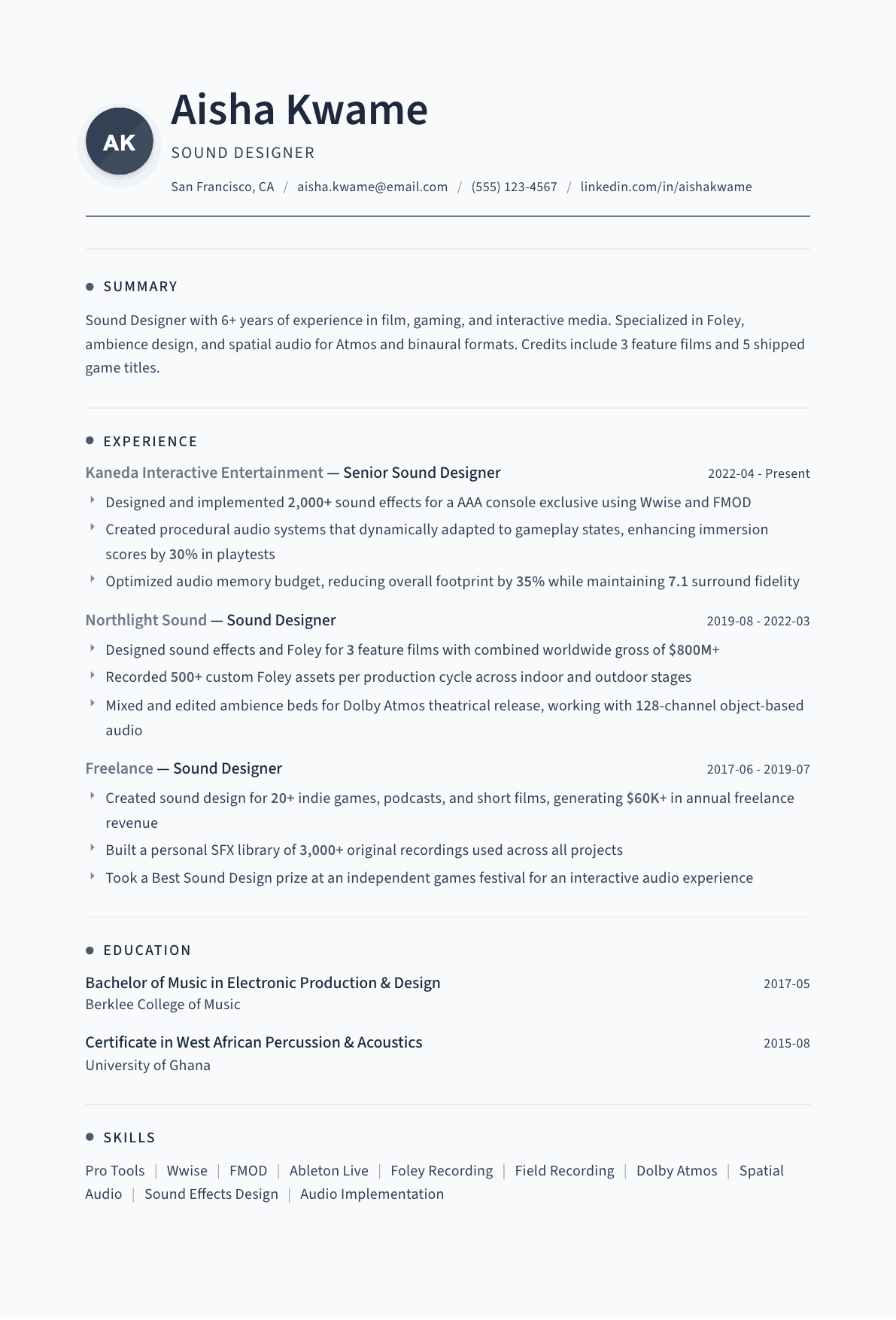
Example Sound Designer summary
Creative Sound Designer with 6 years of experience across film, gaming, and interactive media. Expert in Wwise, Pro Tools, and Dolby Atmos with credits on 3 feature films and 5 shipped game titles. Designed 2,000+ original sound effects and took a festival Best Sound Design prize.
Skills to list on a Sound Designer resume
- Pro Tools
- Wwise
- FMOD
- Ableton Live
- Logic Pro
- Foley Recording
- Field Recording
- Dolby Atmos
- Spatial Audio
- Sound Effects Design
- Audio Implementation
- Mixing & Mastering
- Dialogue Editing
- Music Composition
What actually gets this resume read
- Include a link to your sound reel or Soundcloud/Bandcamp with curated examples of your work.
- List specific credits: film titles, game titles, series -- verifiable work builds trust instantly.
- Mention middleware tools (Wwise, FMOD) and DAWs (Pro Tools, Ableton) to match technical job requirements.
- Highlight specialized skills: Foley, field recording, spatial audio, procedural audio, or music composition.
- Quantify your output: sound effects created, assets delivered, memory optimizations, or turnaround improvements.
How to write a sound designer resume
Sound design hiring is credit driven and pipeline specific. The supervising sound editor, audio director or studio lead reading your resume wants to know which projects you worked on, what you personally cut or built, and whether you can be dropped into their session structure and delivery spec without slowing the schedule. Everything else is decoration.
The word covers at least three separate jobs. In film and television, a sound designer cuts effects and creates the sounds that do not exist, then hands sessions to a re-recording mixer. In games, the job is half creative and half technical: designing assets, then implementing them in middleware with states, parameters and memory budgets. In theatre and live events, it is system design, plotting and running a show. A resume that does not declare which of these you are will not be read by any of them.
This guide sets out the credit-first layout that audio departments expect, three summaries at different levels, before and after bullets that make session work legible, and the questions sound designers hit when they try to compress a reel into a page.
Format: one page, reel link in the header, credits before duties
One page, with a second page for a long credit list only. The header carries name, location, phone, email and a link to a reel that plays without a download. Say in one line what the reel contains and how to listen: stereo or binaural, and whether the pieces are your work alone or a team mix you contributed to. Audio people are unusually strict about attribution and will notice if you are vague.
Section order: summary, selected credits, experience, technical proficiency, equipment and studio, education, awards. In games, add a middleware and engine line high on the page, because it is the first filter an audio director applies.
- Every credit needs the title, the format, the studio or production company, your role and the year.
- State your exact function on each project: sound design, Foley editing, dialogue editing, implementation, or mix.
- Link a reel that streams, and keep individual asset breakdowns in the portfolio rather than the resume.
- Say whether you have your own recording rig and edit suite, because it changes what a remote contract can ask of you.
Summary: medium, specialty, delivery format, credit anchor
Open with the medium you work in and the part of the chain you own. Designing hard effects and creature vocalizations is not the same job as cutting backgrounds, and neither is the same as implementing a system in middleware. Then name the delivery formats you have actually delivered to: stereo, 5.1, 7.1, Dolby Atmos, binaural, or a console platform spec.
Finish with a credit anchor. One recognizable feature, series or title tells a supervisor more about your level than three sentences about your passion for texture and detail.
Credits and experience: the session, not the vibe
Under each credit, write what you did at the level a supervisor would check. Asset counts are meaningful in this trade: the number of designed effects, the number of Foley cues cut, the number of ambience beds built, the number of minutes of dialogue edited. So are the constraints you worked inside: a memory budget, a voice count, a turnaround, a locked picture date.
Name the source of your material. Designers who record their own material are worth more than designers who assemble libraries, so say what you recorded, on what, and where: field recording sessions, a Foley stage, a prop build, vehicle or weapons recording, a controlled room for creature performance.
For games, describe the implementation as its own work. Building an event structure in Wwise or FMOD, driving parameters from gameplay state, writing blueprints or scripts to trigger audio, profiling memory and streaming, and mixing with real time snapshots are all engineering tasks a studio has to staff, and a designer who can do them is hired ahead of one who hands off assets.
- Give one bullet to what you designed, one to what you recorded, one to how it was delivered or implemented.
- Include the picture editorial and turnaround pressure when it was real, since schedule tolerance is part of the hire.
- Note collaboration with composer, dialogue and mix teams, because handoff discipline is what supervisors complain about.
- Mention loudness and delivery compliance for broadcast and streaming, since a failed QC costs the vendor money.
Technical block: tools, formats and the parts people forget
Split the technical section so it can be scanned. Editing and mixing environment first: Pro Tools, Reaper, Nuendo, and the plugin families you actually rely on for pitch, granular, convolution and spectral repair. Then synthesis and processing skills, since designing a sound that has never existed is a synthesis problem before it is an editing one.
Then implementation and delivery. For games that means Wwise, FMOD, Unreal and Unity, plus profiling and platform submission requirements. For picture that means AAF and OMF conform, session handover, stems, printmaster deliverables and loudness targets for the platform. For theatre and live it means QLab, show control, system design and prediction software, network audio and console programming.
Recording gear belongs here in short form: the recorder class, the microphones you own or are fluent on, and whether you have a treated space. It matters because half of a designer's advantage is a personal library that nobody else has.
The library, the awards and the keyword layer
A personal sound library is an asset a studio can benefit from, so it is worth a line: the size, what it covers, and how it is metadata tagged and searchable. A designer with a deep tagged library of original recordings solves problems faster, and supervisors know it.
Awards go near the bottom and only from bodies a reader recognizes, such as guild awards, established festivals and industry association recognitions. Job postings across the field reuse a stable vocabulary: sound design, Foley, ambience, hard effects, sweetening, dialogue edit, spatial audio, implementation, middleware, mix stem, conform and delivery spec. Mirror the words the posting uses once in the technical block and once where you demonstrated them.
Sound Designer resume summary examples
First credits
Sound designer with two years on short films, indie games and podcast fiction, cutting effects and ambiences in Reaper and implementing basic event structures in FMOD. Records original material with a portable rig and maintains a tagged library of 3,000 self recorded assets.
Five years in games
Game sound designer with five years across four shipped titles, responsible for weapon, creature and world ambience design plus Wwise implementation. Works to platform memory and voice budgets, drives audio from gameplay state through RTPCs, and profiles mixes on console hardware before submission.
Supervising designer
Supervising sound designer with eleven years in film and episodic television, credited on 9 features and 3 series. Leads a team of four editors, owns the effects and Foley schedule against locked picture, and delivers stems and printmasters for Dolby Atmos theatrical and streaming releases.
Work experience bullets: before and after
Before: Created sound effects for a video game.
After: Designed and implemented 1,800 effects for a console action title in Wwise, driving weapon, traversal and creature audio from gameplay parameters within a fixed voice and memory budget.
It names the asset volume, the middleware, the systems driven and the constraint, which is how an audio director evaluates a designer.
Before: Recorded and edited Foley for films.
After: Cut 400 Foley cues per feature against locked picture on a Foley stage, covering footsteps, cloth and props for three lead characters, and conformed sessions after two picture changes.
Cue counts, coverage and handling picture changes show a supervisor you can hold a schedule, not just make sounds.
Before: Built a library of original recordings.
After: Built a metadata tagged library of original field recordings covering vehicles, water, metal and rural ambience, indexed in a searchable database and used as the primary source on every project since.
Tagging and searchability turn a personal hobby into a production asset the studio can actually use.
Before: Worked with the mix team on final delivery.
After: Prepared and delivered predub stems to the re-recording mixer for a 7.1 theatrical mix and an Atmos near-field pass, meeting the distributor loudness spec on the first QC submission.
Delivery discipline and a clean first QC pass are exactly what a vendor is worried about when hiring.
Before: Made ambiences and backgrounds for the show.
After: Designed 60 minutes of layered ambience beds per episode across a season, building interior and exterior worlds from original recordings and matching continuity across scenes shot months apart.
Duration per episode and the continuity problem show the actual scale and difficulty of background work.
Hard skills
- Sound effects design
- Foley recording and editing
- Ambience and background design
- Dialogue editing and repair
- Field recording
- Synthesis and granular processing
- Pro Tools
- Reaper
- Wwise
- FMOD
- Unreal and Unity audio integration
- Spatial and object based audio
- Stem preparation and delivery specs
- Loudness compliance and QC
Soft skills
- Taking creative notes
- Working to locked picture dates
- Handoff discipline with mix teams
- Problem solving under budget limits
- Communicating audio ideas to non-audio leads
- Library and session organization
Certifications worth listing
- Wwise Certification (Audiokinetic)
- Avid Certified User, Pro Tools (Avid)
- Avid Certified Professional, Pro Tools Post Production (Avid)
- Dante Certification (Audinate)
Mistakes that cost sound designer candidates the interview
- Sending one resume to a film post house, a game studio and a theatre company when each buys a different half of the craft.
- Linking a reel that requires a download or a login, which most supervisors will simply skip.
- Claiming a project credit without stating what you personally cut, built or implemented on it.
- Listing every plugin owned instead of the editing environment, middleware and delivery formats that determine whether you fit the pipeline.
- Omitting implementation entirely on a game resume, which reads as a designer who needs an engineer attached.
- Ignoring delivery specs, conform and QC, the unglamorous work that decides whether a vendor keeps the contract.
Sound Designer resume questions
How long should a sound designer resume be?
One page for the resume itself, with a separate credit list if your filmography or title list runs long. Supervisors read the top third and then go to the reel, so anything that pushes credits below the fold is working against you.
What should be on a sound design reel and how do I reference it?
Two to three minutes of your strongest work, front loaded, with the link in the header. State on the resume whether each piece is your solo design or a team mix, and name what you contributed. Vague attribution is the single fastest way to lose credibility in an audio department.
Do I need to know Wwise or FMOD for a game sound design job?
For nearly every studio role, yes. Designing assets is half the job and implementing them with states, parameters and memory budgets is the other half. Put the middleware and engine on the first third of the page, because it is the first thing an audio director filters on.
How do I show sound design work on projects covered by an NDA?
Describe the format, the scope and the technical work without naming the title: a console action game, a streaming limited series, an unannounced project. Give asset counts, tools and delivery formats. Supervisors understand the constraint and judge the detail you can give.
How do I move from film post into game audio?
Rebuild the page around implementation. Learn one middleware tool properly, build a playable vertical slice that proves you can drive audio from gameplay state, then lead your credits with asset design and library work while the technical block carries Wwise or FMOD and an engine.