Automation Engineer Resume Examples: what gets the call
Program an Automation Engineer Resume That Gets Callbacks
By Mustafa Tarabya, founder of CVBooster · Published · Updated
Create an automation engineer resume showcasing PLC programming, SCADA systems, and industrial controls expertise with quantifiable uptime and efficiency metrics.
Sample resumes for a automation engineer
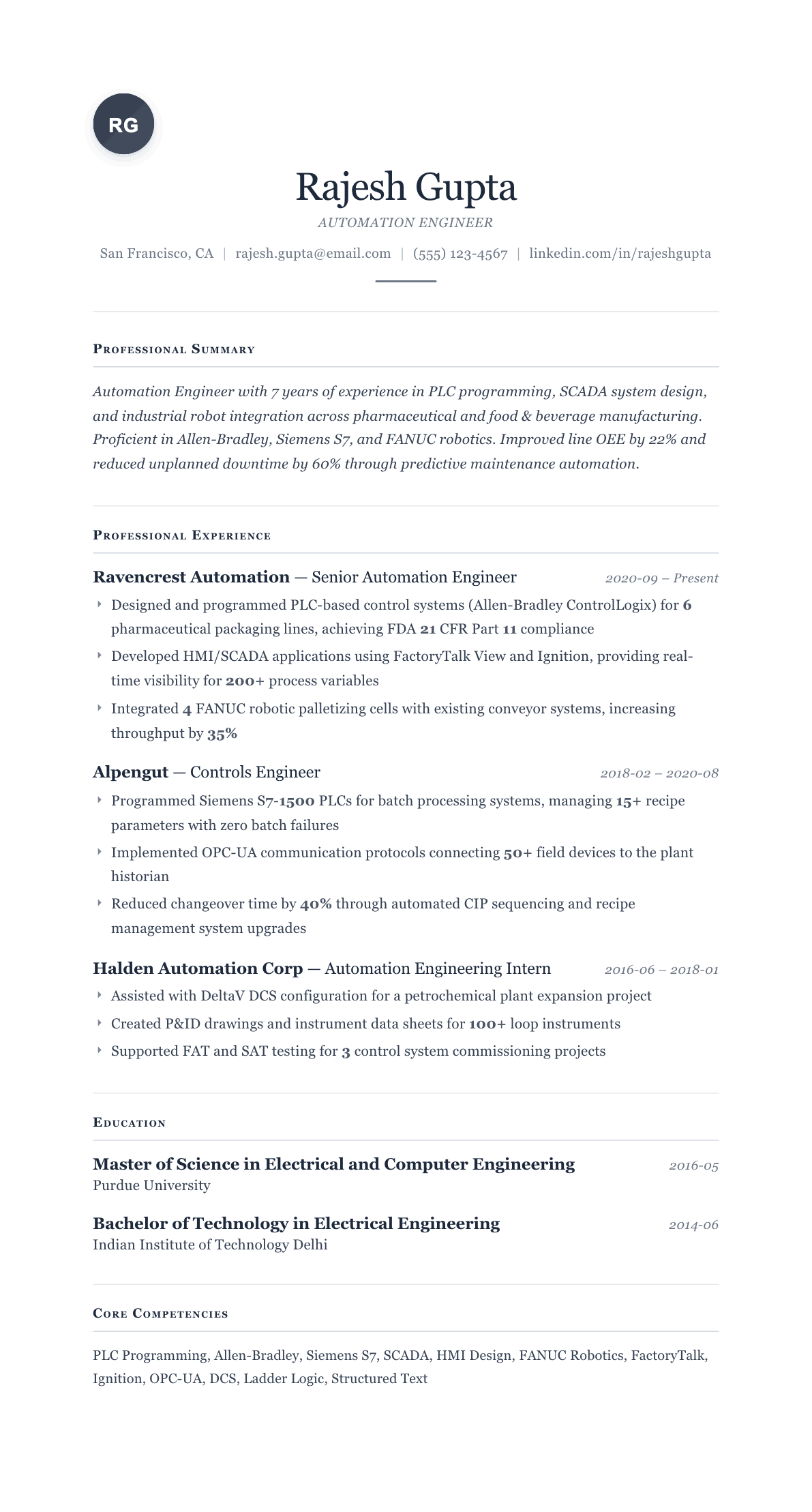
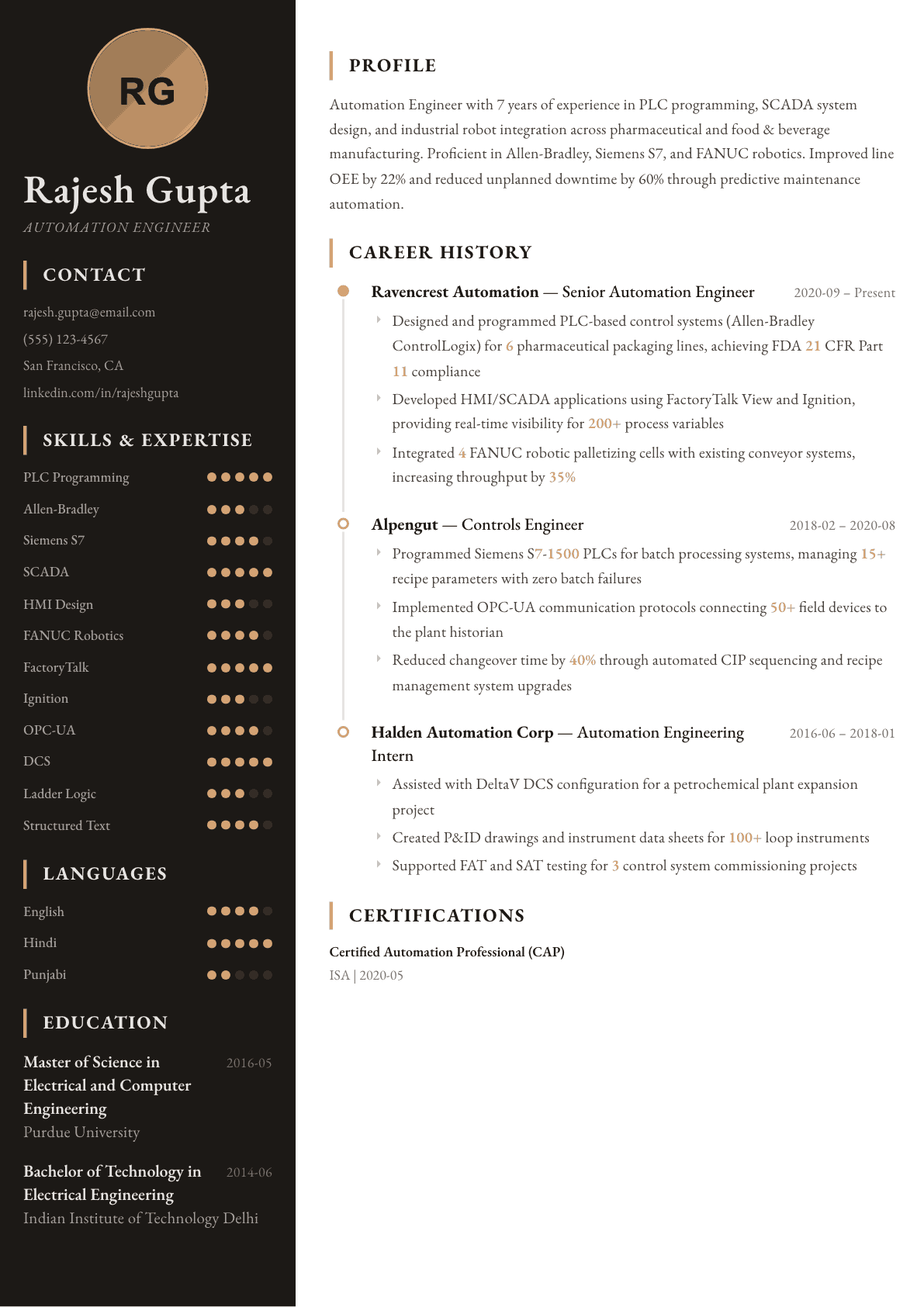
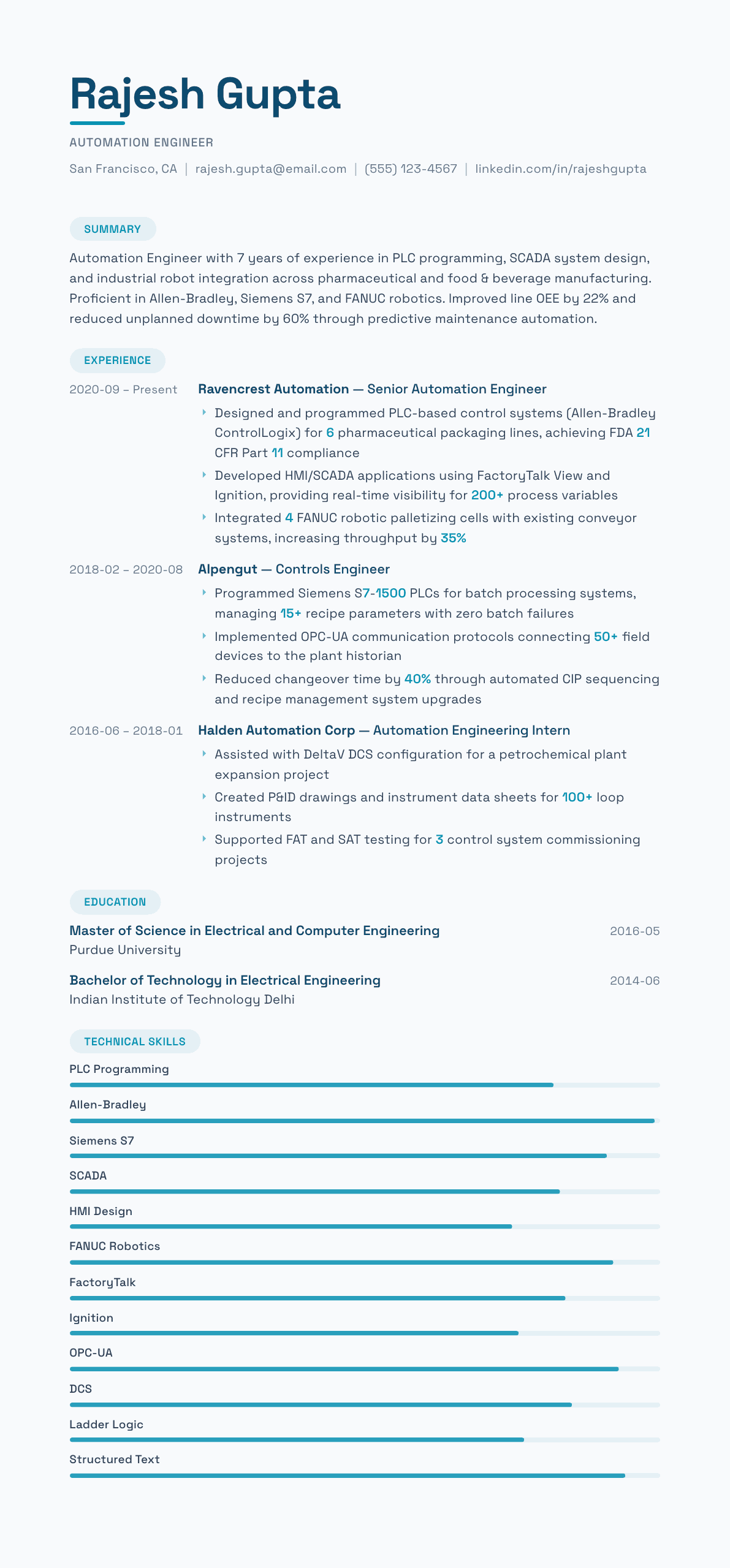
The same automation engineer content laid out in three CVBooster templates, so you can see what the finished document looks like before you write a word.
Example Automation Engineer summary
Certified Automation Professional with 7 years of experience in PLC programming, SCADA design, and industrial robotics integration. Expert in Allen-Bradley and Siemens platforms with strong pharmaceutical and food & beverage industry knowledge. Improved OEE by 22% and reduced unplanned downtime by 60% through intelligent automation solutions.
Skills to list on a Automation Engineer resume
- PLC Programming
- Allen-Bradley ControlLogix
- Siemens S7
- SCADA Design
- HMI Development
- Industrial Robotics
- FANUC
- FactoryTalk
- Ignition
- DCS (DeltaV)
- OPC-UA
- Ladder Logic
- Structured Text
- Electrical Schematics
- Commissioning & SAT
What actually gets this resume read
- List PLC platforms: Allen-Bradley (RSLogix/Studio 5000), Siemens (TIA Portal/S7), Mitsubishi, Omron.
- Specify programming languages: Ladder Logic, Structured Text, Function Block Diagram, Sequential Function Chart.
- Include SCADA/HMI platforms: FactoryTalk, Ignition, WinCC, Wonderware, Citect.
- Quantify automation outcomes: uptime improvements, OEE gains, throughput increases, downtime reductions.
- Mention communication protocols: OPC-UA, Modbus, EtherNet/IP, Profinet, DeviceNet.
- Reference industrial robotics experience: FANUC, ABB, KUKA, Universal Robots.
How to write a automation engineer resume
Automation engineer means two different careers depending on the industry, and the first job of your resume is to remove the ambiguity. In manufacturing, utilities and process plants it means industrial controls: programmable logic controllers, human machine interfaces, supervisory control systems, drives, robots and the safety circuits around them. In software it means test automation. The two share a word and nothing else, so put the discipline in your title line rather than letting a recruiter guess.
For the controls version, hiring is unusually concrete. A controls manager wants to know which platforms you can program without a manual open, whether you have commissioned equipment on a live floor, whether you can be trusted around a safety system, and whether you have worked in a regulated plant where every change needs a paper trail. Those four answers decide the interview.
This guide covers how to present platform fluency, how to write commissioning and startup work, how to handle safety and validation experience, and how to quantify results in the language a plant manager already uses. It includes summaries for a graduate, a mid-level controls engineer and a lead.
Format: platforms visible before the reader scrolls
One page under about eight years, two after that, single column and plain. Put a technical proficiency block immediately below the summary rather than at the bottom of page two, grouped by controller, visualization, network and motion. Controls managers read that block first and use it to decide whether the rest is worth their time.
Name the industries you have worked in near the top as well. Automotive, food and beverage, pharmaceutical, water treatment, oil and gas, packaging and warehouse automation each have their own cadence, regulations and downtime tolerance, and a plant hiring for a validated pharmaceutical line will not shortlist a resume that only shows general packaging work.
- Header: name, discipline in the title line, city, phone, email, travel availability if you do startups.
- Sections in order: summary, platform and technical proficiencies, experience, education, certifications, industries served.
- Add a travel percentage band if you have worked as an integrator, because that is a real screening question.
Summary: platform family, process type, and where you sit
Say the controller family you are strongest in, the type of process you have automated, and whether you work in-house at a plant, for an integrator, or for a machine builder. In-house engineers live with their own code for years and are measured on uptime. Integrators build fast, commission and leave, and are measured on projects delivered and acceptance passed. Machine builders design repeatable standard equipment. Managers hire for one of these.
Add whether you write from scratch or maintain existing code. Taking over a machine with twenty years of undocumented ladder logic is a distinct and valuable skill, and a candidate who can read someone else's program and improve it safely is worth saying so.
Experience: from design through commissioning and back
Follow the actual project lifecycle in your bullets, because that is how a controls manager evaluates depth. Requirements and functional specification, panel and electrical design, controller and visualization development, factory acceptance testing, installation, commissioning and startup, operator training, and then the sustaining phase when the line runs and problems land on you at three in the morning.
The strongest bullets sit at commissioning. Anyone can write code at a desk; far fewer people can stand at a machine that will not run, with production waiting, and find the fault. Say what you started up, how long the window was, how many input and output points or drives were involved, and whether the line met rate on handover.
Sustaining and improvement work deserves equal weight. Root cause analysis on recurring faults, reducing changeover time through recipe handling, adding diagnostics that let maintenance find a problem without an engineer, and pulling process data into a historian are the projects that show you think past the initial installation.
Platforms, networks and the parts people fake
Group platforms honestly by depth. There is a real difference between programming a controller from a blank project, modifying existing routines, and having watched someone else do it. List the development environments by name, the controller families under them, and the visualization or supervisory package you built in, whether that is a plant floor terminal application or a full server-based system with historian and reporting.
Networks are where inexperience shows fastest. Say which industrial protocols you have configured and troubleshot, which device-level buses you have commissioned, how you handled time synchronization, and whether you have set up a data path from the controller to a historian or business system. Add motion and drives separately, because servo tuning and drive commissioning are their own skill and are chronically short in the market.
- Controller platforms with the development software, grouped by depth of use.
- Visualization and supervisory packages, including any reporting or historian work.
- Industrial networks, device buses and the data path to plant systems.
- Drives, servo motion and robot platforms you have commissioned and taught.
Safety, validation and the paperwork that proves discipline
Functional safety experience separates senior candidates. Say whether you have performed or contributed to a machine risk assessment, designed to a required performance level, programmed a safety controller, validated a safety function and documented it. Panel and installation standards matter too if you have designed or reviewed control panels and worked to the electrical standards for industrial machinery.
In regulated plants, the discipline around change is the job. Life science and food manufacturing run on validated systems, so name the deliverables you have written: functional and design specifications, installation, operational and performance qualification protocols, traceability matrices, electronic records and signature requirements, and change control. An engineer who has written and executed qualification protocols is hard to find and should not bury it.
Automation Engineer resume summary examples
Graduate controls engineer
Electrical engineering graduate with a controls focus, an internship at a system integrator and a senior project automating a 4-station test rig with a compact controller and an operator terminal. Comfortable in ladder logic and structured text, and has supported 2 factory acceptance tests end to end.
Five years in
Controls engineer with 5 years in food and beverage packaging, programming Allen-Bradley and Siemens controllers and building operator interfaces for 9 filling and packaging lines. Commissioned 6 lines on site and cut average changeover time by 40% through recipe management and automated cleaning sequences.
Lead automation engineer
Lead automation engineer with 12 years across pharmaceutical and food manufacturing, owning controls architecture for 3 plants and a team of 5 engineers. Delivers validated systems with full qualification documentation, integrates robotic cells, and holds functional safety responsibility for machine risk assessments.
Work experience bullets: before and after
Before: Programmed PLCs for production lines.
After: Programmed 6 packaging lines on ControlLogix from blank projects, covering roughly 900 input and output points each, with structured text recipe handling and a standard fault code scheme reused across all 6.
Point counts, a blank-project start and a reusable standard show engineering depth rather than editing existing code.
Before: Commissioned equipment at customer sites.
After: Commissioned a 3-line filling hall during a 10-day plant shutdown, ran the site acceptance test with the customer and handed over at full rate on day 9.
The window, the acceptance test and the handover condition are what an integrator is actually judged on.
Before: Reduced downtime on the plant floor.
After: Cut unplanned downtime on 4 lines by 60% by adding drive and sensor diagnostics to the operator interface and building a fault history that maintenance could read without an engineer on site.
Naming the mechanism explains how the number happened and shows the improvement outlives you.
Before: Worked with robots on the line.
After: Integrated 4 robotic palletizing cells with existing conveyor control, writing the handshake logic and safety interlocks and teaching the pick and place paths for 12 product formats.
Interlocks, handshakes and format counts prove hands-on integration rather than supervising a vendor.
Before: Followed validation procedures in a regulated plant.
After: Authored and executed installation, operational and performance qualification protocols for 2 batch systems under electronic records requirements, closing 30 test deviations before release to production.
Writing and executing protocols, and closing deviations, is the evidence a life science plant is looking for.
Hard skills
- PLC programming in ladder logic and structured text
- Allen-Bradley ControlLogix and Studio 5000
- Siemens S7 and TIA Portal
- HMI development and operator interface design
- SCADA and supervisory systems
- Distributed control systems
- Industrial networks including EtherNet/IP and Profinet
- OPC UA and historian integration
- Variable frequency drives and servo motion
- Robot integration and path teaching
- Safety controllers and machine risk assessment
- Control panel and electrical design
- Factory and site acceptance testing
- Qualification protocols and change control
Soft skills
- Troubleshooting under production pressure
- Operator and maintenance training
- Working with plant electricians
- Customer handover communication
- Documentation discipline
- On-call composure
Certifications worth listing
- Certified Automation Professional (CAP) (International Society of Automation)
- Certified Control Systems Technician (CCST) (International Society of Automation)
- Certified Functional Safety Engineer (TUV Rheinland)
- Ignition Core Certification (Inductive Automation)
- Professional Engineer (PE) License (State Board of Professional Engineers)
Mistakes that cost automation engineer candidates the interview
- Not saying whether you do industrial controls or software test automation, so the resume matches the wrong postings.
- Listing every controller family as equal when you can only start a blank project on one of them.
- Describing programming work with no commissioning, which leaves a manager unsure you have ever stood at a running machine.
- Skipping the industry, when a validated pharmaceutical plant and a job shop want very different discipline.
- Leaving safety work off the page, when functional safety experience is one of the strongest differentiators available.
- Quoting improvements with no mechanism, which makes a downtime or efficiency number impossible to believe.
- Omitting travel availability for integrator roles, which is a screening question you will be asked anyway.
Automation Engineer resume questions
How do I show PLC skills without exaggerating?
Grade them. Say which platforms you develop on from a blank project, which you modify and maintain, and which you have only supported. Controls interviews go straight to a specific instruction or a fault scenario, so an honest grading protects you.
Is commissioning experience really that important?
Yes. Writing code is common; starting up equipment on a live floor, running an acceptance test with a customer watching and handing over at rate is not. If you have any startup experience, give it its own bullets with the window and the outcome.
Should I list every project I have worked on?
No. Group similar work and give the aggregate, then detail three or four projects that show range: a new build, a retrofit of legacy equipment, a safety or validation project, and an improvement that reduced downtime or changeover time.
What if I came from maintenance or as an electrician?
That background is an advantage and should be visible. Troubleshooting live equipment, reading electrical drawings and knowing how a plant really runs are things graduates lack. Show the transition through code you have written and machines you have commissioned.
How do I write about work under a nondisclosure agreement?
Describe the equipment class, the controller platform, the input and output scale and the result without naming the customer or the product. Say confectionery packaging line rather than the brand, and keep recipes, formulations and process parameters off the page.
Related resume examples
- Robotics Engineer Resume example
- Electrical Engineer Resume example
- Industrial Engineer Resume example
- Controls Engineer Resume example
- Mechatronics Engineer Resume example
- Solar Energy Engineer Resume example