Automotive Technician Resume Examples: read this first
Tune Up Your Career with an Automotive Technician Resume
By Mustafa Tarabya, founder of CVBooster · Published · Updated
Create an automotive technician resume highlighting your ASE certifications, diagnostic skills, and repair expertise.
Sample resumes for a automotive technician
The same automotive technician content laid out in three CVBooster templates, so you can see what the finished document looks like before you write a word.
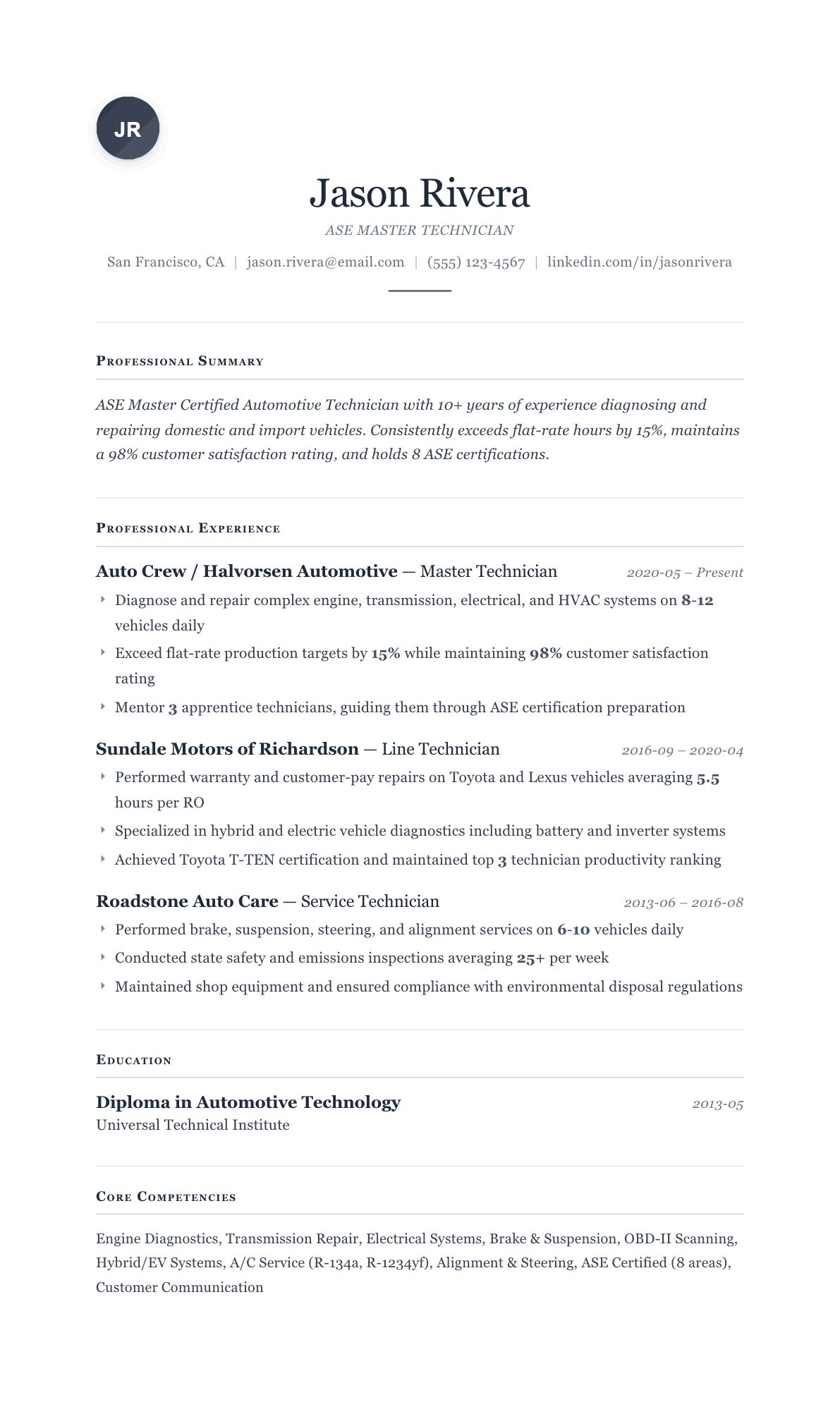
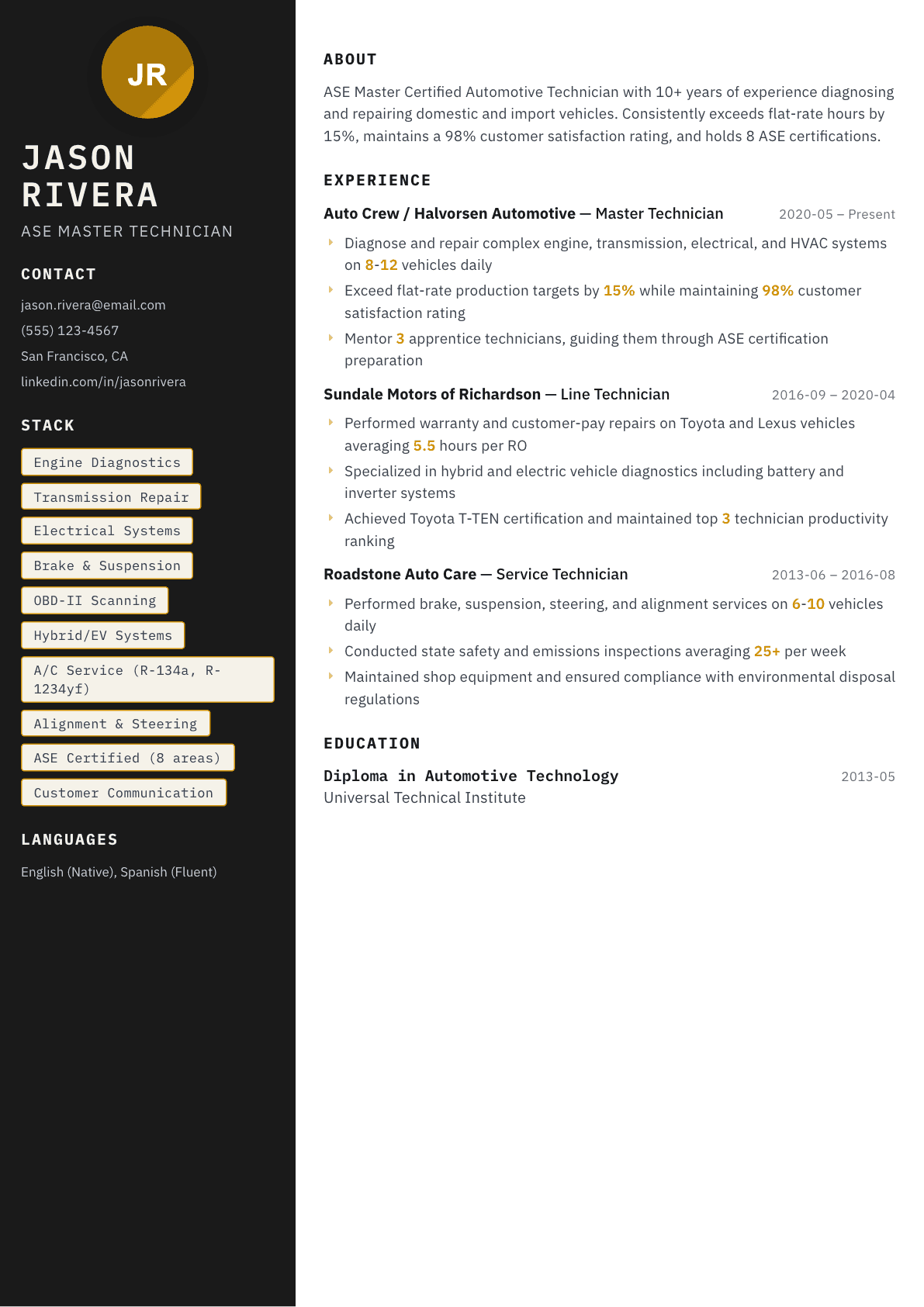
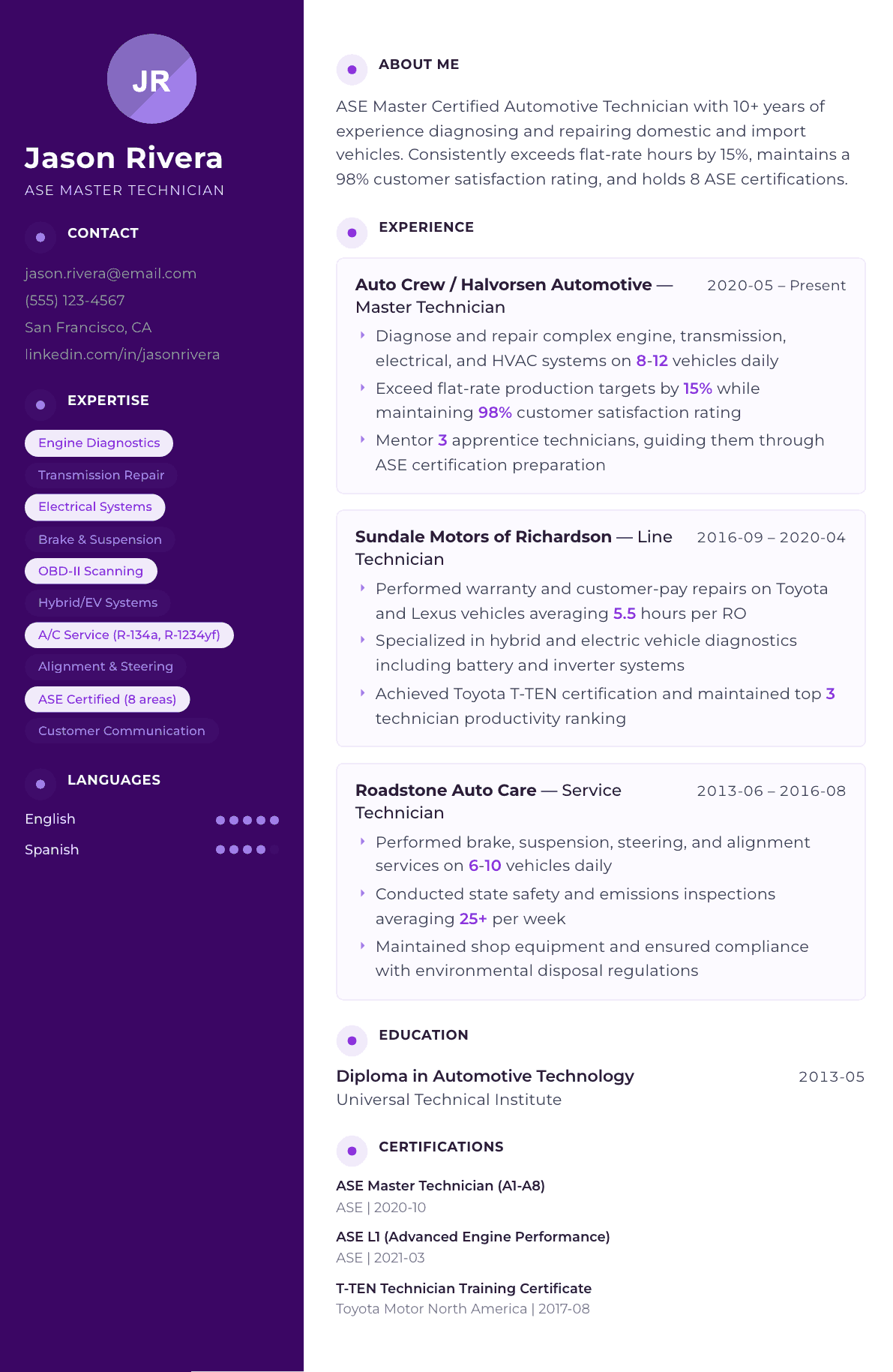
Example Automotive Technician summary
ASE Master Certified Automotive Technician with 10 years of experience in engine, transmission, and electrical system diagnostics and repair. Exceeds flat-rate targets by 15% with a 98% customer satisfaction rating. Seeking a shop foreman or lead technician role.
Skills to list on a Automotive Technician resume
- Engine Diagnostics
- Transmission Service
- Electrical Systems
- Brake & Suspension
- OBD-II / Scan Tools
- Hybrid & EV Systems
- A/C Service & Repair
- Alignment & Steering
- Emissions Testing
- Preventive Maintenance
- Welding (MIG)
- Customer Service
- ASE Certifications
- Shop Equipment Operation
What actually gets this resume read
- List all ASE certifications with their codes (A1 through A8, L1, L2, L3) prominently.
- Quantify your productivity: flat-rate hours, vehicles per day, customer satisfaction ratings.
- Include manufacturer-specific training: Toyota T-TEN, GM ASEP, Ford ASSET, Honda PACT.
- Highlight hybrid and EV diagnostic experience as this is increasingly in demand.
- Mention diagnostic equipment proficiency: scan tools, oscilloscopes, multimeters.
- Show career progression from service tech to line tech to master technician.
How to write a automotive technician resume
A service manager reading automotive technician resumes is trying to answer one commercial question before lunch: how many flat-rate hours will this person turn in a week, and how many of those jobs will come back. Everything on the page is judged against that. The ASE certificates, the brand training, the diagnostic gear you have actually held, the kind of shop you came from.
That is why generic trade resumes stall. A line that says you repaired vehicles tells the manager nothing about whether you can chase a parasitic draw, program a module, or bleed a hybrid cooling loop without turning the bay into a warranty claim. The resume has to name the work at system level.
This guide covers the layout dealers and independents expect, how to write the certification block so it survives an applicant tracking system, three summaries for an apprentice, a mid-career line technician and a master technician, before and after bullets, and the questions technicians ask when they sit down to rewrite the page.
Format: one page, certifications high, no decorative columns
Reverse chronological, one page unless you have more than a decade and multiple brands. Service managers skim in a noisy office, often on a phone between write-ups, so the shop name, the badge and the dates need to be findable without zooming.
Put a certifications block directly under the header, above experience. In this trade the badge set is the qualification, and dealer groups often filter candidate files on the exact ASE codes.
- Header: name, city and state, phone, email, and the words ASE Master Technician if you hold the full A1 through A8 set.
- Order: summary, ASE and manufacturer certifications, experience, education and training, skills.
- Give each shop a type label: franchise dealer, independent repair, fleet, or quick-lube chain. They are different jobs.
Summary: brand, badge, and the work you get handed
Two or three lines. Name the certification level, the years, the vehicle lines you know best, and the category of work you are trusted with. A technician who gets the driveability tickets nobody else can close should say so in the first sentence, because that is the hire a shop is short of.
If you are moving from an independent shop into a dealer, or from light duty into diesel or high voltage, state the move and name the training that supports it. Managers assume a lube technician cannot diagnose unless the page proves otherwise.
Experience: systems, volume, and comeback rate
Under each shop, give the setting in one line: number of bays, brands serviced, whether the work is warranty, customer pay, or fleet, and whether you worked flat rate or hourly. Then three to five bullets on the systems you owned.
Lead with diagnosis, not replacement. Anyone can hang a part. Write the bullets around the fault codes and symptoms you chased: intermittent no-starts, CAN bus communication faults, evaporative emission leaks, misfire under load, transmission shudder, ABS module coding. Name the scan tools and the manufacturer software by name.
Two numbers carry more weight than any adjective: hours turned against hours flagged, and comeback or first-time-fix rate. If you have them from a dispatch report, use them. If you do not, use volume: repair orders per day, inspections per week, the size of the fleet you kept moving.
Certifications and training: codes, dates and the manufacturer track
List ASE credentials by their code and title rather than as a lump. A1 Engine Repair and A6 Electrical are not interchangeable, and a shop hiring for driveability wants to see A8 and L1. Include the current expiry, since ASE credentials need recertification and an expired badge on a resume is an easy reason to pass.
Manufacturer training belongs in its own short list: the brand, the level reached, and the specialty tracks such as high voltage safety or advanced driver assistance calibration. Add your state inspection license and the EPA Section 609 refrigerant handling certificate if you hold them.
Skills and keywords a service manager scans for
Postings recycle a short vocabulary: diagnostics, driveability, electrical, brakes, suspension and steering, alignment, HVAC, engine performance, preventive maintenance, and increasingly hybrid and battery electric service. Mirror the wording of the posting once in the skills block and once inside a bullet where you show the work.
Name the equipment. Scan platforms, the manufacturer subscription software you have used, oscilloscopes, smoke machines, alignment racks, tire and wheel balancers, and the shop management system where you write your stories. Technicians who can write a clean repair order story are worth more to a warranty administrator, and that is worth a line.
Automotive Technician resume summary examples
Recent trade school graduate
Automotive technology graduate with ASE G1 and two entry certifications, plus 18 months in a five-bay independent shop performing brakes, suspension, fluid service and state inspections. Comfortable with scan tool basics and looking for a dealer apprentice seat with a mentor and manufacturer training.
Five years on the line
Line technician with five years at a high-volume import dealer, holding six ASE certifications and current brand electrical training. Runs warranty and customer-pay work across engine, electrical and HVAC, averaging 52 flagged hours a week with a comeback rate under 2%.
Master technician
ASE Master Technician with L1 advanced engine performance and 12 years across domestic and import lines. Takes the driveability and intermittent electrical tickets other technicians hand back, calibrates driver assistance systems after glass and suspension work, and mentors two apprentices through their first ASE attempts.
Work experience bullets: before and after
Before: Repaired cars and performed maintenance.
After: Diagnosed and repaired engine, electrical and HVAC faults on 8 to 12 repair orders a day across three domestic brands, working flat rate in a 14-bay dealer service department.
Volume, systems, brands and pay structure let a service manager picture the exact bay you came from.
Before: Used diagnostic tools to find problems.
After: Traced intermittent no-start and CAN bus communication faults using a two-channel oscilloscope and factory scan software, closing tickets two other technicians had returned as no fault found.
The method and the difficulty of the job show diagnostic ability rather than tool ownership.
Before: Worked on hybrid vehicles.
After: Serviced hybrid and battery electric vehicles under high voltage safety procedures, including inverter coolant service, battery pack isolation testing and drive motor replacement.
Naming the high voltage procedures is what tells a manager you can be assigned that work legally and safely.
Before: Was a fast and productive technician.
After: Turned an average of 55 flagged hours against a 40-hour week for six consecutive quarters while holding first-time-fix above 95% on the dispatch report.
Two numbers a service manager already tracks beat any self-description of speed.
Before: Helped train the new guys in the shop.
After: Mentored three apprentice technicians through brake, steering and suspension sign-offs, and built a bay checklist for pre-delivery inspections that cut repeat write-ups on new units.
The training scope and the artifact you left behind prove the mentoring actually happened.
Hard skills
- Engine performance diagnostics
- Electrical and CAN bus troubleshooting
- Brake and ABS service
- Steering, suspension and alignment
- Automatic transmission service
- HVAC and refrigerant recovery
- Hybrid and high voltage systems
- Module programming and reflashing
- Oscilloscope and smoke testing
- State safety and emissions inspection
- Repair order documentation
- Preventive maintenance schedules
Soft skills
- Customer write-up communication
- Working flat rate under dispatch pressure
- Mentoring apprentices
- Parts and service advisor coordination
- Shop safety discipline
- Patience with intermittent faults
Certifications worth listing
- ASE Master Automobile Technician (A1 to A8) (National Institute for Automotive Service Excellence)
- ASE L1 Advanced Engine Performance Specialist (National Institute for Automotive Service Excellence)
- ASE L3 Light Duty Hybrid/Electric Vehicle Specialist (National Institute for Automotive Service Excellence)
- ASE G1 Auto Maintenance and Light Repair (National Institute for Automotive Service Excellence)
- Section 609 Motor Vehicle Air Conditioning Certification (United States Environmental Protection Agency)
Mistakes that cost automotive technician candidates the interview
- Burying the ASE codes at the bottom of the page, so a dealer filtering for A8 and L1 never sees them.
- Listing an expired certification without a date, which reads as either careless or hopeful.
- Writing every bullet around parts replacement, leaving the reader unsure whether you can diagnose at all.
- Leaving out the shop type, so a fleet garage, a quick-lube chain and a franchise dealer all look identical.
- Skipping productivity numbers when your dispatch reports have them sitting there ready to quote.
- Using a heavily styled two-column template with icons for a trade the applicant tracking system parses literally.
- Ignoring hybrid, battery electric and driver assistance calibration work even when you have done it.
Automotive Technician resume questions
How many ASE certifications should I list on my resume?
List every current one by code and title, and say Master Technician in the header if you hold the full automobile series. Do not pad the list with expired badges. A short honest set with recertification dates reads far better than a long stale one.
Do I need to include flat-rate productivity numbers?
Include them if you can defend them in an interview. Hours flagged against hours available and first-time-fix rate are the two figures a service manager already pulls from the dispatch report, so quoting them shows you understand how the shop makes money.
How do I move from an independent shop to a dealership?
Lead the summary with the brands you already know and any manufacturer web training you have completed on your own. Then reorganize your bullets so warranty-style diagnostic work and module programming come first, because dealer work is heavier on both.
Should a technician resume list every vehicle system?
No. Group them the way ASE does and lead with the areas the posting names. A shop hiring a driveability technician wants engine performance and electrical at the top, and will not be impressed by a long undifferentiated list of every job you have touched.
What belongs in the education section for an automotive technician?
Your trade school program or manufacturer training academy, the completion date, and any dealer training track you finished with the level reached. Add apprenticeship hours if you served one, because dealer groups treat documented hours as evidence of a structured background.
Related resume examples
- Diesel Mechanic Resume example
- Mechanic Resume example
- Maintenance Technician Resume example
- Auto Technician Resume example
- Auto Mechanic Resume example
- Fleet Mechanic Resume example