Fleet Mechanic Resume Examples: the lines they read
Build a Fleet Mechanic Resume Around Uptime and Inspections
By Mustafa Tarabya, founder of CVBooster · Published · Updated
Fleet mechanic resume example with keywords and a writing guide on DOT inspections, preventive maintenance intervals, uptime and fleet software.
Sample resumes for a fleet mechanic
The same fleet mechanic content laid out in three CVBooster templates, so you can see what the finished document looks like before you write a word.
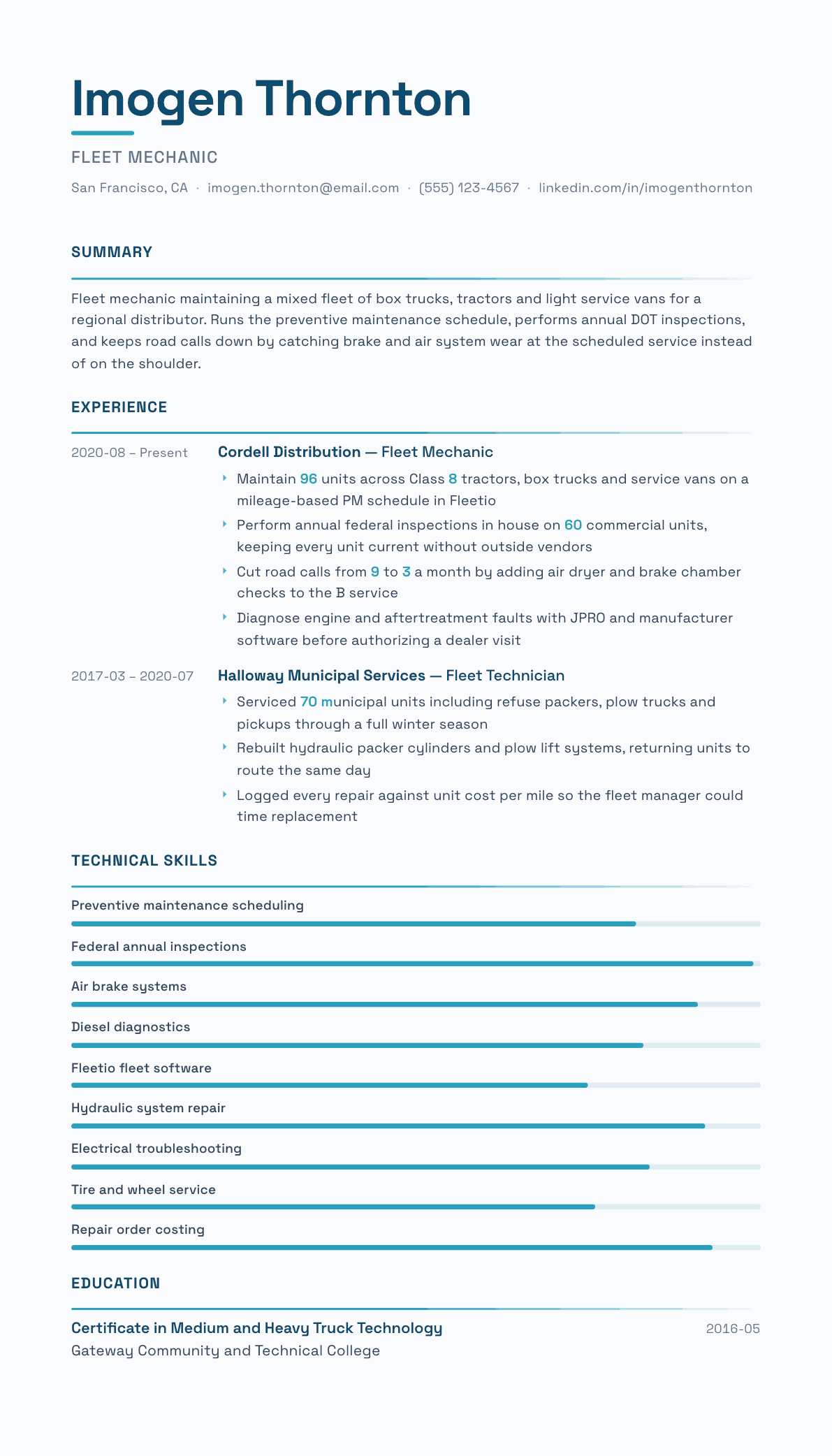
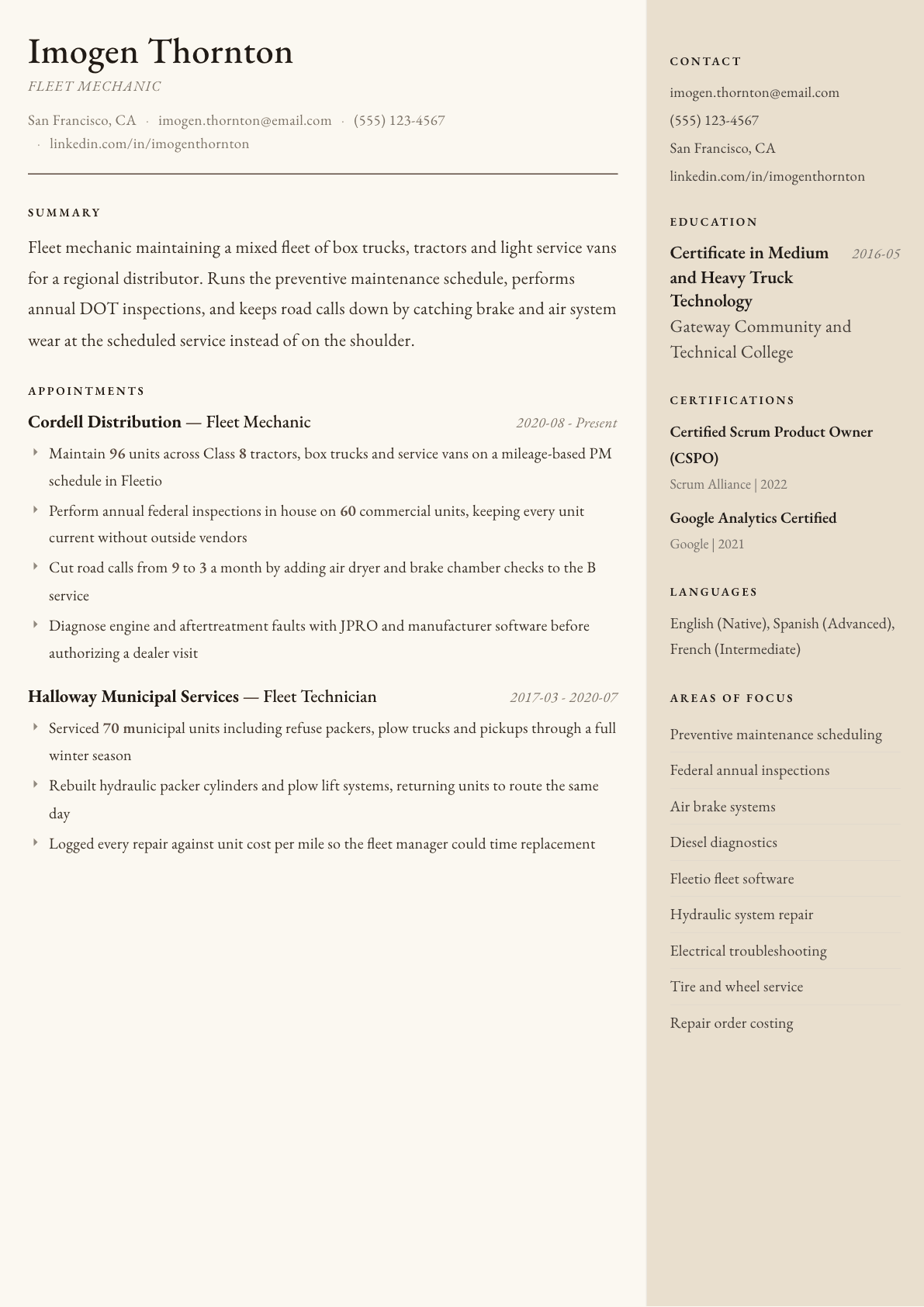
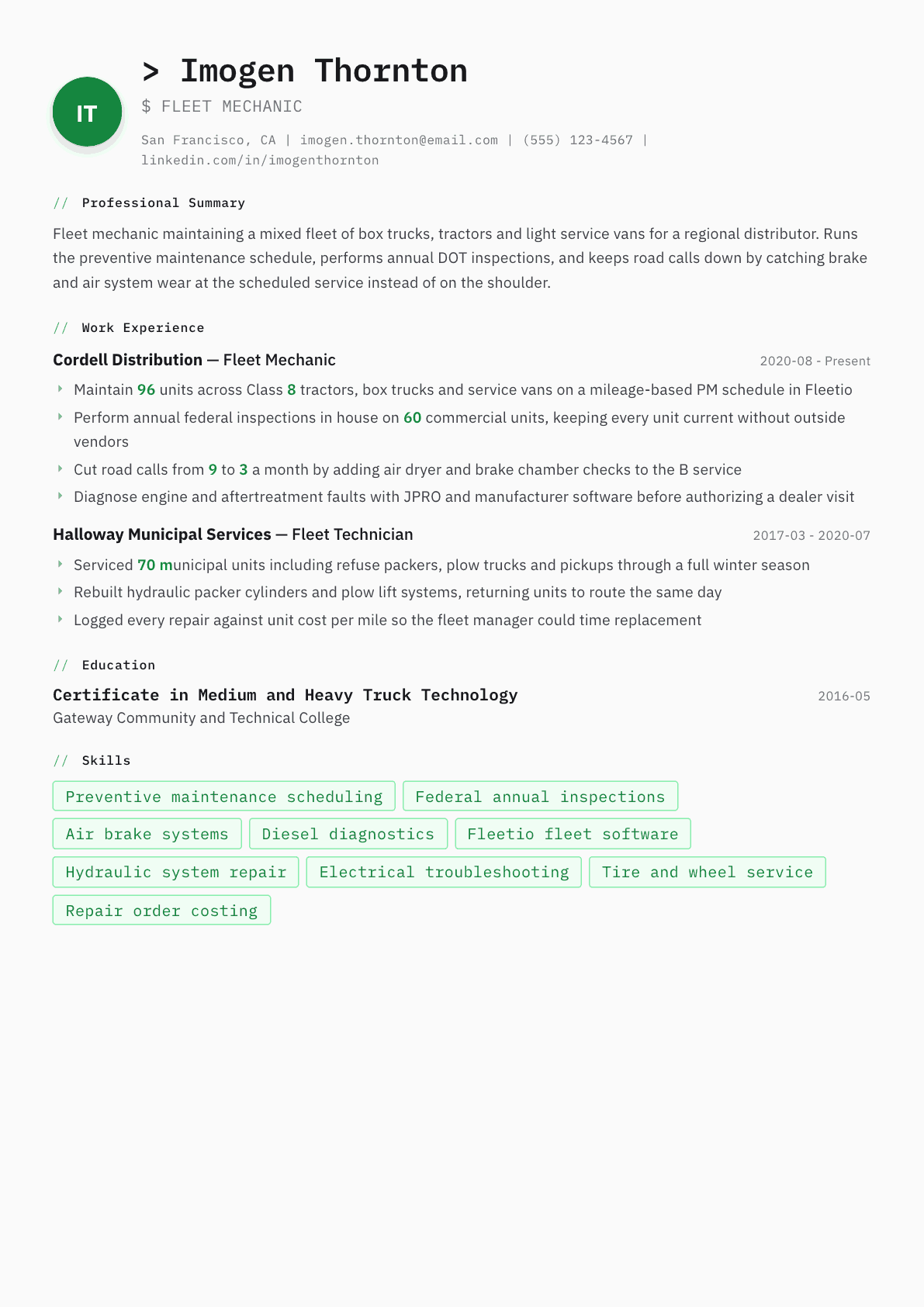
Example Fleet Mechanic summary
Fleet mechanic with seven years keeping mixed commercial fleets on the road, from Class 8 tractors to refuse packers and light service vans. Runs mileage-based preventive maintenance in fleet software, signs annual federal inspections in house, and diagnoses engine and aftertreatment faults before a unit goes to a dealer. Known for turning road calls into scheduled work by catching air system and brake wear early.
Skills to list on a Fleet Mechanic resume
- Preventive maintenance programs
- Federal annual vehicle inspection
- Air brake service and adjustment
- Diesel engine diagnostics
- Aftertreatment and DPF service
- Electrical and charging systems
- Hydraulic system repair
- Suspension and steering repair
- Tire and wheel-end service
- Fleet maintenance software
- Repair order documentation
- Parts inventory control
- Driver write-up triage
- Road call response
What actually gets this resume read
- Give the fleet size and the mix of unit classes, since a van fleet and a tractor fleet hire differently.
- State whether you are qualified to sign annual federal inspections, because that saves a fleet outside vendor money.
- Name the maintenance software you have worked in, as fleet managers live inside those service records.
- Show uptime or road call numbers, which are the figures a fleet manager is measured on every month.
- Separate preventive maintenance work from breakdown repair so a reader sees you can run a schedule.
- Mention any DOT paperwork, driver write-up handling or parts inventory duties you carried alongside the wrenching.
How to write a fleet mechanic resume
A fleet mechanic is hired to keep vehicles earning. The person reading your resume is usually a fleet or maintenance manager who reports on cost per mile, downtime and inspection compliance, and who gets a phone call every time a unit stops on the highway. He wants a technician who prevents that call, not one who is good at answering it.
That changes what belongs on the page. A retail shop resume sells flag hours and diagnostic wins. A fleet resume sells the fleet you carried, the service schedule you ran, the inspections you signed and the road calls that stopped happening after you arrived. The wrenching skill is assumed; the maintenance program is what gets you interviewed.
This guide walks through each section the way a fleet manager reads it, with summaries for a technician new to fleet work, a settled fleet mechanic and a shop lead, before and after bullets, and answers to the questions technicians ask when they move from a dealership or an independent shop into a fleet bay.
Format: fleet profile first, inspection authority visible early
Reverse chronological, one or two pages, plain formatting that a maintenance software resume parser can read. Skip the graphics. What earns the space instead is a short fleet profile near the top: unit classes, fleet size and the maintenance systems you have worked inside.
If you are qualified to perform annual federal inspections, put it where it cannot be missed. A fleet that sends units to an outside vendor for inspections is paying for something you can bring in house, and that is a budget argument the manager can make on your behalf.
- Header: name, city and state, phone, email, plus your commercial driver license class and endorsements if you hold them.
- Fleet profile block: unit types, fleet size, and whether the shop ran one facility or several yards.
- Credentials next: inspector qualification, refrigerant handling card, and any brand or component training.
- Then experience, education and a skills block that keeps preventive maintenance language separate from repair language.
Summary: fleet size, unit mix, and what you own
Three lines that answer what you have maintained, how much of it, and which part of the program was yours. Fleet managers think in units, so a summary that names 96 units across tractors, box trucks and vans lands harder than one describing years of experience in vehicle maintenance.
Add the part you owned outright. Running the service schedule, keeping inspection records current, managing parts stock or handling driver write-ups all show that you can be left with the shop, and that is the difference between a technician headcount and a lead.
Experience: the schedule, the inspections and the road calls
Each job opens with the fleet: how many units, what classes, how many yards and how many technicians. Then write the maintenance program as a story with numbers in it. What was the service interval before you arrived, what did you change it to, and what happened to unplanned repairs afterward.
Inspections deserve their own bullets. Say how many units you inspected annually, whether you performed brake work that requires the correct qualification, and how you kept the paperwork current, since a fleet audit lands on the maintenance manager and clean records are worth as much as clean wheel ends.
Road calls are the honest measure of a maintenance program. If you reduced them, say by how much and what you changed to do it. If you responded to them, say how far you traveled, what you carried and how often you got the unit home rather than towed.
Software, costing and the paperwork side of the bay
Fleet shops run on maintenance software, and the records are how the manager defends his budget. Name the systems you have used for work orders, service scheduling and parts, and say what you actually did inside them: closed repair orders against unit numbers, tracked cost per mile, flagged units approaching replacement.
Do not treat the paperwork as an afterthought. A technician who writes clear repair orders lets a manager see which units are consuming the budget and which drivers are reporting faults early, and that reporting habit gets you into the conversation about replacement planning rather than leaving you at the bench.
Skills and keywords a fleet posting filters on
The vocabulary is stable across postings: preventive maintenance, annual inspection, air brakes, aftertreatment, electrical diagnosis, hydraulics, wheel ends, work orders, uptime. Use those exact words once in the skills block and once in a bullet where the work is shown, and keep the light duty and heavy duty terms separate because a mixed fleet expects both.
Emissions and electrical work carry the most weight right now. Aftertreatment faults and control module problems are the repairs fleets most often pay a dealer for, so a mechanic who handles them in house should say so plainly with the tooling named.
Fleet Mechanic resume summary examples
Moving into fleet work
Automotive technician with three years in an independent shop moving into fleet maintenance. Strong on brakes, suspension, electrical diagnosis and light diesel service, and completed inspection training this year. Comfortable working a scheduled service list rather than a customer queue, and keeping repair records against unit numbers.
Five years on a fleet
Fleet mechanic maintaining 96 mixed units including Class 8 tractors, box trucks and service vans. Runs the mileage based preventive maintenance schedule in fleet software, performs annual federal inspections in house, and cut monthly road calls to a third by adding air system and wheel end checks to the scheduled service.
Shop lead
Fleet shop lead running a three-technician bay across two yards and 180 units. Owns the service schedule, parts stock and inspection compliance file, reviews driver write-ups each morning, and reports cost per mile by unit so the fleet manager can time replacements instead of reacting to failures.
Work experience bullets: before and after
Before: Performed preventive maintenance on fleet vehicles.
After: Ran a mileage based A, B and C service schedule across 96 units in fleet software, closing every service against the unit number with the next interval set before the truck left the bay.
The service tiers, the unit count and the record keeping show a program rather than a chore.
Before: Did DOT inspections.
After: Performed annual federal inspections on 60 commercial units in house, keeping every unit current and removing an outside vendor from the maintenance budget.
The volume plus the vendor removal turns a compliance task into a saving the manager can point at.
Before: Responded to breakdowns.
After: Cut road calls from nine a month to three by adding air dryer, brake chamber and wheel end checks to the B service after tracking which failures repeated.
A before and after number with the change that caused it is the strongest bullet a fleet resume can carry.
Before: Fixed engine problems on trucks.
After: Diagnosed engine and aftertreatment faults with JPRO and manufacturer software, repairing dosing and sensor failures in house instead of booking dealer time.
Naming the tooling and the in-house decision shows both capability and cost awareness.
Before: Kept records of repairs.
After: Logged parts and labor against each unit so cost per mile could be compared across the fleet, and flagged four units whose repair spend justified replacement.
It shows the records were used for a decision, which is what a fleet manager needs from them.
Hard skills
- Preventive maintenance program design
- Annual federal vehicle inspection
- Air brake service, adjustment and testing
- Diesel engine diagnosis
- Aftertreatment and diesel particulate filter service
- Electrical and charging system diagnosis
- Hydraulic system repair on work equipment
- Suspension, steering and wheel end service
- Tire and wheel service to torque specification
- Fleet maintenance software and work orders
- Parts inventory and reorder control
- Driver write-up triage
- Cost per mile tracking
- Road call response and recovery decisions
Soft skills
- Reading a vague driver complaint without dismissing it
- Balancing a scheduled list against the truck that broke this morning
- Explaining a repair cost to a manager who thinks in budget lines
- Keeping records current when the bay is full
- Coaching drivers on what to report and when
Certifications worth listing
- Master Medium-Heavy Truck Technician (National Institute for Automotive Service Excellence)
- North American Standard Inspection Certification (Commercial Vehicle Safety Alliance)
- Section 609 Motor Vehicle Air Conditioning Certification (United States Environmental Protection Agency)
Mistakes that cost fleet mechanic candidates the interview
- Writing a retail repair resume for a fleet job, so the page sells diagnostic wins and never mentions a service schedule.
- Leaving out the fleet size and unit mix, which are the first two facts a maintenance manager needs.
- Failing to state inspection qualification, when in-house inspections are one of the strongest arguments for hiring you.
- Describing road calls as work performed rather than as a number you reduced with a specific change.
- Ignoring the maintenance software, even though the records are how the shop is measured and defended.
- Mixing light duty and heavy duty experience into one blur when the posting is clearly for one of them.
Fleet Mechanic resume questions
Do I need a commercial driver license to be a fleet mechanic?
Many fleets want one so a technician can road test a loaded unit and move vehicles between yards. If you hold it, state the class and endorsements in the header. If you do not, say whether you are willing to obtain it rather than staying silent.
How do I move from a dealership to a fleet shop?
Reframe your history around scheduled work and vehicle uptime instead of flag hours and customer pay. Keep your brand training, since it still proves depth, but add every example where you prevented a failure or handled a unit that had to be back on the road that day.
What numbers should a fleet mechanic put on a resume?
Units maintained, services completed in a period, inspections performed, road calls before and after a change you made, and turnaround on a repair that kept a unit earning. Those four are the figures a fleet manager already reports upward every month.
Should I list every truck brand I have worked on?
List engine and chassis brands as separate lines, because a fleet running one chassis with two engine families cares about both. Group anything you have only touched briefly under general exposure so the depth of your main experience stays visible.
Is preventive maintenance work worth writing about in detail?
Yes, it is the core of the job. Describe the intervals, what each service level covered, how you tracked completion and what failures you caught early. A manager reading that knows you will protect his uptime rather than waiting for the phone to ring.
Related resume examples
- Diesel Mechanic Resume example
- Auto Mechanic Resume example
- Heavy Equipment Mechanic Resume example
- Truck Driver Resume example
- Bicycle Mechanic Resume example
- Tire Technician Resume example