Maintenance Technician Resume Examples: read this first
Maintenance Tech Resume: Maintenance Technician Examples
By Mustafa Tarabya, founder of CVBooster · Published · Updated
Maintenance tech resume examples for plant and facilities technicians: preventive work, troubleshooting, downtime results and the keywords postings use.
Sample resumes for a maintenance technician
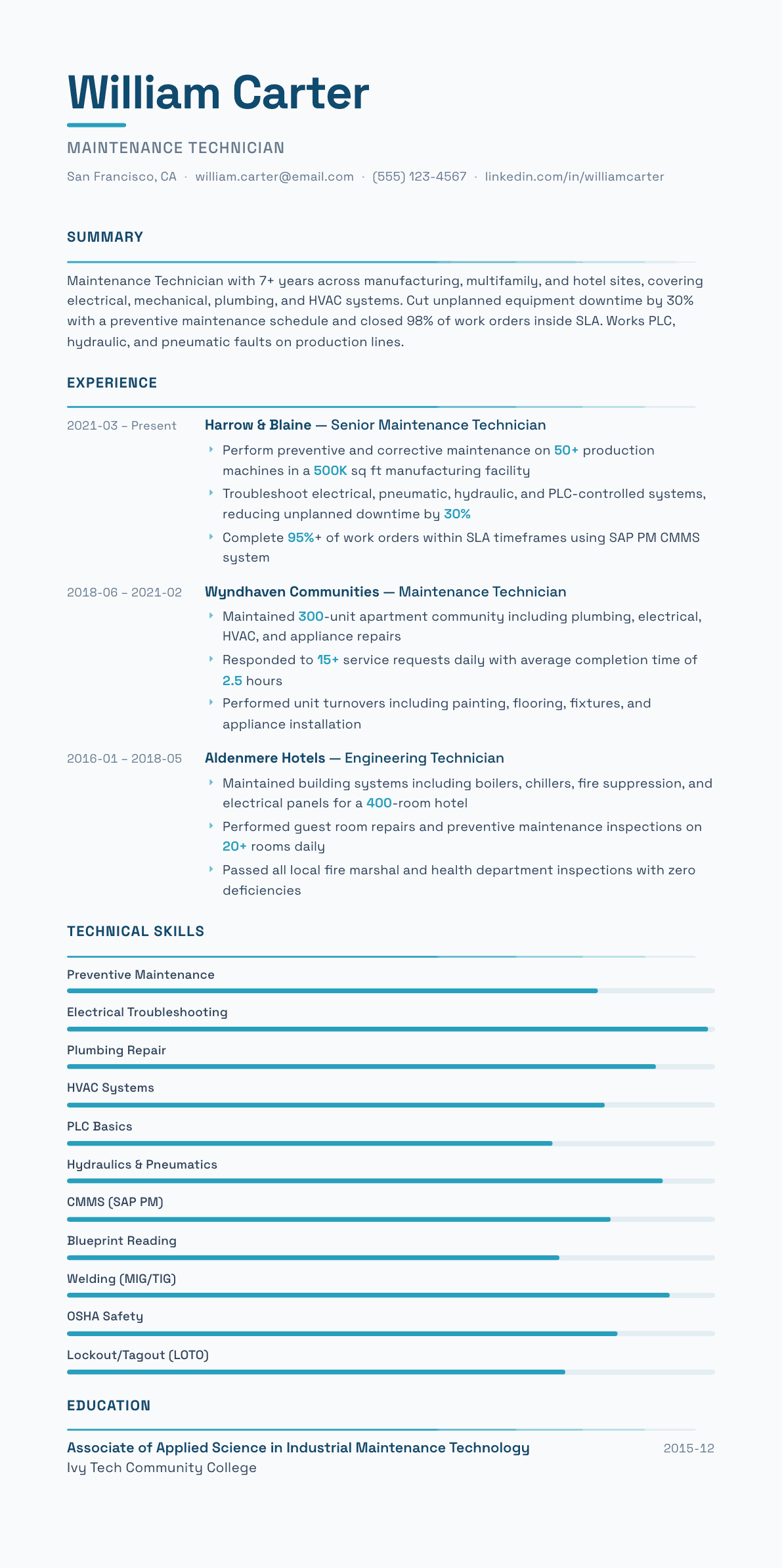
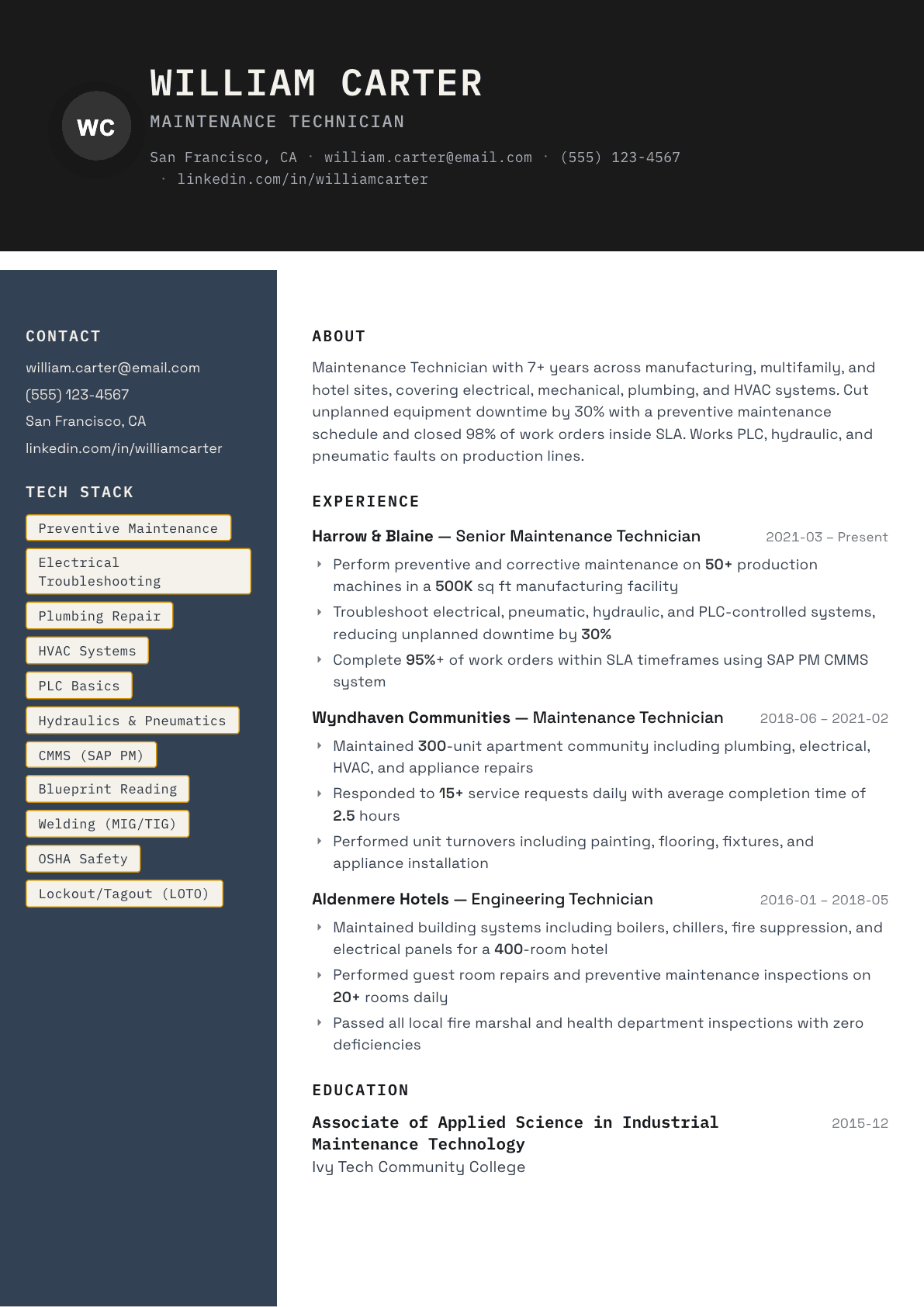
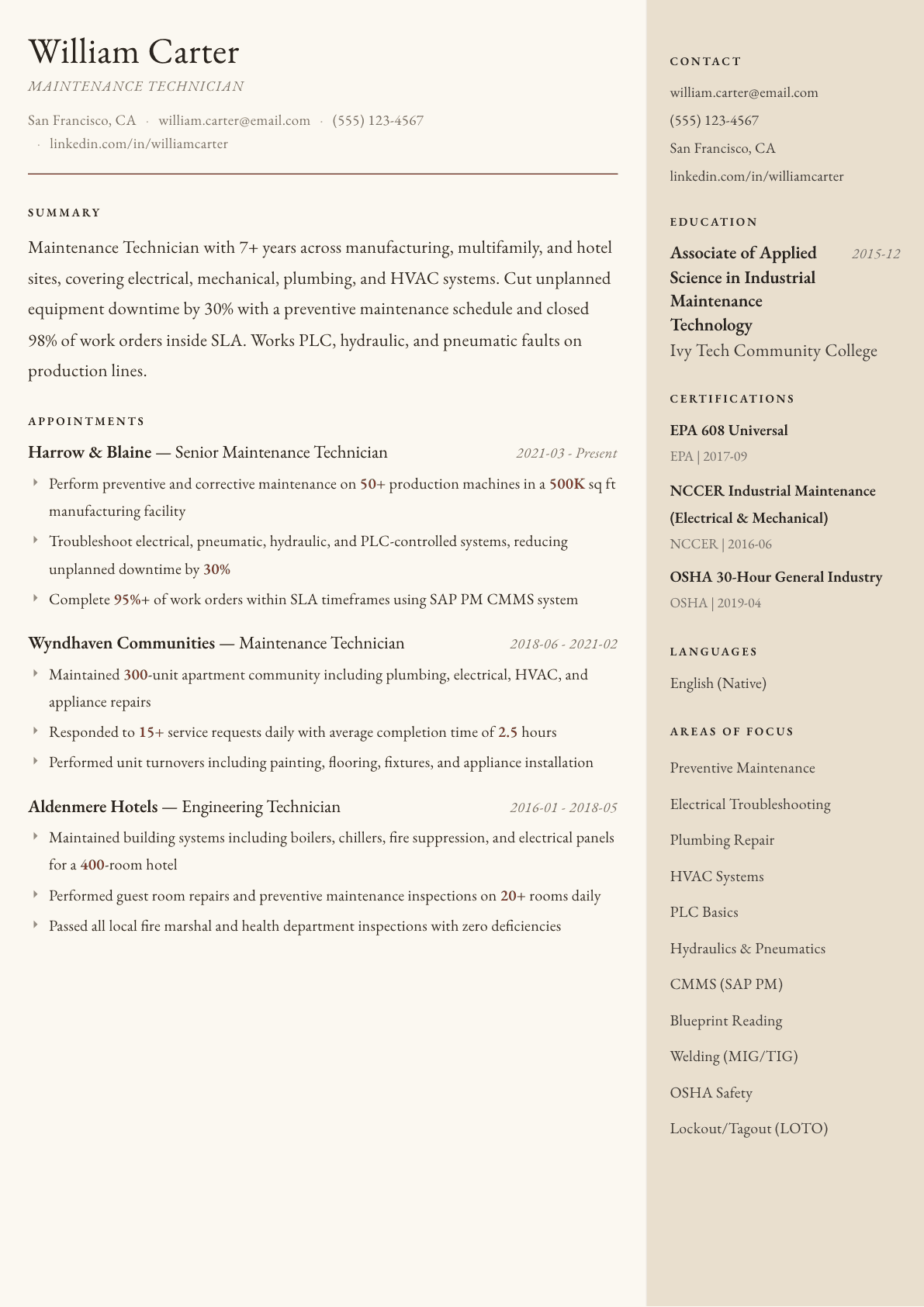
The same maintenance technician content laid out in three CVBooster templates, so you can see what the finished document looks like before you write a word.
Example Maintenance Technician summary
Maintenance Technician with 7 years in industrial and facility maintenance, from a 500K sq ft plant to a 300-unit apartment community. Cut unplanned downtime 30% and holds a 98% work order completion rate in SAP PM. EPA 608 Universal and OSHA 30 certified, targeting a lead maintenance or facility engineer role.
Skills to list on a Maintenance Technician resume
- Preventive Maintenance
- Electrical Systems
- Plumbing
- HVAC
- Mechanical Repair
- PLC Troubleshooting
- Hydraulics & Pneumatics
- CMMS Systems
- Blueprint Reading
- Welding
- Carpentry
- Lockout/Tagout (LOTO)
- OSHA Compliance
- Building Codes
What actually gets this resume read
- Highlight your multi-trade skills: electrical, plumbing, HVAC, mechanical, carpentry.
- Quantify your impact: downtime reduction, work order completion rates, response times.
- Include CMMS system experience: SAP PM, Maximo, eMaint, Fiix, MaintenanceConnection.
- Mention safety record and OSHA certifications.
- Specify the types of facilities you have maintained: industrial, commercial, residential, hospitality.
- Include PLC, VFD, and automation troubleshooting skills for industrial maintenance roles.
How to write a maintenance technician resume
Maintenance technician is one of the widest job titles in industry, which is exactly why the resume so often misses. The same title covers a plant technician keeping packaging lines running, a facilities technician looking after chillers and air handlers, and a property technician turning apartments. The reader knows which one they need, and if your page does not declare it in the first two lines it gets filed as unclear.
Whichever setting you are aiming at, the hiring manager is measuring one thing: does equipment run longer and fail less when you are on shift. That is why downtime, mean time between failures, preventive compliance and work order backlog appear so often in these postings. They are the numbers the maintenance manager reports to the plant or property leadership every week.
This guide covers how to declare your setting, how to write about preventive and predictive work without sounding generic, three summaries at different stages, before and after bullets, and the certifications and controls experience that separate a technician from a helper.
Format: declare the setting, then the disciplines
One page, reverse chronological, plain headings. Directly under your name, write a single line that names the environment and the disciplines: industrial manufacturing, commercial facilities, or residential property, followed by electrical, mechanical, hydraulic, pneumatic, controls and whatever else you genuinely cover.
Then a disciplines block rather than a long alphabetical skills soup. Group by system so a reader can find what they came for: electrical and controls, mechanical and rotating equipment, fluid power, building systems, and diagnostics.
Postings shorten the title constantly. Maintenance tech, maintenance technician and facilities tech can describe the same job, and an applicant tracking system matches the words in the advert. Put the exact posting title in your headline, write the full title once in the summary, and keep the title your employer gave you in the job heading. A maintenance tech resume is otherwise the same document.
- Header: name, city and state, phone, email, shift availability if you are open to nights or weekends.
- Order: summary, disciplines, experience, certifications and safety training, education and apprenticeship.
- Note whether each site ran continuous production, a five-day schedule, or a call-out rotation.
Summary: environment, equipment, and the downtime story
Three lines. Years, environment, the equipment families you own, and one line on outcome. The outcome sentence should be about availability rather than activity: unplanned downtime reduced, preventive compliance held, or a chronic failure eliminated.
If you are crossing between environments, address it directly. Facilities to plant maintenance means moving from comfort systems to production equipment on a clock, and a plant manager wants to see that you understand the difference in urgency before they read further.
Experience: equipment owned, work order flow, and reliability work
Open each entry with the asset base: what the site makes or does, how many production lines or how much conditioned floor area, and the major equipment you were responsible for. Conveyors, fillers, palletizers, compressors, boilers, chillers, air handlers, pumps and motor control centers all read as concrete.
The bullets should cover three layers. Corrective work, meaning the breakdowns you diagnosed and repaired. Preventive work, meaning the scheduled routines you executed and kept compliant. Reliability work, meaning root cause analysis, precision alignment, vibration or thermal inspection, lubrication programs and changes you made so a failure stopped repeating. The third layer is what promotes a technician.
Use the systems by name. Programmable logic controllers, variable frequency drives, servo drives, sensors and safety circuits, building automation front ends, and the maintenance management platform where you closed the work orders. Controls literacy is the single biggest pay differentiator in this job.
Safety and permits: how you are allowed to work
Maintenance technicians touch stored energy every day, so show the discipline. Lockout and tagout as a written procedure, arc flash boundaries and the rating of the equipment you approach, confined space entry with a permit and an attendant, hot work permits, and fall protection on roofs and lifts.
Audits and inspections belong here too. If you kept the equipment files, calibration records and preventive history in order for a customer, regulatory or quality audit and it passed without findings, that is a bullet a maintenance manager will notice, because paperwork failures cost more than most repairs.
Skills and the keywords that repeat in postings
Common phrasing across postings: preventive maintenance, troubleshooting, PLC, VFD, hydraulics, pneumatics, electrical, mechanical, welding, blueprint and schematic reading, CMMS, root cause analysis and total productive maintenance. Mirror the terms the posting uses once in your disciplines block and once inside a bullet.
Add the measurement tools. Multimeter and clamp meter, megohmmeter, infrared camera, vibration pen or analyzer, dial indicator and laser alignment, and ultrasonic leak detection. A technician who lists measurement instead of only tools is describing predictive work, and predictive work is what plants are short of.
Maintenance Technician resume summary examples
Two years in
Maintenance technician with 2 years in a food packaging plant supporting conveyors, case packers and compressed air systems. Completed an industrial maintenance certificate covering electrical, hydraulics and motor controls, closes preventive work orders in the plant system, and is qualified for lockout and confined space entry.
Seven years, multi-craft
Multi-craft maintenance technician with 7 years across manufacturing and commercial facilities, covering electrical, mechanical, hydraulic and PLC-controlled systems. Cut unplanned downtime on a bottling line by rebuilding the lubrication routine and correcting chronic misalignment, and holds preventive compliance above 95%.
Lead maintenance technician
Lead maintenance technician with 13 years, responsible for the reliability program across two production buildings: preventive schedules, spare parts minimums, vibration and thermal routes, and root cause reviews after every major failure. Trains four technicians and runs the maintenance management system.
Work experience bullets: before and after
Before: Performed preventive maintenance on plant equipment.
After: Executed weekly and quarterly preventive routines on 50 production machines including belt and chain adjustment, lubrication, sensor cleaning and gearbox oil sampling, holding schedule compliance above 95%.
The routine content and the compliance figure turn a duty statement into an auditable program.
Before: Troubleshot electrical issues.
After: Traced faults through motor control centers, variable frequency drives and safety circuits using schematics and a clamp meter, restoring a stalled packaging line inside an hour on repeat night shift call-outs.
Naming the equipment and the response time shows the level of electrical work rather than the category.
Before: Fixed a machine that kept breaking.
After: Ran a root cause review on a filler that failed monthly, found a shaft misalignment introduced during rebuilds, corrected it with laser alignment and rewrote the rebuild procedure so the failure did not return.
A root cause plus a procedure change is reliability work, which is a level above repair.
Before: Used the CMMS system daily.
After: Closed and documented roughly 40 work orders a week in the maintenance management system, recording failure codes and parts used so the reliability team could trend repeat failures by asset.
Explaining what the data was used for proves you understand why documentation exists.
Before: Knew how to work with PLCs.
After: Read ladder logic to isolate faults between field devices and controller outputs, forced outputs safely during commissioning, and worked with controls engineering to correct timing on a reject station.
The specific controls tasks show real capability, since claiming PLC knowledge is common and rarely tested on paper.
Hard skills
- Preventive and predictive maintenance
- Electrical troubleshooting to motor control centers
- PLC ladder logic diagnosis
- Variable frequency drive setup
- Hydraulic and pneumatic systems
- Precision alignment and balancing
- Bearing, belt and chain replacement
- Welding and light fabrication
- Building systems and HVAC support
- Vibration and thermal inspection
- CMMS work order management
- Root cause failure analysis
Soft skills
- Calm under production pressure
- Shift handover discipline
- Operator coaching
- Written failure documentation
- Cross-craft teamwork
- Judgment on repair versus replace
Certifications worth listing
- Certified Maintenance and Reliability Technician (CMRT) (Society for Maintenance and Reliability Professionals)
- NCCER Industrial Maintenance Certification (National Center for Construction Education and Research)
- OSHA 30-Hour General Industry Outreach (OSHA Outreach Training Program)
- EPA Section 608 Universal Technician (United States Environmental Protection Agency)
- Certified Facility Manager support credential, Facility Management Professional (International Facility Management Association)
Mistakes that cost maintenance technician candidates the interview
- Not declaring whether you are an industrial, facilities or residential technician, which makes the whole resume ambiguous.
- Listing tools instead of systems, so the reader learns you own a meter but not what you diagnosed with it.
- Claiming PLC experience with no example of what you actually did inside the logic or the drive.
- Writing only corrective work, which suggests you wait for failures rather than prevent them.
- Leaving out preventive compliance, downtime or backlog numbers even when the maintenance system tracked them.
- Ignoring shift availability and call-out history, which is often the practical reason one candidate is chosen over another.
Maintenance Technician resume questions
What is the difference between a maintenance technician and an industrial mechanic?
The industrial mechanic title usually implies mechanical depth on rotating equipment, while maintenance technician implies multi-craft coverage including electrical and controls. Write the resume toward the title in the posting and lead with the discipline that job weights most heavily.
How do I show controls experience without being an engineer?
Describe what you did rather than what you know. Reading ladder logic to isolate a fault, replacing and configuring a drive, calibrating sensors, and working with controls engineering during commissioning are all technician-level tasks that prove genuine capability.
Which metrics belong on a maintenance technician resume?
Preventive schedule compliance, unplanned downtime hours, mean time between failures on a problem asset, work order throughput, and backlog. Use whatever your site actually tracked, and be ready to explain how the number was measured in the interview.
Should I write maintenance tech or maintenance technician on my resume?
Use the title from the posting in your headline, because that is the phrase the hiring manager and the applicant tracking system search for. Write the full title, maintenance technician, once in the summary, and leave the title your employer used in each job heading. Mention a trade certificate or associate degree under education.
How do I move from facilities into manufacturing maintenance?
Reframe your experience around production impact. Highlight motor controls, pumps, compressed air, conveyors and any automated equipment you supported, then explain that you understand a line stoppage carries a cost per minute that a building comfort call does not.
Related resume examples
- Mechanic Resume example
- Building Maintenance Worker Resume example
- Elevator Technician Resume example
- Industrial Maintenance Technician Resume example
- Maintenance Mechanic Resume example
- Facilities Technician Resume example