Auto Mechanic Resume Examples: free ATS score and gap list
Write an Auto Mechanic Resume a Shop Foreman Will Read Twice
By Mustafa Tarabya, founder of CVBooster · Published · Updated
Auto mechanic resume example, keyword list and writing guide covering ASE certifications, diagnostic work, comeback rate and flat rate hours.
Sample resumes for a auto mechanic
The same auto mechanic content laid out in three CVBooster templates, so you can see what the finished document looks like before you write a word.
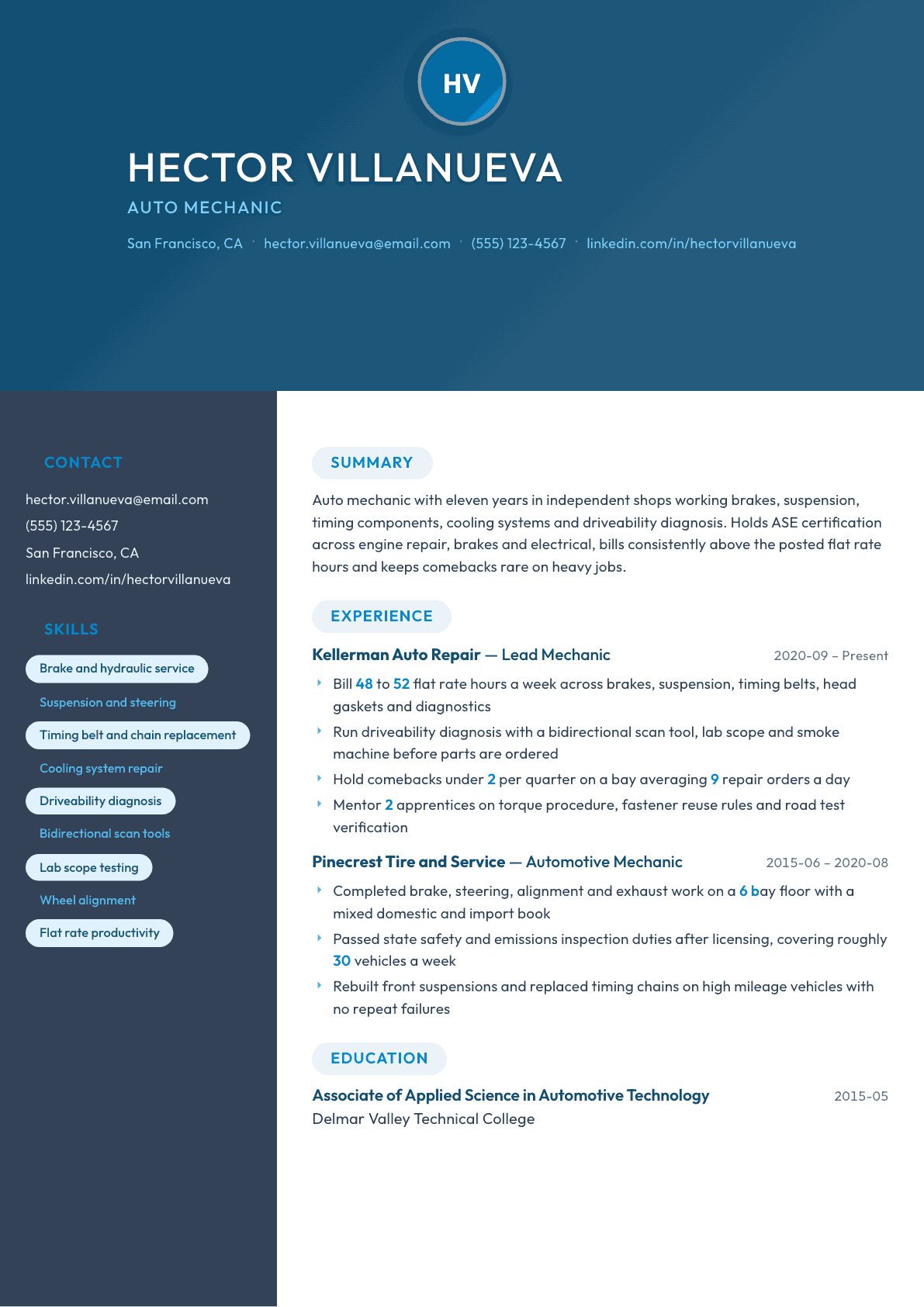
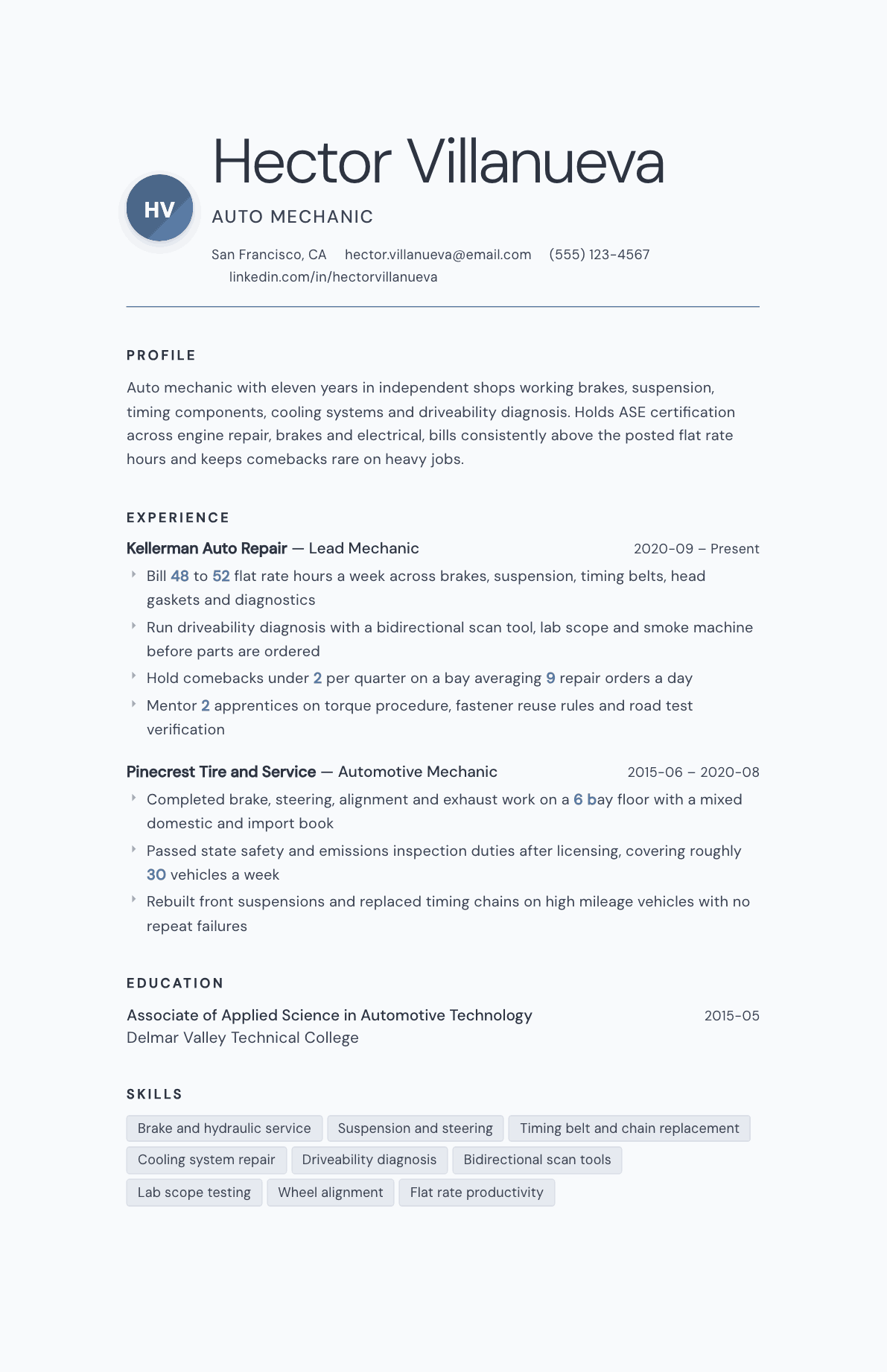
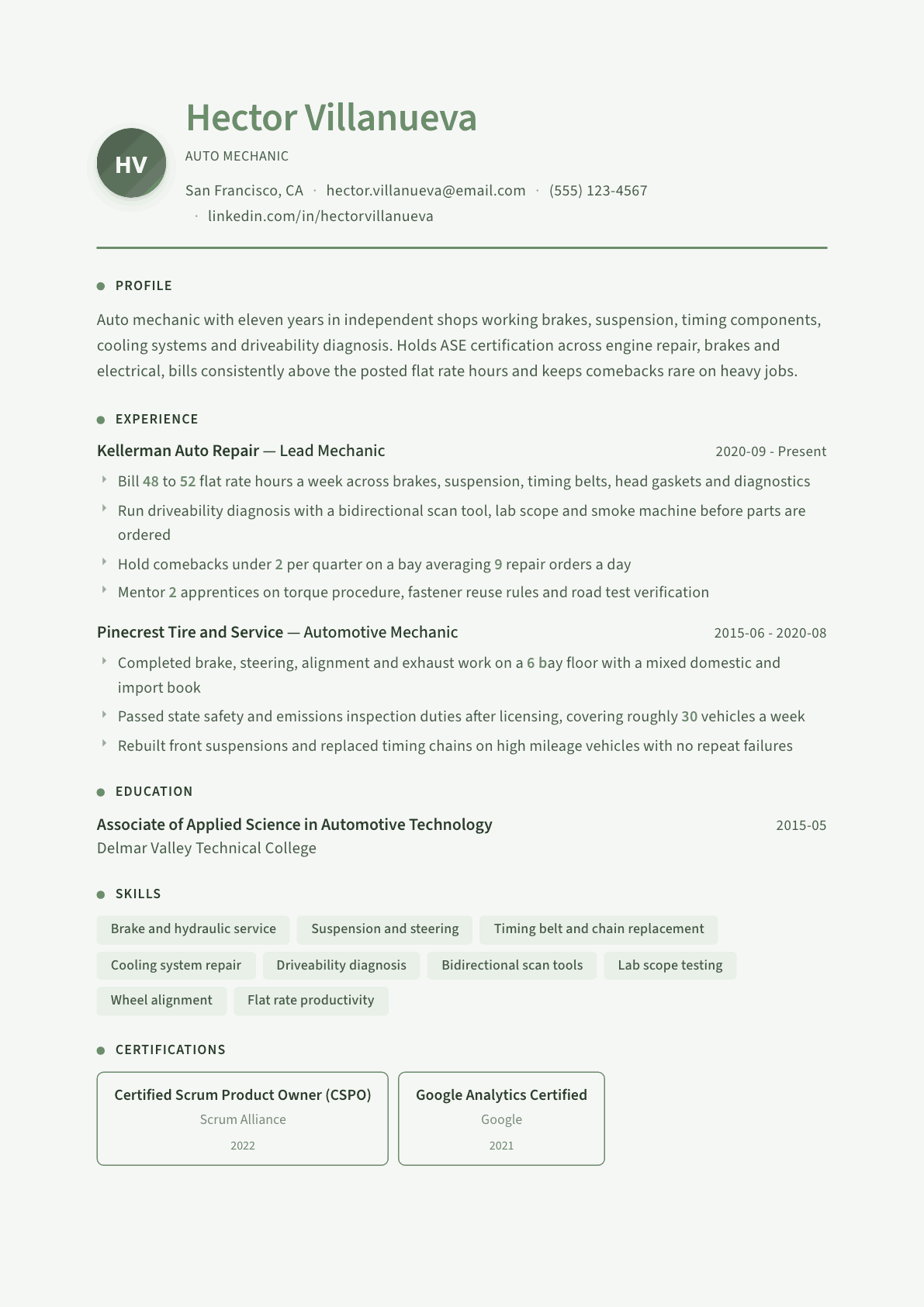
Example Auto Mechanic summary
Auto mechanic with eleven years in independent shops, billing around fifty flat rate hours a week across brakes, suspension, timing components, head gaskets and driveability diagnosis. ASE certified in engine repair, brakes and electrical systems, and diagnoses with a bidirectional scan tool, lab scope and smoke machine before any part is ordered. Keeps comebacks rare on heavy jobs and mentors apprentices on torque procedure and road test verification.
Skills to list on a Auto Mechanic resume
- ASE certified repair
- Brake hydraulics and ABS
- Suspension and steering rebuild
- Wheel alignment
- Timing belt and chain service
- Head gasket and engine repair
- Cooling and heating systems
- Driveability and misfire diagnosis
- Bidirectional scan tool use
- Lab scope waveform reading
- Smoke machine leak testing
- Electrical and wiring repair
- Air conditioning service
- Flat rate efficiency
- Repair order documentation
What actually gets this resume read
- Put your ASE certification list on the resume by test code, because shops screen that block before the prose.
- Give flat rate hours billed per week, since that is the number a service manager converts into shop revenue.
- Name your diagnostic equipment: scan tool brand, lab scope, smoke machine, pressure transducer, thermal camera.
- Say which vehicle lines you know best, because a European specialty shop and a domestic fleet want opposites.
- Report your comeback rate honestly, because a low comeback number is worth more than an extra hour billed.
- List your own tool inventory and box in one line, since a shop needs to know what walks in with you.
How to write a auto mechanic resume
A shop foreman reading an auto mechanic resume is doing arithmetic. He has bays that cost money whether they are full or empty, a book of work that arrives unevenly, and a comeback problem he would like to make smaller. He is trying to work out how many billable hours you turn and how many of them come back through the door.
That arithmetic is why the strongest mechanic resumes lead with certifications, hours billed and comeback rate, and why the weakest ones lead with responsible for performing vehicle maintenance and repairs. The second version describes a job title. The first describes a person the shop can plan around.
This guide covers how to lay out the page for an independent shop or fleet garage, how to write diagnostic work so it proves method rather than parts swapping, how to handle tools and certifications, with summaries at three stages and rewritten bullets you can adapt.
Format: certifications block, then hours, then what you actually repair
One page for most mechanics, two only when you carry a long certification list plus a fleet or specialty history. Reverse chronological. The certification block goes high, because it is the first thing a foreman scans and the only part of the page that is externally verified.
Under it, put the work you take on: brakes and hydraulics, suspension and steering, timing components, cooling, engine mechanical, electrical, air conditioning and driveability. A shop is filling a specific hole in its floor, and a clear capability block lets the foreman see instantly whether you fill it.
- Certification block by test area, with the ones you hold currently and the ones you are scheduled to retake.
- Capability block listing repair categories rather than the phrase general automotive repair.
- Equipment line naming your diagnostic tools: scan tool, lab scope, smoke machine, pressure transducer.
- Tool line stating that you own a full box, so nobody has to ask what walks in with you on day one.
Summary: hours billed, repair range, comeback discipline
Three or four lines carrying years in the trade, the repair categories you own, flat rate hours billed in a typical week, and your certification status. Those facts convert straight into a revenue estimate, which is the number the foreman needs before he calls you.
Add one line on how you diagnose. Saying you confirm the customer concern, test before you order, and verify with a road test tells a shop owner you are not the mechanic who bills two parts to find one fault. That is a bigger hiring factor than most applicants believe.
Experience: bays, books and the jobs you take when nobody else will
Lead each job with the shop type and size: an independent six bay shop, a fleet garage, a tire and service chain, a European specialty shop. Then say what the book looked like, because a mechanic on a domestic truck book and a mechanic on an import driveability book are not interchangeable.
Write the heavy work explicitly. Timing belts and chains, head gaskets, transmission removal, front suspension rebuilds, rack replacement. Heavy jobs are where a shop makes its margin and where a weak mechanic fails, so a resume that names them plainly separates itself from one that lists oil changes and brake pads.
Then give the numbers a shop tracks: flat rate hours billed per week, repair orders per day, comebacks per quarter. Being honest about comebacks is not a risk. A stated low number is credible, and a stated moderate number with an explanation reads far better than silence.
Diagnosis: proving method rather than luck
Diagnostic ability is the hardest thing to prove on paper, and it is what the interview will be about. Do not claim to be a strong diagnostician. Instead, describe your process in one or two bullets: verify the concern, pull codes and freeze frame, test the circuit or the system with a scope or a pressure test, then confirm the repair on a road test.
One worked example is worth a paragraph of claims. An intermittent misfire traced to an injector driver rather than replaced coils. A parasitic draw isolated by current clamp instead of by pulling fuses at random. A vacuum leak found with a smoke machine after a scan tool pointed at the wrong bank. Foremen read those and picture you in a bay.
Certifications, tools and the words shops search
Automotive Service Excellence certifications carry test codes that shops search on directly, so write them by area: engine repair, automatic transmission, manual drivetrain, suspension and steering, brakes, electrical, heating and air conditioning, engine performance. If you hold master status, say it once and let the list prove it.
Other terms shops filter on include flat rate, repair order, technical service bulletin, alignment, driveability, state inspection license, and any state emissions or safety inspection authority you carry. Add your own tool inventory and whether you have a scan tool of your own, since that shortens a shop startup cost.
Auto Mechanic resume summary examples
Apprentice
Automotive graduate with an associate degree and one year in a six bay independent shop, working brakes, suspension, fluid service and tire work under a lead mechanic. Holds two Automotive Service Excellence certifications, owns a starter tool box, and is building toward brakes and electrical testing within the year.
Six years in
Auto mechanic with six years on a mixed domestic and import book, billing in the high forties of flat rate hours most weeks. Works brakes, suspension, timing components and cooling systems, diagnoses driveability faults with a bidirectional scan tool and a smoke machine, and verifies every repair on a road test.
Lead mechanic
Lead mechanic with eleven years in independent shops, holding certification across engine repair, brakes and electrical systems. Takes the heavy work including head gaskets, timing chains and suspension rebuilds, holds comebacks to a handful a quarter on a busy bay, and mentors two apprentices on torque procedure and verification.
Work experience bullets: before and after
Before: Performed a variety of automotive repairs.
After: Billed forty eight to fifty two flat rate hours a week across brakes, suspension, timing belts, head gaskets and driveability diagnosis on a mixed domestic and import book.
Hours plus repair categories give a foreman the revenue and the capability in a single line.
Before: Diagnosed check engine lights.
After: Diagnosed driveability faults with a bidirectional scan tool, lab scope and smoke machine, confirming the failed component with a live test before any part was ordered.
It shows a method with tools attached, which is how a shop separates diagnosis from parts swapping.
Before: Did quality work with few problems.
After: Held comebacks under two per quarter on a bay averaging nine repair orders a day, including heavy engine and suspension jobs.
A comeback rate against a workload is the quality measure the shop already keeps its own record of.
Before: Helped train newer staff.
After: Mentored two apprentices on torque procedure, fastener reuse rules and road test verification, and signed off their first unsupervised brake jobs.
Specific teaching content and a sign-off responsibility show real seniority rather than helpfulness.
Before: Worked on brakes and suspension.
After: Rebuilt front suspensions and replaced timing chains on high mileage vehicles, with no repeat failures returned across the period.
Naming the heavy jobs and their outcome proves you take the work that carries a shop margin.
Hard skills
- Brake hydraulics and antilock systems
- Suspension and steering rebuild
- Wheel alignment
- Timing belt and chain replacement
- Head gasket and engine mechanical repair
- Cooling and heating system repair
- Driveability and misfire diagnosis
- Bidirectional scan tool use
- Lab scope waveform reading
- Smoke machine leak testing
- Electrical and wiring repair
- Air conditioning service and recovery
- Repair order documentation
Soft skills
- Explaining a repair to a customer without talking down
- Saying no to a repair that will not hold
- Working a flat rate day without cutting verification
- Handling a comeback without blaming the parts
- Teaching an apprentice while still turning hours
Certifications worth listing
- ASE Automobile and Light Truck Certification (A1 to A8) (National Institute for Automotive Service Excellence)
- ASE L1 Advanced Engine Performance Specialist (National Institute for Automotive Service Excellence)
- EPA Section 609 Motor Vehicle Air Conditioning Certification (U.S. Environmental Protection Agency)
Mistakes that cost auto mechanic candidates the interview
- Burying the certification list at the bottom when it is the first block a foreman looks for and the only verified one.
- Listing oil changes and tire rotations while leaving the heavy jobs that pay the shop off the page entirely.
- Claiming to be an excellent diagnostician instead of describing the tools and the sequence you actually use.
- Omitting flat rate hours, which forces a service manager to guess at your output and usually guess low.
- Saying nothing about comebacks, so the reader assumes the number is bad rather than unrecorded.
- Forgetting to state that you own a full tool box, a practical question every shop asks before an offer.
Auto Mechanic resume questions
How many ASE certifications should I have before applying?
Any is better than none, and the ones that match the shop book matter more than the total. Brakes, suspension and steering, and electrical open the most doors at independent shops, while engine performance carries the most weight where diagnostic work is the bottleneck.
Should I put flat rate hours on my resume?
Yes, if you work flat rate and know the figure. Give a typical weekly range rather than your best week ever, because a range reads as honest and a service manager will compare it against the posted times in his own system.
How do I write a resume with no shop experience yet?
Lead with your program, the hours it covered and the systems you worked on, then add any lube, tire or express service job. Add your tool inventory and any certification you already passed, since shops hire apprentices on attitude, tools and evidence of study.
Is it a problem to have worked at several shops?
Not in this trade, where shops close, books change and pay plans shift. Give a one line reason where a move was short, and make sure the longer posts stand out, because steady stretches are what a foreman reads for.
What should I say about my own tools?
State that you own a full box and name anything unusual you bring, such as a scan tool, a lab scope or specialty engine tools. It removes a real hiring cost for the shop and answers a question that would otherwise wait until the interview.
Related resume examples
- Mechanic Resume example
- Automotive Technician Resume example
- Auto Technician Resume example
- Diesel Technician Resume example
- Tire Technician Resume example
- Fleet Mechanic Resume example