Shipping Clerk Resume Examples: the lines they read
Write a Dock Office Resume That Proves Your Paperwork Is Clean
By Mustafa Tarabya, founder of CVBooster · Published · Updated
Resume examples for outbound dock clerks, with carrier, bill of lading and WMS keywords and a guide to writing bullets a warehouse lead trusts.
Sample resumes for a shipping clerk
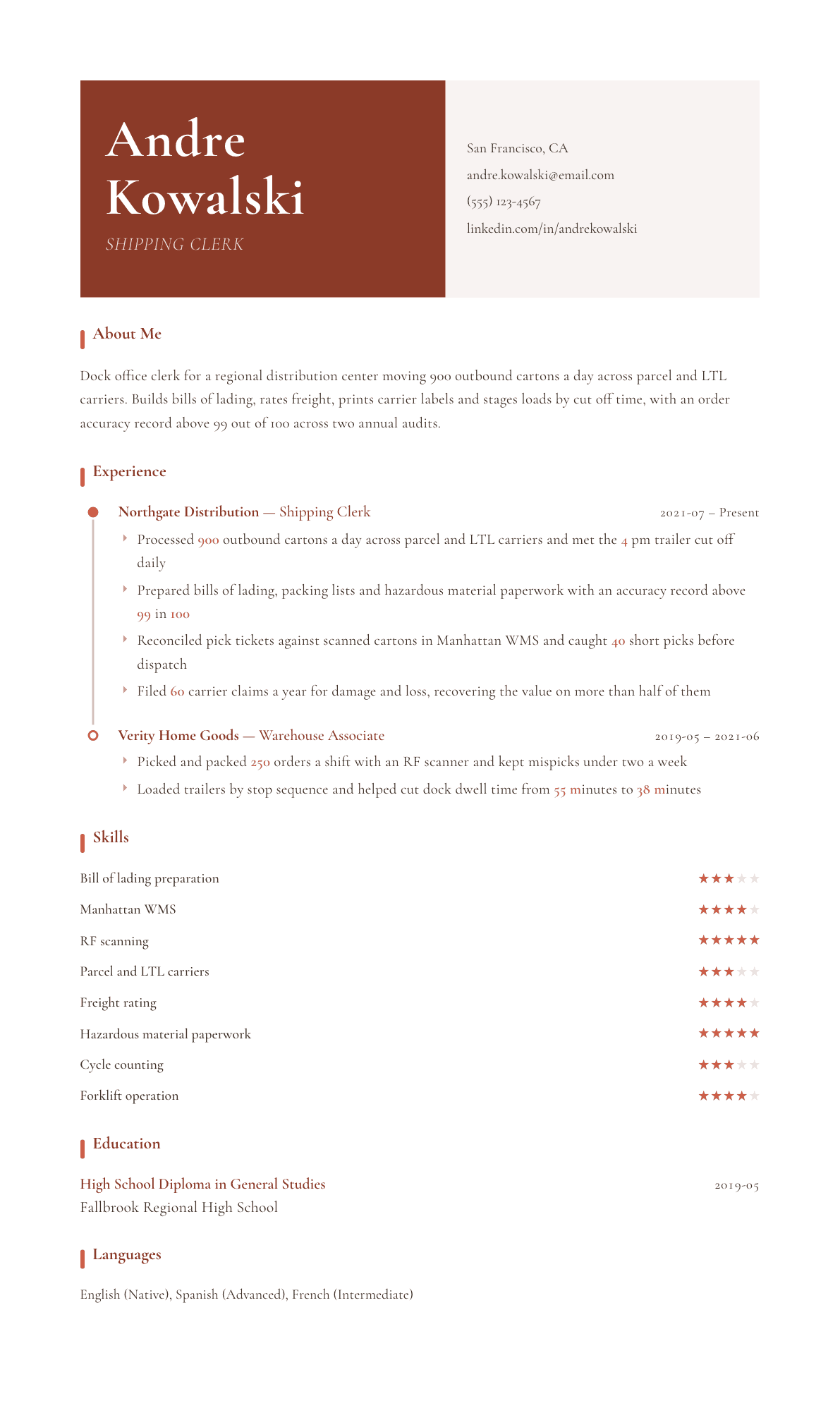
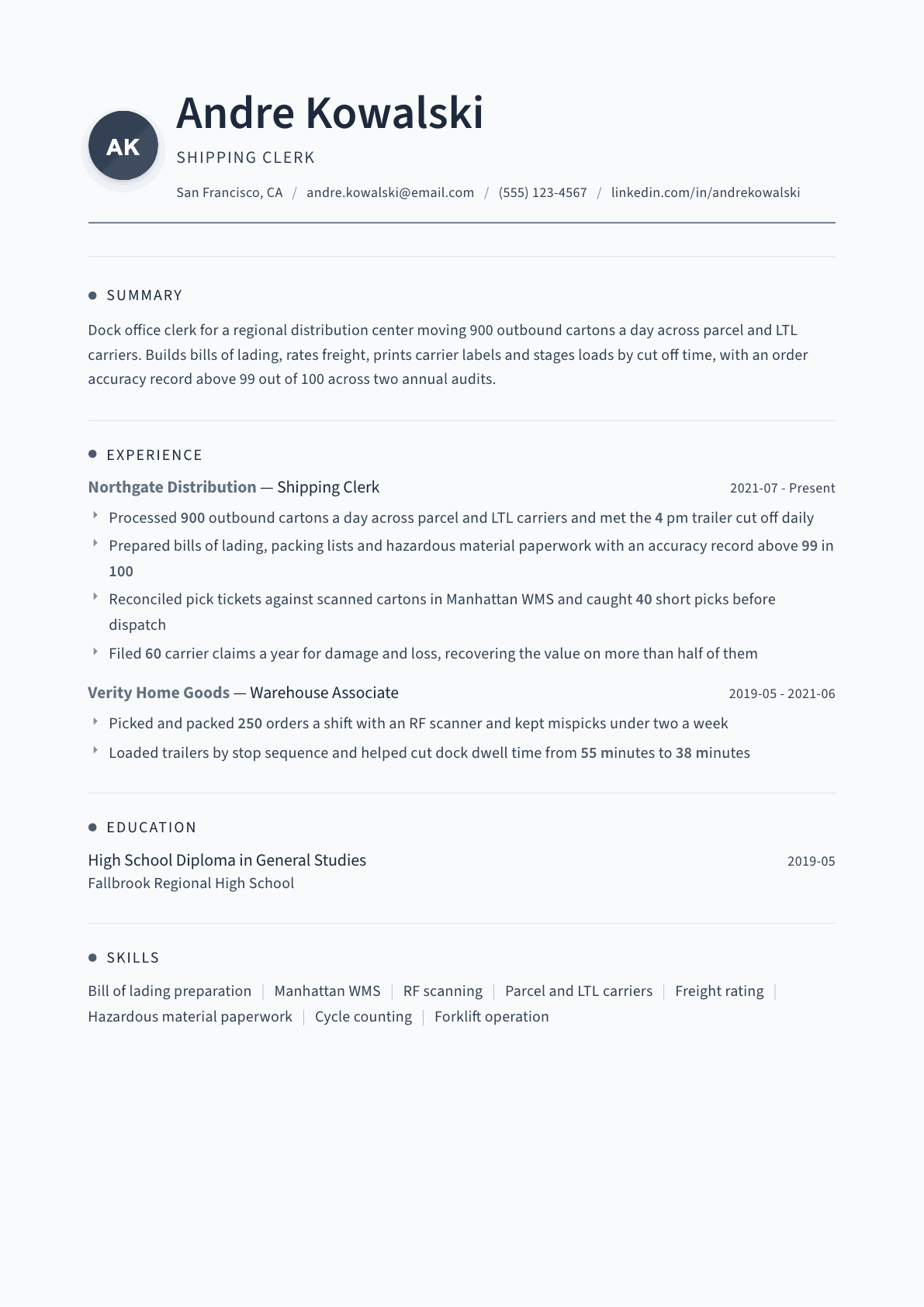
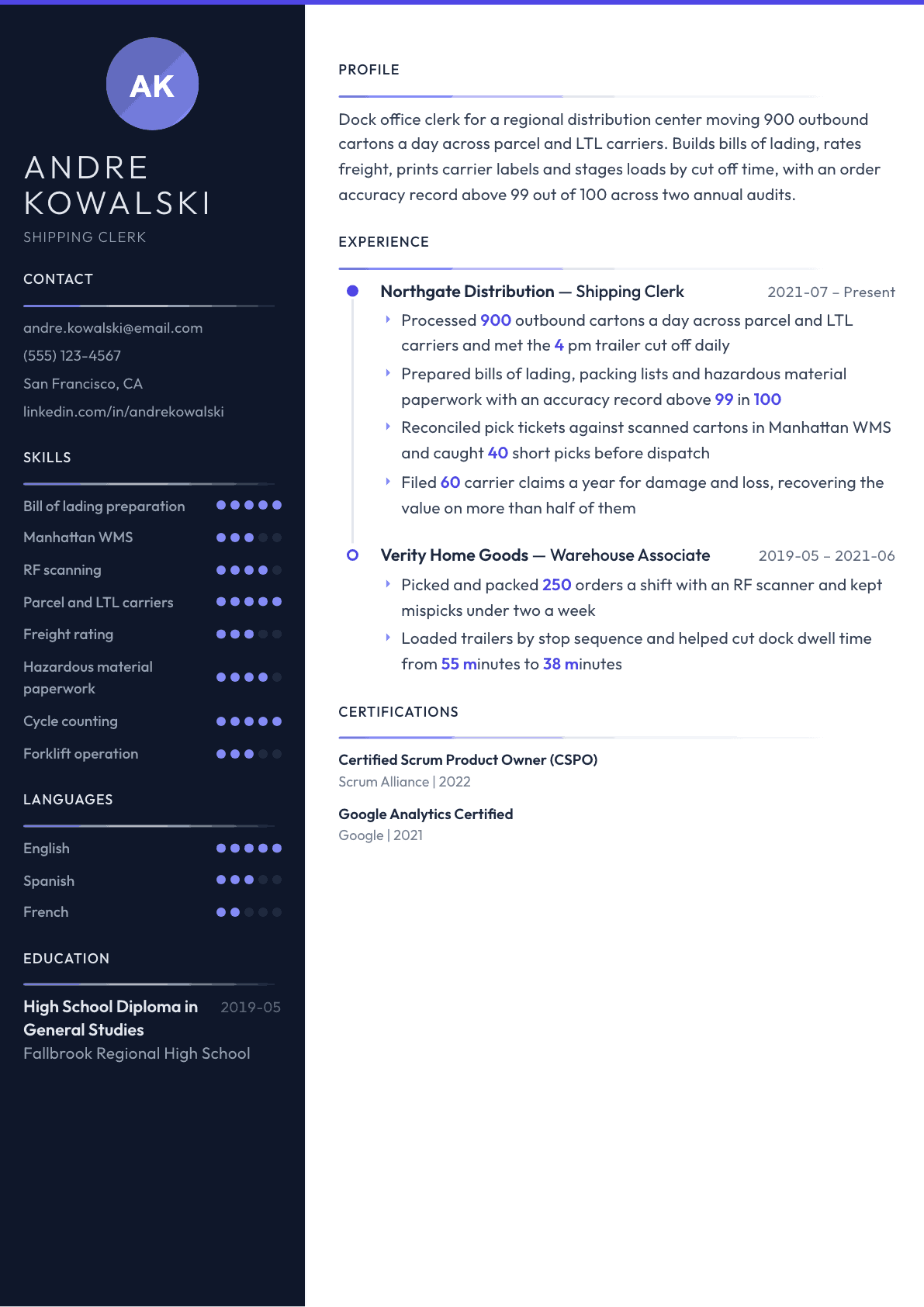
The same shipping clerk content laid out in three CVBooster templates, so you can see what the finished document looks like before you write a word.
Example Shipping Clerk summary
Dock office clerk with four years in regional distribution, releasing 900 outbound cartons a day across parcel and LTL carriers and meeting a 4 pm trailer cut off every working day. Builds bills of lading and hazardous material paperwork with an accuracy record above 99 in 100, and recovers on more than half of the carrier claims filed. Seeking a lead clerk seat.
Skills to list on a Shipping Clerk resume
- Bill of lading preparation
- Packing lists and manifests
- Parcel and LTL carrier systems
- Freight rating and quoting
- Warehouse management systems
- RF scanning
- Order verification
- Hazardous material documentation
- Carrier claims filing
- Cycle counting
- Trailer loading and staging
- Forklift and pallet jack operation
- Inventory reconciliation
- Customs export paperwork
What actually gets this resume read
- Put the daily outbound volume in cartons, pallets or orders in your first bullet, since that is the scale question.
- Name the carriers and service types you work with, because parcel, LTL and full truckload paperwork differ a lot.
- Say which warehouse management system you use, such as Manhattan, Blue Yonder, NetSuite or a paper pick ticket process.
- Give an accuracy figure from an audit or a mispick count, which is the number a dock supervisor actually watches.
- Mention the cut off times you hit, because meeting a trailer departure daily is the core promise of the role.
- List certifications like a forklift license or a hazardous materials endorsement with the body that issued them.
How to write a shipping clerk resume
A shipping clerk holds the paperwork that decides whether freight moves or sits. A bill of lading with the wrong class, a missing hazardous material declaration or a pick ticket that was never reconciled turns into a refused load, a claim or a customer calling about an order that never left the building. The warehouse lead reading your resume has lived through all three, and he is screening for someone whose documents are clean.
That is why volume and accuracy carry this resume rather than duties. Cartons or pallets released a day, carriers and service types handled, the cut off time you met, and the accuracy figure from the last audit. Those four facts describe the job better than a paragraph about being a reliable team player in a warehouse environment.
This guide covers the section order a distribution center supervisor expects, three summaries from warehouse associate to lead clerk, before and after bullets drawn from bill of lading and carrier claim work, and the questions shipping clerks ask when they want to move into a larger operation.
Format: one page, daily volume in the first bullet
One page, reverse chronological, single column. Distribution centers screen quickly and often through a basic applicant tracking system, so keep the layout plain and the dates unambiguous. A clerk whose own resume parses badly is an unfortunate advertisement for document accuracy.
Open each job with the operation: the type of facility, what it moves, and the daily outbound volume in cartons, pallets or orders. That single line lets a supervisor place you against his own dock before he reads anything else.
- Header: name, city and state, phone, email, plus forklift authorization and any hazardous materials training you hold.
- Section order: summary, experience, systems and equipment, certifications, education.
- Each job header: facility type, daily outbound volume, and the carriers or service types worked.
Summary: volume, carriers, cut off, accuracy
Four facts, no adjectives. Daily volume, the carrier mix, the trailer cut off you met, and the accuracy figure from an audit or a mispick count. A supervisor can staff a shipping desk from that summary; he cannot staff anything from hardworking and dependable.
Name the carrier types explicitly. Parcel, less than truckload and full truckload use different paperwork, different rating logic and different claim processes, and a shipping clerk who has only run parcel labels is a different hire from one who rates freight and builds bills of lading by hand.
Experience: paperwork, reconciliation, freight, claims
Lead with throughput and the cut off. Meeting a four in the afternoon trailer departure every working day is the core promise of the shipping desk, and a candidate who states it plainly is already ahead of the pile.
Second bullet: the documents. Bills of lading, packing lists, manifests and hazardous material paperwork, with the accuracy record attached. Third: reconciliation. Matching pick tickets against scanned cartons before dispatch and catching short picks is the control that keeps customers from calling, and the number of catches is a genuinely persuasive figure.
Then freight and claims. Rating loads, choosing service levels, and filing damage or loss claims with carriers are the tasks that show you understand cost rather than only labels. Recovery on claims filed is a rare number on this resume and worth including when you have it. If you have handled hub routing or a handoff from one carrier to another mid route, name it, because it signals a clerk who has worked beyond a single lane.
Systems and equipment: name the warehouse platform
Name the warehouse management system rather than describing it. Manhattan, an enterprise system with a warehouse module, or a paper pick ticket process are very different starting points and the supervisor is estimating your training time. Add the carrier systems you have used to produce labels and rate loads.
Equipment belongs here too. Radio frequency scanning, a forklift, a pallet jack and a stretch wrapper are all worth listing, and the forklift authorization matters because it decides whether you can cover the floor when the dock is short handed.
- Systems: Manhattan or an equivalent warehouse management platform, plus carrier label and rating tools.
- Documents: bills of lading, packing lists, manifests, hazardous material declarations, customs export paperwork.
- Equipment: radio frequency scanners, forklift, pallet jack, and the scale and dimensioning tools used to rate freight.
Certifications and training: list the real ones
Forklift operation is authorized by your employer under the federal powered industrial truck standard rather than by a national body, so write it as employer authorization and name the equipment classes. Claiming a national forklift license invites a correction in the interview.
Hazardous materials training is different and is genuinely certified by training providers and air transport bodies, so list it with the issuer and keep it current. Supply chain credentials from a recognized council carry weight when you are aiming at a lead clerk or coordinator seat.
Shipping Clerk resume summary examples
From the warehouse floor
Warehouse associate with two years picking and packing 250 orders a shift on a radio frequency scanner, keeping mispicks under two a week. Loaded trailers by stop sequence and helped cut dock dwell time from 55 minutes to 38. Seeking a shipping clerk seat with document and carrier responsibility.
Shipping clerk
Shipping clerk for a regional distribution center releasing 900 cartons a day across parcel and less than truckload carriers. Builds bills of lading, rates freight and stages loads to meet a four in the afternoon trailer cut off daily, with paperwork accuracy above 99 in 100 across two annual audits.
Lead clerk
Lead shipping clerk directing three clerks across two outbound doors, owning the carrier mix, the hazardous material paperwork and the claims file. Recovers value on more than half of the 60 carrier claims filed each year and reconciles every pick ticket against scanned cartons before a trailer is sealed.
Work experience bullets: before and after
Before: Prepared paperwork for outgoing orders.
After: Prepared bills of lading, packing lists and hazardous material declarations for 900 outbound cartons a day, with an accuracy record above 99 in 100 across two annual audits.
The document types, the volume and an audited accuracy figure prove control over the paperwork rather than familiarity with it.
Before: Made sure trucks left on time.
After: Staged and released loads to meet a four in the afternoon trailer cut off every working day, sequencing by carrier pickup window so no trailer waited on documents.
Naming the cut off and the sequencing shows the promise being kept and the method that kept it.
Before: Checked orders before they went out.
After: Reconciled pick tickets against scanned cartons in the warehouse management system before dispatch and caught 40 short picks that would otherwise have left the building.
A count of errors intercepted is the clearest evidence that a verification step actually functioned.
Before: Dealt with damaged or lost freight.
After: Filed 60 carrier claims a year for damage and loss, assembling proof of delivery, photographs and weight records, and recovered the value on more than half of them.
The evidence pack and the recovery outcome show a clerk who protects margin rather than only reporting a problem.
Before: Loaded trailers in the warehouse.
After: Loaded trailers by stop sequence with a forklift and pallet jack, and helped cut average dock dwell time from 55 minutes to 38 by staging pallets before the driver arrived.
Stop sequence loading and a dwell time improvement demonstrate operational judgment beyond moving freight.
Hard skills
- Bill of lading preparation
- Packing lists and manifests
- Parcel and less than truckload carrier systems
- Freight rating and service selection
- Warehouse management systems
- Radio frequency scanning
- Order verification and reconciliation
- Hazardous material documentation
- Carrier claims filing
- Trailer loading and staging
- Cycle counting support
- Customs export paperwork
Soft skills
- Working to a hard daily cut off
- Accuracy at speed
- Coordination with drivers and pickers
- Calm handling of a late load
- Clear written notes on exceptions
- Physical stamina across a full shift
Certifications worth listing
- Certified Logistics Associate (CLA) (Manufacturing Skill Standards Council)
- Certified Logistics Technician (CLT) (Manufacturing Skill Standards Council)
- Dangerous Goods Regulations Training (International Air Transport Association)
- OSHA 10-Hour General Industry (OSHA Training Institute)
Mistakes that cost shipping clerk candidates the interview
- Giving no daily volume, which leaves a supervisor unable to tell a small dock from a regional distribution center.
- Failing to name the carrier types, when parcel, less than truckload and full truckload paperwork differ substantially.
- Leaving the warehouse management system unnamed, so the reader has to assume the longest possible training period.
- Reporting no accuracy figure, when an audit result or mispick count is the number the dock supervisor actually watches.
- Claiming a national forklift license instead of employer authorization under the powered industrial truck standard.
- Describing general warehouse duties and burying the shipping paperwork that makes this a desk seat rather than a floor seat.
Shipping Clerk resume questions
What is the difference between a shipping clerk and a warehouse associate?
The associate moves the freight and the clerk owns the paperwork and the carrier relationship. If your job included both, split the bullets so the document, rating and reconciliation work sits at the top and the material handling sits below it.
How do I quantify accuracy on this resume?
Use whatever the operation already measured: audit results, mispick counts, short picks intercepted before dispatch, refused loads, or claims caused by paperwork errors. Any of those beats calling yourself detail focused, because a supervisor can question the number and you can answer.
Do I need hazardous materials training to apply?
Not for most postings, but it widens the range considerably because facilities that move regulated goods must staff trained clerks. If you hold it, list the issuer and keep it current, since this training expires and an outdated entry raises a question.
Should I list forklift experience if the job is office based?
Yes. Shipping clerk seats routinely need cover on the floor, and a clerk who can stage a pallet during a short handed afternoon is more useful than one who cannot. Write it as employer authorization and name the equipment class.
How do I get into a larger distribution operation?
Show rating, claims and reconciliation rather than label printing alone, and name the warehouse management platform. Larger sites are buying judgment about cost and exceptions, because the volume alone is something they can train in a week.
Related resume examples
- Warehouse Worker Resume example
- Inventory Clerk Resume example
- Receiving Clerk Resume example
- Logistics Coordinator Resume example
- Office Clerk Resume example
- Secretary Resume example