Barista Resume Examples: free score, then the gap list
Brew a Barista Resume That Stands Out
By Mustafa Tarabya, founder of CVBooster · Published · Updated
Barista resume examples and a coffee shop resume template: availability, espresso equipment, drink volume, summaries, bullets and cafe keywords.
Sample resumes for a barista
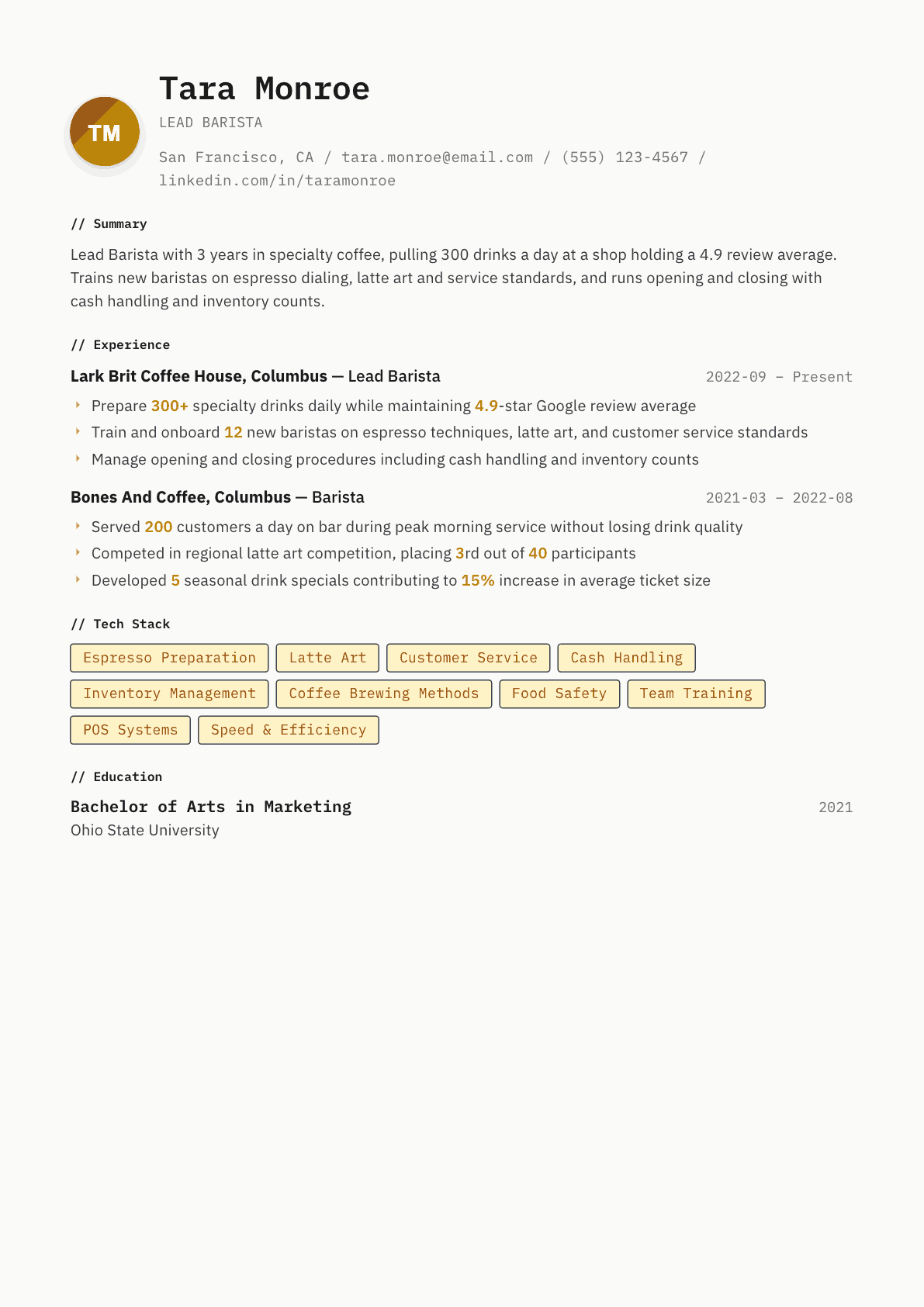
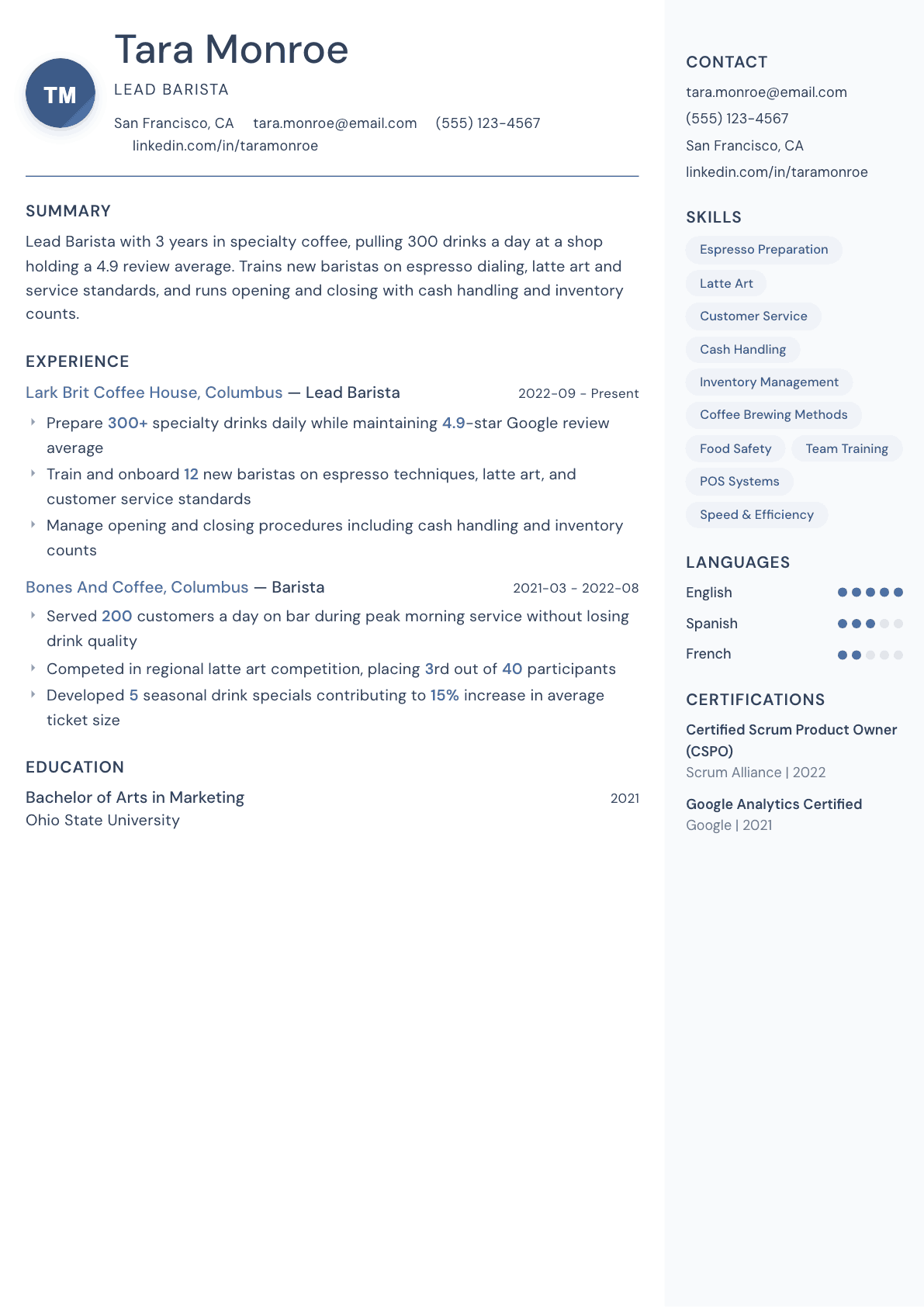
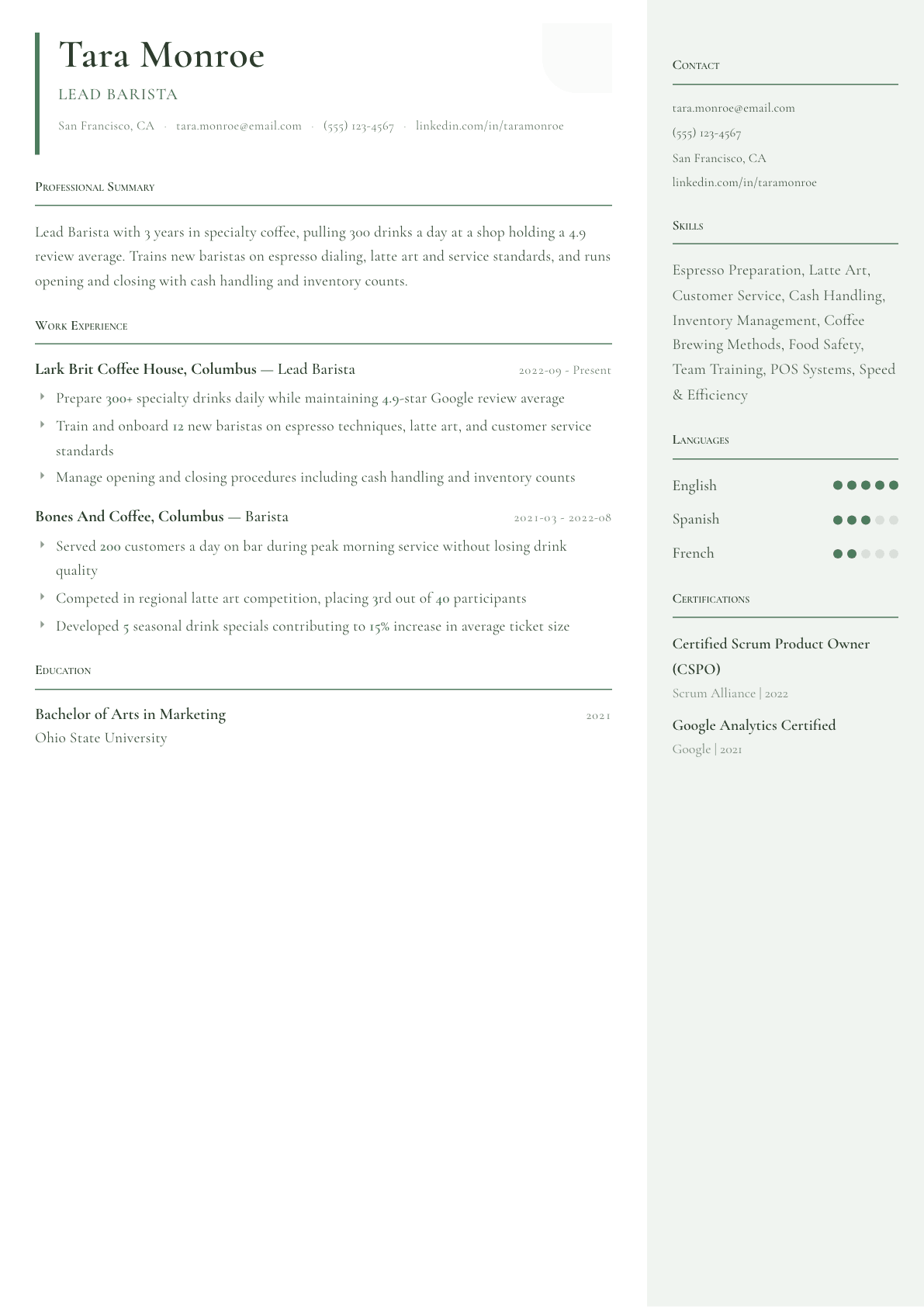
The same barista content laid out in three CVBooster templates, so you can see what the finished document looks like before you write a word.
Example Barista summary
Lead barista, 3 years in specialty coffee, 300 drinks a day and 12 new baristas trained on espresso and latte art. Placed third of 40 in a regional latte art competition and built five seasonal specials that raised average ticket 15%.
Skills to list on a Barista resume
- Espresso Preparation
- Latte Art
- Customer Service
- Cash Handling
- Inventory Management
- Coffee Brewing Methods
- Food Safety
- Team Training
- POS Systems
- Speed & Efficiency
What actually gets this resume read
- Highlight customer service skills and review scores.
- Include coffee certifications or competition placements.
- Show leadership: training new hires, opening/closing responsibilities.
- Quantify volume: drinks per shift, customers served.
- Mention any menu development or seasonal drink creation.
How to write a barista resume
A barista resume is usually read in under a minute by a cafe owner or a store manager who is short-staffed and wants to know three things: can you hold a bar during a rush, can you be trusted with a till and an opening key, and will you still be here in six months. Because the hiring bar is availability plus reliability plus speed, the resume that wins is the one that makes those three things obvious on the first pass.
The field is split, and the split matters. High volume chain work is throughput, drink standards, drive-through timing and mobile order flow. Specialty and third wave work is dialing in a grinder, dose and yield, pour-over methods, single origin knowledge and customer education. A resume written for one reads as unserious to the other, so pick your target before you write a line.
This guide covers what to put in each section, with example summaries for a first coffee job, an experienced bar barista and a lead or trainer, before and after bullets that show what specificity looks like in cafe work, and the questions baristas ask when they apply with no formal experience or want to move into a roastery or management.
Format: one page, availability visible, no exceptions
One page, reverse chronological, no graphics. Cafes hire fast and often print the stack. Put your availability directly under your contact line, because the single most common reason a strong barista resume gets passed over is that the manager needs opens at five in the morning and cannot tell whether you can work them.
If you have gaps or short stints, which are normal in food service, group short seasonal jobs under one heading rather than leaving a spray of two-month entries. Managers read many short stints as a retention risk, and grouping them honestly removes the impression without hiding anything.
- Header: name, city, phone, email, availability, and food handler card if you hold one.
- Order: summary, experience, coffee skills, certifications and training, education.
- Name the shop type in each job: specialty cafe, chain store, hotel outlet, drive-through, roastery cafe.
Summary: volume, machine, and what you are known for on bar
Two or three lines. Name the espresso machine and grinder you have worked on, the drink volume at peak, and one thing you actually do well. A manager reading La Marzocco Linea with a Mazzer grinder immediately knows your muscle memory transfers to their bar, where a general claim about coffee passion tells them nothing.
If you are applying to specialty from a chain, say what you learned that transfers, which is usually speed, sequencing and register accuracy, and say plainly that you want to learn manual brew and dialing in. Specialty owners hire trainable speed all the time. They rarely hire someone who pretends to already know the palate work.
Experience: throughput, bar position, cash and open or close
Write bullets around the things that make a shift work. Drinks per hour at peak and how many people were on bar with you. Which position you ran: register, bar, steam and pour, food and pastry, or drive-through window. Whether you opened or closed, which means calibrating the grinder, pulling and tasting shots, brewing batch, counting the drawer, closing the machine down and backflushing.
Add the money and the stock. Cash drawer accuracy, mobile and third party order handling, waste tracking, milk and bean par levels, and ordering. A barista who has placed the green coffee or dairy order has been trusted with the shop, and that reads as ready for a lead role.
Then the coffee itself: pour-over and immersion methods you brew, latte art you can produce consistently, dialing in by dose, yield and time, calibration checks through the day, and any cupping or tasting you have taken part in. Be honest about the level. Claiming rosettas you cannot pour is a test you will fail on the trial shift.
Coffee skills: name the equipment and the method
Equipment names are keywords here. List the espresso machines and grinders by manufacturer, the brewers you have used, and the point of sale. Square, Toast and Clover are the systems most cafes run, and a manager sees the training time saved.
For brew methods, be specific rather than writing brewing methods. V60, Chemex, Kalita Wave, AeroPress, French press, batch brew, cold brew and nitro all appear in postings by name, and each implies a different level of technique.
- Espresso: machine and grinder by name, plus dose, yield and time as your dialing-in language.
- Milk: steaming to texture, latte art patterns you pour reliably, alternative milks and their behavior.
- Service: register speed, mobile order queue, drive-through window times, allergen handling.
Training, competitions and the credentials that exist
A food handler card is required in most jurisdictions and takes an afternoon, so hold one before you apply. Beyond that, the Specialty Coffee Association runs a formal skills program with barista, brewing, sensory and roasting modules at foundation, intermediate and professional levels, and any module you have completed belongs on the page.
Competition placements, latte art throwdown wins and internal company certifications are all worth listing, because they show you practice outside your shift. So does any coffee education you have delivered: leading a tasting, writing tasting notes for the board, or running an espresso class for customers.
A coffee shop resume template, written out for a barista
A coffee resume, whether you call it a barista resume or a coffee shop resume, is one page with your availability near the top, the equipment you have used, the volume you handled and your food safety card. O*NET, the US occupational database, lists barista tasks that read like a checklist for the page, from "Prepare or serve hot or cold beverages, such as coffee, espresso drinks, blended coffees, or teas" to "Weigh, grind, or pack coffee beans for customers." Here is a full barista resume template written out for an invented barista, Sam Rivera, applying to a specialty cafe after a year at a chain. Copy the order and replace every line with something true about you.
- Header: Sam Rivera, Denver, CO, phone, email.
- Summary: Barista with one year at a high-volume chain store, comfortable on bar and register at morning peak. Dials in espresso at open and pours hearts and rosettas reliably. Available weekdays from 5 am and every Saturday.
- Experience: Barista, Starbucks, Denver, CO, current job, one year so far. Work bar and register on morning peak, including mobile order and drive-through. Dial in espresso at open and check grind through the morning. Close the store two nights a week, including cash count and machine cleaning.
- Skills: Espresso dialing in, milk steaming and latte art, pour over (V60, Chemex), batch and cold brew, Square POS, cash handling, allergen awareness.
- Certifications: Food handler card, Colorado. Any Specialty Coffee Association module you have completed.
- Education: High school diploma, with the year.
Barista resume summary examples
First coffee job
Customer service worker with 2 years of retail and food handling certification, seeking a first barista role. Comfortable on a high volume register, trained on cash reconciliation, and available for weekday opens from 5 a.m. Learning espresso at home on a manual machine and eager for formal bar training.
Three years on bar
Barista with 3 years on a two-group La Marzocco with Mazzer grinders, running 200 drinks an hour at peak alongside one other bar partner. Pours rosetta and tulip consistently, dials in by dose and yield each morning, and brews V60, Chemex and batch. Opening and closing certified.
Lead barista and trainer
Lead barista at a specialty cafe, responsible for the bar during peak, weekly calibration, and training 12 new hires through a four-week program. Places the dairy and bean order, tracks waste, and has completed Specialty Coffee Association barista and brewing modules at intermediate level.
Work experience bullets: before and after
Before: Made coffee drinks for customers.
After: Produced 200 espresso and milk drinks an hour at morning peak on a two-group machine with one bar partner, holding ticket times under three minutes through the rush.
Volume, machine group count and ticket time turn a description of the job into evidence you can survive a rush.
Before: Handled cash and the register.
After: Ran the register and reconciled a cash drawer across 300 transactions per shift on Square, closing the month with no variance over a dollar and handling mobile and delivery order queues in parallel.
Transaction volume plus drawer accuracy is the exact evidence a manager needs before handing over a key.
Before: Trained new baristas.
After: Trained 12 new hires through a four-week bar progression from register to steam to espresso, signing each off on dialing in and milk texture before they worked a solo shift.
A named training structure and a sign-off standard show you built competence rather than shadowing someone.
Before: Responsible for opening the cafe.
After: Opened five mornings a week: calibrated grinders against dose and yield targets, tasted and adjusted the espresso, brewed batch, set the pastry case, and had the bar ready before the 6 a.m. doors.
The open is a checklist, and listing it proves you have owned the shop before anyone else was in the building.
Before: Helped reduce waste in the cafe.
After: Rebuilt milk and pastry par levels off two weeks of hourly sales data, cutting dairy waste by 30% while keeping the bar stocked through Saturday peaks.
The method behind the reduction shows commercial judgment, which is what separates a lead from a barista.
Hard skills
- Espresso extraction and dialing in
- Grinder calibration
- Milk steaming and latte art
- Pour-over brewing (V60, Chemex, Kalita)
- Batch brew and cold brew production
- La Marzocco and Mazzer equipment
- Machine cleaning and backflushing
- Cash handling and drawer reconciliation
- Square and Toast point of sale
- Inventory par levels and ordering
- Food safety and allergen handling
- Opening and closing procedures
Soft skills
- Speed under a rush
- Regular customer recall
- Coaching on bar
- Clear ticket communication
- Composure with difficult guests
- Reliability on early shifts
Certifications worth listing
- Food Handler Card (State or county health department)
- ServSafe Food Handler (National Restaurant Association)
- SCA Barista Skills (Foundation, Intermediate, Professional) (Specialty Coffee Association)
- SCA Brewing (Foundation, Intermediate, Professional) (Specialty Coffee Association)
- SCA Sensory Skills (Specialty Coffee Association)
Mistakes that cost barista candidates the interview
- Leaving availability off the resume, which is the first thing a cafe manager needs and the fastest reason to skip you.
- Writing passionate about coffee instead of naming the machine, the grinder and the brew methods you have actually used.
- Claiming latte art or dialing-in ability you cannot reproduce on a trial shift, which ends the process on the spot.
- Omitting cash accuracy and open or close duties, which are what qualify you for a key and a lead role.
- Listing every two-month seasonal job separately so the page reads as constant turnover.
- Applying to a specialty cafe with a resume written entirely in chain drink names and no mention of brew method.
Barista resume questions
Can I get a barista job with no experience?
Yes, and most shops expect to train. Lead with customer service, register accuracy and food handling certification, state your availability including early opens, and say you want formal bar training. Reliability and open availability outweigh unproven coffee knowledge for a first hire.
What should a barista put on a resume instead of duties?
Numbers a manager recognizes: drinks per hour at peak, how many people were on bar, transaction count and drawer accuracy, whether you opened or closed, and which brew methods you run. Those replace generic lines about preparing beverages and providing service.
How do I move from a coffee chain to a specialty cafe?
Keep the speed and volume numbers, drop the proprietary drink vocabulary, and add whatever manual brewing and dialing in you have practiced, even at home. Say plainly that you want to learn the shop's process rather than claiming palate experience you do not yet have.
Should latte art go on a barista resume?
List only the patterns you can pour reliably in a rush, since a trial shift will test it within ten minutes. If you pour hearts consistently and are working on rosettas, say exactly that. Honest calibration reads better than an overclaim that collapses on bar.
What should I put on a coffee shop resume?
Put your availability near the top, then each coffee job with the volume you handled, your position on bar or register, opening and closing duties and cash handling. Add a skills line naming the espresso machine, brew methods and point of sale system you know, and your food handler card. Keep it to one page.
Related resume examples
- Restaurant Manager Resume example
- Chef Resume example
- Store Manager Resume example
- Cafe Manager Resume example
- Casino Dealer Resume example
- Fast Food Worker Resume example